JEE Main · Chemistry → Steady

Chemical Kinetics appeared 42 times across 3 years — 4.9% of Chemistry. This question is from First Order Kinetics.

Year 2026 2025 2024 Total
Questions 14 20 8 42

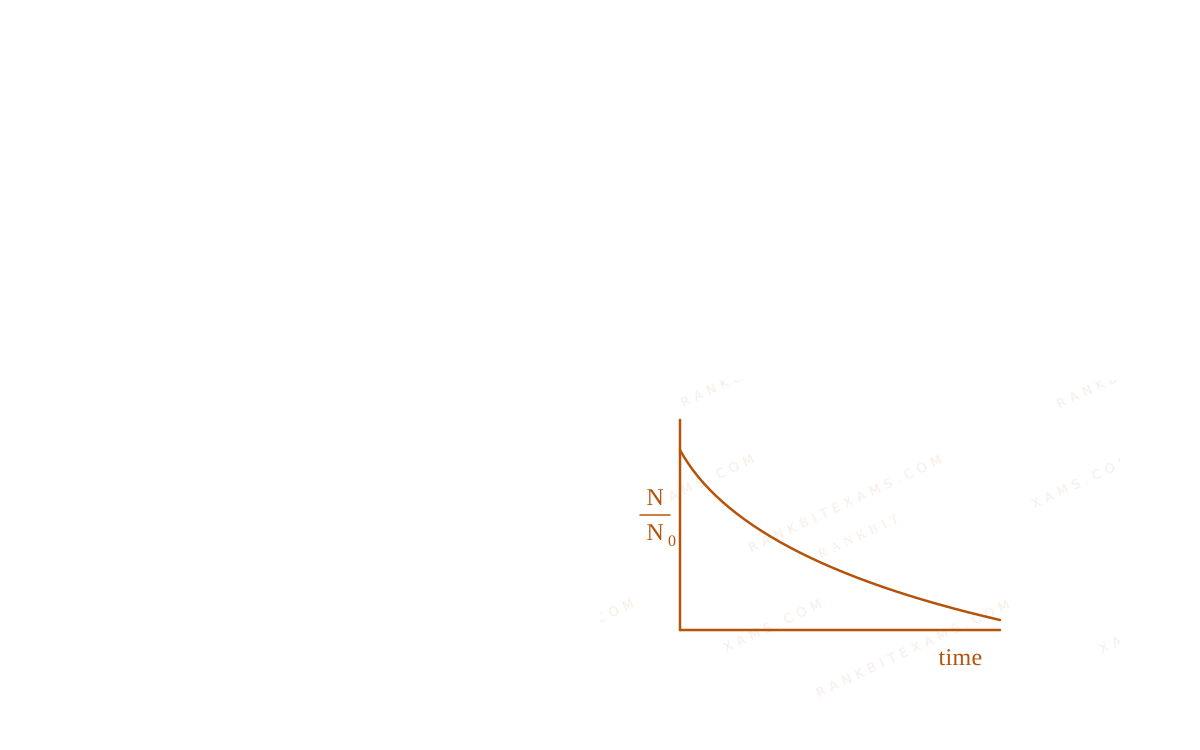
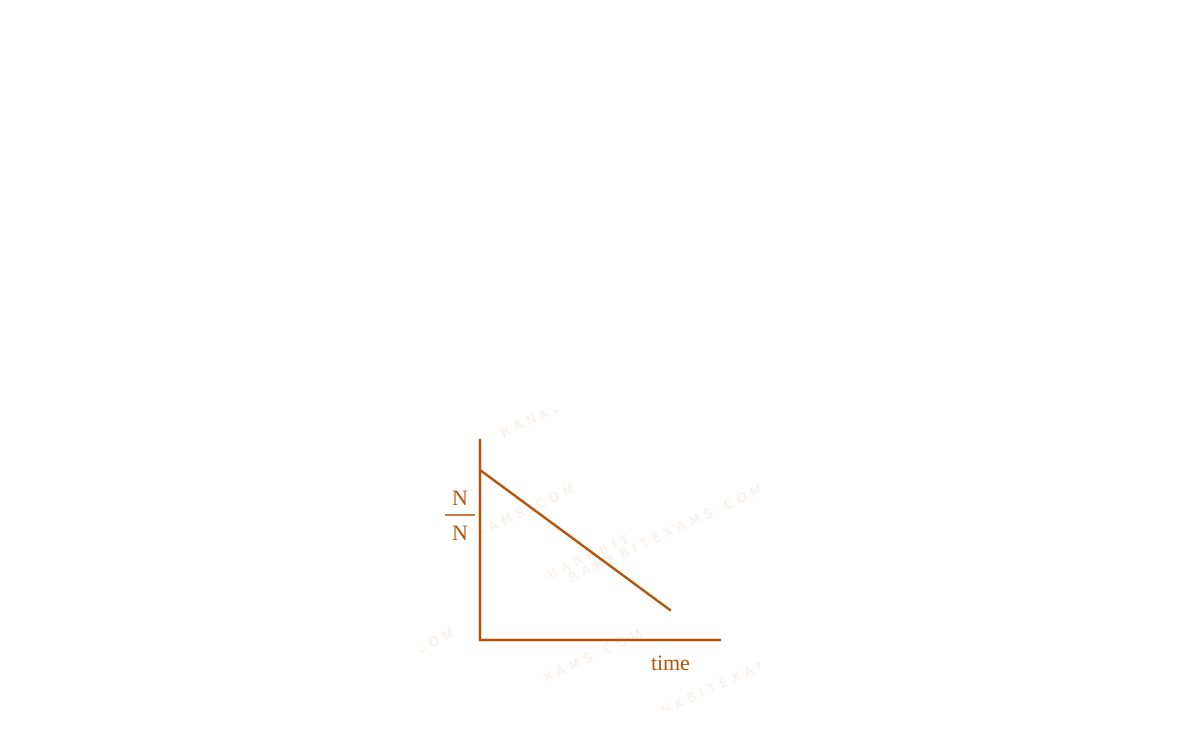
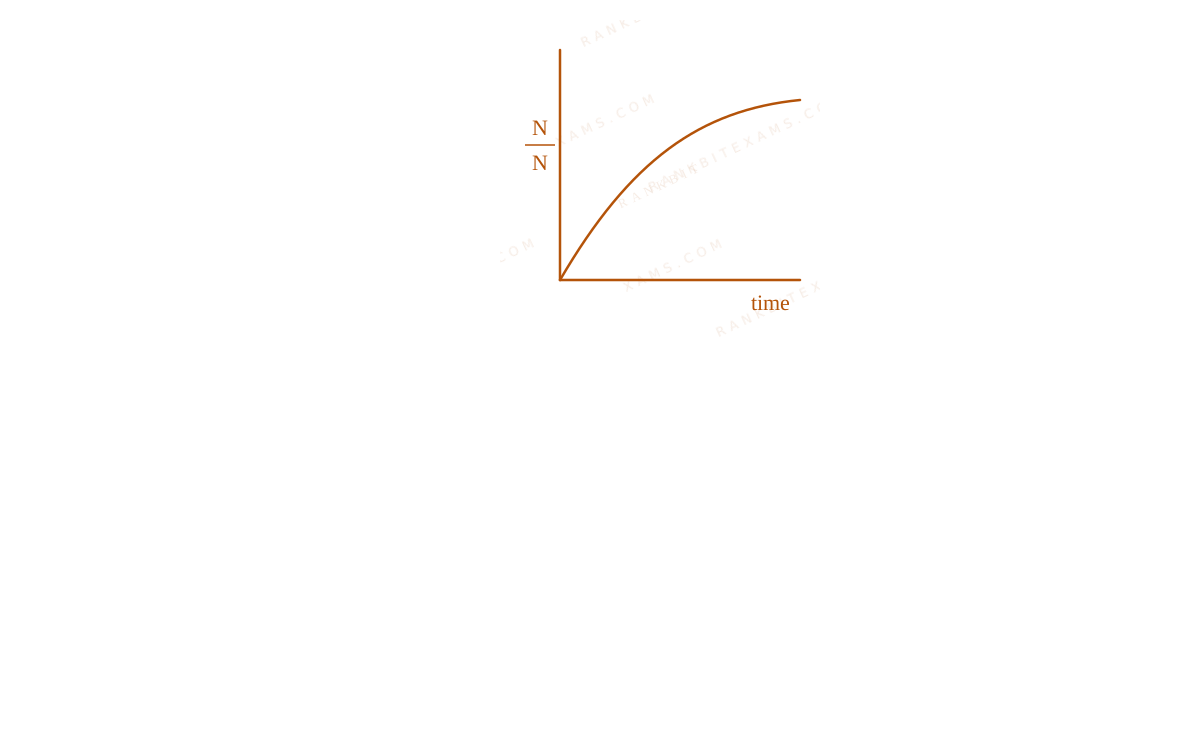
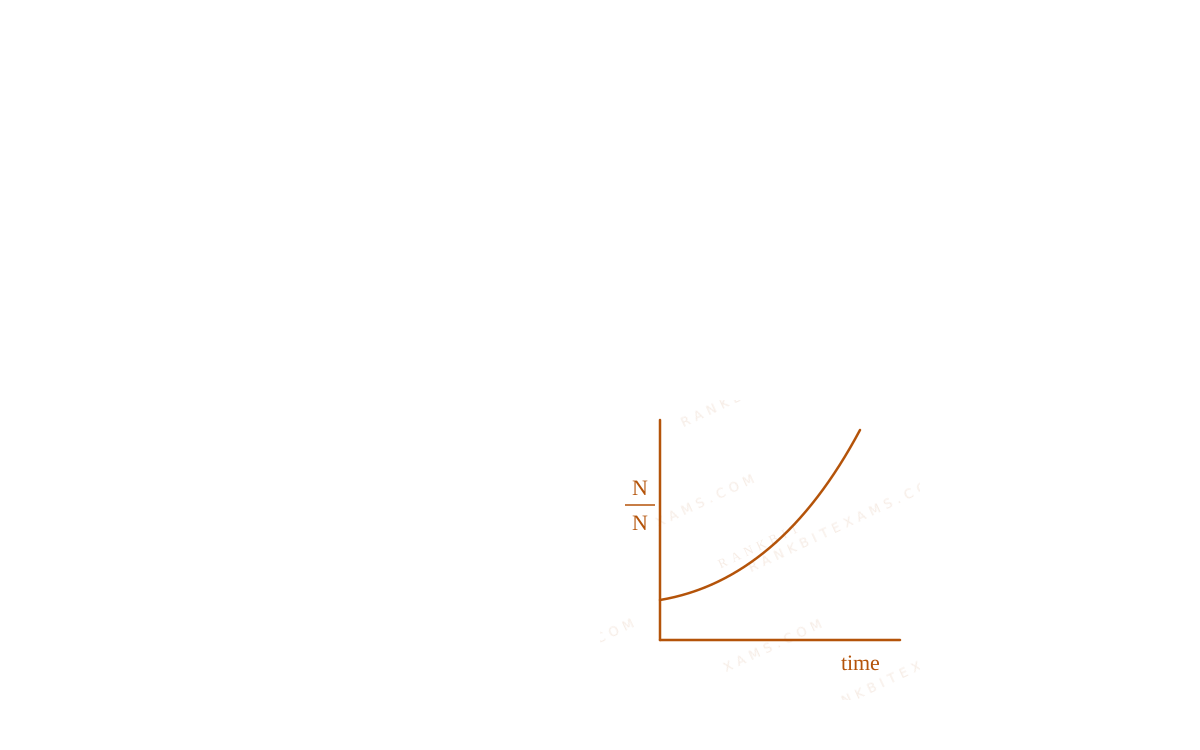
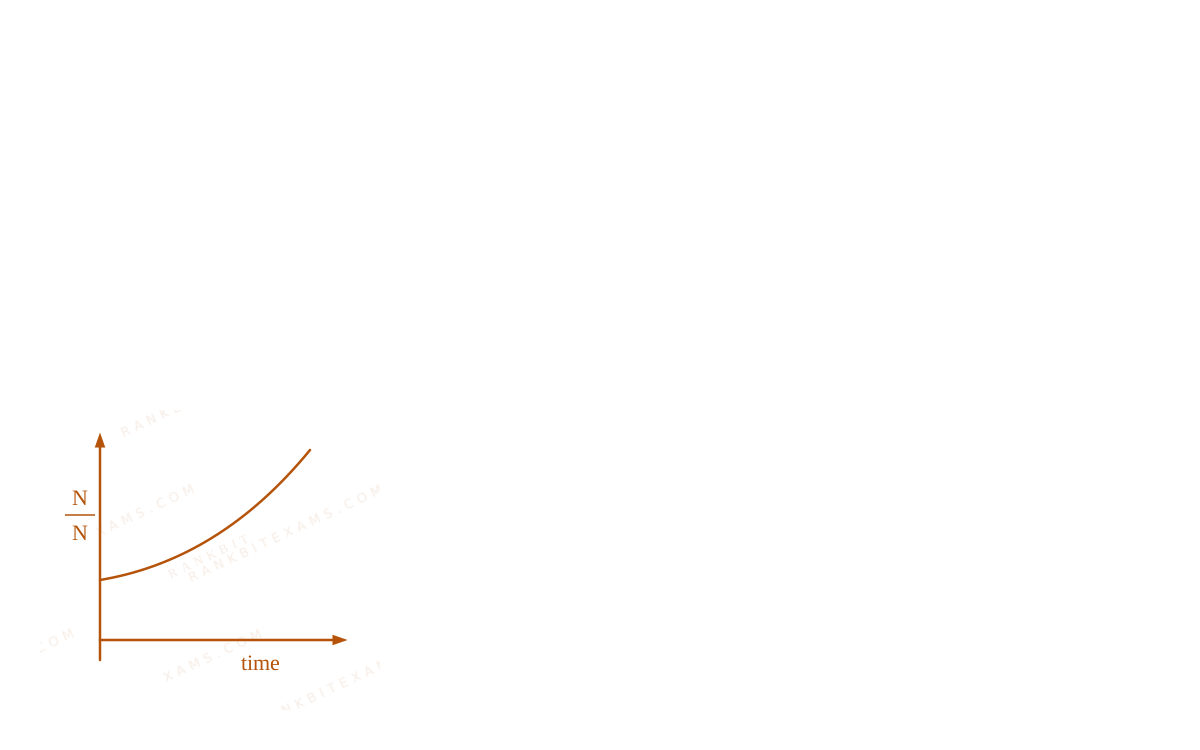
For bacterial growth in a cell culture, growth law is very similar to the law of radioactive decay. Which of the following graphs is most suitable to represent bacterial colony growth?

Solution & Explanation

Related Formula

Exponential growth equation model:

N = N₀ eKt

Normalized configuration formula:

(N)/(N₀) = eKt
Core Logic

Radioactive decay follows a decreasing exponential path (N = N₀ e-λ t).

Conversely, cell culture growth functions via an increasing exponential pattern because the rate of growth is directly proportional to the current population size (dN/dt = KN). This results in an exponential curve that starts at (N)/(N₀) = 1 when t = 0 and curves sharply upward over time.

Step 1: Finding the Matching Curve

Plotting (N)/(N₀) against time shows an upward-clinging exponential profile starting from 1, which perfectly matches the curve in option (4).

Exponential growth profile plot for Q40

Pattern Recognition

The expression eKt dictates an exponential increase. Ensure the curve starts from a non-zero value (1) at t=0, as (N₀)/(N₀) = 1, rather than starting from the origin (0).

Chapter Mix

Class 12 Chemistry: Chemical Kinetics

Reference Study Guides

More Chemical Kinetics Previous-Year Questions — Page 9

Q82 jee_main_2024_31_jan_evening First Order Kinetics
r = k[A] for a reaction, 50% of A is decomposed in 120 minutes. The time taken for 90% decomposition of A is ________ minutes.
Numerical Answer. Answer: 398.5 to 399.5

Solution

Related Formula
k = 0.693t1/2 t = (2.303)/(k) ( (a)/(a - x) )
Core Logic

Since r = k[A], the reaction follows first-order kinetics. The half-life (50% decomposition) is t1/2 = 120 minutes.

Step 1: Calculating for 90% decomposition

For 90% completion of the reaction, [A]₀ = 100 and [A]ₜ = 100 - 90 = 10.

t = (2.303)/(k) (100)/(10) t = 2.303( 0.693t1/2 ) (10) t = (2.303 × 120)/(0.693) × 1 t = 398.78 minutes

Rounding off to the nearest integer, we get 399 minutes.

Pattern Recognition

For a first order reaction, t90% ≈ 3.32 × t50%. 120 × 3.32 = 398.4, so roughly 399.

Chapter Mix

Class 12 Chemistry: Chemical Kinetics

Q73 jee_main_2024_31_jan_morning First Order Reactions
Integrated rate law equation for a first order gas phase reaction is given by (where Pᵢ is initial pressure and Pₜ is total pressure at time t)
  • A. k = (2.303)/(t) × (Pᵢ)/((2Pᵢ - Pₜ))
  • B. k = (2.303)/(t) × (2Pᵢ)/((2Pᵢ - Pₜ))
  • C. k = (2.303)/(t) × ((2Pᵢ - Pₜ))/(Pᵢ)
  • D. k = (2.303)/(t) × (Pᵢ)/((2Pᵢ - Pₜ))

Solution

Core Logic

Consider a general gas phase reaction: A arrow B + C

Initial (t=0): Pᵢ 0 0 At time t: Pᵢ - x x x

Total pressure at time t:

Pₜ = (Pᵢ - x) + x + x = Pᵢ + x

x = Pₜ - Pᵢ

Partial pressure of A at time t (PA): PA = Pᵢ - x

PA = Pᵢ - (Pₜ - Pᵢ) = 2Pᵢ - Pₜ

For a first-order reaction:

k = (2.303)/(t) (P₀)/(Pₜ)

Here, P₀ = Pᵢ and the pressure of the reactant at time t is PA.

k = (2.303)/(t) (Pᵢ)/(2Pᵢ - Pₜ)
Chapter Mix

Class 12 Chemistry: Chemical Kinetics

More Chemical Kinetics Questions — jee_main_2025_28_jan_evening

Practice all Chemical Kinetics previous-year questions →

Rankbit System
JEE Physics: Waves (+15.5%) | Electrostatics: Concentric Shells (-29.7%) | Modern Physics: Photoelectric Clones (+34.2%) | Mathematics: Definite Integrals (+18.1%) | Chemistry: Coordination Splitting (-11.4%) | JEE Physics: Waves (+15.5%) | Electrostatics: Concentric Shells (-29.7%) | Modern Physics: Photoelectric Clones (+34.2%) | Mathematics: Definite Integrals (+18.1%) | Chemistry: Coordination Splitting (-11.4%)