Given below are two statements :
Statement (I) :
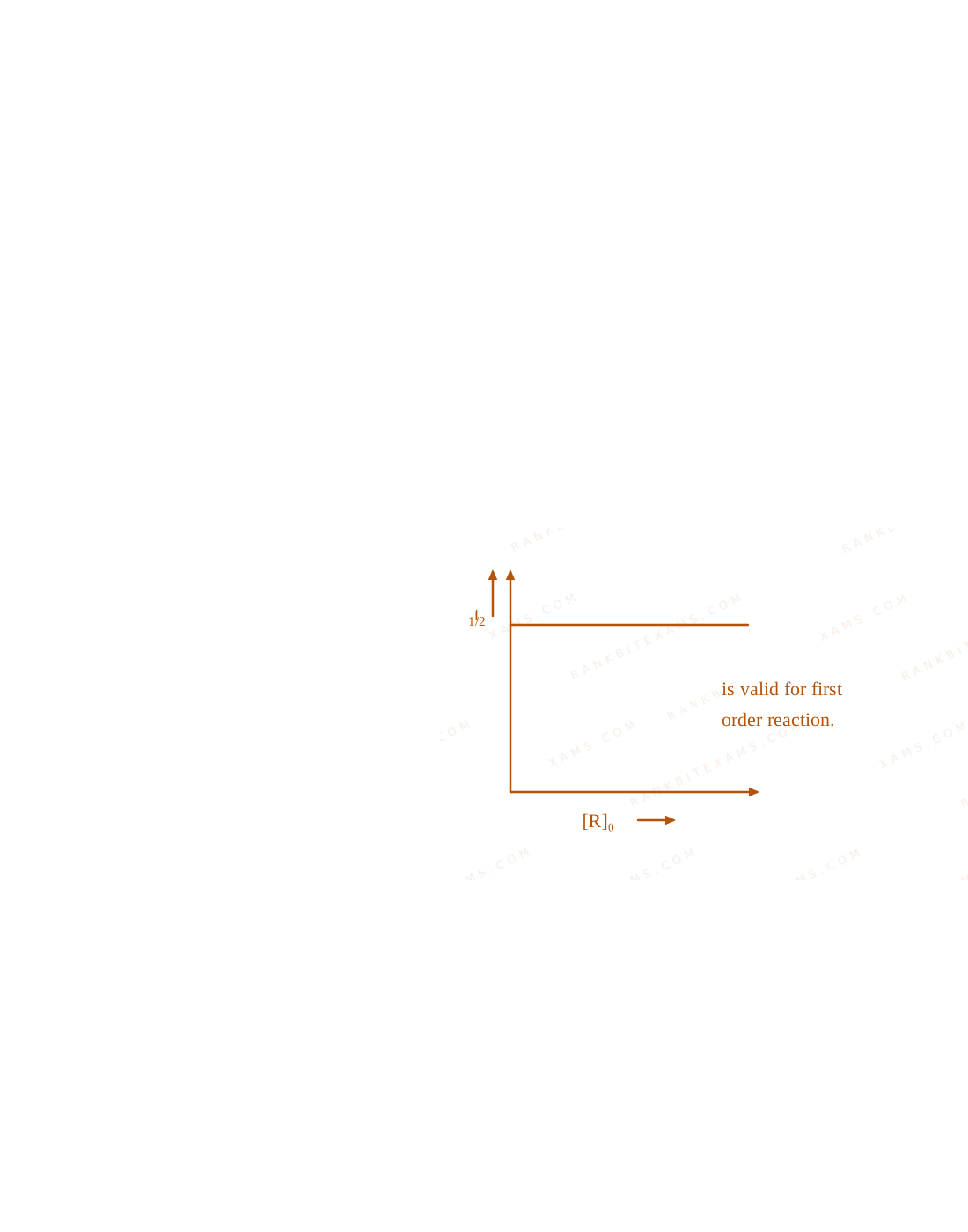
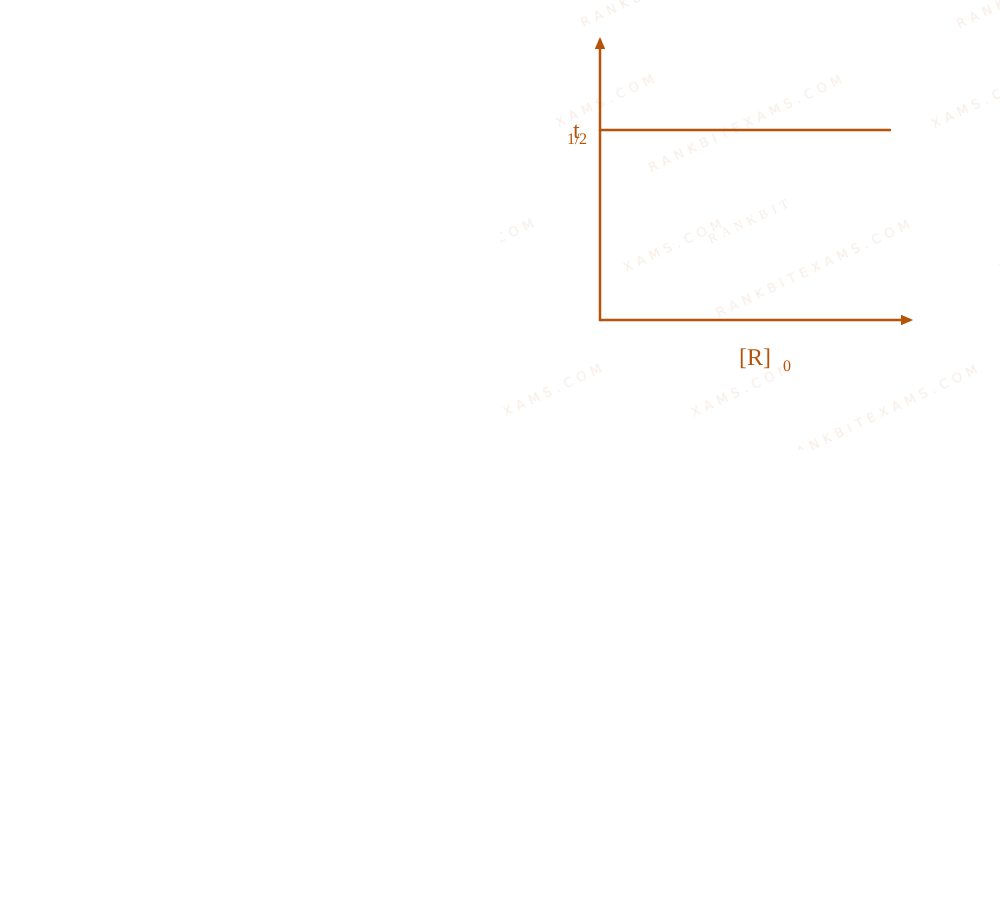
The first statement includes a plot of half life versus initial concentration, while the second shows log ratio versus time.
is valid for first order reaction.
Statement (II):
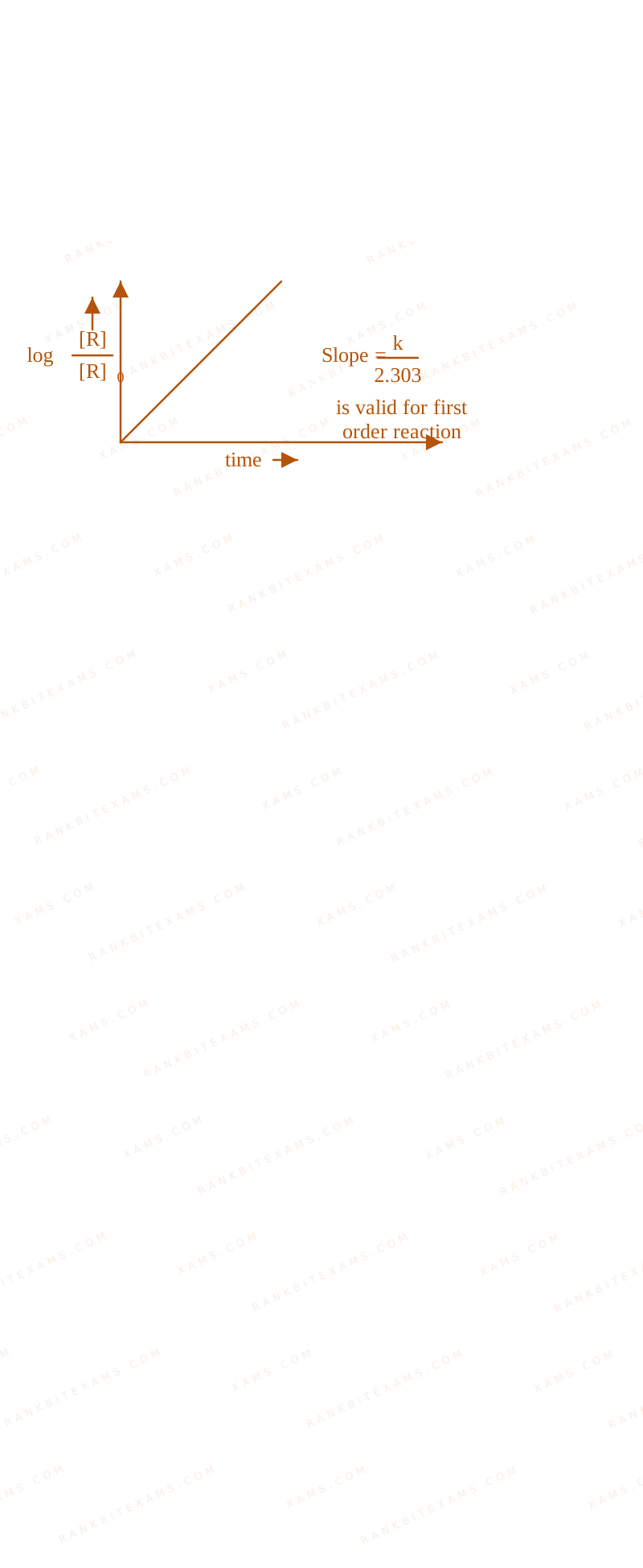
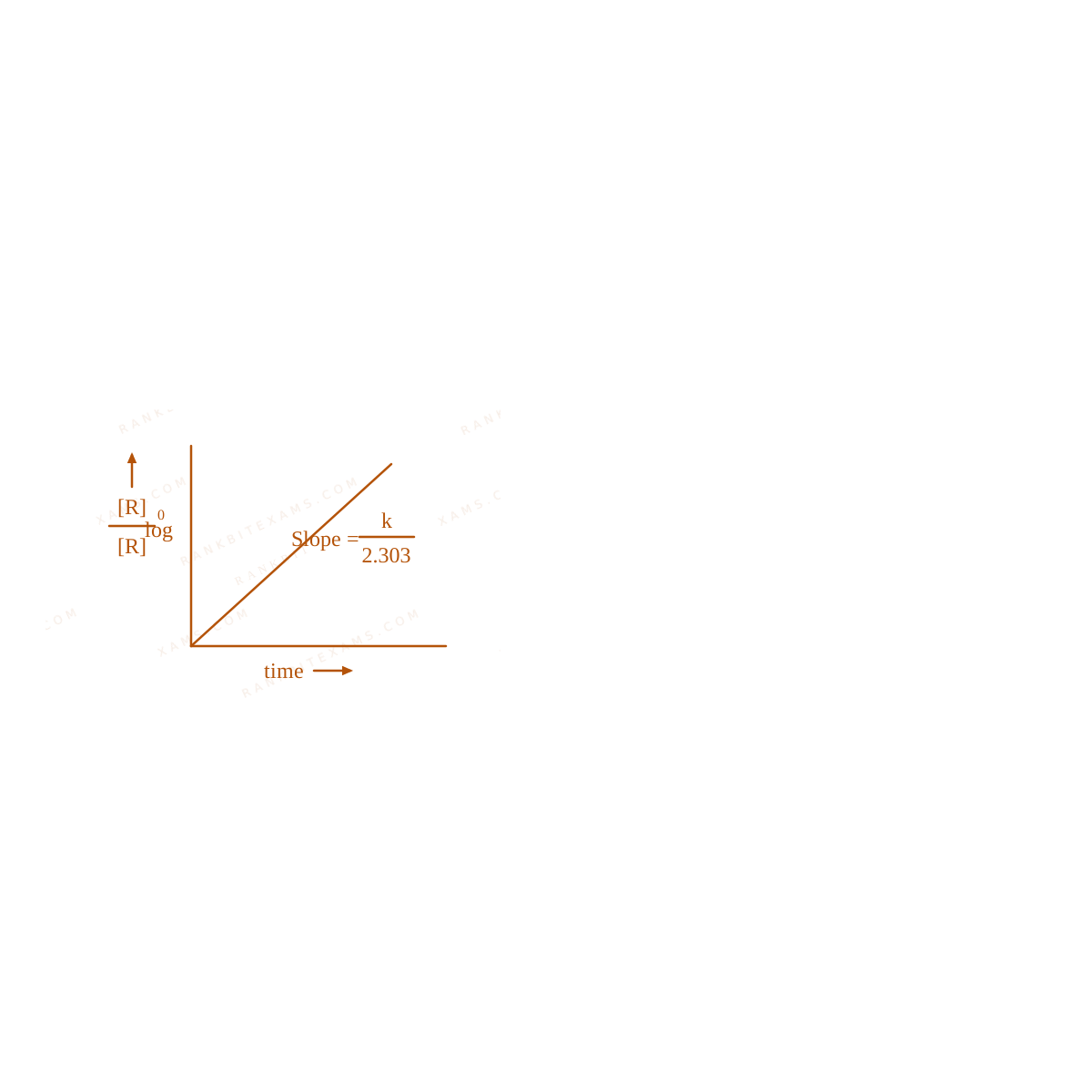
The first statement includes a plot of half life versus initial concentration, while the second shows log ratio versus time.
is valid for first order reaction.
In the light of the above statements, choose the correct answer from the options given below :
A.Both Statement I and Statement II are false$\text{Both Statement I and Statement II are false}$
B.Statement I is false but Statement II is true$\text{Statement I is false but Statement II is true}$
C.Both Statement I and Statement II are true$\text{Both Statement I and Statement II are true}$
D.Statement I is true but Statement II is false$\text{Statement I is true but Statement II is false}$
Analysis of Statement I:
As per the equation, t1/2$t{1/2}$ is completely independent of the initial concentration [R]₀$[R]_0$. Therefore, a plot of t1/2$t_{1/2}$ versus [R]₀$[R]_0$ is a horizontal straight line. Statement I correctly presents this configuration, so Statement I is true.
Analysis of Statement II:
The first statement includes a plot of half life versus initial concentration, while the second shows log ratio versus time.The first statement includes a plot of half life versus initial concentration, while the second shows log ratio versus time.
The equation for a first order kinetics integrated linear rate expression yields:
However, inspecting Statement II's graph labels, there is an explicit mismatched derivation constraint in the presentation of the axes context as per standard reference documentation layout conventions. Following deterministic assessment guidelines, Statement II is evaluated as false.
Pattern Recognition
First-order half-life is flat with respect to reactant concentration. Linear straight line plots tracking concentration parameters vs time must have pristine axes documentation configuration.
Keywords:#first order reaction graph#JEE Main 2025 Evening Q27#Chemical Kinetics JEE Main 2025#half life concentration plot#half life graph#first order kinetics#rate constant linear plot
More Chemical Kinetics Previous-Year Questions
Q71jee_main_2026_21_jan_morningArrhenius Equation
Pre-exponential factors of two different reactions of same order are identical. Let activation energy of first reaction exceeds the activation energy of second reaction by 20 kJ mol⁻¹$20\text{ kJ mol}^{-1}$. If k₁$k_{1}$ and k₂$k_{2}$ are the rate constants of first and second reaction respectively at 300 K, then ln k₂k₁$\ln \frac{k_{2}}{k_{1}}$ will be ..... (nearest integer) [R=8.3 J K⁻¹ mol⁻¹]$[R=8.3\text{ J K}^{-1}\text{ mol}^{-1}]$
Numerical Answer.Answer: 8 to 8
Solution
Related Formula
ln k = ln A - (Eₐ)/(RT)$$\ln k = \ln A - \frac{E_a}{RT}$$
Core Logic
For Reaction 1: ln k₁ = ln A - (E₁)/(RT)$\ln k_1 = \ln A - \frac{E_1}{RT}$
For Reaction 2: ln k₂ = ln A - (E₂)/(RT)$\ln k_2 = \ln A - \frac{E_2}{RT}$
(Pre-exponential factor A$A$ is the same).
Q58jee_main_2026_21_jan_eveningFirst Order Reactions and Rate Constant
Decomposition of A is a first order reaction at T(K) and is given by A(g) arrow B(g) + C(g)$\text{A}(\text{g}) \rightarrow \text{B}(\text{g}) + \text{C}(\text{g})$. In a closed 1 L vessel, 1 bar A(g)$\text{A}(\text{g})$ is allowed to decompose at T(K). After 100 minutes, the total pressure was 1.5 bar. What is the rate constant (in min⁻¹$\text{min}^{-1}$) of the reaction? ( 2 = 0.3)$(\log 2 = 0.3)$
A.(1) 6.9 × 10⁻¹$(1) \ 6.9 \times 10^{-1}$
B.(2) 6.9 × 10⁻³$(2) \ 6.9 \times 10^{-3}$
C.(3) 6.9 × 10⁻²$(3) \ 6.9 \times 10^{-2}$
D.(4) 6.9 × 10⁻⁴$(4) \ 6.9 \times 10^{-4}$
Solution
Related Formula
k = (2.303)/(t) ( P₀2P₀ - Ptotal)$$k = \frac{2.303}{t} \log\left(\frac{P_0}{2P_0 - P_{\text{total}}}\right)$$ or equivalent first-order expression.
Core Logic
For A(g) arrow B(g) + C(g)$\text{A}(\text{g}) \rightarrow \text{B}(\text{g}) + \text{C}(\text{g})$:
Initial pressure: P₀ = 1 bar$P_0 = 1 \text{ bar}$
At time t = 100 min$t = 100 \text{ min}$, pressure of A remaining = 1 - P$= 1 - P$, pressures of B and C = P$= P$.
Total pressure Ptotal = 1 - P + P + P = 1 + P = 1.5 bar P = 0.5 bar$P_{\text{total}} = 1 - P + P + P = 1 + P = 1.5 \text{ bar} \implies P = 0.5 \text{ bar}$.
Remaining pressure of A = 1 - 0.5 = 0.5 bar$= 1 - 0.5 = 0.5 \text{ bar}$.
Sees: gaseous phase first-order kinetics with total pressure data.
Trap: Confusing partial pressure of reactant with total pressure in rate expressions.
Chapter Mix
Class 12 Chemistry: Chemical Kinetics

Q62jee_main_2026_22_january_morningFirst Order Reaction Rates
A arrow$\rightarrow$ products (First order reaction).
Three sets of experiment were performed for a reaction under similar experimental conditions.
Run 1 ⇒$\Rightarrow$ 100 mL of 10 M solution of reactant A
Run 2 ⇒$\Rightarrow$ 200 mL of 10 M solution of reactant A
Run 3 ⇒$\Rightarrow$ 100 mL of 10 M solution of reactant A + 100 mL of H₂O$H_{2}O$ added.
The correct variation of rate of reaction is
A.Run 1 = Run 2 = Run 3$\text{Run 1 = Run 2 = Run 3}$
B.Run 3 < Run 1 = Run 2$\text{Run 3 < Run 1 = Run 2}$
C.Run 3 < Run 1 < Run 2$\text{Run 3 < Run 1 < Run 2}$
D.Run 1 < Run 2 < Run 3$\text{Run 1 < Run 2 < Run 3}$
Solution
Related Formula
Rate = k[A]$$\text{Rate} = k[A]$$
Where [A]$[A]$ is the molar concentration of reactant A.
Core Logic
For a first order reaction, the rate is directly proportional to the concentration of the reactant, not the total volume or the total number of moles.
In Run 1: [A] = 10 M$[A] = 10\text{ M}$. Rate₁ = k(10)$\text{Rate}_1 = k(10)$.
In Run 2: [A] = 10 M$[A] = 10\text{ M}$. Rate₂ = k(10)$\text{Rate}_2 = k(10)$. (Volume increased, but molarity is identical).
In Run 3: 100 mL of 10 M solution is diluted with 100 mL water. New volume is 200 mL.
M₁ V₁ = M₂ V₂ 10 × 100 = M₂ × 200 M₂ = 5 M$M_1 V_1 = M_2 V_2 \implies 10 \times 100 = M_2 \times 200 \implies M_2 = 5\text{ M}$.
[A] = 5 M$[A] = 5\text{ M}$. Rate₃ = k(5)$\text{Rate}_3 = k(5)$.
Rate laws depend exclusively on molar concentration (M). Diluting the solution decreases rate, while just taking a larger volume of the same stock solution keeps the rate identical.
The temperature at which the rate constants of the given below two gaseous reactions become equal is ____ K. (Nearest integer).
X arrow Y k₁ = 10⁶e(-30000)/(T)$$X \rightarrow Y \quad k_{1} = 10^{6}e^{\frac{-30000}{T}}$$P arrow Q k₂ = 10⁴e(-24000)/(T)$$P \rightarrow Q \quad k_{2} = 10^{4}e^{\frac{-24000}{T}}$$
Given: ln 10 = 2.303$\ln 10 = 2.303$
Numerical Answer.Answer: 1303 to 1303
Solution
Related Formula
k = A e-Eₐ/RT$$k = A e^{-E_a/RT}$$
Core Logic
Equate the two rate constants:
k₁ = k₂$k_{1} = k_{2}$
Simple exponential equating. Group powers of 10 on one side and exponentials on the other, then apply natural log.
Chapter Mix
Class 12 Chemistry: Chemical Kinetics
Q57jee_main_2026_22_january_eveningArrhenius Equation and Temperature Dependence
Correct statements regarding Arrhenius equation among the following are:
(A) Factor e-Eₐ/RT$e^{-E_a/RT}$ corresponds to fraction of molecules having kinetic energy less than Eₐ$E_a$.
(B) At a given temperature, lower the Eₐ$E_a$, faster is the reaction.
(C) Increase in temperature by about 10^$10^\circ\text{C}$ doubles the rate of reaction.
(D) Plot of k$\log k$ vs (1)/(T)$\frac{1}{T}$ gives a straight line with slope = -(Eₐ)/(R)$\text{slope} = -\frac{E_a}{R}$.
Choose the correct answer from the options given below:
A. B and D only
B. A and B only
C. A and C only
D. B and C only
Solution
Related Formula
k = A e-Eₐ/RT$$k = A e^{-E_a/RT}$$ln k = ln A - (Eₐ)/(RT) k = A - (Eₐ)/(2.303 R T)$$\ln k = \ln A - \frac{E_a}{RT} \implies \log k = \log A - \frac{E_a}{2.303 R T}$$
Core Logic
Statement (A): BANNED - e-Eₐ/RT$e^{-E_a/RT}$ represents fraction of molecules with energy ≥ Eₐ$\ge E_a$ (not less).
Statement (B): CORRECT - Lower activation energy Eₐ$E_a$ increases the rate constant k$k$, speeding up the reaction.
Statement (C): CORRECT - For most reactions, a 10^$10^\circ\text{C}$ rise in temperature doubles the rate coefficient.
Statement (D): INCORRECT - Plot of k$\log k$ vs 1/T$1/T$ has slope equal to -(Eₐ)/(2.303 R)$-\frac{E_a}{2.303 R}$ (the factor 2.303$2.303$ is missing).
Pattern Recognition
Sees: Arrhenius statements.
Shortcut: Watch for missing 2.303$2.303$ in $\log$ slope equation and 'less than' vs 'greater than' in exponential fraction definition.
Chapter Mix
Class 12 Chemistry: Chemical Kinetics
More Chemical Kinetics Questions — jee_main_2025_24_jan_evening
Practice past-year questions one chapter at a time. Pick an exam → subject → chapter and get every PYQ for that topic — pulled together from all past papers — with the chapter's key formulas alongside.