Related Formula
t1/2 = (ln 2)/(k)$$t_{1/2} = \frac{\ln 2}{k}$$
t = (1)/(k) ln((A₀)/(Aₜ))$$t = \frac{1}{k} \ln\left(\frac{A_0}{A_t}\right)$$
Core Logic
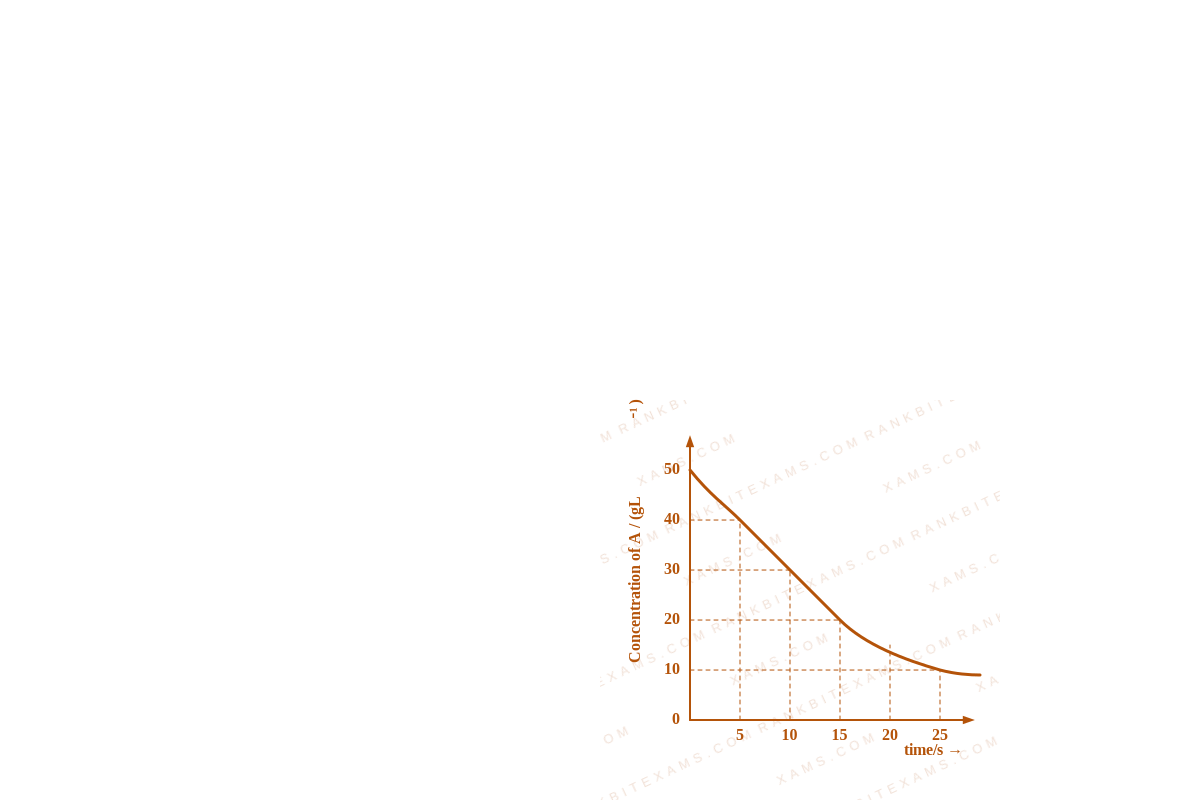
Let's first analyze the order of the reaction using the concentration-time coordinates from the graph:
- At t=5~s$t=5~\mathrm{s}$, concentration [A] = 40~ g~L⁻¹$[A] = 40~\mathrm{g~L^{-1}}$
- At t=15~s$t=15~\mathrm{s}$, concentration [A] = 20~ g~L⁻¹$[A] = 20~\mathrm{g~L^{-1}}$
Notice that the concentration drops to exactly half of its value (40 arrow 20$40 \rightarrow 20$) over a time interval of Δ t = 15 - 5 = 10~s$\Delta t = 15 - 5 = 10~\mathrm{s}$.
- At t=25~s$t=25~\mathrm{s}$, concentration [A] = 10~ g~L⁻¹$[A] = 10~\mathrm{g~L^{-1}}$
Again, the concentration drops to half (20 arrow 10$20 \rightarrow 10$) in another interval of Δ t = 25 - 15 = 10~s$\Delta t = 25 - 15 = 10~\mathrm{s}$.
Since the half-life (t1/2$t_{1/2}$) is constant and independent of the initial concentration, this reaction follows first-order kinetics.
Step 1: Calculate the Rate Constant (k)
The half-life of the reaction is t1/2 = 10~s$t_{1/2} = 10~\mathrm{s}$.
k = (ln 2)/(10) = (2.303 2)/(10) = (2.303 × 0.3010)/(10) ≈ 0.0693~ s⁻¹$$k = \frac{\ln 2}{10} = \frac{2.303 \log 2}{10} = \frac{2.303 \times 0.3010}{10} \approx 0.0693~\mathrm{s^{-1}}$$
Step 2: Calculate the Time for Decay to 2.5 g/L
Given initial concentration A₀ = 50~ g~L⁻¹$A_0 = 50~\mathrm{g~L^{-1}}$ and target concentration Aₜ = 2.5~ g~L⁻¹$A_t = 2.5~\mathrm{g~L^{-1}}$:
t = (2.303)/(k) ((A₀)/(Aₜ))$$t = \frac{2.303}{k} \log\left(\frac{A_0}{A_t}\right)$$
t = (2.303)/((2.303 2)/(10)) ((50)/(2.5))$$t = \frac{2.303}{\frac{2.303 \log 2}{10}} \log\left(\frac{50}{2.5}\right)$$
t = (10)/( 2) (20)$$t = \frac{10}{\log 2} \log(20)$$
t = 10 × ( (10) + (2))/( (2))$$t = 10 \times \frac{\log(10) + \log(2)}{\log(2)}$$
t = 10 × ( (1 + 0.3010)/(0.3010) )$$t = 10 \times \left( \frac{1 + 0.3010}{0.3010} \right)$$
t = 10 × ( (1.3010)/(0.3010) ) ≈ 43.22~s$$t = 10 \times \left( \frac{1.3010}{0.3010} \right) \approx 43.22~\mathrm{s}$$
Rounding to the nearest integer gives 43 seconds.
Pattern Recognition
Shortcut trick: If t1/2 = 10~s$t_{1/2} = 10~\mathrm{s}$, any concentration drop of 2ⁿ$2^n$ times takes n × t1/2$n \times t_{1/2}$ seconds. Here, (50)/(2.5) = 20$\frac{50}{2.5} = 20$. Since 2⁴ = 16$2^4 = 16$ (takes 40 s) and 2⁵ = 32$2^5 = 32$ (takes 50 s), a drop of 20 times must take slightly over 40 seconds. This confirms our calculation of 43 seconds.
Chapter Mix
Class 12 Chemistry: Chemical Kinetics