JEE Main · Chemistry → Steady

Chemical Kinetics appeared 42 times across 3 years — 4.9% of Chemistry. This question is from First Order Kinetics.

Year 2026 2025 2024 Total
Questions 14 20 8 42

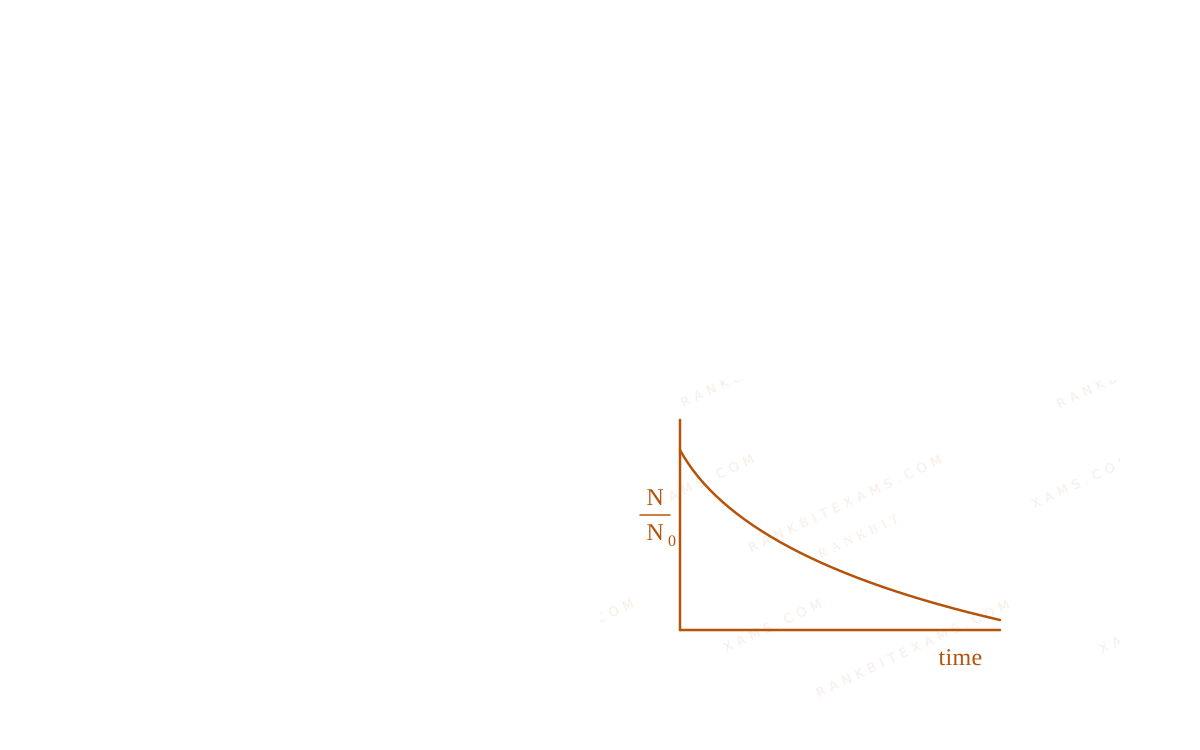
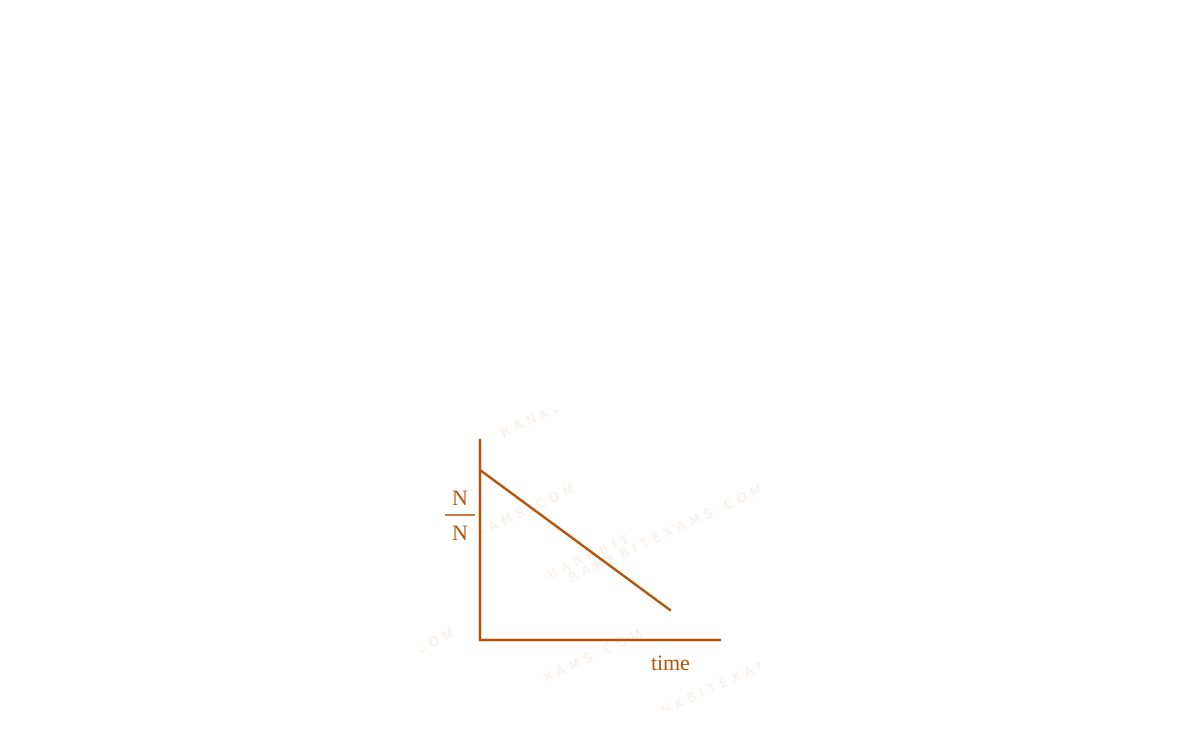
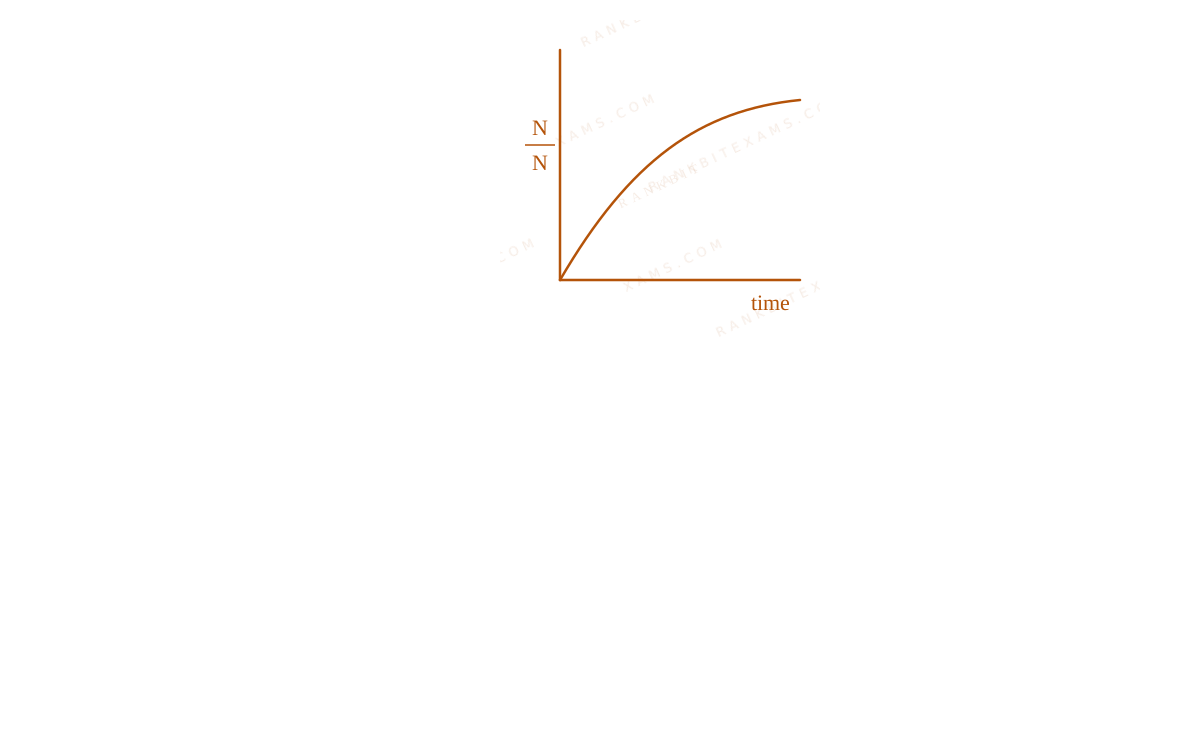
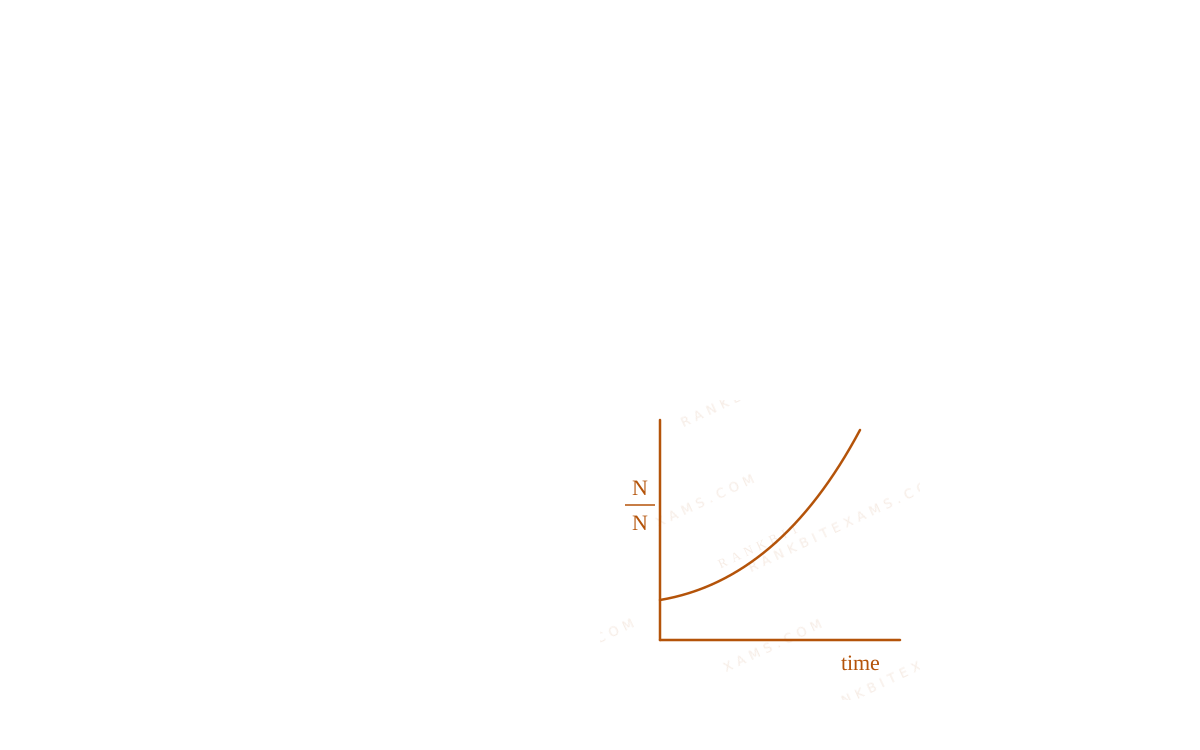
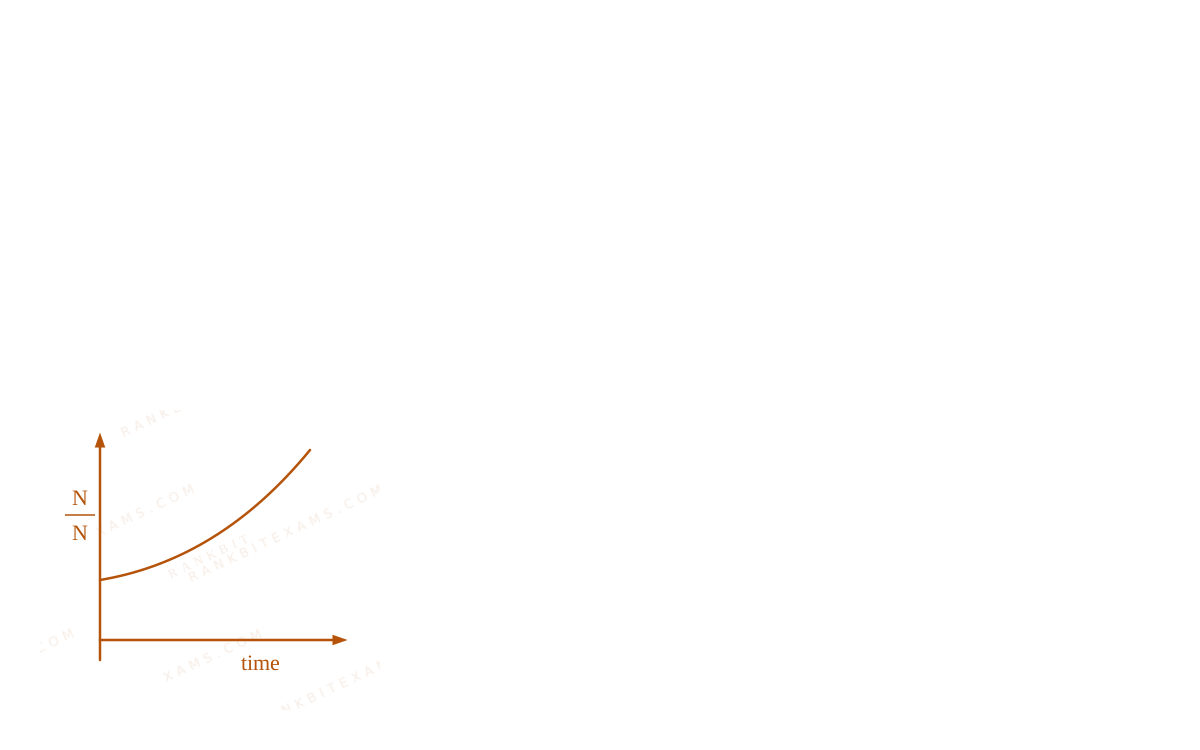
For bacterial growth in a cell culture, growth law is very similar to the law of radioactive decay. Which of the following graphs is most suitable to represent bacterial colony growth?

Solution & Explanation

Related Formula

Exponential growth equation model:

N = N₀ eKt

Normalized configuration formula:

(N)/(N₀) = eKt
Core Logic

Radioactive decay follows a decreasing exponential path (N = N₀ e-λ t).

Conversely, cell culture growth functions via an increasing exponential pattern because the rate of growth is directly proportional to the current population size (dN/dt = KN). This results in an exponential curve that starts at (N)/(N₀) = 1 when t = 0 and curves sharply upward over time.

Step 1: Finding the Matching Curve

Plotting (N)/(N₀) against time shows an upward-clinging exponential profile starting from 1, which perfectly matches the curve in option (4).

Exponential growth profile plot for Q40

Pattern Recognition

The expression eKt dictates an exponential increase. Ensure the curve starts from a non-zero value (1) at t=0, as (N₀)/(N₀) = 1, rather than starting from the origin (0).

Chapter Mix

Class 12 Chemistry: Chemical Kinetics

Reference Study Guides

More Chemical Kinetics Previous-Year Questions — Page 8

Q jee_main_2024_29_january_evening First Order Kinetics and Half Life
The half-life of radioisotopic bromine - 82 is 36 hours. The fraction which remains after one day is ________ × 10⁻². (Given antilog 0.2006 = 1.587)
Numerical Answer. Answer: 63 to 63

Solution

Related Formula
k = 0.693t1/2 and t = (2.303)/(k) ₁₀ ((a)/(a-x))
Core Logic

Given t1/2 = 36 hours, calculate the decay constant (k):

k = (0.693)/(36) = 0.01925 hr⁻¹

We want to find the fraction remaining after 1 day = 24 hours:

₁₀ ((a)/(a-x)) = (k × t)/(2.303) = (0.01925 × 24)/(2.303) = 0.2006
Step 1: Antilog Application

Taking the antilog on both sides:

(a)/(a-x) = 1.587 Fraction remaining ((a-x)/(a)) = (1)/(1.587) ≈ 0.6301

Expressing the remaining fraction in the requested format:

0.6301 = 63 × 10⁻²

Thus, the required integer value is 63.

Pattern Recognition

Ensure all time variables are in matching units (hours) before substituting values into first-order kinetic equations.

Chapter Mix

Class 12 Chemistry: Chemical Kinetics

Q82 jee_main_2024_27_jan_morning Determination of Order of Reaction
Consider the following data for the given reaction: 2HI(g) arrow H2(g) + I2(g)
Experiment[HI] (mol L⁻¹)Rate (mol L⁻¹s⁻¹)
10.0057.5 × 10⁻⁴
20.013.0 × 10⁻³
30.021.2 × 10⁻²
The order of the reaction is .
Numerical Answer. Answer: 2 to 2

Solution

Related Formula

Rate law relation expression:

R = k[HI]ⁿ

where n represents the overall reaction order indicator.

Step 1: Set up ratios using data subsets

Comparing data from experiment 1 and experiment 2:

(R₂)/(R₁) = 3.0 × 10⁻³7.5 × 10⁻⁴ = ((0.01)/(0.005))ⁿ

4 = (2)ⁿ

2² = 2ⁿ n = 2
Pattern Recognition

Doubling concentration (0.005 arrow 0.01) increases the reaction rate by 4 times (7.5 × 10⁻⁴ arrow 3.0 × 10⁻³). Hence, it is a clear second-order (2² = 4) dynamic pattern.

Chapter Mix

Class 12 Chemistry: Chemical Kinetics

Q83 jee_main_2024_29_jan_morning Arrhenius Equation and Activation Energy
For a reaction taking place in three steps at same temperature, overall rate constant K = K₁K₂K₃ . If Ea₁ , Ea₂ and Ea₃ are 40, 50 and 60 kJ/mol respectively, the overall Ea is ______ kJ/mol.
Numerical Answer. Answer: 30 to 30

Solution

Related Formula
K = A e-Eₐ/RT
Core Logic

Given the relationship between the rate constants:

K = (K₁ · K₂)/(K₃)

Substituting the Arrhenius equation for each rate constant:

A · e-Eₐ/RT = A₁ · e^-Eₐ₁/RT · A₂ · e^-Eₐ₂/RTA₃ · e^-Eₐ₃/RT

Combining the exponential terms using rules of exponents:

A · e-Eₐ/RT = ((A₁ · A₂)/(A₃)) · e^ -(Eₐ₁ + Eₐ₂ - Eₐ₃)RT
Step 1: Equating Activation Energies

By comparing the powers of e on both sides, the overall activation energy Eₐ is related to the individual steps as follows:

Eₐ = Eₐ₁ + Eₐ₂ - Eₐ₃

Substitute the given values (Eₐ₁ = 40, Eₐ₂ = 50, Eₐ₃ = 60 kJ/mol):

Eₐ = 40 + 50 - 60

Eₐ = 90 - 60

Eₐ = 30 kJ/mol
Pattern Recognition

When rate constants are multiplied or divided (K = K₁^a K₂^b / K₃^c), the corresponding overall activation energy follows the linear combination of the exponents: Eₐ = a Eₐ₁ + b Eₐ₂ - c Eₐ₃.

Chapter Mix

Class 12 Chemistry: Chemical Kinetics

Q82 jee_main_2024_30_january_evening Rate of Chemical Reaction
NO₂ required for a reaction is produced by decomposition of N₂O₅ in CCl₄ as by equation 2N₂O5(g) arrow 4NO2(g) + O2(g) The initial concentration of N₂O₅ is 3 mol L⁻¹ and it is 2.75 mol L⁻¹ after 30 minutes. The rate of formation of NO₂ is x × 10⁻³ mol L⁻¹ min⁻¹, value of x is
Numerical Answer. Answer: 17 to 17

Solution

Related Formula
Rate of Reaction (ROR) = -(1)/(2) Δ [N₂O₅]Δ t = (1)/(4) Δ [NO₂]Δ t
Core Logic

First, find the rate of disappearance of N₂O₅.

- Δ [N₂O₅]Δ t = - ((2.75 - 3))/(30) = (0.25)/(30) mol L⁻¹ min⁻¹

Now, equate it to the general Rate of Reaction:

ROR = -(1)/(2) Δ [N₂O₅]Δ t = (1)/(2) ((0.25)/(30)) = (0.125)/(30) = (1)/(240) mol L⁻¹ min⁻¹
Step 1: Calculate the Rate of Formation of NO₂

Rate of formation of NO₂ = Δ [NO₂]Δ t = 4 × ROR

= 4 × (1)/(240) = (1)/(60) mol L⁻¹ min⁻¹

Convert this to scientific notation to find x:

(1)/(60) ≈ 0.01666 = 16.66 × 10⁻³ mol L⁻¹ min⁻¹

Rounding to the nearest integer, we get x = 17.

Chapter Mix

Class 12 Chemistry: Chemical Kinetics

Q81 jee_main_2024_30_jan_morning First Order Reactions
The rate of first order reaction is 0.04 mol L⁻¹s⁻¹ at 10 minutes and 0.03 mol L⁻¹s⁻¹ at 20 minutes after initiation. Half life of the reaction is ________ minutes. (Given 2=0.3010, 3=0.4771)
Numerical Answer. Answer: 24 to 24.1

Solution

Related Formula

Rate = k[A]

[A] = [A]₀ e-kt t1/2 = (ln 2)/(k)
Core Logic

For a first order reaction, rate is directly proportional to concentration.

R₁ = k[A]₁₀ = k[A]₀ e-k(10 × 60) R₂ = k[A]₂₀ = k[A]₀ e-k(20 × 60)
Step 1: Setting up equations
0.04 = k[A]₀ e-600k (1) 0.03 = k[A]₀ e-1200k (2)
Step 2: Solving for k

Dividing equation (1) by (2):

(0.04)/(0.03) = e-600ke-1200k (4)/(3) = e600k

Take natural log on both sides:

ln((4)/(3)) = 600k k = (ln(4/3))/(600) s⁻¹
Step 3: Calculating half life
t1/2 = (ln 2)/(k) = (ln 2)/((ln(4/3))/(600)) = (600 ln 2)/(ln 4 - ln 3) seconds

Convert to minutes by dividing by 60:

t1/2 = (10 ln 2)/(ln 4 - ln 3) minutes

Substitute log values (since ln x = 2.303 x, the 2.303 cancels out):

t1/2 = 10 × ( 2)/( 4 - 3) minutes t1/2 = 10 × (0.3010)/(2(0.3010) - 0.4771) t1/2 = 10 × (0.3010)/(0.6020 - 0.4771) = 10 × (0.3010)/(0.1249) t1/2 = 24.099 ≈ 24 minutes
Chapter Mix

Class 12 Chemistry: Chemical Kinetics

More Chemical Kinetics Questions — jee_main_2025_28_jan_evening

Practice all Chemical Kinetics previous-year questions →

Rankbit System
JEE Physics: Waves (+15.5%) | Electrostatics: Concentric Shells (-29.7%) | Modern Physics: Photoelectric Clones (+34.2%) | Mathematics: Definite Integrals (+18.1%) | Chemistry: Coordination Splitting (-11.4%) | JEE Physics: Waves (+15.5%) | Electrostatics: Concentric Shells (-29.7%) | Modern Physics: Photoelectric Clones (+34.2%) | Mathematics: Definite Integrals (+18.1%) | Chemistry: Coordination Splitting (-11.4%)