JEE Main · Physics ↓ Falling

Laws of Motion appeared 34 times across 3 years — 3.9% of Physics. This question is from Circular Motion and Banking of Roads.

Year 2026 2025 2024 Total
Questions 9 10 15 34

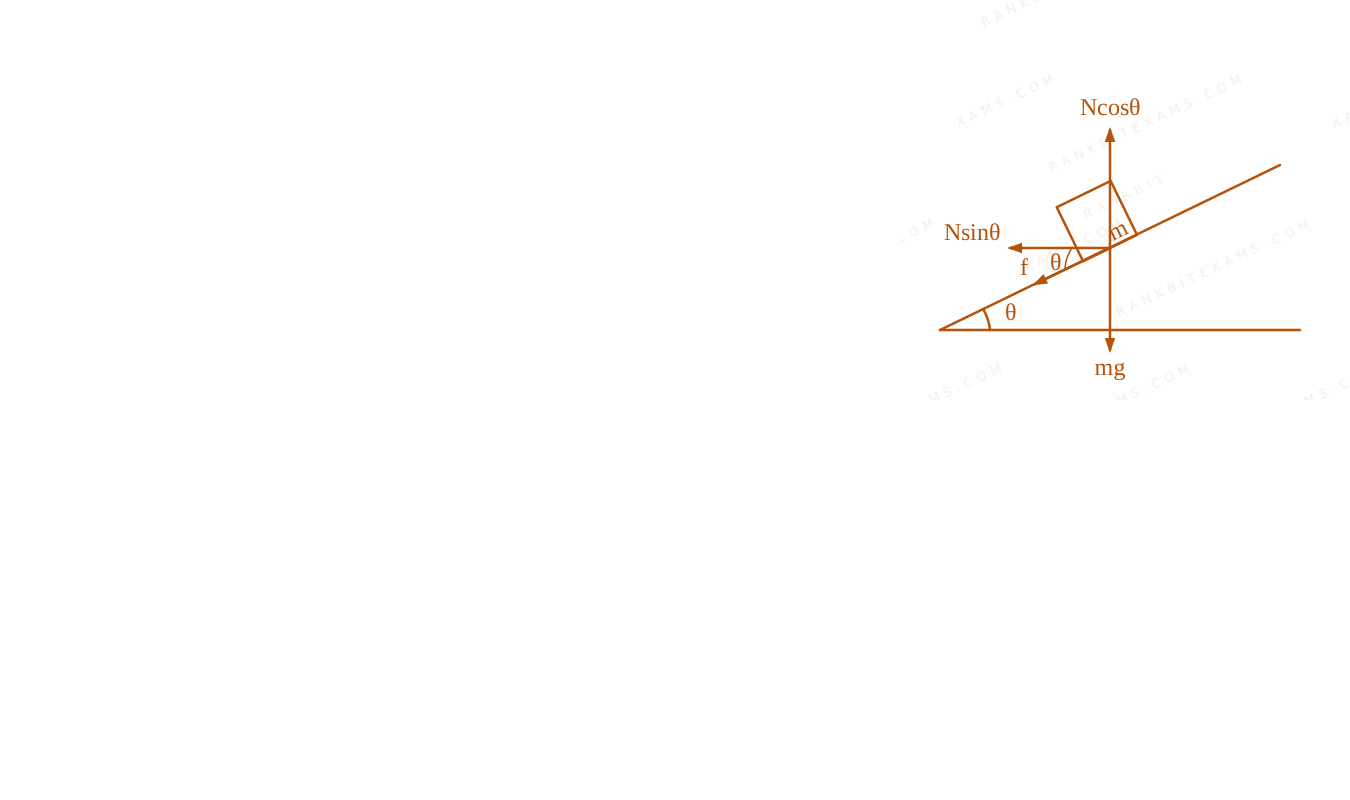
A car of mass 'm' moves on a banked road having radius 'r' and banking angle θ To avoid slipping from banked road, the maximum permissible speed of the car is v₀. The coefficient of friction μ between the wheels of the car and the banked road is :-

Solution & Explanation

Related Formula

The maximum velocity limit preventing outer slide breakout on a rough banked plane profile is given by standard centrifugal force equations:

v₀ = √(rg (( θ + μ)/(1 - μ θ)))
Core Logic

By writing out the components shown in the free body layout

Circular Motion and Banking of Roads diagram for Q10 - JEE Main 2025 Morning
:

N θ + f θ = mv₀²r N θ - f θ = mg
Step 1: Isolate Coefficient of Friction

Squaring the velocity boundary relation gives :

v₀²rg = ( θ + μ)/(1 - μ θ)

Cross multiply to isolate the variable terms :

v₀² - μ v₀² θ = rg θ + μ rg v₀² - rg θ = μ(rg + v₀² θ) μ = v₀² - rg θrg + v₀² θ
Pattern Recognition

Maximum limits always balance with plus signs in the numerator fraction. Simply rearrange that template expression directly to map the targeted parameter.

Chapter Mix

Class 11 Physics: Laws of Motion
More Laws of Motion Previous-Year Questions — Page 5

Q37 jee_main_2024_01_february_morning Circular Motion
A ball of mass 0.5~kg is attached to a string of length 50~cm. The ball is rotated on a horizontal circular path about its vertical axis. The maximum tension that the string can bear is 400~N. The maximum possible value of angular velocity of the ball in rad/s is:
  • A. 1600
  • B. 40
  • C. 1000
  • D. 20

Solution

Related Formula

Centripetal force configuration for simplified horizontal rotation layout:

T = mω² l

Core Logic

Given values: m = 0.5~kg, l = 50~cm = 0.5~m, Tmax = 400~N.

Equating max tension to centripetal requirement:

400 = 0.5 × ω² × 0.5
Step 1: Compute Angular Velocity
400 = 0.25 ω² ω² = (400)/(0.25) = 1600 ω = √(1600) = 40~rad/s
Pattern Recognition

Ensure units are metric (50~cm → 0.5~m). Direct mapping to horizontal string projection metrics.

Chapter Mix

Class 11 Physics: Laws of Motion
Q36 jee_main_2024_29_january_evening Circular Motion and Tension
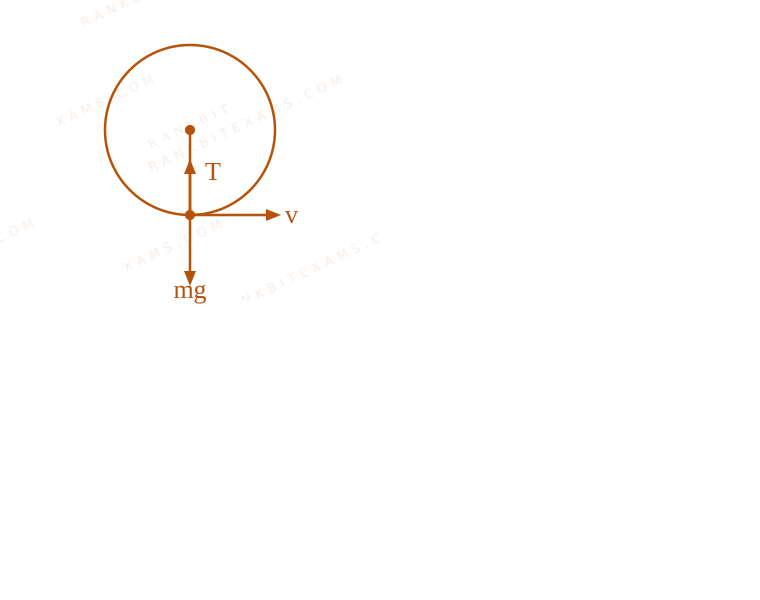
A stone of mass 900 g is tied to a string and moved in a vertical circle of radius 1 m making 10 rpm. The tension in the string, when the stone is at the lowest point is (if π² = 9.8 and g = 9.8 m/s²):
  • A. 97 N
  • B. 9.8 N
  • C. 8.82 N
  • D. 17.8 N

Solution

Related Formula

At the lowest point of a vertical circle, the equation of motion for a mass m is:

T - mg = m r ω²

Rearranging to solve for tension T:

T = mg + m r ω²
Core Logic

Given data:

  • Mass, m = 900 g = 0.9 kg
  • Radius, r = 1 m
  • Frequency, N = 10 rpm = (10)/(60) rps = (1)/(6) rps
  • Angular velocity, ω = 2π N = 2π ((1)/(6)) = (π)/(3) rad/s
Step 1: Calculate Force Values

Now we substitute our parameters into the tension equation:

T = (0.9)(9.8) + (0.9)(1)((π)/(3))² T = 8.82 + 0.9 × (π²)/(9)

Since π² = 9.8:

T = 8.82 + 0.1 × 9.8 T = 8.82 + 0.98 = 9.80 N

Free-body diagram of stone at lowest point in vertical circle for Q36

Pattern Recognition

Always convert Mass to kg and rotational speed to rad/s first. Using the prompt constraint π² = 9.8 yields a perfect decimal addition match.

Chapter Mix

Class 11 Physics: Laws of Motion

Q59 jee_main_2024_29_january_evening Non-uniform Circular Motion
A particle is moving in a circle of radius 50 cm in such a way that at any instant the normal and tangential components of its acceleration are equal. If its speed at t = 0 is 4 m/s, the time taken to complete the first revolution will be (1)/(α)[ 1 - e-2π ] s, where α = ________.
Numerical Answer. Answer: 8 to 8

Solution

Related Formula

For a particle in circular motion:

  • Normal (centripetal) acceleration: ac = (v²)/(r)
  • Tangential acceleration: aₜ = (dv)/(dt)
Core Logic

Given ac = aₜ:

(v²)/(r) = (dv)/(dt) ∫v₀v (dv)/(v²) = ∫₀t (dt)/(r) [ -(1)/(v) ]v₀v = (t)/(r) -(1)/(v) + (1)/(v₀) = (t)/(r) (1)/(v) = (1)/(v₀) - (t)/(r) v = (v₀)/(1 - (v₀ t)/(r))
Step 1: Relate Velocity to Position and Integrate

Substitute the parameters v₀ = 4 m/s and r = 50 cm = 0.5 m:

v = (4)/(1 - 8t) = (ds)/(dt)

Integrating this to find the position s(t):

∫₀s ds = ∫₀t (4)/(1 - 8t) dt s = 4 [ (ln(1 - 8t))/(-8) ]₀^t = -(1)/(2) ln(1 - 8t)
Step 2: Solve for Time of First Revolution

To complete the first revolution, the distance covered is:

s = 2π r = 2π (0.5) = π m

Equating the distance:

π = -(1)/(2) ln(1 - 8t) -2π = ln(1 - 8t) 1 - 8t = e-2π 8t = 1 - e-2π t = (1)/(8) [ 1 - e-2π ] s

Comparing this to (1)/(α)[ 1 - e-2π ] s, we get:

α = 8

Pattern Recognition

The condition aₜ = ac v (dv)/(ds) = (v²)/(r) (dv)/(v) = (ds)/(r). Integrating directly gives v = v₀ es/r. Substituting this back into v = ds/dt makes the final time integral much more intuitive.

Chapter Mix

Class 11 Physics: Laws of Motion

Q36 jee_main_2024_27_jan_morning Banking of Tracks
A train is moving with a speed of 12 m/s on rails which are 1.5 m apart. To negotiate a curve of radius 400 m, the height by which the outer rail should be raised with respect to the inner rail is (Given, g = 10 m/s²):
  • A. 6.0 cm
  • B. 5.4 cm
  • C. 4.8 cm
  • D. 4.2 cm

Solution

Related Formula
θ = (v²)/(Rg)

For small angles, θ ≈ θ = (h)/(d), where h is the raised height and d is the separation between the tracks.

Core Logic

Equating the two relationships:

(h)/(d) = (v²)/(Rg) (h)/(1.5) = (12 × 12)/(400 × 10)
Step 1: Compute height value
h = 1.5 × (144)/(4000) = 1.5 × 0.036 = 0.054 m

Converting to centimeters:

h = 0.054 × 100 = 5.4 cm
Pattern Recognition

Whenever θ is small, geometry permits approximating θ with hwidth, vastly reducing computational transcendental overhead.

Chapter Mix

Class 11 Physics: Laws of Motion

Q45 jee_main_2024_27_jan_morning Conservation of Linear Momentum
A body of mass 1000 kg is moving horizontally with a velocity 6 m/s. If 200 kg extra mass is added, the final velocity (in m/s) is:
  • A. 6
  • B. 2
  • C. 3
  • D. 5

Solution

Related Formula
m₁ v₁ = m₂ v₂
Core Logic

Since there is no external horizontal force acting on the body, linear momentum along the horizontal axis is conserved.

Initial mass m₁ = 1000 kg, initial velocity v₁ = 6 m/s. Final mass m₂ = 1000 + 200 = 1200 kg.

Step 1: Balance conservation equation
1000 × 6 = 1200 × v₂ 6000 = 1200 v₂ v₂ = (6000)/(1200) = 5 m/s
Pattern Recognition

Inelastic mass addition transitions are classic momentum-balance equations, scaling velocity inversely with total expanded mass profiles.

Chapter Mix

Class 11 Physics: Laws of Motion

More Laws of Motion Questions — jee_main_2025_24_jan_morning

Practice all Laws of Motion previous-year questions →

Rankbit System
JEE Physics: Waves (+15.5%) | Electrostatics: Concentric Shells (-29.7%) | Modern Physics: Photoelectric Clones (+34.2%) | Mathematics: Definite Integrals (+18.1%) | Chemistry: Coordination Splitting (-11.4%) | JEE Physics: Waves (+15.5%) | Electrostatics: Concentric Shells (-29.7%) | Modern Physics: Photoelectric Clones (+34.2%) | Mathematics: Definite Integrals (+18.1%) | Chemistry: Coordination Splitting (-11.4%)