Given below are two statements. One is labelled as Assertion (A) and the other is labelled as Reason (R).
Assertion (A): An electron in a certain region of uniform magnetic field is moving with constant velocity in a straight line path.
Reason (R): The magnetic field in that region is along the direction of velocity of the electron.
In the light of the above statements, choose the correct answer from the options given below:
A.(A)$(A)$ is false but (R)$(R)$ is true
B.Both (A)$(A)$ and (R)$(R)$ are true and (R)$(R)$ is the correct explanation of (A)$(A)$
C.Both (A)$(A)$ and (R)$(R)$ are true but (R)$(R)$ is NOT the correct explanation of (A)$(A)$
D.(A)$(A)$ is true but (R)$(R)$ is false
Solution & Explanation
Related Formula
F = q( v × B)$$\vec{F} = q(\vec{v} \times \vec{B})$$
Core Logic
For a particle to move with a constant velocity in a straight line inside a magnetic field alone, the net magnetic force must be zero:
F = 0 v ∥ B$$\vec{F} = 0 \implies \vec{v} \parallel \vec{B}$$
This means the angle θ$\theta$ between the velocity vector and the magnetic field vector is either 0°$0^{\circ}$ or 180°$180^{\circ}$. Thus, if the magnetic field is along the direction of velocity, the force is zero, allowing unaccelerated straight-line motion. Both Assertion and Reason are true, and the Reason correctly explains the Assertion.
Pattern Recognition
Magnetic field cannot change the speed of a charged particle, but it changes direction unless v$\vec{v}$ is parallel or anti-parallel to B$\vec{B}$, in which case the magnetic force vanishes entirely.
Keywords:#Magnetic force on electron#JEE Main 2025 Evening Q3#Moving Charges and Magnetism JEE Main 2025#Constant velocity in magnetic field
More Moving Charges and Magnetism Previous-Year Questions — Page 6
Qjee_main_2025_28_jan_eveningBiot Savart Law
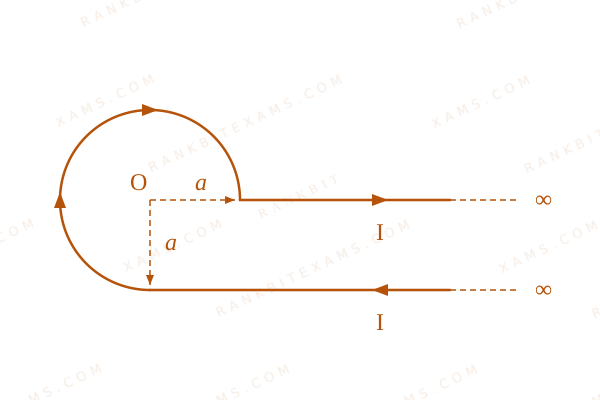
An infinite wire has a circular bend of radius a$a$ , and carrying a current I as shown in figure. The magnitude of magnetic field at the origin O of the arc is given by:
An infinite current carrying wire presenting a three-quarter circular bend around center origin O.
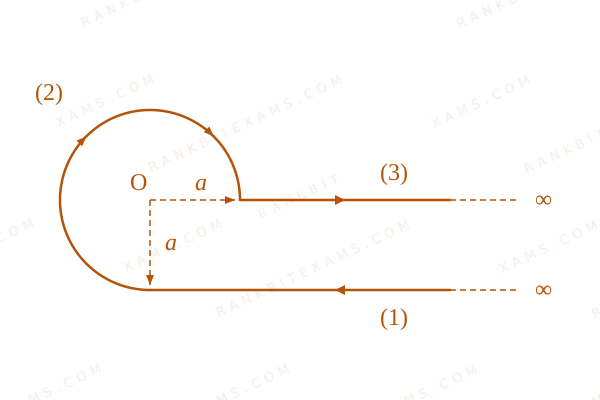
Let us decompose the structure into three functional parts as mapped out below:
An infinite current carrying wire presenting a three-quarter circular bend around center origin O.
Segment 1 (Incoming semi-infinite line): The straight line extends to infinity, with its terminating tip at a perpendicular distance a$a$ from origin O$O$. Using the right-hand grip rule, the direction points into the page:
Segment 2 (Three-quarter circular loop): The loop forms an angle of θ = (3π)/(2)$\theta = \frac{3\pi}{2}$ radians around O$O$. The field points into the page:
Always check the axis alignment first. Any straight wire segment whose extended line passes directly through the field point contributes exactly zero to the total magnetic field value.
Qjee_main_2025_29_jan_morningAmpere\'s Circuital Law
Consider a long straight wire of a circular cross-section (radius a) carrying a steady current I. The current is uniformly distributed across this cross-section. The distances from the centre of the wire\'s cross-section at which the magnetic field [inside the wire, outside the wire] is half of the maximum possible magnetic field, any where due to the wire, will be
A galvanometer has a resistance of 50~Ω$50\mathrm{~\Omega}$ and it allows maximum current of 5~mA$5\mathrm{~mA}$. It can be converted into voltmeter to measure upto 100~V$100\mathrm{~V}$ by connecting in series a resistor of resistance:
Voltmeter resistance is always high because it is connected in parallel to circuits to prevent current drawing leaks.
Chapter Mix
Class 12 Physics: Moving Charges and Magnetism
Class 12 Physics: Current Electricity
Qjee_main_2024_01_february_morningMagnetic Field due to a Current Element
A regular polygon of 6 sides is formed by bending a wire of length 4pi$4pi$ meter. If an electric current of 4pisqrt3~A$4pisqrt{3}\mathrm{~A}$ is flowing through the sides of the polygon, the magnetic field at the centre of the polygon would be x × 10⁻⁷~T$x \times 10^{-7}\mathrm{~T}$. The value of x$x$ is:
Numerical Answer.Answer: 72 to 72
Solution
Related Formula
Magnetic field due to a straight wire segment of length 2L$2L$ at distance r$r$:
Total perimeter = 6 · a = 4π side length a = (4π)/(6) = (2π)/(3)~m$= 6 \cdot a = 4\pi \implies \text{side length } a = \frac{4\pi}{6} = \frac{2\pi}{3}\mathrm{~m}$.
For a regular hexagon segment, the interior angles relative to the normal vector are θ₁ = θ₂ = 30^°$\theta_1 = \theta_2 = 30^\circ$.
The normal distance r$r$ from the center to a side is:
For regular polygons, the normal distance r$r$ to the side is always r = (a)/(2) ((π)/(n))$r = \frac{a}{2}\cot(\frac{\pi}{n})$. The contribution from all n$n$ symmetric segments adds up constructively.
Chapter Mix
Class 12 Physics: Moving Charges and Magnetism
Q39jee_main_2024_29_january_eveningMotion of Charged Particle in Magnetic Field
Two particles X and Y having equal charges are being accelerated through the same potential difference. Thereafter they enter normally in a region of uniform magnetic field and describes circular paths of radii R₁$R_1$ and R₂$R_2$ respectively. The mass ratio of X and Y is:
A.((R₂)/(R₁))²$\left(\frac{R_2}{R_1}\right)^2$
B.((R₁)/(R₂))²$\left(\frac{R_1}{R_2}\right)^2$
C.((R₁)/(R₂))$\left(\frac{R_1}{R_2}\right)$
D.((R₂)/(R₁))$\left(\frac{R_2}{R_1}\right)$
Solution
Related Formula
The radius R$R$ of the path of a charged particle moving perpendicular to a magnetic field B$B$ is:
R = (mv)/(qB) = (p)/(qB)$$R = \frac{mv}{qB} = \frac{p}{qB}$$
In terms of kinetic energy K$K$:
R = √(2mK)qB$$R = \frac{\sqrt{2mK}}{qB}$$
Since the particle is accelerated through potential V$V$, kinetic energy K = qV$K = qV$:
Shortcut: Whenever charges and potential differences are equal, the radius of orbit in a magnetic field scales as R ∝ √(m)$R \propto \sqrt{m}$. Squaring both sides yields m ∝ R²$m \propto R^2$ instantly.
Chapter Mix
Class 12 Physics: Moving Charges and Magnetism
More Moving Charges and Magnetism Questions — jee_main_2025_24_jan_evening
Practice past-year questions one chapter at a time. Pick an exam → subject → chapter and get every PYQ for that topic — pulled together from all past papers — with the chapter's key formulas alongside.