Let the position vectors of three vertices of a $$$$$$\triangle$$$be$ be $4\vec{p}+\vec{q}-3\vec{r},$, $-5\vec{p}+\vec{q}+2\vec{r}and$ and $2\vec{p}-\vec{q}+2\vec{r}If the position vectors of the orthocenter and the circumcenter of the$ If the position vectors of the orthocenter and the circumcenter of the $\triangleare$ are $\frac{\vec{p}+\vec{q}+\vec{r}}{4}and$ and $\alpha\vec{p}+\beta\vec{q}+\gamma\vec{r}respectively, then$ respectively, then $\alpha+2\beta+5\gamma$ is equal to:
A.3$3$
B.1$1$
C.6$6$
D.4$4$
Solution & Explanation
Related Formula
Centroid (G$G$) of a $$$$$$\triangle$$with vertices $A, B, C$ is given by:
$$ with vertices $A, B, C$ is given by:
$$\vec{G} = \frac{\vec{A} + \vec{B} + \vec{C}}{3}
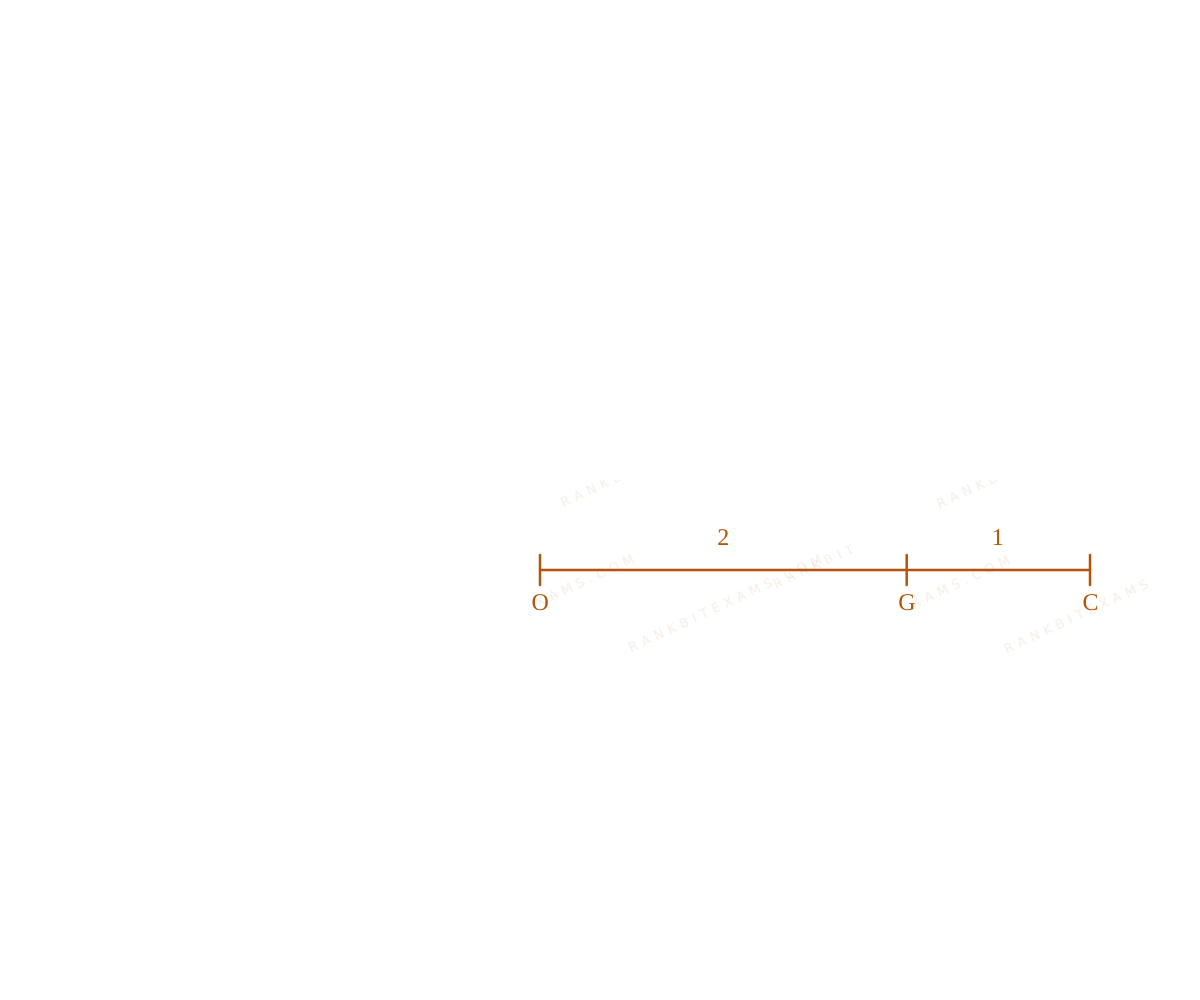
Euler's line property: The orthocenter ($O$), centroid ($G$), and circumcenter ($C$) are collinear, and $G$ divides the segment $OC$ internally in the ratio $2:1$.
Step 1: Compute the Centroid Vector
Sum the vectors of the three given vertices:
$$
Euler's line property: The orthocenter ($O$), centroid ($G$), and circumcenter ($C$) are collinear, and $G$ divides the segment $OC$ internally in the ratio $2:1$.
O-G-Cin$ in $2:1. Remember the mnemonic 'Oil-Gas-Company' or simply$. Remember the mnemonic 'Oil-Gas-Company' or simply $3G = 2C + O$ to prevent swapping structural coefficients under exam stress.
Chapter Mix
Class 12 Mathematics: Vector Algebra
Class 11 Mathematics: Properties of Triangles
Keywords:#Euler line section formula \triangle#JEE Main 2025 Evening Q56#Centroid vector calculation#orthocenter circumcenter vector relationship
More Vector Algebra Previous-Year Questions — Page 2
Q21jee_main_2026_22_january_eveningAngle Between Vectors
Let a vector a = √(2) i - j + λ k$\vec{a} = \sqrt{2}\hat{i} - \hat{j} + \lambda\hat{k}$, λ > 0$\lambda > 0$, make an obtuse angle with the vector b = -λ² i + 4√(2) j + 4√(2) k$\vec{b} = -\lambda^2\hat{i} + 4\sqrt{2}\hat{j} + 4\sqrt{2}\hat{k}$ and an angle θ$\theta$, (π)/(6) < θ < (π)/(2)$\frac{\pi}{6} < \theta < \frac{\pi}{2}$, with the positive z-axis. If the set of all possible values of λ$\lambda$ is (α, β) - γ$(\alpha, \beta) - \{\gamma\}$, then α + β + γ$\alpha + \beta + \gamma$ is equal to ____.
Numerical Answer.Answer: 5 to 5
Solution
Related Formula
Cos angle with z-axis: θ = a · k| a|$\cos\theta = \frac{\vec{a} \cdot \hat{k}}{|\vec{a}|}$.
Obtuse angle condition: a · b < 0$\vec{a} \cdot \vec{b} < 0$.
Let a = - i + j + 2 k$\vec{a} = -\hat{i} + \hat{j} + 2\hat{k}$, b = i - j - 3 k$\vec{b} = \hat{i} - \hat{j} - 3\hat{k}$, c = a × b$\vec{c} = \vec{a} \times \vec{b}$ and d = c × a$\vec{d} = \vec{c} \times \vec{a}$. Then ( a - b) · d$(\vec{a} - \vec{b}) \cdot \vec{d}$ is equal to:
A.4$4$
B.-4$-4$
C.-2$-2$
D.2$2$
Solution
Related Formula
x × ( y × z) = ( x · z) y - ( x · y) z$$\vec{x} \times (\vec{y} \times \vec{z}) = (\vec{x} \cdot \vec{z})\vec{y} - (\vec{x} \cdot \vec{y})\vec{z}$$
Core Logic
Given c = a × b$\vec{c} = \vec{a} \times \vec{b}$ and d = c × a$\vec{d} = \vec{c} \times \vec{a}$. Substitute c$\vec{c}$ into the expression for d$\vec{d}$:
d = ( a × b) × a$$\vec{d} = (\vec{a} \times \vec{b}) \times \vec{a}$$
d = ( a · a) b - ( a · b) a = a² b - ( a · b) a$$\vec{d} = (\vec{a} \cdot \vec{a})\vec{b} - (\vec{a} \cdot \vec{b})\vec{a} = a^2 \vec{b} - (\vec{a} \cdot \vec{b})\vec{a}$$
Step 1: Calculate Magnitudes and Dot Products
For a = - i + j + 2 k$\vec{a} = -\hat{i} + \hat{j} + 2\hat{k}$ and b = i - j - 3 k$\vec{b} = \hat{i} - \hat{j} - 3\hat{k}$:
Instead of computing cross products sequentially (which is tedious and error-prone), immediately expand nested cross products using the standard vector triple product identity BAC-CAB$BAC-CAB$.
Chapter Mix
Class 12 Maths: Vector Algebra
Q3jee_main_2026_23_january_eveningCross Product and Projection
Let a= i-2 j+3 k, b=2 i+ j- k, c=λ i+ j+ k$\vec{a}=\hat{i}-2\hat{j}+3\hat{k}, \vec{b}=2\hat{i}+\hat{j}-\hat{k}, \vec{c}=\lambda\hat{i}+\hat{j}+\hat{k}$ and v= a× b$\vec{v}=\vec{a}\times\vec{b}$. If v· c=11$\vec{v}\cdot\vec{c}=11$ and the length of the projection of b$\vec{b}$ on c$\vec{c}$ is p$p$, then 9p²$9p^{2}$ is equal to:
A.9$9$
B.6$6$
C.4$4$
D.12$12$
Solution
Related Formula
Length of projection of b on c = | b· c|| c|$$\text{Length of projection of } \vec{b} \text{ on } \vec{c} = \frac{|\vec{b}\cdot\vec{c}|}{|\vec{c}|}$$
Core Logic
First, find v = a × b$\vec{v} = \vec{a} \times \vec{b}$.
Standard sequence: compute cross product to find normal vector v$\vec{v}$, take dot product to deduce missing parameter λ$\lambda$, then substitute into scalar projection formula.
Chapter Mix
Class 12 Maths: Vector Algebra
Q10jee_main_2026_23_january_eveningVector Product
Let a, b, c$\vec{a}, \vec{b}, \vec{c}$ be three vectors such that a× b=2( a× c)$\vec{a}\times\vec{b}=2(\vec{a}\times\vec{c})$. If | a|=1, | b|=4, | c|=2$|\vec{a}|=1, |\vec{b}|=4, |\vec{c}|=2$, and the angle between b$\vec{b}$ and c$\vec{c}$ is 60°$60^{\circ}$, then | a· c|$|\vec{a}\cdot\vec{c}|$ is:
A.2$2$
B.4$4$
C.0$0$
D.1$1$
Solution
Related Formula
u × v = 0 u and v are parallel ($ u = λ v $)$$\vec{u} \times \vec{v} = 0 \implies \vec{u} \text{ and } \vec{v} \text{ are parallel ($ \vec{u} = \lambda\vec{v} $)}$$| x + y|² = | x|² + | y|² + 2 x· y$$|\vec{x} + \vec{y}|^2 = |\vec{x}|^2 + |\vec{y}|^2 + 2\vec{x}\cdot\vec{y}$$
Core Logic
a × b - 2( a × c) = 0$$\vec{a} \times \vec{b} - 2(\vec{a} \times \vec{c}) = 0$$a × ( b - 2 c) = 0$$\vec{a} \times (\vec{b} - 2\vec{c}) = 0$$
This implies that ( b - 2 c)$(\vec{b} - 2\vec{c})$ is collinear with a$\vec{a}$.
So, b - 2 c = λ a$\vec{b} - 2\vec{c} = \lambda \vec{a}$ for some scalar λ$\lambda$.
A cross-product equation structured as a×( X)=0$\vec{a}\times(\vec{X})=0$ immediately gives X = λ a$\vec{X} = \lambda\vec{a}$. Expanding the magnitude squared is the standard method to expose the dot products and solve for λ$\lambda$.
Chapter Mix
Class 12 Maths: Vector Algebra
Q5jee_main_2026_24_january_morningCross and Dot Products
Let a = 2 i + j - 2 k$\vec{a} = 2\hat{i} + \hat{j} - 2\hat{k}$, b = i + j$\vec{b} = \hat{i} + \hat{j}$ and c = a × b$\vec{c} = \vec{a} \times \vec{b}$. Let d$\vec{d}$ be a vector such that| d - a| = √(11)$|\vec{d} - \vec{a}| = \sqrt{11}$, | c × d| = 3$|\vec{c} \times \vec{d}| = 3$ and the angle between c$\vec{c}$ and d$\vec{d}$ is (π)/(4)$\frac{\pi}{4}$. Then a · d$\vec{a} \cdot \vec{d}$ is equal to
Practice past-year questions one chapter at a time. Pick an exam → subject → chapter and get every PYQ for that topic — pulled together from all past papers — with the chapter's key formulas alongside.