JEE Main · Mathematics → Steady

Conic Sections appeared 94 times across 3 years — 10.9% of Mathematics. This question is from Parabola Equation with Given Vertex and Directrix.

Year 2026 2025 2024 Total
Questions 29 44 21 94

If the equation of the parabola with vertex V((3)/(2),3) and the directrix x+2y=0 is α x²+β y²-γ xy-30x-60y+225=0, then α+β+γ is equal to:

Solution & Explanation

Related Formula

The locus definition of a parabola states that the squared distance from any point P(x,y) to the focus S(x₀, y₀) equals the squared perpendicular distance to the directrix line Ax + By + C = 0:

(x - x₀)² + (y - y₀)² = ((Ax + By + C)²)/(A² + By²)
Step 1: Determine the Focus coordinates

The axis line of the parabola is perpendicular to the directrix x + 2y = 0 and passes through the vertex V(1.5, 3). Slope of directrix = -0.5 ⇒ Slope of axis = 2.

Equation of axis :

y - 3 = 2(x - (3)/(2)) ⇒ y - 2x = 0

The intersection of the axis (y - 2x = 0) and directrix (x + 2y = 0) gives the foot of the directrix, which is (0, 0).

Since the vertex is the midpoint between the focus and the foot of the directrix :

((3)/(2), 3) = ((xf + 0)/(2), (yf + 0)/(2)) ⇒ Focus S = (3, 6)
Step 2: Derive the Parabola Locus Equation

Equate the distance equations from point P(x,y) :

(x - 3)² + (y - 6)² = ((x + 2y)²)/(1² + 2²) 5(x² - 6x + 9 + y² - 12y + 36) = x² + 4xy + 4y² 5x² - 30x + 45 + 5y² - 60y + 180 = x² + 4xy + 4y² 4x² + y² - 4xy - 30x - 60y + 225 = 0
Step 3: Coefficient Extraction

Compare with the equation template α x² + β y² - γ xy - 30x - 60y + 225 = 0 :

α = 4, β = 1, γ = 4 α + β + γ = 4 + 1 + 4 = 9
Pattern Recognition

The vertex is always exactly midway between the focus and the foot of the directrix line along the line of symmetry. Finding the origin (0,0) as the foot quickly reveals the focus coordinates via doubling.

Chapter Mix

Class 11 Mathematics: Conic Sections
Reference Study Guides

More Conic Sections Previous-Year Questions — Page 3

Q11 jee_main_2026_22_january_evening Hyperbola Properties and Area of Triangle
Let P(10, 2√(15)) be a point on the hyperbola (x²)/(a²) - (y²)/(b²) = 1, whose foci are S and S'. If the length of its latus rectum is 8, then the square of the area of Δ PSS' is equal to:
  • A. 4200
  • B. 900
  • C. 1462
  • D. 2700

Solution

Related Formula

Latus rectum length = (2b²)/(a) = 8 b² = 4a. Focal length = 2ae = 2√(a² + b²).

Core Logic

Substitute P(10, 2√(15)) and b² = 4a into hyperbola equation:

(100)/(a²) - (60)/(4a) = 1 a² + 15a - 100 = 0 (a + 20)(a - 5) = 0 a = 5 (a > 0)

Thus, b² = 20 b = √(20).

Step 1: Calculate Focal Distance and Area

Focal distance SS' = 2ae = 2 √(a² + b²) = 2 √(25 + 20) = 6√(5). Area of Δ PSS' = (1)/(2) × base × height = (1)/(2) (6√(5)) (2√(15)) = 30√(3) = A.

Step 2: Square of Area
A² = (30√(3))² = 900 × 3 = 2700
Pattern Recognition

Use latus rectum relation to reduce hyperbola parameter to single variable quadratic.

Chapter Mix

Class 11 Maths: Conic Sections

Q16 jee_main_2026_22_january_evening Ellipse Focal Distances
Let S and S' be the foci of the ellipse (x²)/(25) + (y²)/(9) = 1 and P(α, β) be a point on the ellipse in the first quadrant. If (SP)² + (S'P)² - SP · S'P = 37, then α² + β² is equal to:
  • A. 15
  • B. 11
  • C. 17
  • D. 13

Solution

Related Formula

For ellipse (x²)/(a²) + (y²)/(b²) = 1: SP + S'P = 2a = 10, e = √(1 - b²/a²) = √(1 - 9/25) = 4/5. Focal distances: SP = a - eα = 5 - (4)/(5)α, S'P = a + eα = 5 + (4)/(5)α.

Core Logic

Using algebraic identity:

(SP + S'P)² - 3 SP · S'P = 37 100 - 3 SP · S'P = 37 SP · S'P = 21

Substitute focal distance formula:

25 - (16)/(25)α² = 21 (16)/(25)α² = 4 α² = (25)/(4)
Step 1: Calculate beta^2 and Sum

Substitute α² into ellipse equation (α²)/(25) + (β²)/(9) = 1:

(1)/(4) + (β²)/(9) = 1 β² = (27)/(4) α² + β² = (25)/(4) + (27)/(4) = (52)/(4) = 13
Pattern Recognition

Express (SP)² + (S'P)² - SP · S'P in terms of (SP+S'P) to determine SP · S'P instantly.

Chapter Mix

Class 11 Maths: Conic Sections

Q17 jee_main_2026_22_january_evening Locus of Midpoint of Chord
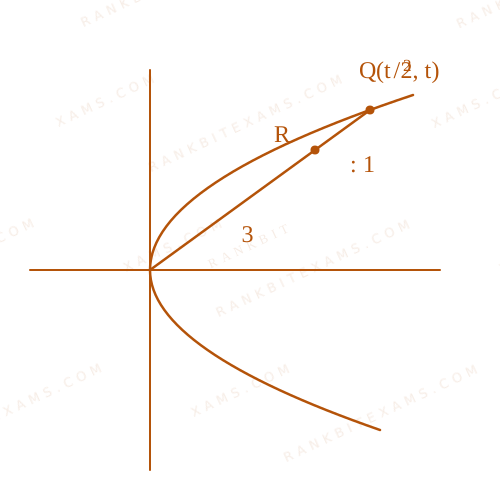
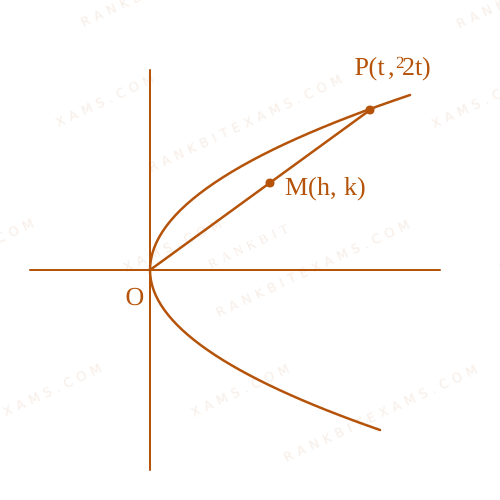
Let the locus of the mid-point of the chord through the origin O of the parabola y² = 4x be the curve S. Let P be any point on S. Then the locus of the point, which internally divides OP in the ratio 3:1, is:
  • A. 3y² = 2x
  • B. 2y² = 3x
  • C. 3x² = 2y
  • D. 2x² = 3y

Solution

Related Formula

Section formula for internal division in ratio m:n:

R(h,k) = ( (m x₂ + n x₁)/(m+n), (m y₂ + n y₁)/(m+n) )
Core Logic

Locus of midpoint diagram for Q17 - JEE Main 2026 Evening

Let chord endpoint be Q(t², 2t). Midpoint M(h,k) of OQ:

h = (t²)/(2), k = t k² = 2h

So curve S is y² = 2x.

Now P lies on S: y² = 2x, so P = ((t²)/(2), t). Point R(h,k) divides OP in ratio 3:1:

Step 1: Section Formula Application

Locus of midpoint diagram for Q17 - JEE Main 2026 Evening

h = (3(t²/2) + 0)/(4) = (3t²)/(8), k = (3(t) + 0)/(4) = (3t)/(4)

From k = (3t)/(4) t = (4k)/(3). Substitute into h:

h = (3)/(8) ((4k)/(3))² = (3)/(8) · (16k²)/(9) = (2k²)/(3) 2k² = 3h 2y² = 3x
Pattern Recognition

Parametrize midpoint curve S, then re-apply section ratio to derive final locus equation.

Chapter Mix

Class 11 Maths: Conic Sections

Q1 jee_main_2026_23_january_morning Hyperbola
Let the domain of the function f(x) = ₃ ₅ ₇(9x - x² - 13) be the interval (m, n). Let the hyperbola (x²)/(a²) - (y²)/(b²) = 1 have eccentricity (n)/(3) and the length of the latus rectum (8m)/(3). Then b² - a² is equal to:
  • A. 5
  • B. 11
  • C. 9
  • D. 7

Solution

Related Formula
e = √(1 + (b²)/(a²)) L.R. = (2b²)/(a)
Core Logic

For the domain of the given logarithmic function, the argument of the innermost logarithm must be strictly greater than 1 because of the nested logs:

₅( ₇(9x-x²-13))>0 ⇒ ₇(9x-x²-13) > 1 ⇒ 9x-x²-13 > 7 ⇒ x²-9x+20 < 0 ⇒ (x-4)(x-5) < 0

Thus, 4 < x < 5. Therefore, the domain interval is (4, 5), yielding m = 4 and n = 5.

Step 1: Hyperbola Properties

Given eccentricity e = (n)/(3) = (5)/(3):

e = √(1 + (b²)/(a²)) = (5)/(3) ⇒ (b²)/(a²) = (25)/(9) - 1 = (16)/(9) ⇒ (b)/(a) = (4)/(3)

Given the length of the latus rectum is (8m)/(3):

(2b²)/(a) = (8(4))/(3) = (32)/(3) ⇒ 2b((b)/(a)) = (32)/(3) ⇒ 2b((4)/(3)) = (32)/(3) ⇒ 8b = 32 ⇒ b = 4

Since (b)/(a) = (4)/(3), we get a = 3.

Step 2: Final Calculation

We need to find b² - a²:

b² - a² = (4)² - (3)² = 16 - 9 = 7
Pattern Recognition

Nested logarithmic domains require unpacking from the outside in: ₐ(X) > 0 ⇒ X > 1. Linking function domains to coordinate geometry parameters is a standard JEE cross-topic pattern.

Chapter Mix

Class 11 Maths: Conic Sections Class 11 Maths: Relations and Functions

Q5 jee_main_2026_23_january_morning Ellipse
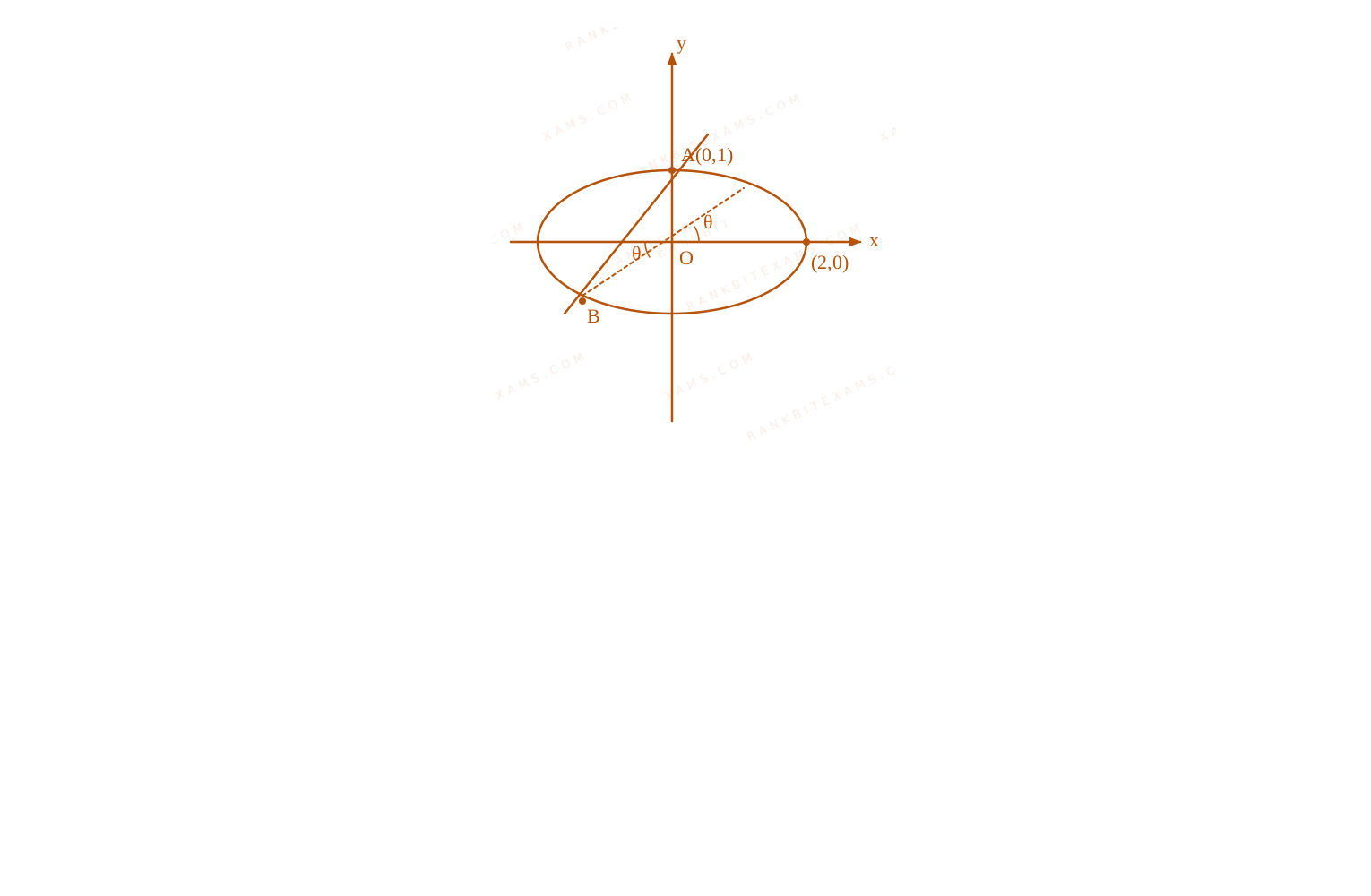
Let the line y - x = 1 intersect the ellipse (x²)/(2) + (y²)/(1) = 1 at the points A and B. Then the angle made by the line segment AB at the center of the ellipse is:
  • A. π - ⁻¹((1)/(4))
  • B. (π)/(2) + ⁻¹((1)/(4))
  • C. (π)/(2) + 2 ⁻¹((1)/(4))
  • D. (π)/(2) - ⁻¹((1)/(4))

Solution

Related Formula
θ = | (m₁ - m₂)/(1 + m₁ m₂) |
Core Logic

Find the intersection points of the line y = x + 1 and the ellipse (x²)/(2) + y² = 1.

Ellipse diagram for Q5 - JEE Main 2026 Morning
Substitute y = x + 1 into the ellipse equation:

(x²)/(2) + (x + 1)² = 1 x² + 2(x² + 2x + 1) = 2 3x² + 4x = 0 ⇒ x(3x + 4) = 0

This gives x = 0 or x = -(4)/(3).

Step 1: Calculate Intersection Points

For x = 0, y = 1 ⇒ A(0, 1). For x = -(4)/(3), y = -(4)/(3) + 1 = -(1)/(3) ⇒ B(-(4)/(3), -(1)/(3)).

Ellipse diagram for Q5 - JEE Main 2026 Morning

Step 2: Find Angle at the Origin

Let O(0,0) be the center of the ellipse. The angle made by segment AB at O is ∠ AOB. The slope of OA is m₁ = (1 - 0)/(0 - 0) = ∞ (which means OA is along the y-axis, angle is π/2). The slope of OB is m₂ = (-1/3 - 0)/(-4/3 - 0) = (1)/(4). The angle of OB with the positive x-axis is θ = ⁻¹((1)/(4)). The total angle ∠ AOB is (π)/(2) + θ = (π)/(2) + ⁻¹((1)/(4)).

Pattern Recognition

When solving line-conic intersection, explicit extraction of points (A, B) is often simpler than using homogenization if the intersection yields simple rational or integer coordinates.

Chapter Mix

Class 11 Maths: Conic Sections Class 11 Maths: Straight Lines

More Conic Sections Questions — jee_main_2025_24_jan_evening

Practice all Conic Sections previous-year questions →

Rankbit System
JEE Physics: Waves (+15.5%) | Electrostatics: Concentric Shells (-29.7%) | Modern Physics: Photoelectric Clones (+34.2%) | Mathematics: Definite Integrals (+18.1%) | Chemistry: Coordination Splitting (-11.4%) | JEE Physics: Waves (+15.5%) | Electrostatics: Concentric Shells (-29.7%) | Modern Physics: Photoelectric Clones (+34.2%) | Mathematics: Definite Integrals (+18.1%) | Chemistry: Coordination Splitting (-11.4%)