Let H₁: x²a²- y²b²=1$H_{1}:\frac{x^{2}}{a^{2}}-\frac{y^{2}}{b^{2}}=1$ and H₂:- x²A²+ y²B²=1$H_{2}:-\frac{x^{2}}{A^{2}}+\frac{y^{2}}{B^{2}}=1$ be two hyperbolas having length of latus rectums 15√(2)$15\sqrt{2}$ and 12√(5)$12\sqrt{5}$ respectively. Let their eccentricities be e₁=√((5)/(2))$e_{1}=\sqrt{\frac{5}{2}}$ and e₂$e_{2}$ respectively. If the product of the lengths of their transverse axes is 100√(10)$100\sqrt{10}$ then 25e₂²$25e_{2}^{2}$ is equal to \_\_\_\_.
Pay extra attention to conjugate-type equations (-(x²)/(A²) + (y²)/(B²) = 1$-\frac{x^2}{A^2} + \frac{y^2}{B^2} = 1$). For these vertical hyperbolas, the transverse axis corresponds to the variable with the positive sign (2B$2B$), and the components inside the latus rectum swap positions proportionally.
Keywords:#hyperbola latus rectum transverse axis#JEE Main 2025 Evening Q74#conjugate hyperbola eccentricity parameters#product of geometric axes conic
More Conic Sections Previous-Year Questions — Page 2
Q6jee_main_2026_21_jan_eveningParabola
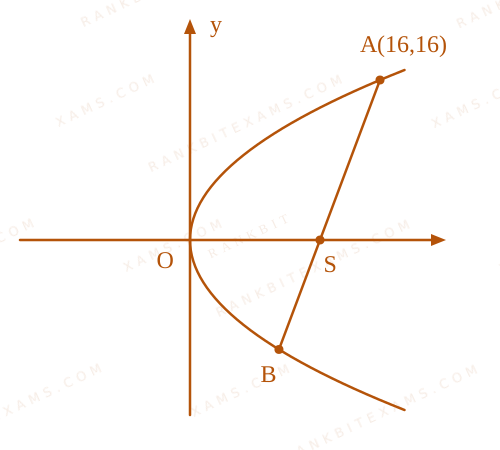
Let one end of a focal chord of the parabolay²=16x$y^{2}=16x$ be (16, 16). If P(α,β)$P(\alpha,\beta)$ divides this focal chord internally in the ratio 5:2, then the minimum value of α+β$\alpha+\beta$ is equal to:
A.22$22$
B.7$7$
C.5$5$
D.16$16$
Solution
Related Formula
For a focal chord with ends (at₁², 2at₁) and (at₂², 2at₂), the relation is t₁t₂ = -1$$\text{For a focal chord with ends } (at_1^2, 2at_1) \text{ and } (at_2^2, 2at_2), \text{ the relation is } t_1t_2 = -1$$Section formula: (x, y) = ( (mx₂ + nx₁)/(m+n), (my₂ + ny₁)/(m+n) )$$\text{Section formula: } (x, y) = \left( \frac{mx_2 + nx_1}{m+n}, \frac{my_2 + ny_1}{m+n} \right)$$
Core Logic
Parabola focal chord division diagram for Q6 - JEE Main 2026 Evening
For y² = 16x$y^2 = 16x$, a = 4$a = 4$. The given point A(16, 16)$A(16, 16)$ is equivalent to 4t² = 16$4t^2 = 16$ and 2(4)t = 16$2(4)t = 16$, which gives parameter t₁ = 2$t_1 = 2$.
The other end B$B$ has parameter t₂ = -(1)/(t₁) = -(1)/(2)$t_2 = -\frac{1}{t_1} = -\frac{1}{2}$.
Step 1: Calculate coordinates of B
For t₂ = -1/2$t_2 = -1/2$, point B$B$ is:
x = 4(-1/2)² = 1$x = 4(-1/2)^2 = 1$y = 8(-1/2) = -4$y = 8(-1/2) = -4$
So, B(1, -4)$B(1, -4)$.
Step 2: Section formula calculations (Two cases)
Point P(α, β)$P(\alpha, \beta)$ divides AB$AB$ in the ratio 5:2$5:2$. There are two possibilities depending on which end the ratio starts from.
Case 1: Ratio 5 from B to A (i.e. A is x₂$x_2$ and B is x₁$x_1$):
Comparing the two possible sums, 7 < 22$7 < 22$. Thus, the minimum value is 7$7$.
Pattern Recognition
When a line segment is divided in a given ratio, 'internal division' inherently bears two solutions based on the orientation (from point A or point B). Always evaluate both cases when finding a minimum or maximum.
Chapter Mix
Class 11 Maths: Conic Sections
Q25jee_main_2026_21_jan_eveningLocus
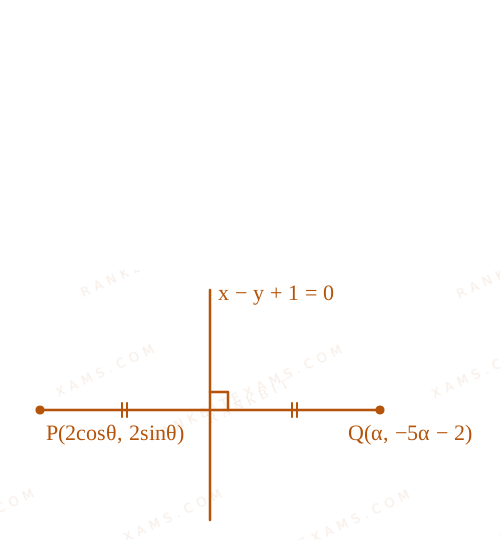
If P$P$ is a point on the circlex² + y² = 4$x^{2} + y^{2} = 4$, Q$Q$ is a point on the straight line 5x + y + 2 = 0$5x + y + 2 = 0$ and x - y + 1 = 0$x - y + 1 = 0$ is the perpendicular bisector of PQ$PQ$, then 13 times the sum of abscissa of all such point P$P$ is ____.
Numerical Answer.Answer: 2 to 2
Solution
Related Formula
Perpendicular bisector properties: m₁m₂ = -1 and mid-point lies on the line.$$\text{Perpendicular bisector properties: } m_1m_2 = -1 \text{ and mid-point lies on the line.}$$Parametric point on circle x²+y²=r² is (r θ, r θ)$$\text{Parametric point on circle } x^2+y^2=r^2 \text{ is } (r\cos\theta, r\sin\theta)$$
Core Logic
Circle locus perpendicular bisector diagram for Q25 - JEE Main 2026 Evening
Let P = (2 θ, 2 θ)$P = (2\cos\theta, 2\sin\theta)$.
Let Q$Q$ on the line 5x + y + 2 = 0$5x + y + 2 = 0$ be Q(α, -5α-2)$Q(\alpha, -5\alpha-2)$.
The line x - y + 1 = 0$x - y + 1 = 0$ is the perpendicular bisector of PQ$PQ$. This gives two conditions: slope of PQ$PQ$ is -1$-1$, and mid-point of PQ$PQ$ satisfies the bisector equation.
Step 1: Apply Slope Condition
Slope of bisector is 1$1$, so slope of PQ$PQ$ must be -1$-1$.
The abscissa of P$P$ is 2 θ$2\cos\theta$.
Values of abscissa are 2(1) = 2$2(1) = 2$ and 2(-(12)/(13)) = -(24)/(13)$2\left(-\frac{12}{13}\right) = -\frac{24}{13}$.
Sum of abscissa values = 2 - (24)/(13) = (26 - 24)/(13) = (2)/(13)$= 2 - \frac{24}{13} = \frac{26 - 24}{13} = \frac{2}{13}$.
We need 13 × (Sum) = 13 × (2)/(13) = 2$13 \times (\text{Sum}) = 13 \times \frac{2}{13} = 2$.
Pattern Recognition
Instead of finding the image of a generic circle point in a line, construct the reflection point Q$Q$ parameter, use slope logic (m₁m₂=-1$m_1m_2=-1$) and midpoint logic simultaneously to create a trigonometric linear equation.
Chapter Mix
Class 11 Maths: Circles
Class 11 Maths: Straight Lines
Q10jee_main_2026_22_january_morningHyperbola and Line Intersection
If the line α x + 2y = 1$\alpha x + 2y = 1$, where α in R$\alpha \in \mathbb{R}$, does not meet the hyperbolax² - 9y² = 9$x^{2} - 9y^{2} = 9$, then a possible value of α$\alpha$ is:
A.0.6$0.6$
B.0.8$0.8$
C.0.5$0.5$
D.0.7$0.7$
Solution
Related Formula
For a line y = mx + c and hyperbola (x²)/(a²) - (y²)/(b²) = 1:$$\text{For a line } y = mx + c \text{ and hyperbola } \frac{x^2}{a^2} - \frac{y^2}{b^2} = 1:$$If they do not intersect, the quadratic in x formed by substituting y has D < 0.$$\text{If they do not intersect, the quadratic in } x \text{ formed by substituting } y \text{ has } D < 0.$$
Core Logic
Given line: α x + 2y = 1 y = (1 - α x)/(2)$\alpha x + 2y = 1 \implies y = \frac{1 - \alpha x}{2}$.
Given hyperbola: x² - 9y² = 9$x^2 - 9y^2 = 9$.
Substitute the expression for y$y$ into the hyperbola's equation:
Since √(5) ≈ 2.236$\sqrt{5} \approx 2.236$, we have √(5)3 ≈ 0.745$\frac{\sqrt{5}}{3} \approx 0.745$.
So α$\alpha$ must be strictly greater than 0.745$0.745$ (or less than -0.745$-0.745$).
Geometrically, for a line not to meet a hyperbola, its slope must lie within a specific range determined by the asymptotes (m = ± b/a$m = \pm b/a$), and its c²$c^2$ must satisfy c² < a²m² - b²$c^2 < a^2m^2 - b^2$. Direct substitution to enforce D < 0$D < 0$ is purely mechanical and robust.
Chapter Mix
Class 11 Maths: Conic Sections
Q12jee_main_2026_22_january_morningIntersection of Two Circles
Let the set of all values of r$r$, for which the circles (x + 1)² + (y + 4)² = r²$(x + 1)^2 + (y + 4)^2 = r^2$ and x² + y² - 4x - 2y - 4 = 0$x^2 + y^2 - 4x - 2y - 4 = 0$ intersect at two distinct points be the interval (α, β)$(\alpha, \beta)$. Then αβ$\alpha\beta$ is equal to
A.25$25$
B.20$20$
C.21$21$
D.24$24$
Solution
Related Formula
Two circles intersect at distinct points if |r₁ - r₂| < d < r₁ + r₂$$\text{Two circles intersect at distinct points if } |r_1 - r_2| < d < r_1 + r_2$$
Intersection of two circles boils down to the fundamental triangle inequality relating the radii to the center distance: |r₁ - r₂| < d < r₁ + r₂$|r_1 - r_2| < d < r_1 + r_2$. Solving this naturally yields an interval (α, β)$(\alpha, \beta)$ formatted as a difference of squares upon multiplication.
Chapter Mix
Class 11 Maths: Circles
Q17jee_main_2026_22_january_morningProperties of Parabola
If the chord joining the points P₁(x₁, y₁)$P_{1}(x_{1}, y_{1})$ and P₂(x₂, y₂)$P_{2}(x_{2}, y_{2})$ on the parabola y² = 12x$y^{2} = 12x$subtends a right angle at the vertex of the parabola, then x₁x₂ - y₁y₂$x_{1}x_{2} - y_{1}y_{2}$ is equal to
A.288$288$
B.280$280$
C.284$284$
D.292$292$
Solution
Related Formula
If a chord joining t₁ and t₂ subtends a right angle at the vertex (0,0), then t₁ t₂ = -4.$$\text{If a chord joining } t_1 \text{ and } t_2 \text{ subtends a right angle at the vertex } (0,0), \text{ then } t_1 t_2 = -4.$$Parametric coordinates for y² = 4ax: (at², 2at)$$\text{Parametric coordinates for } y^2 = 4ax: (at^2, 2at)$$
Core Logic
Given parabola y² = 12x 4a = 12 a = 3$y^2 = 12x \implies 4a = 12 \implies a = 3$.
Let the points be P₁(x₁, y₁) = (3t₁², 6t₁)$P_1(x_1, y_1) = (3t_1^2, 6t_1)$ and P₂(x₂, y₂) = (3t₂², 6t₂)$P_2(x_2, y_2) = (3t_2^2, 6t_2)$.
Right angles subtended at the vertex by a chord on y² = 4ax$y^2 = 4ax$ instantly lock the parameter product to t₁ t₂ = -4$t_1 t_2 = -4$. Substitute this directly into any coordinate products required by the problem.
Chapter Mix
Class 11 Maths: Conic Sections
More Conic Sections Questions — jee_main_2025_24_jan_evening
Practice past-year questions one chapter at a time. Pick an exam → subject → chapter and get every PYQ for that topic — pulled together from all past papers — with the chapter's key formulas alongside.