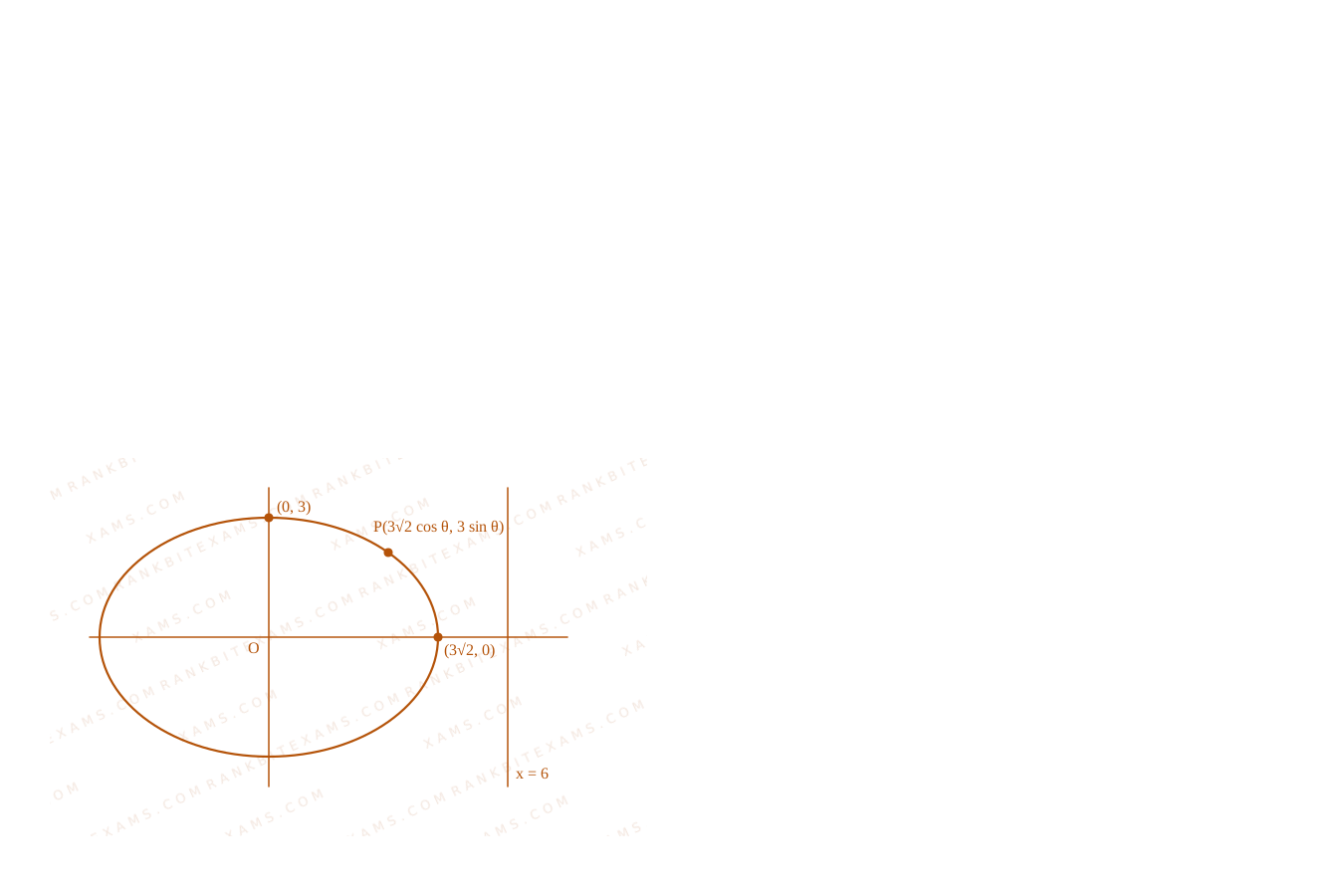
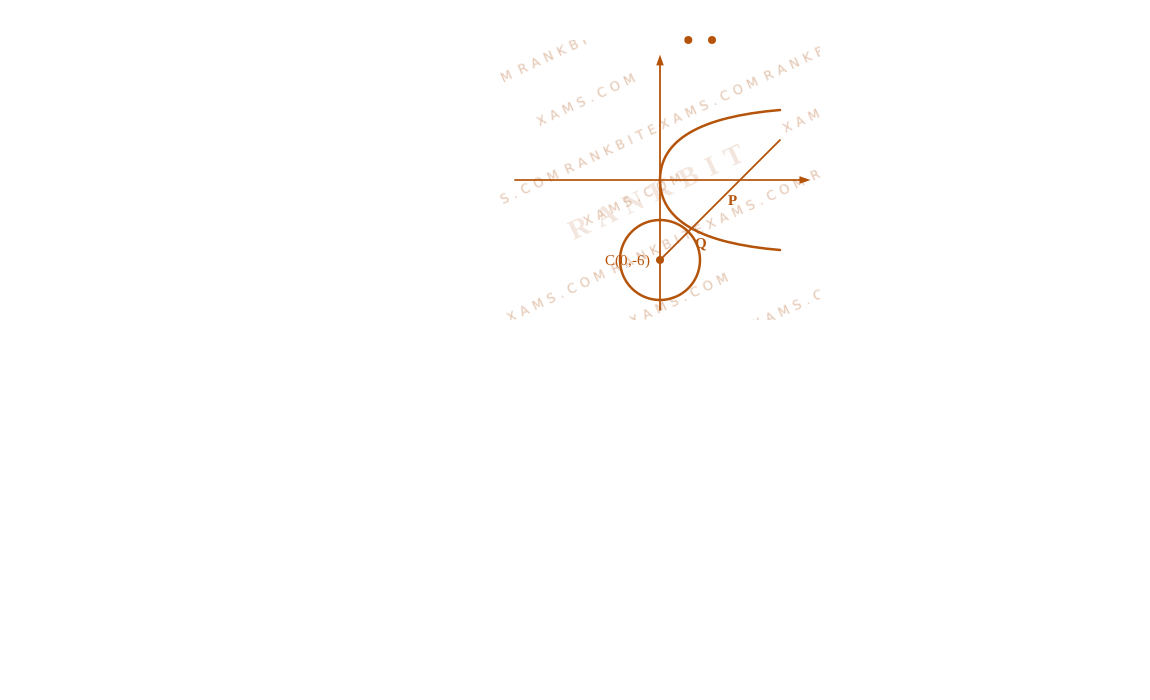
Let r be the radius of the circle, which touches x -axis at point (a, 0) , a < 0 and the parabola y^2 = 9x at the point (4, 6) . Then r is equal to

Numerical Answer Type:
Enter a numerical value Answer: 30 to 30 +4 marks

Solution & Explanation

### Related Formula textTangent line at point (x_1, y_1) implies yy_1 = 2a(x+x_1) ### Core Logic Establish the tangent vector expression at the parabola intersection mark. Since this path line functions as a shared contact tangent boundaries sheet for the circular arc, impose radius equations. ### Step 1: Derive Shared Parabola Tangent Line Tangent line profile for y^2 = 9x at coordinate indicator (4,6): 6y = 9 cdot left( fracx+42 right) implies 3x - 4y + 12 = 0 ### Step 2: Build Geometric Metric Connections Circle touches axis at (a,0), mapping coordinates center directly to C(a,r). Perpendicular boundary constraint steps require: frac3a - 4r + 125 = pm r implies 3a + 12 = 4r pm 5r ### Step 3: Solve for Radius Matrix Bounds Enforce circle equation intersection constraint profile (x-a)^2 + (y-r)^2 = r^2 at point (4,6): a^2 - 8a - 12r + 52 = 0 Evaluating the target systems from structural logic tracks rejects positive value parameters, providing: a = -14, quad r = 30 {{SOL_IMG_75}} ### Pattern Recognition Shared tangent elements connect independent conic fields. Locating circular center boundaries using axial coordinate tracking simplifies secondary equations. ### Evaluation Rubric / Model Answer null ### Chapter Mix Class 11 Mathematics: Conic Sections Class 11 Mathematics: Circles
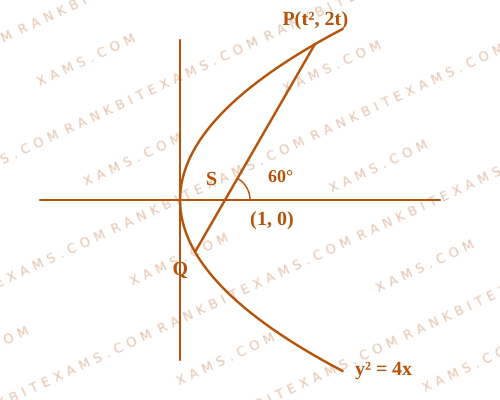
Tangent to Parabola and Circle Properties diagram for Q75 - JEE Main 2025 Evening

Reference Study Guides

More Conic Sections Previous-Year Questions — Page 6

Q67 jee_main_2025_04_april_evening Ellipse Properties
The centre of a circle C is at the centre of the ellipse E: fracx^2a^2 + fracy^2b^2 = 1, a > b. Let C pass through the foci F_1 and F_2 of E such that the circle C and the ellipse E intersect at four points. Let P be one of these four points. If the area of the triangle PF_1F_2 is 30 and the length of the major axis of E is 17, then the distance between the foci of E$ is :
  • A. 26
  • B. 13
  • C. 12
  • D. frac132

Solution

### Core Logic The circle C has its center at the origin and passes through the foci F_1(-ae, 0) and F_2(ae, 0). This means F_1F_2 is the diameter of the circle. Any point P lying on this circle satisfies the property that the angle subtended by the diameter is a right angle: angle F_1PF_2 = 90^circ
Ellipse properties diagram for Q67 - JEE Main 2025 Evening
### Step 1: Using the Area and Ellipse Definition Since triangle PF_1F_2 is a right-angled triangle at P: textArea = frac12 cdot PF_1 cdot PF_2 = 30 implies PF_1 cdot PF_2 = 60 By the definition of an ellipse, the sum of the focal distances to any point on the curve is equal to the length of the major axis (2a = 17): PF_1 + PF_2 = 17 ### Step 2: Calculating Distance between Foci Applying Pythagoras' theorem in right-angled triangle PF_1F_2: F_1F_2^2 = PF_1^2 + PF_2^2 = (PF_1 + PF_2)^2 - 2(PF_1 cdot PF_2) Substitute the known values from our equations block: F_1F_2^2 = (17)^2 - 2(60) = 289 - 120 = 169 F_1F_2 = sqrt169 = 13 Therefore, the distance between the foci is 13. ### Pattern Recognition Whenever a circle is circumscribed around the foci of an ellipse, remember Thales' theorem: any intersection point with the ellipse forms a right triangle with the focal diameter, linking focal properties directly to Pythagoras. ### Evaluation Rubric / Model Answer null ### Chapter Mix Class 11 Mathematics: Conic Sections
Q67 jee_main_2025_04_april_morning Ellipse - Foci and Latus Rectum
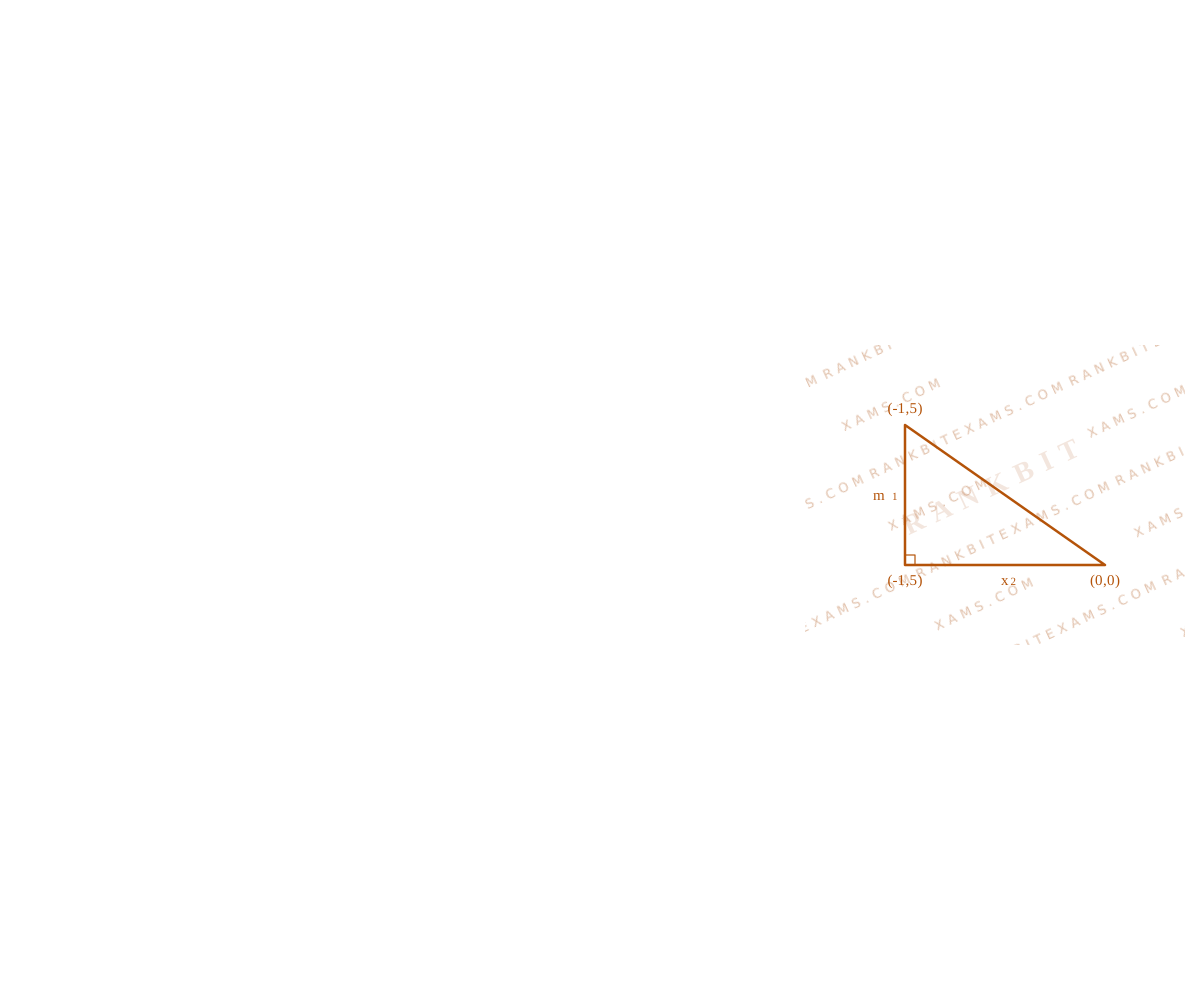
The length of the latus-rectum of the ellipse, whose foci are (2, 5) and (2, -3) and eccentricity is frac45, is
  • A. frac65
  • B. frac503
  • C. frac103
  • D. frac185

Solution

### Related Formula Distance between foci = 2be (for vertical major axis). Length of Latus Rectum (textL.R.) = frac2a^2b. ### Core Logic Foci are F_1(2,5) and F_2(2,-3). The x-coordinates are identical, indicating a vertical ellipse. Distance between foci: 2be = 5 - (-3) = 8 implies be = 4 Given eccentricity e = frac45: bleft(frac45right) = 4 implies b = 5
Ellipse - Foci and Latus Rectum diagram for Q67 - JEE Main 2025 Morning
### Step 1: Calculate Minor Axis length Use eccentricity relation: a^2 = b^2(1 - e^2) implies a^2 = 25left(1 - frac1625right) = 25 times frac925 = 9 implies a = 3 ### Step 2: Evaluate Latus Rectum textL.R. = frac2a^2b = frac2 times 95 = frac185 ### Pattern Recognition Always verify axis orientation (horizontal vs vertical) from coordinates before blindly substituting into standard formulas. Symmetrical components match axis lengths parameters directly. ### Evaluation Rubric / Model Answer null ### Chapter Mix Class 11 Mathematics: Conic Sections
Q74 jee_main_2025_04_april_morning Tangents to Conics
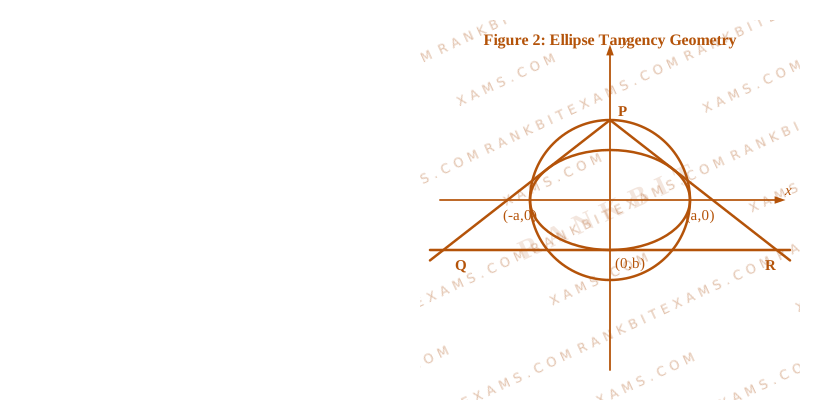
Let C be the circle x^2 + (y - 1)^2 = 2, E_1 and E_2 be two ellipses whose centres lie at the origin and major axes lie on the x-axis and y-axis respectively. Let the straight line x + y = 3 touch the curves C, E_1 and E_2 at P(x_1, y_1), Q(x_2, y_2) and R(x_3, y_3) respectively. Given that P is the mid-point of the line segment QR and PQ = frac2sqrt23, the value of 9(x_1y_1 + x_2y_2 + x_3y_3) is equal to
Numerical Answer. Answer: 46 to 46

Solution

### Related Formula Parametric equation of a straight line: x = x_1 + rcostheta, quad y = y_1 + rsintheta ### Core Logic Step 1: Find point P(x_1,y_1) on circle C. Equation of tangent at P on x^2 + y^2 - 2y - 1 = 0 is xx_1 + y(y_1 - 1) - (y_1 + 1) = 0. Comparing with line x + y = 3 implies fracx_11 = fracy_1 - 11 = fracy_1 + 13. Solving gives x_1 = 1, y_1 = 2. Thus, P = (1, 2). ### Step 1: Use Line Parametrics for Q and R Line x + y = 3 makes an angle theta = 135^circ with the positive x-axis. Using parametric distances from P(1,2) with r = PQ = frac2sqrt23: x = 1 pm rcos(135^circ) = 1 mp fracrsqrt2 y = 2 pm rsin(135^circ) = 2 pm fracrsqrt2 Substitute r = frac2sqrt23: For Q: x_2 = 1 + frac23 = frac53, y_2 = 2 - frac23 = frac43. For R: x_3 = 1 - frac23 = frac13, y_3 = 2 + frac23 = frac83. ### Step 2: Evaluate Final Expression Calculate the products: x_1y_1 = 1 times 2 = 2 x_2y_2 = frac53 times frac43 = frac209 x_3y_3 = frac13 times frac83 = frac89 9(x_1y_1 + x_2y_2 + x_3y_3) = 9left(2 + frac209 + frac89right) = 18 + 20 + 8 = 46 ### Pattern Recognition Parametric distance equations are perfect for lines containing midpoints. This approach bypasses calculating the individual ellipse equations a^2, b^2 completely. ### Evaluation Rubric / Model Answer null ### Chapter Mix Class 11 Mathematics: Circles Class 11 Mathematics: Conic Sections
Q62 jee_main_2025_07_april_evening Properties of Ellipse
Let the length of a latus rectum of an ellipse fracx^2a^2 + fracy^2b^2 = 1 be 10. If its eccentricity is the minimum value of the function f(t) = t^2 + t + frac1112, t in mathbfR, then a^2 + b^2 is equal to:
  • A. 125
  • B. 126
  • C. 120
  • D. 115

Solution

### Related Formula Length of latus rectum of an ellipse and its eccentricity relation are: textLR = frac2b^2a e^2 = 1 - fracb^2a^2 ### Core Logic Given length of textLR = 10 implies frac2b^2a = 10 implies b^2 = 5a quad dots text(i) Now, let's find the minimum value of f(t) = t^2 + t + frac1112. Differentiating: f'(t) = 2t + 1 = 0 implies t = -frac12. textMinimum value e = fleft(-frac12 ight) = left(-frac12 ight)^2 + left(-frac12 ight) + frac1112 = frac14 - frac12 + frac1112 = frac3 - 6 + 1112 = frac812 = frac23 ### Step 1: Solve for a and b Using eccentricity formula: e^2 = frac49 = 1 - fracb^2a^2 implies fracb^2a^2 = frac59 implies b^2 = frac5a^29 quad dots text(ii) Equating (i) and (ii): 5a = frac5a^29 implies a = 9 Then from (i): b^2 = 5(9) = 45 implies b = 3sqrt5 Hence, a^2 = 81. ### Step 2: Calculate a^2 + b^2 a^2 + b^2 = 81 + 45 = 126 ### Pattern Recognition A quadratic function at^2+bt+c reaches its extreme value at t = -fracb2a. Using this layout avoids full calculus derivation steps. ### Evaluation Rubric / Model Answer null ### Chapter Mix Class 11 Mathematics: Conic Sections Class 11 Mathematics: Quadratic Equations

Q68 jee_main_2025_07_april_evening Eccentricity and Foci
Let mathbfe_1 and mathbfe_2 be the eccentricities of the ellipse fracmathrmx^2mathrmb^2 + fracmathrmy^225 = 1 and the hyperbola fracmathrmx^216 - fracmathrmy^2mathrmb^2 = 1, respectively. If mathrmb < 5 and mathrme_1mathrme_2 = 1, then the eccentricity of the ellipse having its axes along the coordinate axes and passing through all four foci (two of the ellipse and two of the hyperbola) is:
  • A. frac45
  • B. frac35
  • C. fracsqrt74
  • D. fracsqrt32

Solution

### Related Formula Eccentricity for ellipse (a

More Conic Sections Questions — jee_main_2025_08_april_evening

Practice all Conic Sections previous-year questions →

Rankbit System
JEE Physics: Waves (+15.5%) | Electrostatics: Concentric Shells (-29.7%) | Modern Physics: Photoelectric Clones (+34.2%) | Mathematics: Definite Integrals (+18.1%) | Chemistry: Coordination Splitting (-11.4%) | JEE Physics: Waves (+15.5%) | Electrostatics: Concentric Shells (-29.7%) | Modern Physics: Photoelectric Clones (+34.2%) | Mathematics: Definite Integrals (+18.1%) | Chemistry: Coordination Splitting (-11.4%)