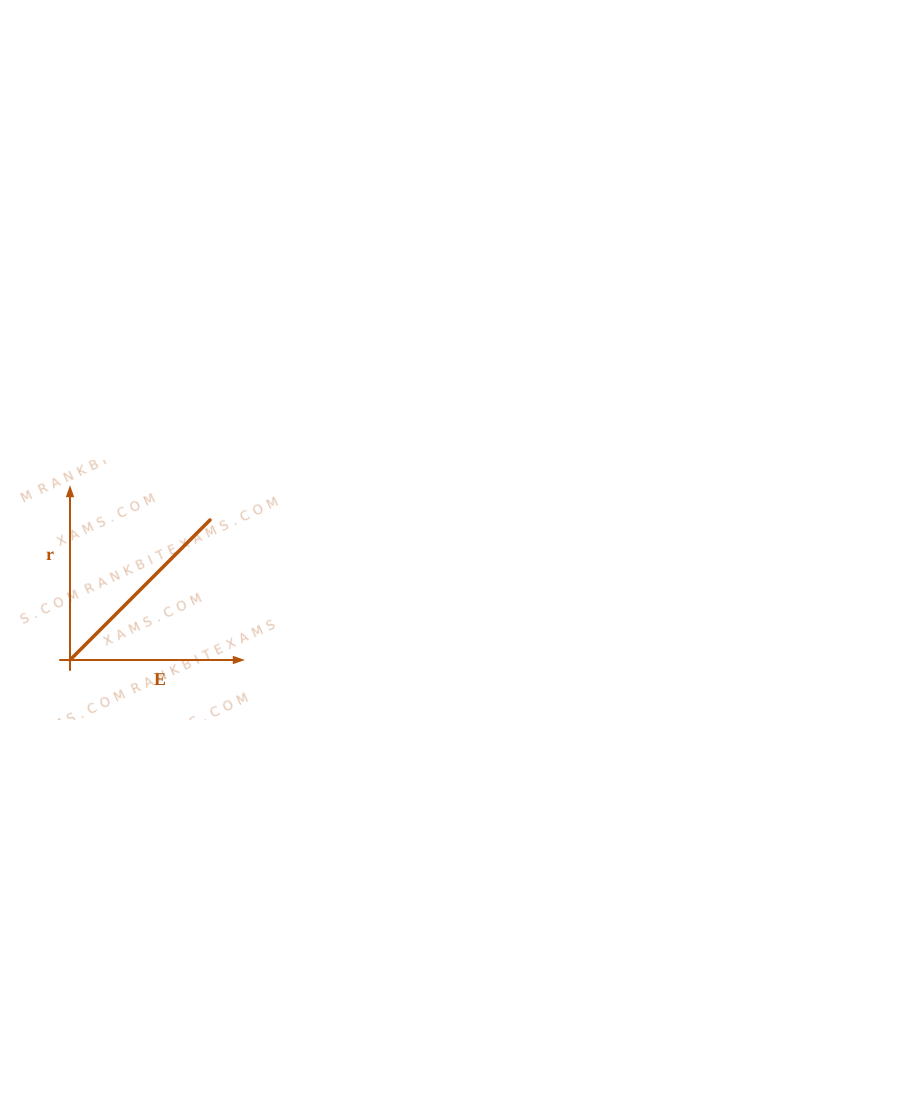
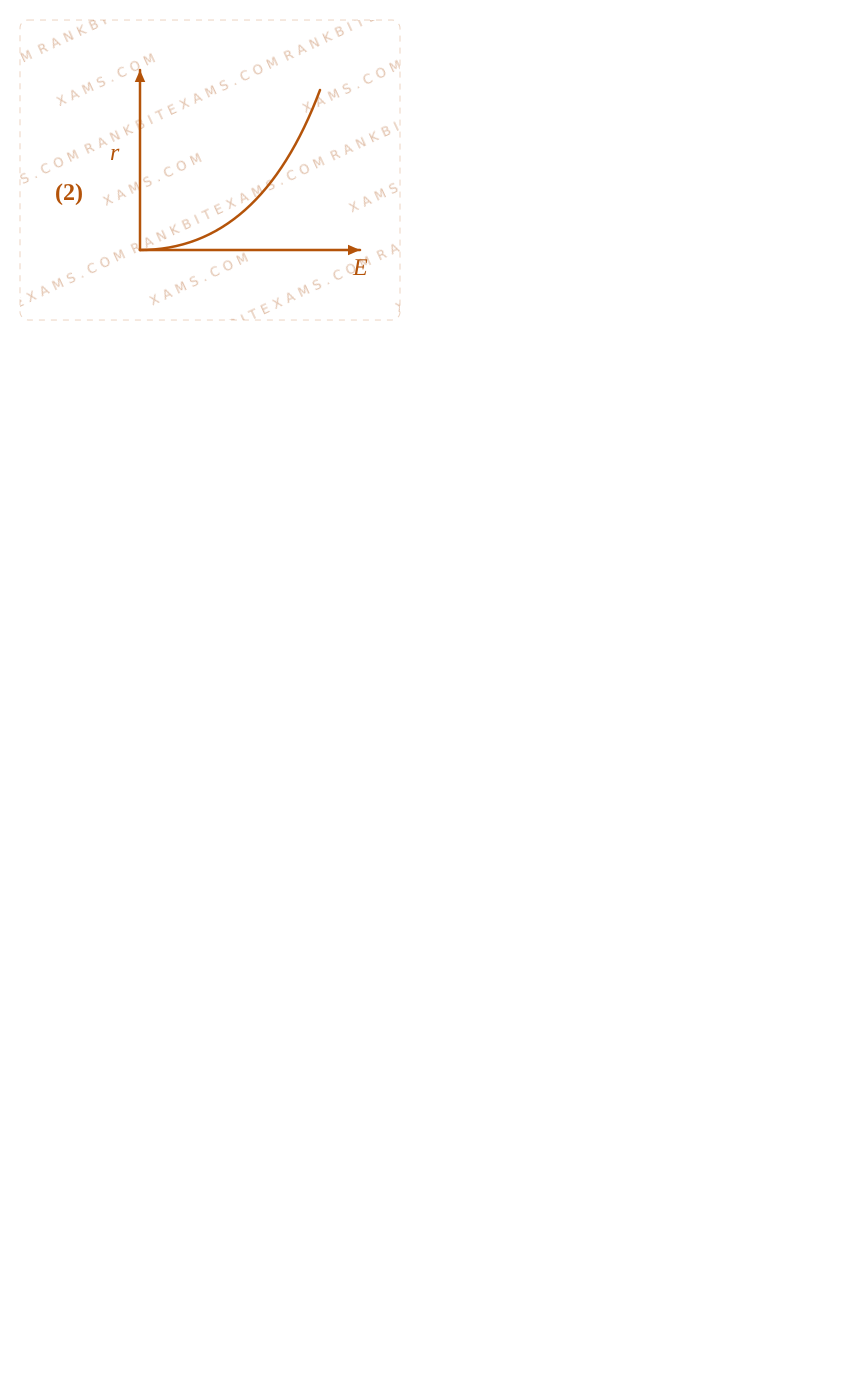
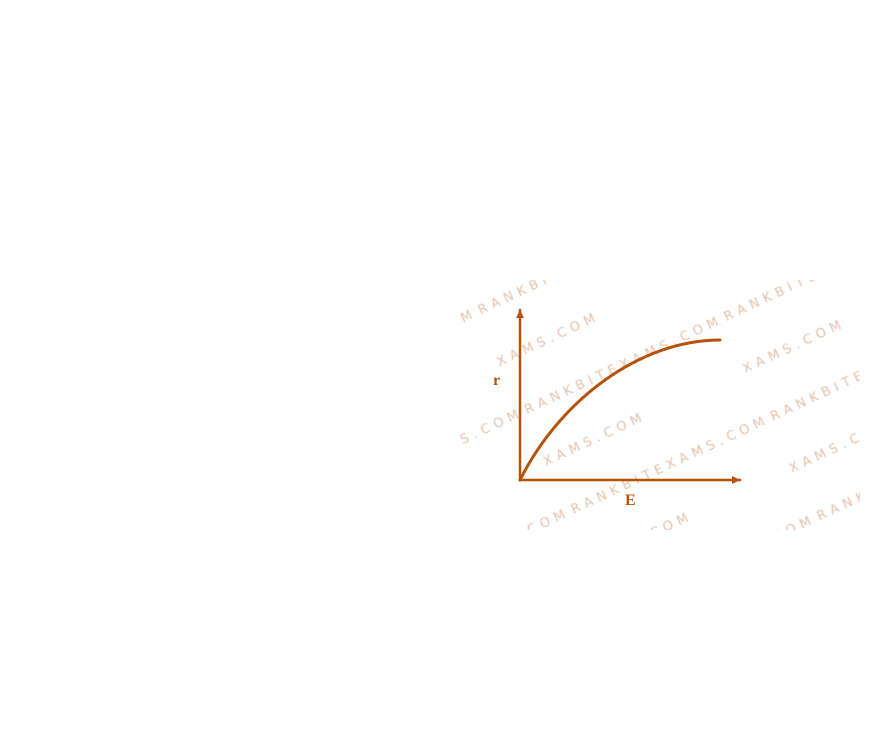
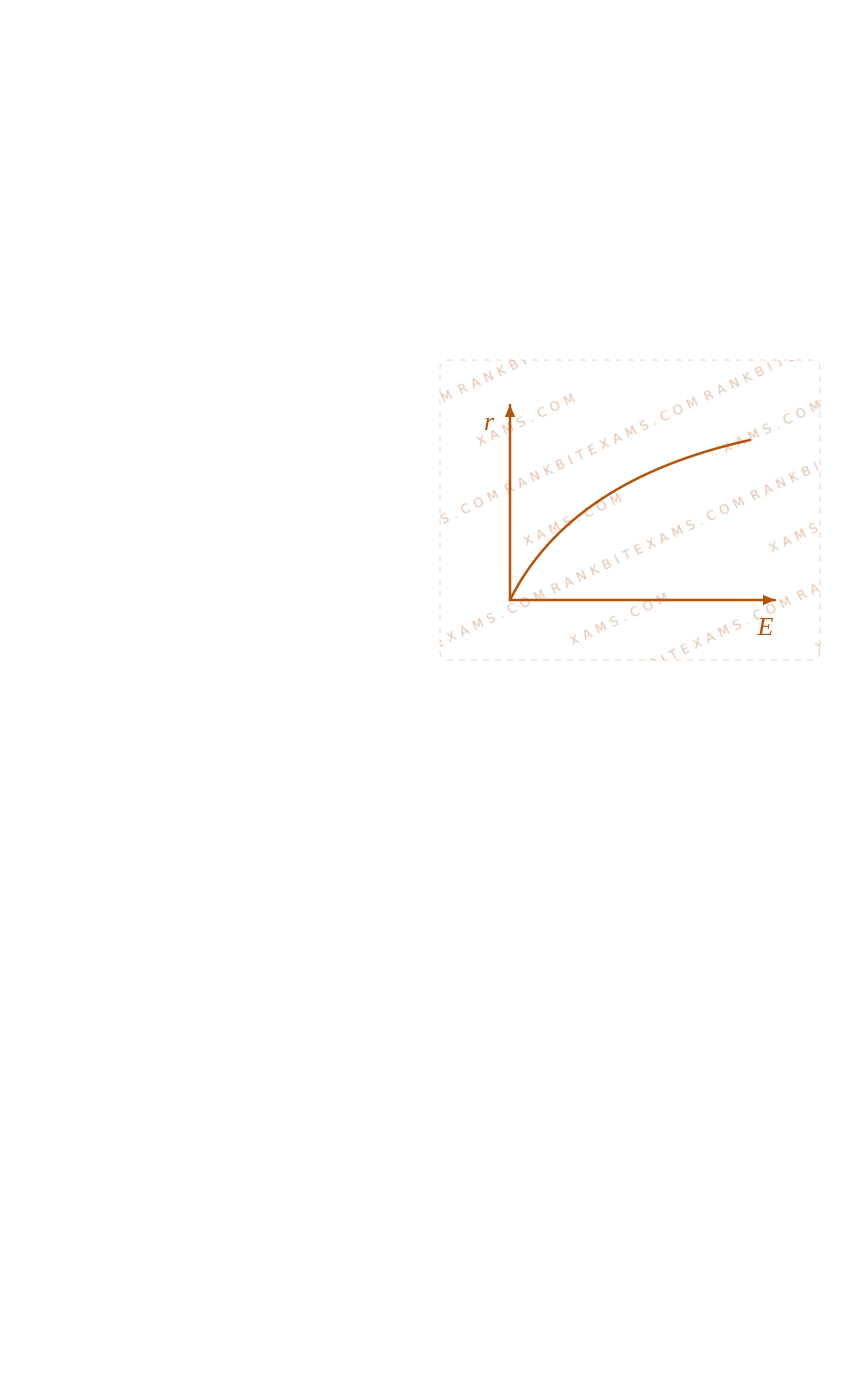
A particle of charge q , mass m and kinetic energy E enters in magnetic field perpendicular to its velocity and undergoes a circular arc of radius (r). Which of the following curves represents the variation of r with E ?

Solution & Explanation

### Related Formula The magnetic force provides the centripetal force for circular motion: fracmv^2r = qvB implies r = fracmvqB Kinetic energy E is related to momentum p = mv by: p = sqrt2mE ### Core Logic Express the radius r in terms of kinetic energy E: r = fracsqrt2mEqB Since m, q, and B are constants: r propto sqrtE implies r^2 propto E ### Step 1: Graph Identification The relation r propto sqrtE describes a parabola that opens towards the horizontal energy axis (concave down, starting at origin (0,0)). Reviewing the options: - Curve 1 (linear graph) - Incorrect - Curve 2 (parabola opening vertically) - Incorrect - Curve 3 (hyperbola / decaying curve) - Incorrect - Curve 4 (square root shape / parabola opening horizontally) - **Correct** ### Pattern Recognition Sees: Circular radius r versus kinetic energy E graph. Shortcut: Radius is proportional to momentum, which grows as the square root of kinetic energy (r propto sqrtE). Any y propto sqrtx plot is a sideways-opening parabola starting at (0,0) with decreasing slope. ### Evaluation Rubric / Model Answer null ### Chapter Mix Class 12 Physics: Moving Charges and Magnetism
Parabolic square root trajectory curve plot

More Moving Charges and Magnetism Previous-Year Questions — Page 4

Q51 jee_main_2024_01_february_morning Magnetic Field due to a Current Element
A regular polygon of 6 sides is formed by bending a wire of length 4pi meter. If an electric current of 4pisqrt3mathrm~A is flowing through the sides of the polygon, the magnetic field at the centre of the polygon would be x times 10^-7mathrm~T. The value of x is:
Numerical Answer. Answer: 72 to 72

Solution

### Related Formula Magnetic field due to a straight wire segment of length 2L at distance r: B_1 = fracmu_0 I4pi r(sintheta_1 + sintheta_2) Total field for a regular hexagon (n=6): B = 6 times B_1 ### Core Logic Total perimeter = 6 cdot a = 4pi implies textside length a = frac4pi6 = frac2pi3mathrm~m. For a regular hexagon segment, the interior angles relative to the normal vector are theta_1 = theta_2 = 30^circ. The normal distance r from the center to a side is: r = fraca2 cot(30^circ) = frac4pi2 times 6 times sqrt3 = fracsqrt3pi3 = fracpisqrt3mathrm~m ### Step 1: Calculate Total Magnetic Field Substitute r and I = 4pisqrt3mathrm~A into the hexagon configuration: B = 6 times left[ fracmu_0 I4pi r (sin(30^circ) + sin(30^circ)) right] B = 6 times left[ frac10^-7 times 4pisqrt3left(fracsqrt3pi3right) times (0.5 + 0.5) right] B = 6 times left[ frac10^-7 times 4pisqrt3 times 3sqrt3pi times 1 right] B = 6 times [ 4 times 3 times 10^-7 ] = 6 times 12 times 10^-7 = 72 times 10^-7mathrm~T Thus, x = 72. ### Pattern Recognition For regular polygons, the normal distance r to the side is always r = fraca2cot(fracpin). The contribution from all n symmetric segments adds up constructively. ### Evaluation Rubric / Model Answer null ### Chapter Mix Class 12 Physics: Moving Charges and Magnetism

Q39 jee_main_2024_29_january_evening Motion of Charged Particle in Magnetic Field
Two particles X and Y having equal charges are being accelerated through the same potential difference. Thereafter they enter normally in a region of uniform magnetic field and describes circular paths of radii R_1 and R_2 respectively. The mass ratio of X and Y is:
  • A. left(fracR_2R_1right)^2
  • B. left(fracR_1R_2right)^2
  • C. left(fracR_1R_2right)
  • D. left(fracR_2R_1right)

Solution

### Related Formula The radius R of the path of a charged particle moving perpendicular to a magnetic field B is: R = fracmvqB = fracpqB In terms of kinetic energy K: R = fracsqrt2mKqB Since the particle is accelerated through potential V, kinetic energy K = qV: R = fracsqrt2mqVqB R = frac1B sqrtfrac2mVq ### Core Logic For both particles X and Y, the following parameters are the same: * Potential Difference, V * Magnetic Field, B * Charge, q Therefore, we have the proportionality: R propto sqrtm implies R^2 propto m ### Step 1: Calculate Mass Ratio Using the proportionality relationship: fracm_1m_2 = left( fracR_1R_2 right)^2 Thus, the mass ratio of X and Y is left(fracR_1R_2right)^2. ### Pattern Recognition Shortcut: Whenever charges and potential differences are equal, the radius of orbit in a magnetic field scales as R propto sqrtm. Squaring both sides yields m propto R^2 instantly. ### Evaluation Rubric / Model Answer null ### Chapter Mix Class 12 Physics: Moving Charges and Magnetism
Q54 jee_main_2024_29_january_evening Magnetic Force on a Charge
A charge of 4.0\ mutextC is moving with a velocity of 4.0 times 10^6text ms^-1 along the positive y-axis under a magnetic field vecB of strength (2hatk)text T. The force acting on the charge is xhatitext N. The value of x is ________.
Numerical Answer. Answer: 32 to 32

Solution

### Related Formula The magnetic force on a moving charge is given by the Lorentz force equation: vecF = q (vecv times vecB) ### Core Logic Given data: * Charge, q = 4.0\ mutextC = 4.0 times 10^-6text C * Velocity vector, vecv = (4.0 times 10^6hatj)text ms^-1 * Magnetic field vector, vecB = 2hatktext T ### Step 1: Calculate the Force Vector Substitute the values into the force equation: vecF = (4.0 times 10^-6) left[ (4.0 times 10^6hatj) times (2hatk) right] vecF = 4.0 times 10^-6 times 8.0 times 10^6 (hatj times hatk) Since hatj times hatk = hati: vecF = 32hatitext N Comparing this to xhatitext N, we find: x = 32 ### Pattern Recognition Cross-product check: hatj times hatk = hati. The product of the scalar terms (4.0 times 10^-6) times (4.0 times 10^6) times 2 immediately simplifies to 4 times 4 times 2 = 32. ### Evaluation Rubric / Model Answer null ### Chapter Mix Class 12 Physics: Moving Charges and Magnetism
Q34 jee_main_2024_27_jan_morning Lorentz Force
A proton moving with a constant velocity passes through a region of space without any change in its velocity. If vecE and vecB represent the electric and magnetic fields respectively, then the region of space may have: (A) E = 0, B = 0 (B) E = 0, B neq 0 (C) E neq 0, B = 0 (D) E neq 0, B neq 0 Choose the most appropriate answer from the options given below:
  • A. text(A), (B) and (C) only
  • B. text(A), (C) and (D) only
  • C. text(A), (B) and (D) only
  • D. text(B), (C) and (D) only

Solution

### Related Formula vecF_textnet = qvecE + q(vecv times vecB) ### Core Logic For velocity to remain constant, the net force must be zero: qvecE + q(vecv times vecB) = 0 Let's evaluate the cases: - Case (A): If E=0 and B=0, vecF = 0. (Possible) - Case (B): If E=0 and B neq 0, the magnetic force is zero if vecv is parallel or antiparallel to vecB (i.e., vecv times vecB = 0). (Possible) - Case (C): If E neq 0 and B=0, vecF = qvecE neq 0, velocity must change. (Not possible) - Case (D): If E neq 0 and B neq 0, the electric and magnetic forces can balance each other perfectly if qvecE = -q(vecv times vecB). (Possible) ### Step 1: Conclusion Hence, statements (A), (B), and (D) represent valid situations where velocity can remain constant. ### Pattern Recognition Velocity filter / velocity selector setups utilize crossed fields where electric fields perfectly balance magnetic components, an archetype of Case (D). ### Evaluation Rubric / Model Answer null ### Chapter Mix Class 12 Physics: Moving Charges and Magnetism
Q58 jee_main_2024_27_jan_morning Magnetic Field due to Long Straight Wire
Two long, straight wires carry equal currents in opposite directions as shown in the figure. The separation between the wires is 5.0text cm. The magnitude of the magnetic field at a point P midway between the wires is ______ mutextT. (Given : mu_0 = 4pi times 10^-7text TcdottextmcdottextA^-1, and each wire carries a current of 10text A).
Magnetic Field due to Long Straight Wire diagram for Q58 - JEE Main 2024 Morning
The diagram maps two vertical wires carrying anti-parallel currents of 10 A separated by 5.0 cm, with central node P denoting the common field contribution site.
Numerical Answer. Answer: 160 to 160

Solution

### Related Formula B = fracmu_0 i2pi r ### Core Logic Using the right-hand grip rule, both anti-parallel wire systems generate field arrays pointing in the exact same direction at the central midway coordinate. Hence, their field contributions add up directly: B_textnet = 2 B_1 = 2 left(fracmu_0 i2pi rright) = fracmu_0 ipi r Where i = 10text A, total distance = 5text cm implies r = 2.5text cm = 2.5 times 10^-2text m. ### Step 1: Compute numeric value B_textnet = frac4pi times 10^-7 times 10pi times (2.5 times 10^-2) = frac4 times 10^-62.5 times 10^-2 B_textnet = 1.6 times 10^-4text T = 160 times 10^-6text T = 160\ mutextT ### Pattern Recognition Anti-parallel current pairs generate collaborative field additions inside their spatial boundary zone, rather than destructive structural cancellations. ### Evaluation Rubric / Model Answer null ### Chapter Mix Class 12 Physics: Moving Charges and Magnetism

More Moving Charges and Magnetism Questions — jee_main_2025_07_april_morning

Practice all Moving Charges and Magnetism previous-year questions →

Rankbit System
JEE Physics: Waves (+15.5%) | Electrostatics: Concentric Shells (-29.7%) | Modern Physics: Photoelectric Clones (+34.2%) | Mathematics: Definite Integrals (+18.1%) | Chemistry: Coordination Splitting (-11.4%) | JEE Physics: Waves (+15.5%) | Electrostatics: Concentric Shells (-29.7%) | Modern Physics: Photoelectric Clones (+34.2%) | Mathematics: Definite Integrals (+18.1%) | Chemistry: Coordination Splitting (-11.4%)