Let the line L pass through (1, 1, 1) and intersect the lines fracx - 12 = fracy + 13 = fracz - 14$\frac{x - 1}{2} = \frac{y + 1}{3} = \frac{z - 1}{4}$ and fracx - 31 = fracy - 42 = fracz1$\frac{x - 3}{1} = \frac{y - 4}{2} = \frac{z}{1}$ . Then, which of the following points lies on the line L?
A.(4,22,7)$(4,22,7)$
B.(5, 4, 3)$(5, 4, 3)$
C.(10, -29, -50)$(10, -29, -50)$
D.(7, 15, 13)$(7, 15, 13)$
Solution & Explanation
### Related Formula
General coordinates of any variable point on a 3D line given symmetric form equations:
P_1 = (2lambda + 1, \, 3lambda - 1, \, 4lambda + 1)$$P_1 = (2\lambda + 1, \, 3\lambda - 1, \, 4\lambda + 1)$$P_2 = (mu + 3, \, 2mu + 4, \, mu)$$P_2 = (\mu + 3, \, 2\mu + 4, \, \mu)$$
### Core Logic
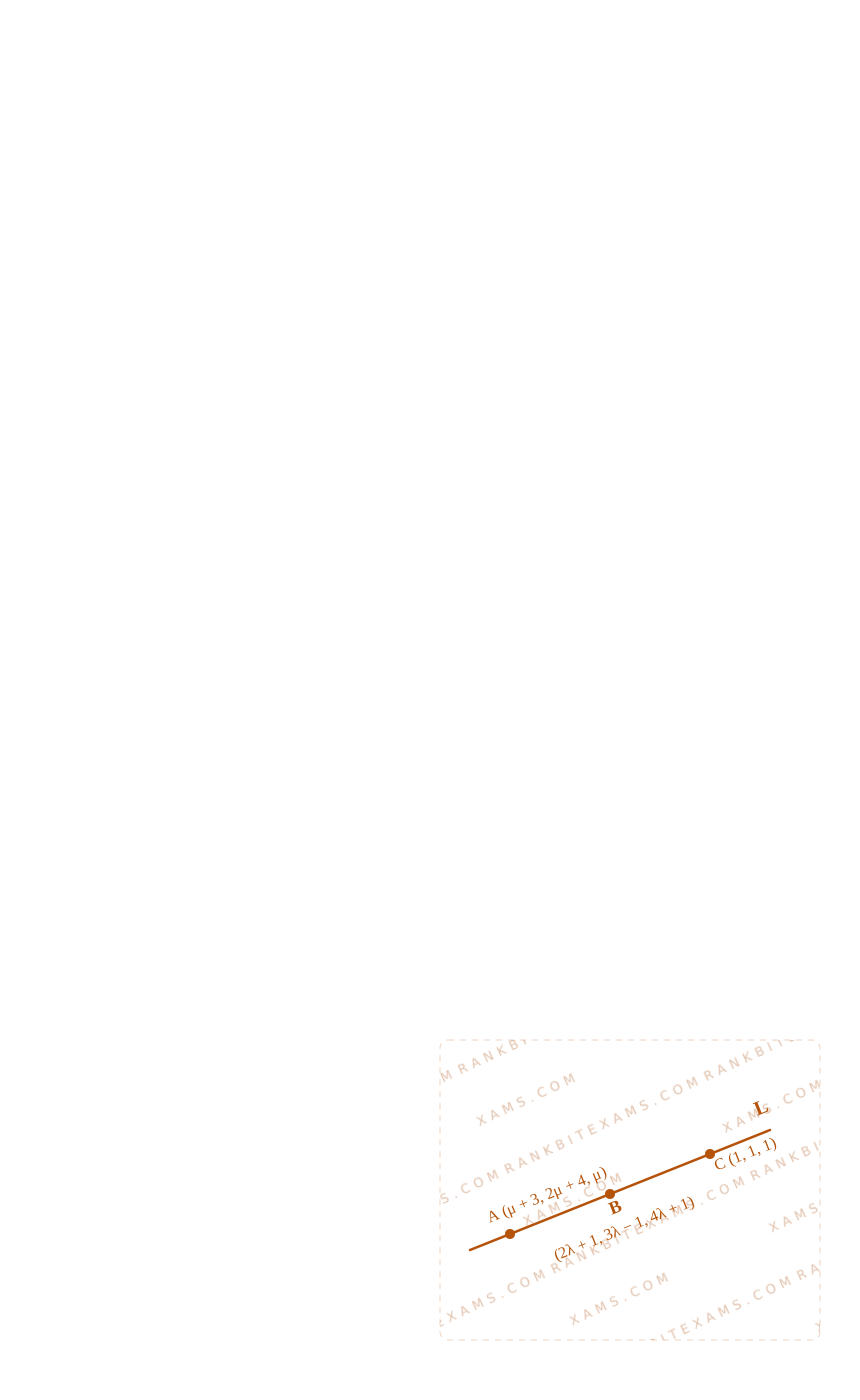
Let line L intersect Line 1 at point A(2lambda + 1, 3lambda - 1, 4lambda + 1)$A(2\lambda + 1, 3\lambda - 1, 4\lambda + 1)$ and Line 2 at point B(mu + 3, 2mu + 4, mu)$B(\mu + 3, 2\mu + 4, \mu)$.
Since line L passes through C(1, 1, 1)$C(1, 1, 1)$, the direction ratios computed from vector segment AC$AC$ must be proportional to the direction ratios computed from vector segment BC$BC$.
### Step 1: Determine Direction Ratio Parameters
Line Intersecting Two Lines diagram for Q68 - JEE Main 2025 Morning
Direction ratios of AC$AC$ segment:
vecAC = (2lambda + 1 - 1, \, 3lambda - 1 - 1, \, 4lambda + 1 - 1) = (2lambda, \, 3lambda - 2, \, 4lambda)$$\vec{AC} = (2\lambda + 1 - 1, \, 3\lambda - 1 - 1, \, 4\lambda + 1 - 1) = (2\lambda, \, 3\lambda - 2, \, 4\lambda)$$
Direction ratios of BC$BC$ segment:
vecBC = (mu + 3 - 1, \, 2mu + 4 - 1, \, mu - 1) = (mu + 2, \, 2mu + 3, \, mu - 1)$$\vec{BC} = (\mu + 3 - 1, \, 2\mu + 4 - 1, \, \mu - 1) = (\mu + 2, \, 2\mu + 3, \, \mu - 1)$$
Equating directional proportionality ratios:
fracmu + 22lambda = frac2mu + 33lambda - 2 = fracmu - 14lambda$$\frac{\mu + 2}{2\lambda} = \frac{2\mu + 3}{3\lambda - 2} = \frac{\mu - 1}{4\lambda}$$
### Step 2: Solve for Parameter Intersection values
From the first and third fractional groups:
fracmu + 22lambda = fracmu - 14lambda implies 2(mu + 2) = mu - 1$$\frac{\mu + 2}{2\lambda} = \frac{\mu - 1}{4\lambda} \implies 2(\mu + 2) = \mu - 1$$2mu + 4 = mu - 1 implies mu = -5$$2\mu + 4 = \mu - 1 \implies \mu = -5$$
Substitute mu = -5$\mu = -5$ back into the second parameter group linkage to evaluate the target structural direction indicators, which gives the simplified direction ratio vector for BC$BC$ as:
textD.R.s = (-5 + 2, \, 2(-5) + 3, \, -5 - 1) = (-3, \, -7, \, -6) equiv (3, \, 7, \, 6)$$\text{D.R.s} = (-5 + 2, \, 2(-5) + 3, \, -5 - 1) = (-3, \, -7, \, -6) \equiv (3, \, 7, \, 6)$$
### Step 3: Construct Line Equation and Verify Choice
Equation of line L passing through C(1, 1, 1)$C(1, 1, 1)$ with direction vector (3, 7, 6)$(3, 7, 6)$:
fracx - 13 = fracy - 17 = fracz - 16$$\frac{x - 1}{3} = \frac{y - 1}{7} = \frac{z - 1}{6}$$
Let's check option (7, 15, 13)$(7, 15, 13)$:
frac7 - 13 = frac63 = 2$$\frac{7 - 1}{3} = \frac{6}{3} = 2$$frac15 - 17 = frac147 = 2$$\frac{15 - 1}{7} = \frac{14}{7} = 2$$frac13 - 16 = frac126 = 2$$\frac{13 - 1}{6} = \frac{12}{6} = 2$$
Since all values match perfectly, (7, 15, 13)$(7, 15, 13)$ lies on the line L.
### Pattern Recognition
By comparing the first and third fractional terms containing lambda$\lambda$ in the denominator, you can solve for mu$\mu$ independently without tracking complex cross-multiplied quadratic lambdamu$\lambda\mu$ variations.
### Evaluation Rubric / Model Answer
null
### Chapter Mix
Class 12 Mathematics: Three Dimensional Geometry
More Three Dimensional Geometry Previous-Year Questions — Page 9
Q22jee_main_2024_30_january_eveningLines in Space
Let a line passing through the point (-1, 2, 3)$(-1, 2, 3)$ intersect the lines L_1: fracx - 13 = fracy - 22 = fracz + 1-2$L_1: \frac{x - 1}{3} = \frac{y - 2}{2} = \frac{z + 1}{-2}$ at M(alpha, beta, gamma)$M(\alpha, \beta, \gamma)$ and L_2: fracx + 2-3 = fracy - 2-2 = fracz - 14$L_2: \frac{x + 2}{-3} = \frac{y - 2}{-2} = \frac{z - 1}{4}$ at N(a, b, c)$N(a, b, c)$. Then the value of frac(alpha + beta + gamma)^2(a + b + c)^2$\frac{(\alpha + \beta + \gamma)^2}{(a + b + c)^2}$ equals
Numerical Answer.Answer: 196 to 196
Solution
### Related Formula
textParametric form of a line: vecr = veca + lambdavecb$$\text{Parametric form of a line: } \vec{r} = \vec{a} + \lambda\vec{b}$$
### Core Logic
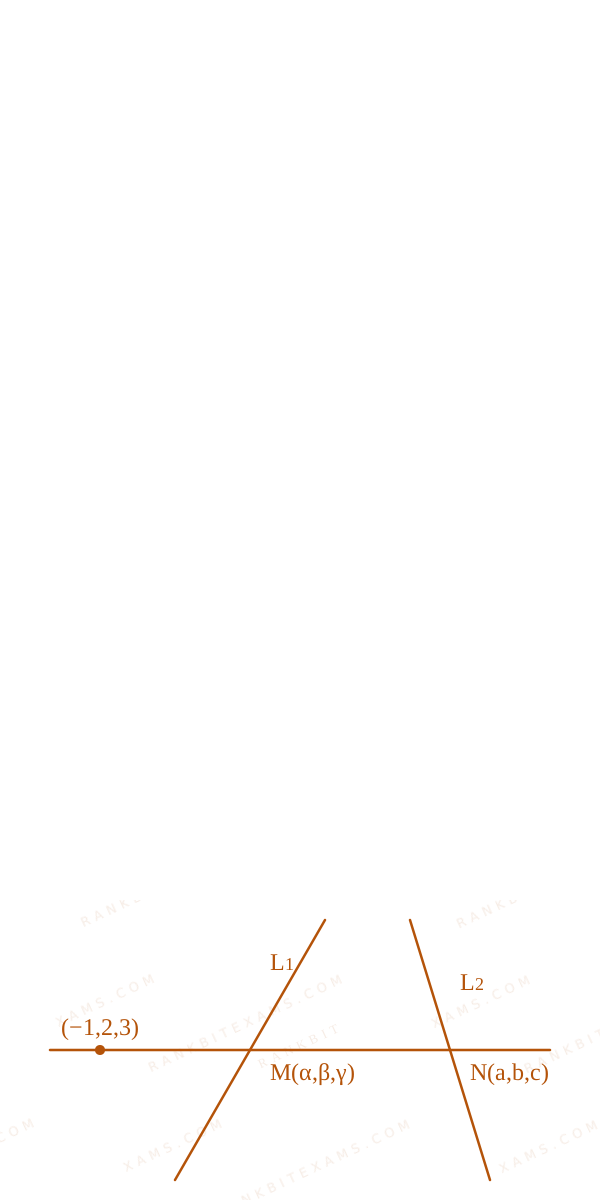
Let the given point be P(-1, 2, 3)$P(-1, 2, 3)$. A line passing through P$P$ intersects L_1$L_1$ at M$M$ and L_2$L_2$ at N$N$.
Write general coordinates for M$M$ on L_1$L_1$ and N$N$ on L_2$L_2$:
L_1: fracx-13 = fracy-22 = fracz+1-2 = lambda Rightarrow M(3lambda + 1, 2lambda + 2, -2lambda - 1)$L_1: \frac{x-1}{3} = \frac{y-2}{2} = \frac{z+1}{-2} = \lambda \Rightarrow M(3\lambda + 1, 2\lambda + 2, -2\lambda - 1)$L_2: fracx+2-3 = fracy-2-2 = fracz-14 = mu Rightarrow N(-3mu - 2, -2mu + 2, 4mu + 1)$L_2: \frac{x+2}{-3} = \frac{y-2}{-2} = \frac{z-1}{4} = \mu \Rightarrow N(-3\mu - 2, -2\mu + 2, 4\mu + 1)$
### Step 1: Collinearity Condition
Since P, M, N$P, M, N$ lie on the same straight line, the direction vectors vecPM$\vec{PM}$ and vecPN$\vec{PN}$ must be proportional.
vecPM = (3lambda + 1 - (-1))hati + (2lambda + 2 - 2)hatj + (-2lambda - 1 - 3)hatk = (3lambda + 2)hati + (2lambda)hatj + (-2lambda - 4)hatk$\vec{PM} = (3\lambda + 1 - (-1))\hat{i} + (2\lambda + 2 - 2)\hat{j} + (-2\lambda - 1 - 3)\hat{k} = (3\lambda + 2)\hat{i} + (2\lambda)\hat{j} + (-2\lambda - 4)\hat{k}$vecPN = (-3mu - 2 - (-1))hati + (-2mu + 2 - 2)hatj + (4mu + 1 - 3)hatk = (-3mu - 1)hati + (-2mu)hatj + (4mu - 2)hatk$\vec{PN} = (-3\mu - 2 - (-1))\hat{i} + (-2\mu + 2 - 2)\hat{j} + (4\mu + 1 - 3)\hat{k} = (-3\mu - 1)\hat{i} + (-2\mu)\hat{j} + (4\mu - 2)\hat{k}$
Proportionality yields:
frac3lambda + 2-3mu - 1 = frac2lambda-2mu = frac-2lambda - 44mu - 2$$\frac{3\lambda + 2}{-3\mu - 1} = \frac{2\lambda}{-2\mu} = \frac{-2\lambda - 4}{4\mu - 2}$$
### Step 2: Solving for Lambda and Mu
Lines in Space diagram for Q22 - JEE Main 2024 Evening
From the first pair:
frac3lambda + 2-3mu - 1 = frac-lambdamu$$\frac{3\lambda + 2}{-3\mu - 1} = \frac{-\lambda}{\mu}$$mu(3lambda + 2) = -lambda(-3mu - 1)$$\mu(3\lambda + 2) = -\lambda(-3\mu - 1)$$3lambdamu + 2mu = 3lambdamu + lambda Rightarrow 2mu = lambda$$3\lambda\mu + 2\mu = 3\lambda\mu + \lambda \Rightarrow 2\mu = \lambda$$
From the second pair (using 2mu = lambda$2\mu = \lambda$):
frac-lambdamu = frac-lambda - 22mu - 1$$\frac{-\lambda}{\mu} = \frac{-\lambda - 2}{2\mu - 1}$$-2mu = frac-2mu - 22mu - 1$$-2\mu = \frac{-2\mu - 2}{2\mu - 1}$$-2mu(2mu - 1) = -2mu - 2$$-2\mu(2\mu - 1) = -2\mu - 2$$-4mu^2 + 2mu = -2mu - 2$$-4\mu^2 + 2\mu = -2\mu - 2$$-4mu^2 + 4mu + 2 = 0 quad text(Wait, alternative grouping):$$-4\mu^2 + 4\mu + 2 = 0 \quad \text{(Wait, alternative grouping)}:$$
Re-checking the second pair with 2mu = lambda$2\mu = \lambda$:
frac2lambda-2mu = frac-lambdamu$$\frac{2\lambda}{-2\mu} = \frac{-\lambda}{\mu}$$frac-lambdamu = frac-2lambda - 44mu - 2$$\frac{-\lambda}{\mu} = \frac{-2\lambda - 4}{4\mu - 2}$$
Substitute lambda = 2mu$\lambda = 2\mu$:
frac-2mumu = frac-4mu - 44mu - 2$$\frac{-2\mu}{\mu} = \frac{-4\mu - 4}{4\mu - 2}$$-2(4mu - 2) = -4mu - 4$$-2(4\mu - 2) = -4\mu - 4$$-8mu + 4 = -4mu - 4$$-8\mu + 4 = -4\mu - 4$$8 = 4mu Rightarrow mu = 2$$8 = 4\mu \Rightarrow \mu = 2$$
Then lambda = 2(2) = 4$\lambda = 2(2) = 4$.
### Step 3: Finalizing Target Coordinates
For lambda = 4$\lambda = 4$:
alpha + beta + gamma = (3(4)+1) + (2(4)+2) + (-2(4)-1) = 13 + 10 - 9 = 14$\alpha + \beta + \gamma = (3(4)+1) + (2(4)+2) + (-2(4)-1) = 13 + 10 - 9 = 14$
For mu = 2$\mu = 2$:
a + b + c = (-3(2)-2) + (-2(2)+2) + (4(2)+1) = -8 - 2 + 9 = -1$a + b + c = (-3(2)-2) + (-2(2)+2) + (4(2)+1) = -8 - 2 + 9 = -1$
Finally, compute the target fraction:
frac(alpha + beta + gamma)^2(a + b + c)^2 = frac(14)^2(-1)^2 = frac1961 = 196$$\frac{(\alpha + \beta + \gamma)^2}{(a + b + c)^2} = \frac{(14)^2}{(-1)^2} = \frac{196}{1} = 196$$
### Pattern Recognition
A line crossing two given lines acts as a transversal holding 3 collinear points. Setting vecPM = k cdot vecPN$\vec{PM} = k \cdot \vec{PN}$ rapidly locks the parametric constants lambda$\lambda$ and mu$\mu$.
### Evaluation Rubric / Model Answer
null
### Chapter Mix
Class 12 Maths: Three Dimensional Geometry
Q10jee_main_2024_30_jan_morningLine in 3D
Let (alpha, beta, gamma)$(\alpha, \beta, \gamma)$ be the foot of perpendicular from the point (1, 2, 3)$(1, 2, 3)$ on the line fracx + 35 = fracy - 12 = fracz + 43$\frac{x + 3}{5} = \frac{y - 1}{2} = \frac{z + 4}{3}$. then 19(alpha + beta + gamma)$19(\alpha + \beta + \gamma)$ is equal to:
A.102$102$
B.101$101$
C.99$99$
D.100$100$
Solution
### Related Formula
a_1 a_2 + b_1 b_2 + c_1 c_2 = 0 quad text(Condition for perpendicular vectors)$$a_1 a_2 + b_1 b_2 + c_1 c_2 = 0 \quad \text{(Condition for perpendicular vectors)}$$
### Core Logic
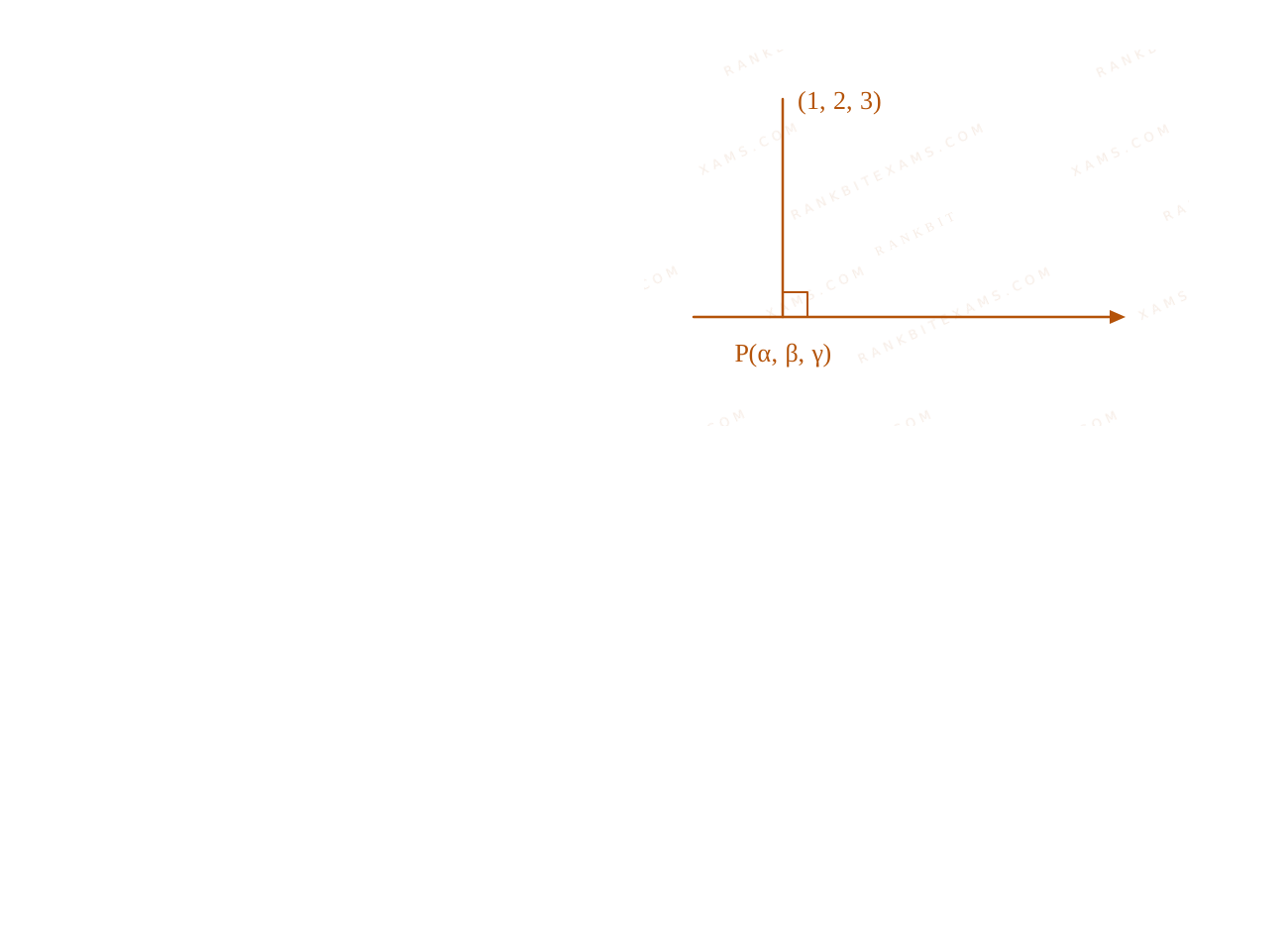
Line in 3D diagram for Q10 - JEE Main 2024 Morning
Let the given point be A(1, 2, 3)$A(1, 2, 3)$. Let the foot of the perpendicular on the line be P(alpha, beta, gamma)$P(\alpha, \beta, \gamma)$.
The equation of the line is fracx + 35 = fracy - 12 = fracz + 43 = k$\frac{x + 3}{5} = \frac{y - 1}{2} = \frac{z + 4}{3} = k$.
So, any point on the line can be written as (5k - 3, 2k + 1, 3k - 4)$(5k - 3, 2k + 1, 3k - 4)$.
Let this point be P$P$. Thus, P(alpha, beta, gamma) equiv (5k - 3, 2k + 1, 3k - 4)$P(\alpha, \beta, \gamma) \equiv (5k - 3, 2k + 1, 3k - 4)$.
### Step 1: Finding Direction Ratios
Direction ratios (DR's) of the line segment AP$AP$ are:
((5k - 3) - 1, (2k + 1) - 2, (3k - 4) - 3) equiv (5k - 4, 2k - 1, 3k - 7)$$((5k - 3) - 1, (2k + 1) - 2, (3k - 4) - 3) \equiv (5k - 4, 2k - 1, 3k - 7)$$
Direction ratios of the given line are (5, 2, 3)$(5, 2, 3)$.
### Step 2: Using Perpendicularity Condition
Since AP$AP$ is perpendicular to the given line, the dot product of their direction ratios is zero:
5(5k - 4) + 2(2k - 1) + 3(3k - 7) = 0$$5(5k - 4) + 2(2k - 1) + 3(3k - 7) = 0$$(25k - 20) + (4k - 2) + (9k - 21) = 0$$(25k - 20) + (4k - 2) + (9k - 21) = 0$$38k - 43 = 0$38k - 43 = 0$k = frac4338$$k = \frac{43}{38}$$
### Step 3: Calculating target expression
We need to find 19(alpha + beta + gamma)$19(\alpha + \beta + \gamma)$.
alpha + beta + gamma = (5k - 3) + (2k + 1) + (3k - 4)$$\alpha + \beta + \gamma = (5k - 3) + (2k + 1) + (3k - 4)$$alpha + beta + gamma = 10k - 6$$\alpha + \beta + \gamma = 10k - 6$$
Substituting k = frac4338$k = \frac{43}{38}$:
19(alpha + beta + gamma) = 19 left(10left(frac4338right) - 6right)$$19(\alpha + \beta + \gamma) = 19 \left(10\left(\frac{43}{38}\right) - 6\right)$$= 19 left( frac43038 - 6 right) = frac4302 - 114 = 215 - 114 = 101$$= 19 \left( \frac{430}{38} - 6 \right) = \frac{430}{2} - 114 = 215 - 114 = 101$$
### Pattern Recognition
To find coordinates of a foot of perpendicular, define a general point on the line using parameter k$k$, create the direction vector, and dot it with the line's direction vector set to zero.
### Evaluation Rubric / Model Answer
null
### Chapter Mix
Class 12 Maths: Three Dimensional Geometry
Q22jee_main_2024_30_jan_morningLine in 3D
If d_1$d_1$ is the shortest distance between the linesx + 1 = 2y = -12z$x + 1 = 2y = -12z$, x = y + 2 = 6z - 6$x = y + 2 = 6z - 6$ and d_2$d_2$ is the shortest distance between the linesfracx - 12 = fracy + 8-7 = fracz - 45, fracx - 12 = fracy - 21 = fracz - 6-3$\frac{x - 1}{2} = \frac{y + 8}{-7} = \frac{z - 4}{5}, \frac{x - 1}{2} = \frac{y - 2}{1} = \frac{z - 6}{-3}$, then the value of frac32sqrt3d_1d_2$\frac{32\sqrt{3}d_1}{d_2}$ is:
Q6jee_main_2024_31_jan_eveningMirror Image of a Point
Let (alpha, beta, gamma)$(\alpha, \beta, \gamma)$ be mirror image of the point (2, 3, 5)$(2, 3, 5)$ in the line fracx - 12 =fracy - 23 =fracz - 34$\frac{x - 1}{2} =\frac{y - 2}{3} =\frac{z - 3}{4}$. Then 2alpha + 3beta + 4gamma$2\alpha + 3\beta + 4\gamma$ is equal to
A.32$32$
B.33$33$
C.31$31$
D.34$34$
Solution
### Related Formula
textDot product constraint: vecPR cdot vecd = 0 text where vecd text is direction of the line.$$\text{Dot product constraint: } \vec{PR} \cdot \vec{d} = 0 \text{ where } \vec{d} \text{ is direction of the line.}$$
### Core Logic
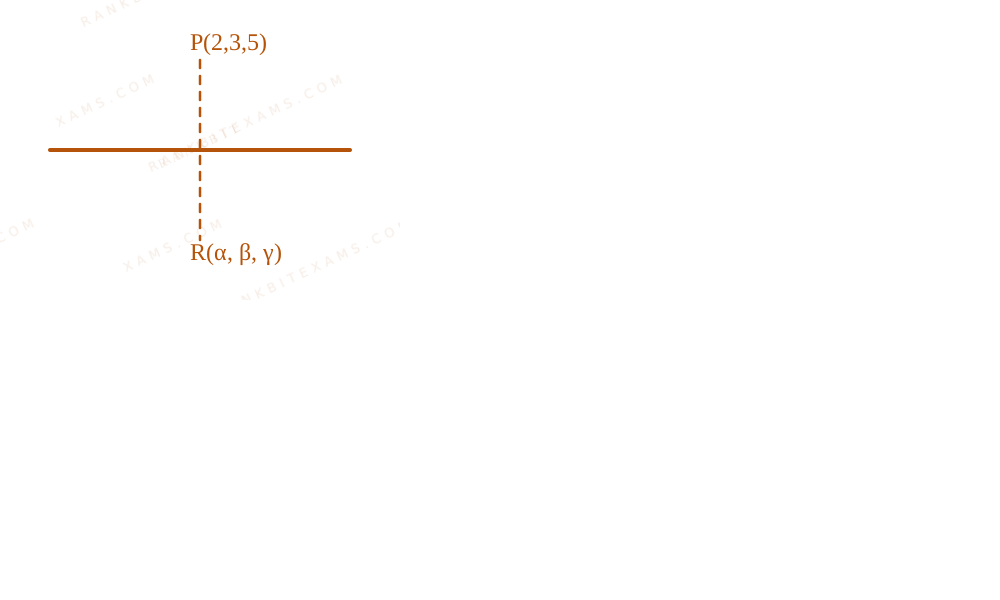
Mirror Image of a Point diagram for Q6 - JEE Main 2024 Evening
Let P = (2, 3, 5)$P = (2, 3, 5)$ and its mirror image be R(alpha, beta, gamma)$R(\alpha, \beta, \gamma)$.
The vector connecting the point and its mirror image, vecPR$\vec{PR}$, is strictly perpendicular to the given line.
The direction ratios of the line are vecd = (2, 3, 4)$\vec{d} = (2, 3, 4)$.
Therefore, the dot product must be zero:
vecPR cdot vecd = 0$$\vec{PR} \cdot \vec{d} = 0$$(alpha - 2, beta - 3, gamma - 5) cdot (2, 3, 4) = 0$$(\alpha - 2, \beta - 3, \gamma - 5) \cdot (2, 3, 4) = 0$$2(alpha - 2) + 3(beta - 3) + 4(gamma - 5) = 0$$2(\alpha - 2) + 3(\beta - 3) + 4(\gamma - 5) = 0$$2alpha - 4 + 3beta - 9 + 4gamma - 20 = 0$$2\alpha - 4 + 3\beta - 9 + 4\gamma - 20 = 0$$2alpha + 3beta + 4gamma = 33$$2\alpha + 3\beta + 4\gamma = 33$$
### Pattern Recognition
When asked for a linear combination of image coordinates matching the direction ratios of the line, skip finding the exact foot of perpendicular. Just use the orthogonality condition directly.
### Evaluation Rubric / Model Answer
null
### Chapter Mix
Class 12 Maths: Three Dimensional Geometry
Q20jee_main_2024_31_jan_eveningShortest Distance between two lines
The shortest distance between lines L_1$L_1$ and L_2$L_2$, where L_1:fracx-12=fracy+1-3=fracz+42$L_1:\frac{x-1}{2}=\frac{y+1}{-3}=\frac{z+4}{2}$ and L_2$L_2$ is the line passing through the points A(-4,4,3), B(-1,6,3)$A(-4,4,3), B(-1,6,3)$ and perpendicular to the line fracx-3-2=fracy3=fracz-11$\frac{x-3}{-2}=\frac{y}{3}=\frac{z-1}{1}$, is
We Map Every Repeating Question in Competitive Exams.
Say goodbye to generic mock test fatigue. RankBit uses smart analysis to group past exam questions into their foundational Repeating Question Types. Find chapter weightage, track repeating questions, and score higher with targeted practice.
Select Your Target Exam
Choose an exam track below to find formulas per chapter and patterns.
Syncing Exam Intelligence
Mapping formulas and patterns across all tracks…
PATH A — FULL LENGTH PRACTICE
Full Mock Test Hub
Simulate real NTA exam conditions with fully tracked mocks. Time yourself against past papers.
Practice past-year questions one chapter at a time. Pick an exam → subject → chapter and get every PYQ for that topic — pulled together from all past papers — with the chapter's key formulas alongside.