Let the line L pass through (1, 1, 1) and intersect the lines fracx - 12 = fracy + 13 = fracz - 14 and fracx - 31 = fracy - 42 = fracz1 . Then, which of the following points lies on the line L?

Solution & Explanation

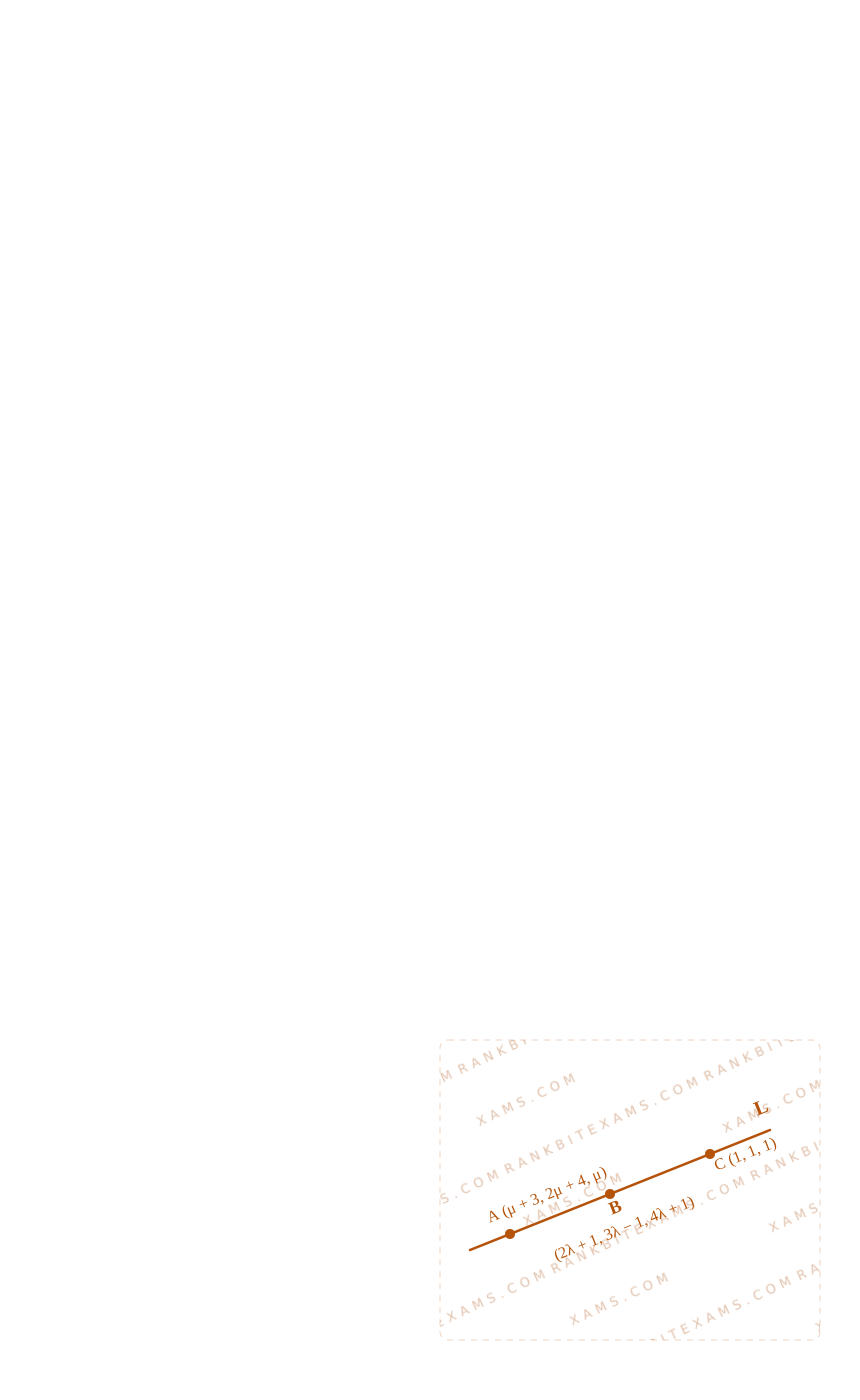
### Related Formula General coordinates of any variable point on a 3D line given symmetric form equations: P_1 = (2lambda + 1, \, 3lambda - 1, \, 4lambda + 1) P_2 = (mu + 3, \, 2mu + 4, \, mu) ### Core Logic Let line L intersect Line 1 at point A(2lambda + 1, 3lambda - 1, 4lambda + 1) and Line 2 at point B(mu + 3, 2mu + 4, mu). Since line L passes through C(1, 1, 1), the direction ratios computed from vector segment AC must be proportional to the direction ratios computed from vector segment BC. ### Step 1: Determine Direction Ratio Parameters
Line Intersecting Two Lines diagram for Q68 - JEE Main 2025 Morning
Direction ratios of AC segment: vecAC = (2lambda + 1 - 1, \, 3lambda - 1 - 1, \, 4lambda + 1 - 1) = (2lambda, \, 3lambda - 2, \, 4lambda) Direction ratios of BC segment: vecBC = (mu + 3 - 1, \, 2mu + 4 - 1, \, mu - 1) = (mu + 2, \, 2mu + 3, \, mu - 1) Equating directional proportionality ratios: fracmu + 22lambda = frac2mu + 33lambda - 2 = fracmu - 14lambda ### Step 2: Solve for Parameter Intersection values From the first and third fractional groups: fracmu + 22lambda = fracmu - 14lambda implies 2(mu + 2) = mu - 1 2mu + 4 = mu - 1 implies mu = -5 Substitute mu = -5 back into the second parameter group linkage to evaluate the target structural direction indicators, which gives the simplified direction ratio vector for BC as: textD.R.s = (-5 + 2, \, 2(-5) + 3, \, -5 - 1) = (-3, \, -7, \, -6) equiv (3, \, 7, \, 6) ### Step 3: Construct Line Equation and Verify Choice Equation of line L passing through C(1, 1, 1) with direction vector (3, 7, 6): fracx - 13 = fracy - 17 = fracz - 16 Let's check option (7, 15, 13): frac7 - 13 = frac63 = 2 frac15 - 17 = frac147 = 2 frac13 - 16 = frac126 = 2 Since all values match perfectly, (7, 15, 13) lies on the line L. ### Pattern Recognition By comparing the first and third fractional terms containing lambda in the denominator, you can solve for mu independently without tracking complex cross-multiplied quadratic lambdamu variations. ### Evaluation Rubric / Model Answer null ### Chapter Mix Class 12 Mathematics: Three Dimensional Geometry
Reference Study Guides

More Three Dimensional Geometry Previous-Year Questions — Page 5

Q56 jee_main_2025_04_april_morning Shortest Distance Between Two Lines
Let the shortest distance between the lines fracx - 33 = fracy - alpha-1 = fracz - 31 and fracx + 3-3 = fracy + 72 = fracz - beta4 be 3sqrt30. Then the positive value of 5alpha + beta is
  • A. 42
  • B. 46
  • C. 48
  • D. 40

Solution

### Related Formula Shortest distance between lines passing through veca_1, veca_2 with directions vecp, vecq: d = frac|(veca_2 - veca_1) cdot (vecp times vecq)||vecp times vecq| ### Core Logic Identify parameters: A = (3, alpha, 3) and B = (-3, -7, beta) implies overrightarrowBA = 6hati + (alpha + 7)hatj + (3 - beta)hatk. Directions: vecp = 3hati - hatj + hatk and \ \vec{q} = -3\hat{i} + 2\hat{j} + 4\hat{k}. Compute cross product \vec{p} \times \vec{q}: vecp times vecq = beginvmatrix hati & hatj & hatk \\ 3 & -1 & 1 \\ -3 & 2 & 4 endvmatrix = -6hati - 15hatj + 3hatk Magnitude |\vec{p} \times \vec{q}| = \sqrt{(-6)^2 + (-15)^2 + 3^2} = \sqrt{36 + 225 + 9} = \sqrt{270} = 3\sqrt{30}. ### Step 1: Apply Distance Equation Set shortest distance equation equal to 3\sqrt{30}: frac|overrightarrowBA cdot (vecp times vecq)|3sqrt30 = 3sqrt30 implies |overrightarrowBA cdot (vecp times vecq)| = 270 -6(6) - 15(alpha + 7) + 3(3 - beta) = pm 270 -36 - 15alpha - 105 + 9 - 3beta = pm 270 implies -132 - 15alpha - 3beta = pm 270 Choosing the negative branch for positive value extraction: -15alpha - 3beta = -138 implies 15alpha + 3beta = 138 implies 5alpha + beta = 46$ ### Pattern Recognition Notice that the determinant logic perfectly structures linear equations. Simplifying the dot product using standard scaling helps prevent sign errors. ### Evaluation Rubric / Model Answer null ### Chapter Mix Class 12 Mathematics: Three Dimensional Geometry
Q59 jee_main_2025_04_april_morning Line and Point Relations
Let A and B be two distinct points on the line L: fracx - 63 = fracy - 72 = fracz - 7-2. Both A and B are at a distance 2sqrt17 from the foot of perpendicular drawn from the point (1,2,3) on the line L. If O is the origin, then overrightarrowOAcdot overrightarrowOB is equal to:
  • A. 49
  • B. 47
  • C. 21
  • D. 62

Solution

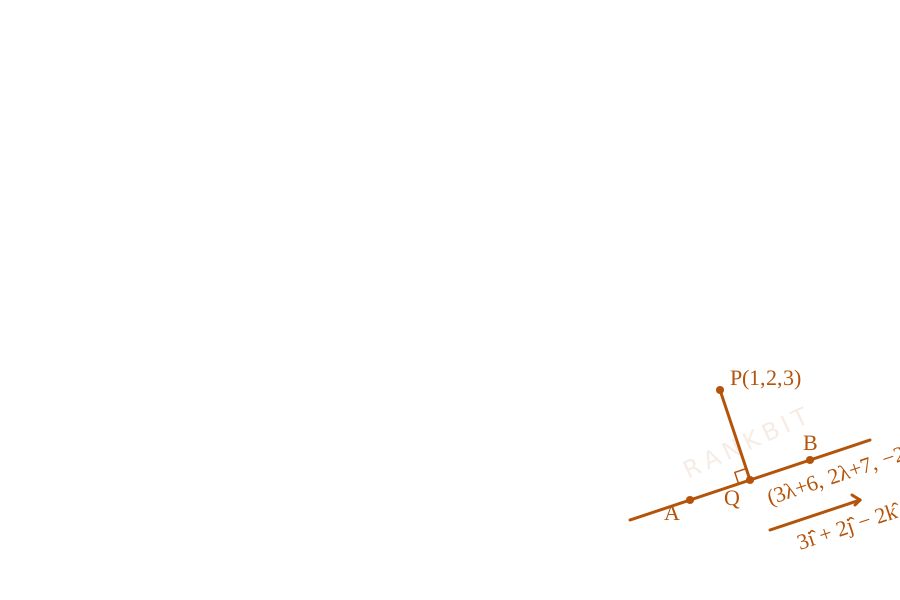
### Related Formula Dot product of vectors: overrightarrowOA cdot overrightarrowOB = x_A x_B + y_A y_B + z_A z_B ### Core Logic Let any general point Q on line L be (3lambda + 6, 2lambda + 7, -2lambda + 7). Vector from P(1,2,3) to Q is overrightarrowPQ = (3lambda + 5)hati + (2lambda + 5)hatj + (-2lambda + 4)hatk. Since Q is the foot of perpendicular, overrightarrowPQ cdot vecb = 0, where vecb = 3hati + 2hatj - 2hatk: 3(3lambda + 5) + 2(2lambda + 5) - 2(-2lambda + 4) = 0 9lambda + 15 + 4lambda + 10 + 4lambda - 8 = 0 implies 17lambda = -17 implies lambda = -1 Thus, the foot of perpendicular is Q(3, 5, 9). ### Step 1: Locate Points A and B Points A and B are on line L, expressed via a distance parameter mu away from Q: General point expression from Q: A, B = (3mu + 3, 2mu + 5, -2mu + 9) [relative tracking points]. Distance squared = 68: (3mu)^2 + (2mu)^2 + (-2mu)^2 = 68 implies 17mu^2 = 68 implies mu = pm 2 For mu = 2: A = (3(2)+3, 2(2)+5, -2(2)+9) = (9, 9, 5) For mu = -2: B = (3(-2)+3, 2(-2)+5, -2(-2)+9) = (-3, 1, 13)
Line and Point Relations diagram for Q59 - JEE Main 2025 Morning
### Step 2: Vector Dot Product Evaluation $overrightarrowOA cdot overrightarrowOB = 9(-3) + 9(1) + 5(13) = -27 + 9 + 65 = 47 ### Pattern Recognition When symmetrical points on a line are equidistant from a central foot position, utilizing standard parametric tracking simplifies vector resolution instantly. Double check calculations sequentially via parallel distance components. ### Evaluation Rubric / Model Answer null ### Chapter Mix Class 12 Mathematics: Three Dimensional Geometry
Q64 jee_main_2025_07_april_evening Lines in 3D Space
If the equation of the line passing through the point left(0, -frac12, 0right) and perpendicular to the lines vec mathrm r = lambda (hat mathrm i + mathrm a hat mathrm j + mathrm b hat mathrm k) and vec mathrm r = left(hat mathrm i - hat mathrm j - 6 hat mathrm kright) + mu left(- b hat mathrm i + a hat mathrm j + 5 hat mathrm kright) is fracmathrmx - 1-2 = fracmathrmy + 4mathrmd = fracmathrmz - mathrmc-4 then a +mathrmb + mathrmc + mathrmd is equal to:
  • A. 10
  • B. 14
  • C. 13
  • D. 12

Solution

### Related Formula The direction vector of a line perpendicular to two given lines with direction vectors vecv_1 and \vec{v}_2 is determined by their cross product: vecv = vecv_1 times vecv_2 ### Core Logic The given point left(0, -frac12, 0right) lies on the required line: fracx - 1-2 = fracy + 4d = fracz - c-4 Substituting the point coordinates into the equation: frac0 - 1-2 = frac-frac12 + 4d = frac0 - c-4 frac12 = frac72d = fracc4 implies d = 7, quad c = 2 ### Step 1: Cross Product Direction Ratios The direction vectors of the lines are vecv_1 = (1, a, b) and vecv_2 = (-b, a, 5). vecv = beginvmatrix hati & hatj & hatk \\ 1 & a & b \\ -b & a & 5 endvmatrix = hati(5a - ab) - hatj(5 + b^2) + hatk(a + ab) Thus, the direction ratios of the line are proportional to: frac5a - ab-2 = frac-(b^2 + 5)7 = fraca + ab-4 quad dots text(i) ### Step 2: Solve for a and b From the first and third components of equation (i): frac5a - ab-2 = fraca + ab-4 implies 2(5a - ab) = a + ab 10a - 2ab = a + ab implies 9a = 3ab implies b = 3 Now use the second component ratio with b = 3 and d = 7: frac-(3^2 + 5)7 = fraca + a(3)-4 implies frac-147 = frac4a-4 implies -2 = -a implies a = 2 ### Step 3: Sum the Variables Summing up a, b, c, d: a + b + c + d = 2 + 3 + 2 + 7 = 14 ### Pattern Recognition Substituting known point values into symmetric equations immediately determines structural values like c and d before running cross product systems. ### Evaluation Rubric / Model Answer null ### Chapter Mix Class 12 Mathematics: Three Dimensional Geometry

Q66 jee_main_2025_07_april_evening Foot of Perpendicular and Area
Consider the lines mathrmL_1: mathrmx - 1 = mathrmy - 2 = mathrmz and mathrmL_2: mathrmx - 2 = mathrmy = mathrmz - 1. Let the feet of the perpendiculars from the point mathrmP(5,1,-3) on the lines mathrmL_1 and mathrmL_2 be mathrmQ and mathrmR respectively. If the area of the triangle PQR is mathrmA, then 4mathrmA^2 is equal to:
  • A. 139
  • B. 147
  • C. 151
  • D. 143

Solution

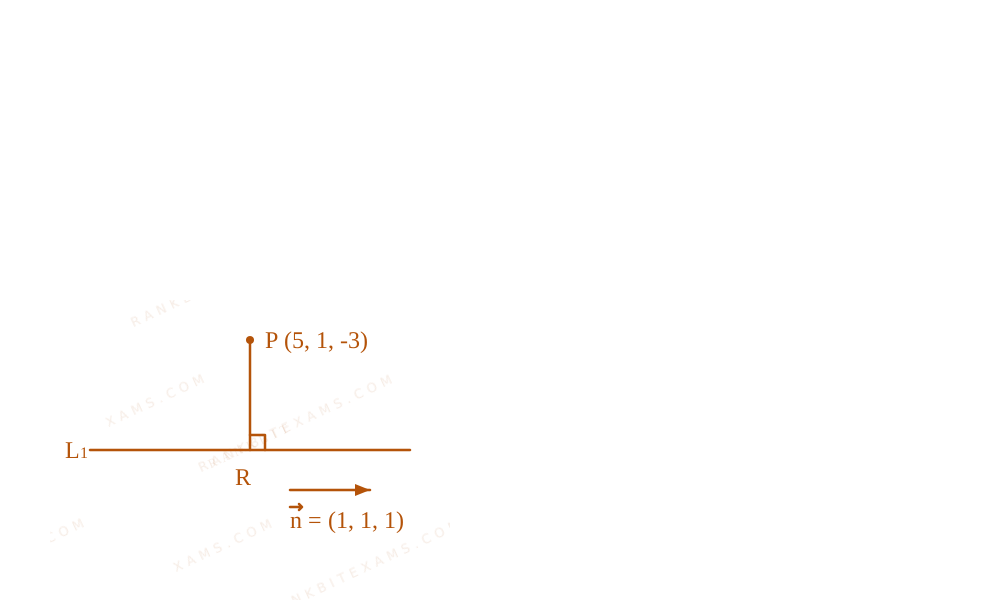
### Related Formula The vector area of a triangle given two adjacent position vectors vecu and vecv is calculated as: textArea = frac12 |vecu times vecv| ### Core Logic For line L_1: fracx-11 = fracy-21 = fracz-01. Let a general point be Q(lambda+1, lambda+2, lambda). vecPQ = (lambda-4, lambda+1, lambda+3) Since vecPQ cdot vecm_1 = 0 (direction vector of L_1 is (1,1,1)): (lambda-4)(1) + (lambda+1)(1) + (lambda+3)(1) = 0 implies 3lambda = 0 implies lambda = 0 Thus, Q(1, 2, 0) and vecPQ = (-4, 1, 3).
Foot of Perpendicular and Area diagram for Q66 - JEE Main 2025 Evening
### Step 1: Compute Foot R For line L_2: fracx-21 = fracy1 = fracz-11. Let a general point be R(mu+2, mu, mu+1). vecPR = (mu-3, mu-1, mu+4) Since vecPR cdot vecm_2 = 0 (direction vector of L_2 is (1,1,1)): (mu-3)(1) + (mu-1)(1) + (mu+4)(1) = 0 implies 3mu = 0 implies mu = 0 Thus, R(2, 0, 1) and vecPR = (-3, 1, 4). ### Step 2: Area Vector Calculation The area A of Delta PQR is given by: A = frac12 |vecPQ times vecPR| vecPQ times vecPR = beginvmatrix hati & hatj & hatk \\ -4 & 1 & 3 \\ -3 & 1 & 4 endvmatrix = hati(4-3) - hatj(-16+9) + hatk(-4+3) = hati + 7hatj - hatk textMagnitude squared: |vecPQ times vecPR|^2 = 1^2 + 7^2 + (-1)^2 = 1 + 49 + 1 = 51 Let's re-verify the matrix arithmetic layout: vecPQ = (-4, 1, 3), vecPR = (-3, 1, 4) = 7hati + 7hatj + 7hatk |7(hati + hatj + hatk)|^2 = 49 cdot 3 = 147 ### Step 3: Evaluate 4A^2 Since A = frac12 sqrt147: 4A^2 = 4 cdot left(frac14 cdot 147right) = 147 ### Pattern Recognition Setting up dot products systematically with general parametric forms quickly locks in spatial feet indices without complex geometric drawings. ### Evaluation Rubric / Model Answer null ### Chapter Mix Class 12 Mathematics: Three Dimensional Geometry
Q72 jee_main_2025_24_jan_evening Image of a Point and Area of Triangle
Let P be the image of the point Q(7,-2,5) in the line L: fracx-12=fracy+13=fracz4 and R(5,p,q) be a point on L. Then the square of the area of triangle PQR is \_\_\_\_. [cite: 3405, 3406]
Numerical Answer. Answer: 957

Solution

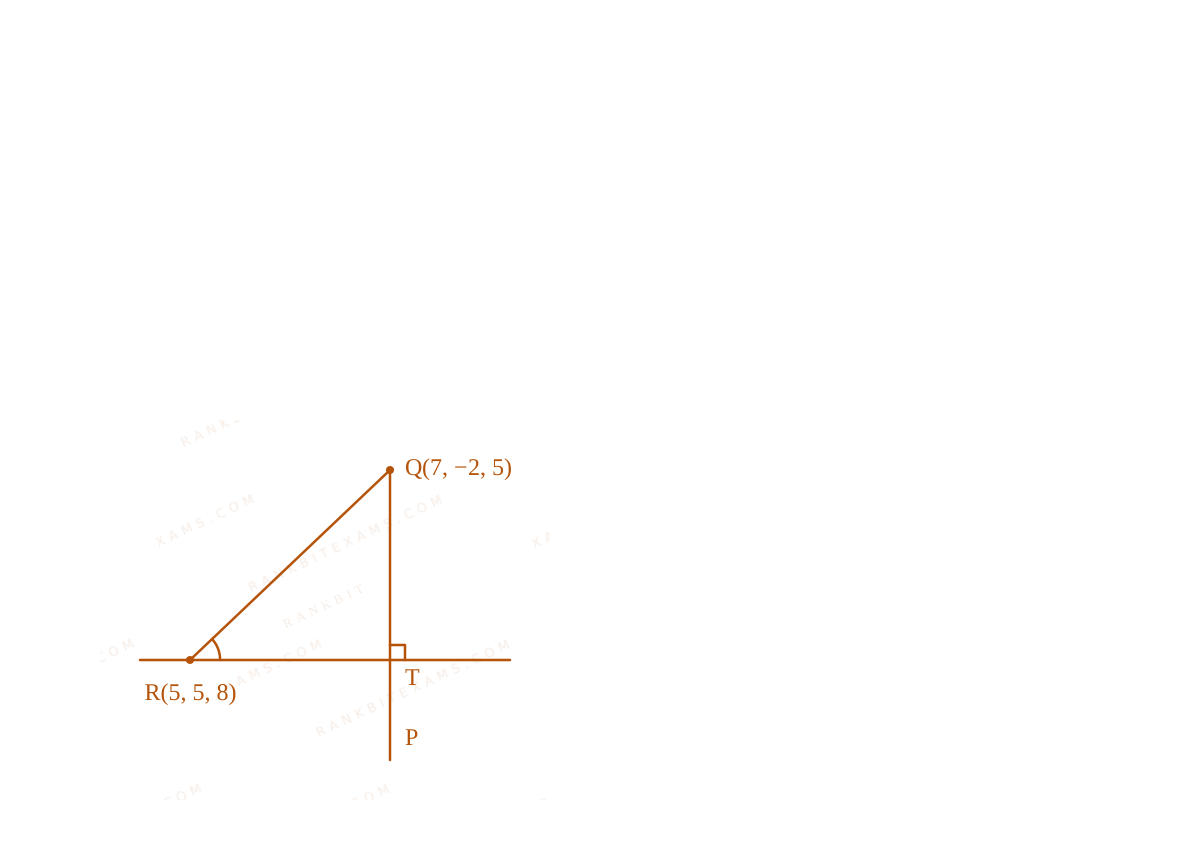
### Related Formula 1. Area of a \triangle with perpendicular height h and base b: textArea = frac12 times b times h 2. Since P is the reflection image of Q across line L, the line acts as a perpendicular bisector. For any point R lying on the line, the height from R to the line is RT, and the base QP = 2QT. ### Core Logic Determine parameters for point R lying directly on line L [cite: 3405, 4071]: frac5-12 = fracp+13 = fracq4 Rightarrow 2 = fracp+13 = fracq4 p+1 = 6 Rightarrow p = 5, quad q = 8 Rightarrow R = (5, 5, 8) [cite: 4071, 4073]
3D line reflection \triangle diagram for Q72 - JEE Main 2025 Evening
### Step 1: Locate Foot of Perpendicular (T) Let the foot of the perpendicular from Q(7, -2, 5) on line L be T(2lambda+1, 3lambda-1, 4lambda) . The directional direction of L is vecb = 2hati + 3hatj + 4hatk . Vector overrightarrowQT = (2lambda - 6)hati + (3lambda + 1)hatj + (4lambda - 5)hatk . Apply orthogonality condition overrightarrowQT cdot vecb = 0 : 2(2lambda - 6) + 3(3lambda + 1) + 4(4lambda - 5) = 0 4lambda - 12 + 9lambda + 3 + 16lambda - 20 = 0 Rightarrow 29lambda - 29 = 0 Rightarrow lambda = 1 [cite: 4077, 4078] Thus, T = (3, 2, 4). ### Step 2: Measure Geometric Distances Compute length QT using distance metrics : QT = sqrt(3-7)^2 + (2 - (-2))^2 + (4-5)^2 = sqrt16 + 16 + 1 = sqrt33 Since P is the symmetrical image, base QP = 2QT = 2sqrt33. Compute length RT representing height from vertex R(5, 5, 8) to base line at T(3, 2, 4) : RT = sqrt(5-3)^2 + (5-2)^2 + (8-4)^2 = sqrt4 + 9 + 16 = sqrt29 ### Step 3: Calculate Squared Area Compute the \triangle area squared value [cite: 3406, 4081]: textArea = frac12 times QP times RT = frac12 times left(2sqrt33right) times sqrt29 = sqrt957 left(textArearight)^2 = 957 [cite: 4081, 4083] ### Pattern Recognition Because the image geometry creates an isosceles pairing from any point on the mirror line to the object and image point, the area reduces beautifully to 2 times textArea(triangle QTR) = QT times RT. ### Evaluation Rubric / Model Answer null ### Chapter Mix Class 12 Mathematics: Three Dimensional Geometry

More Three Dimensional Geometry Questions — jee_main_2025_07_april_morning

Practice all Three Dimensional Geometry previous-year questions →

Rankbit System
JEE Physics: Waves (+15.5%) | Electrostatics: Concentric Shells (-29.7%) | Modern Physics: Photoelectric Clones (+34.2%) | Mathematics: Definite Integrals (+18.1%) | Chemistry: Coordination Splitting (-11.4%) | JEE Physics: Waves (+15.5%) | Electrostatics: Concentric Shells (-29.7%) | Modern Physics: Photoelectric Clones (+34.2%) | Mathematics: Definite Integrals (+18.1%) | Chemistry: Coordination Splitting (-11.4%)