JEE Main · Chemistry ↓ Falling

Biomolecules appeared 35 times across 3 years — 4.1% of Chemistry. This question is from Hydrolysis of Sucrose.

Year 2026 2025 2024 Total
Questions 9 18 8 35

Given below are two statements: Statement I: D-(+)-glucose + D-(+)-fructose -H₂O sucrose sucrose Hydrolysis D-(+)-glucose + D-(+)-fructose Statement II: Invert sugar is formed during sucrose hydrolysis. In the light of given statements, choose the correct answer from the options given below:

Solution & Explanation

Core Logic

Statement I: Sucrose is formed by condensation of D-(+)-glucose and D-(-)-fructose (levorotatory fructose, not dextrorotatory as claimed). Hydrolysis of sucrose yields D-(+)-glucose and D-(-)-fructose. Thus, Statement I is false.

Statement II: Hydrolysis of dextrorotatory sucrose (+66.5°) yields a mixture of dextrorotatory glucose (+52.5°) and highly levorotatory fructose (-92.4°). Because the overall specific rotation of the mixture becomes levorotatory (-39.9°), the hydrolyzed mixture is called invert sugar. Thus, Statement II is true.

Pattern Recognition

Natural fructose is always levorotatory, D-(-)-fructose. Dextrorotatory fructose mentioned in Statement I is an immediate giveaway that the statement is false.

Chapter Mix

Class 12 Chemistry: Biomolecules

Reference Study Guides

More Biomolecules Previous-Year Questions — Page 4

Q jee_main_2025_08_april_evening Amino Acids
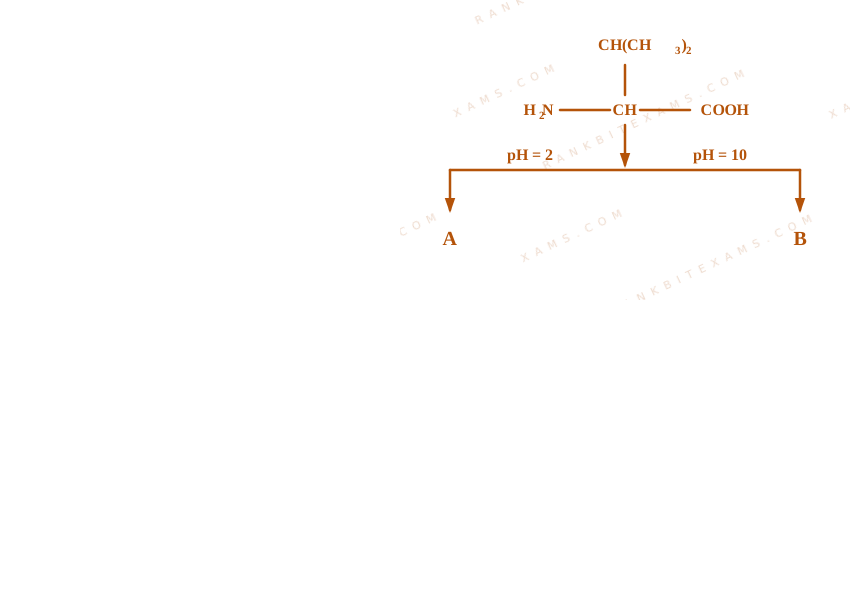
The chemical structure of the amino acid Valine is monitored across different environments: Choose the correct option depicting the structures of products A and B under pH = 2 and pH = 10 conditions respectively.
Valine pH equilibrium conversion layout for Q39
The flowchart maps the structural modifications of Valine when treated at strongly acidic (pH = 2) versus basic (pH = 10) conditions.
Valine pH equilibrium conversion layout for Q39
The flowchart maps the structural modifications of Valine when treated at strongly acidic (pH = 2) versus basic (pH = 10) conditions.
  • A.
  • B.
  • C.
  • D.

Solution

Core Logic

Amino acids exhibit amphoteric behavior due to the simultaneously present basic amino (-NH₂) and acidic carboxyl (-COOH) functional groups:

  • At pH = 2 (Highly Acidic Medium):
  • The abundant concentration of hydronium ions (H^+) protonates the carboxylate ion back into its non-ionized acid state (-COO^- arrow -COOH), while the amine group remains securely protonated as an ammonium ion (-NH₃^+). Hence, product A exists purely as a cation.

  • At pH = 10 (Highly Basic Medium):
  • The high concentration of hydroxide ions (OH^-) abstracts protons from the system, deprotonating the carboxyl group into a carboxylate anion (-COO^-) and neutralizing the ammonium group back into a free amine fraction (-NH₂). Hence, product B exists purely as an anion.
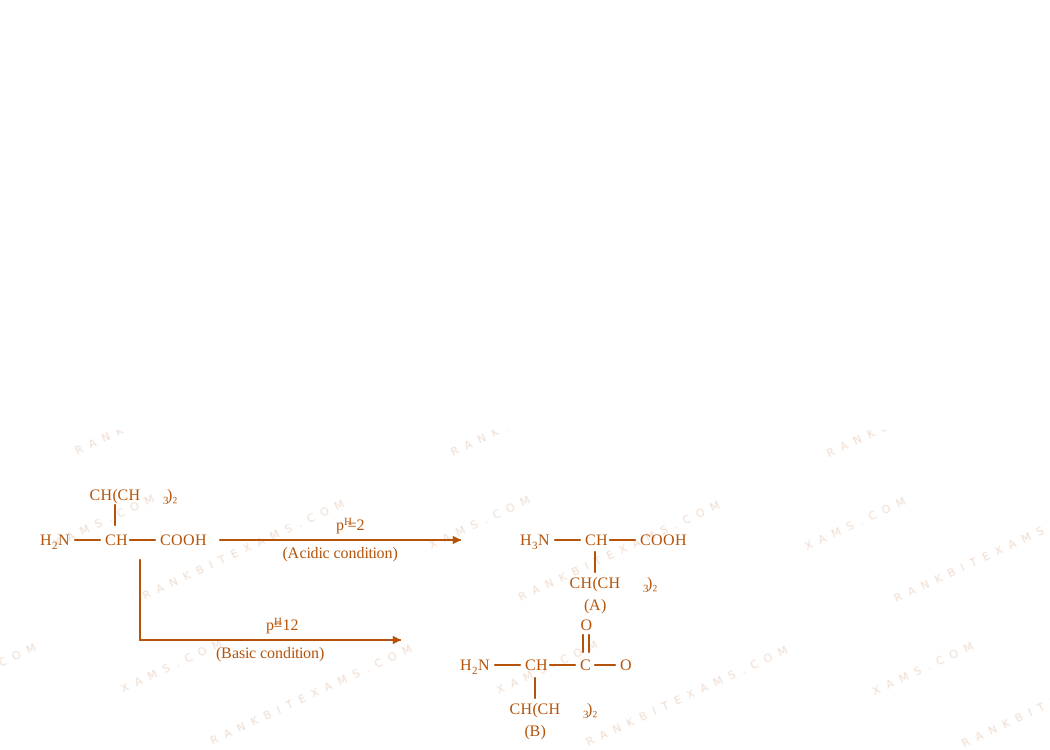
    Protonation state structures of Valine across the pH spectrum
    The flowchart maps the structural modifications of Valine when treated at strongly acidic (pH = 2) versus basic (pH = 10) conditions.

Pattern Recognition

Acidic environments (low pH) force positive overall charges onto amino structures (cation form). Basic environments (high pH) drive a net negative structure (anion form). This simple rule makes picking Option (1) immediate.

Chapter Mix

Class 12 Chemistry: Biomolecules

Q29 jee_main_2025_29_jan_evening Amino Acids and Proteins
Identify the essential amino acids from below: (A) Valine (B) Proline (C) Lysine (D) Threonine (E) Tyrosine Choose the correct answer from the options given below:
  • A. (A), (C) and (D) only
  • B. (A), (C) and (E) only
  • C. (B), (C) and (E) only
  • D. (C), (D) and (E) only

Solution

Core Logic

Essential amino acids cannot be synthesized by the body and must be obtained from diet. From the given choices:

  • Valine (Essential)
  • Proline (Non-essential)
  • Lysine (Essential)
  • Threonine (Essential)
  • Tyrosine (Non-essential)
  • Hence, (A), (C), and (D) are the essential amino acids.

Pattern Recognition

Mnemonic for essential amino acids: TV TILL PM MALL (Threonine, Valine, Tryptophan, Isoleucine, Leucine, Lysine, Phenylalanine, Methionine, Arginine, Histidine).

Chapter Mix

Class 12 Chemistry: Biomolecules

Q45 jee_main_2025_28_jan_morning Reactions of Glucose and Starch
Given below are two statements : Statement I : D-glucose pentaacetate reacts with 2, 4-dinitrophenylhydrazine. Statement II : Starch, on heating with concentrated sulfuric acid at 100°C and 2-3 atmosphere pressure produces glucose. In the light of the above statements, choose the correct answer from the options given below
  • A. Both Statement I and Statement II are false
  • B. Statement I is false but Statement II is true.
  • C. Statement I is true but Statement II is false.
  • D. Both Statement I and Statement II are true.

Solution

Core Logic

Statement I is false because glucose pentaacetate fixes the cyclic hemiacetal system structure securely into an unreactive ester configuration. As a result, it cannot revert to an open-chain form containing a free aldehyde group, meaning it does not react with carbonyl reagents like 2,4-DNP.

Statement II is true because starch, a polysaccharide composed of glucose monomer blocks, undergoes acid-catalyzed hydrolysis to yield glucose when heated under pressure.

Pattern Recognition

Sees: Pentacetate reactivity vs polysaccharide hydrolysis. Shortcut: Acetylation locks the cyclic structure of glucose, preventing reactions that require an open-chain carbonyl group (like 2,4-DNP).

Chapter Mix

Class 12 Chemistry: Biomolecules

Q jee_main_2025_04_april_evening Amino Acids and Peptides
A dipeptide, "x" on complete hydrolysis gives "y" and "z". "y" on treatment with aq. HNO₂ produces lactic acid. On the other hand "z" on heating gives the following cyclic molecule. Based on the information given, the dipeptide X is:
Cyclic molecule from dipeptide residue heating for Q29 - JEE Main 2025 Evening
The image shows a heterocyclic six-membered cyclic molecule containing amide groups, formed by heating amino acid residue z.
Cyclic molecule from dipeptide residue heating for Q29 - JEE Main 2025 Evening
The image shows a heterocyclic six-membered cyclic molecule containing amide groups, formed by heating amino acid residue z.
  • A. valine-glycine
  • B. alanine-glycine
  • C. valine-leucine
  • D. alanine-alanine

Solution

Related Formula
Dipeptide X Hydrolysis Amino Acid y + Amino Acid z
Core Logic
  • Since y reacts with nitrous acid (HNO₂) to give lactic acid (CH₃-CH(OH)-COOH), y must be alanine (CH₃-CH(NH₂)-COOH).
  • When glycine (NH₂-CH₂-COOH) is heated, two molecules undergo intermolecular cyclization to produce a six-membered diketopiperazine ring as shown in the problem diagram. Therefore, z is glycine.
  • Hence, combining residue y (alanine) and z (glycine), the dipeptide X is alanine-glycine.

Step 1: Stepwise Degradation Overview

Reaction scheme:

  • Alanine-Glycine linkage arrow Alanine + Glycine
  • Alanine + HNO₂ arrow Lactic acid + N₂ + H₂O
  • 2 × Glycine Δ Cyclic diketopiperazine + 2H₂O
Pattern Recognition

Lactic acid generation from alpha-amino acids via nitrous acid deamination is a definitive chemical fingerprint for alanine. The unsubstituted cyclic diketopiperazine product confirms glycine as the second component.

Chapter Mix

Class 12 Chemistry: Biomolecules

Q39 jee_main_2025_04_april_morning Proteins and Amino Acids
Identify the pair of reactants that upon reaction, with elimination of HCl will give rise to the dipeptide Gly-Ala.
  • A. NH₂-CH₂-COCl and NH₂-CH(CH₃)-COOH
  • B. NH₂-CH₂-COCl and NH₃-CH(CH₃)-COCl
  • C. NH₂-CH₂-COOH and NH₂-CH(CH₃)-COCl
  • D. NH₂-CH₂-COOH and NH₂-CH(CH₃)-COOH

Solution

Core Logic

A dipeptide sequence is parsed strictly from the N-terminus to the C-terminus. Therefore, in Gly-Ala:

  • Glycine (Gly) must supply its carbonyl end for coupling.
  • Alanine (Ala) must provide its free amine end.
  • To drive peptide bond formation via the explicit elimination of HCl, the carboxyl group of glycine must be pre-activated as an acyl chloride variant: NH₂-CH₂-COCl.

    This reacts smoothly with the unsubstituted amine terminus of alanine, NH₂-CH(CH₃)-COOH, liberating HCl to form the amide bridge linkage: NH₂-CH₂-CONH-CH(CH₃)-COOH.

Pattern Recognition

peptide naming structure sequence convention dictates: First name = N-terminus acyl donor, Second name = C-terminus amine acceptor.

Chapter Mix

Class 12 Chemistry: Biomolecules

More Biomolecules Questions — jee_main_2025_07_april_morning

Practice all Biomolecules previous-year questions →

Rankbit System
JEE Physics: Waves (+15.5%) | Electrostatics: Concentric Shells (-29.7%) | Modern Physics: Photoelectric Clones (+34.2%) | Mathematics: Definite Integrals (+18.1%) | Chemistry: Coordination Splitting (-11.4%) | JEE Physics: Waves (+15.5%) | Electrostatics: Concentric Shells (-29.7%) | Modern Physics: Photoelectric Clones (+34.2%) | Mathematics: Definite Integrals (+18.1%) | Chemistry: Coordination Splitting (-11.4%)
