Given below are two statements: Statement I: Sucrose is dextrorotatory. However sucrose upon hydrolysis gives a solution having mixture of products. This solution shows laevorotation. Statement II: Hydrolysis of sucrose gives glucose and fructose. Since the laevorotation of glucose is more than the dextrorotation of fructose the resulting solution becomes laevorotatory. In the light of the above statements, choose the correct answer from the options given below.

Solution & Explanation

### Related Formula C_12H_22O_11 + H_2O xrightarrowH^+ Dtext-Glucose + Dtext-Fructose ### Core Logic Statement I: Pure sucrose has a specific rotation [alpha]_D = +66.5^circ, so it is dextrorotatory. Upon hydrolysis, it forms an equimolar mixture of D-glucose and D-fructose. The net specific rotation of the mixture is negative, resulting in laevorotation. (This is called inversion of sugar). Statement I is true. Statement II: Hydrolysis gives glucose and fructose. The specific rotation of D-glucose is +52.5^circ (dextrorotation), while that of D-fructose is -92.4^circ (laevorotation). The statement claims that glucose is laevorotatory and fructose is dextrorotatory, which is strictly backward. Therefore, Statement II is false. ### Step 1: Final Conclusion Statement I is true but Statement II is false. ### Pattern Recognition Invert sugar concepts are very common. Always verify which monomer rotates light in which direction. D-fructose is strongly laevorotatory (-92.4^circ). ### Evaluation Rubric / Model Answer null ### Chapter Mix Class 12 Chemistry: Biomolecules

Reference Study Guides

More Biomolecules Previous-Year Questions

Q67 jee_main_2026_21_jan_morning Amino Acids
Identify the correct statements. A. Arginine and Tryptophan are essential amino acids. B. Histidine does not contain heterocyclic ring in its structure. C. Proline is a six membered cyclic ring amino acid. D. Glycine does not have chiral centre. E. Cysteine has characteristic feature of side chain as mathrmMeS-CH_2-CH_2-. Choose the correct answer from the options given below:
  • A. textC and E Only
  • B. textB and E Only
  • C. textC and D Only
  • D. textA and D Only

Solution

### Core Logic A. Arginine and Tryptophan are indeed essential amino acids (cannot be synthesized by the human body). (Correct) B. Histidine contains an imidazole ring, which is a heterocyclic ring. So statement B is incorrect. C. Proline contains a pyrrolidine ring, which is a five-membered cyclic ring. So statement C is incorrect. D. Glycine is mathrmNH_2-CH_2-COOH. Because its alpha carbon has two identical hydrogen atoms attached, it lacks a chiral center. (Correct) E. Cysteine's side chain is a thiol group (-mathrmCH_2-SH), not a thioether (mathrmMeS-CH_2-CH_2- which belongs to Methionine). So statement E is incorrect. Correct statements: A and D. ### Evaluation Rubric / Model Answer null ### Chapter Mix Class 12 Chemistry: Biomolecules
Q61 jee_main_2026_21_jan_evening Proteins and Enzymes
The correct statements are: A. Activation energy for enzyme catalysed hydrolysis of sucrose is lower than that of acid catalysed hydrolysis. B. During denaturation, secondary and tertiary structures of a protein are destroyed but primary structure remains intact. C. Nucleotides are joined together by glycosidic linkage between textC_1 and textC_4 carbons of the pentose sugar. D. Quaternary structure of proteins represents overall folding of the polypeptide chain. Choose the correct answer from the options given below:
  • A. (1) text A, C and D Only
  • B. (2) text A, B and D Only
  • C. (3) text A and B Only
  • D. (4) text B and C Only

Solution

### Core Logic - A is correct: Enzymes lower activation energy significantly. - B is correct: Denaturation affects secondary and tertiary structures while primary structure remains intact. - C is incorrect: Nucleotides are joined by phosphodiester linkages, and glycosidic linkages connect bases to sugars. - D is incorrect: Quaternary structure represents aggregation of multiple polypeptide subunits, not single chain folding. ### Step 1: Final Conclusion Only statements A and B are correct, matching option (3). ### Pattern Recognition Sees: Biomolecules structural and enzymatic properties. Trap: Confusing primary structure disruption with denaturation. ### Chapter Mix Class 12 Chemistry: Biomolecules

Q60 jee_main_2026_22_january_evening Reactions of Glucose
Match List-I with List-II.
List-I (Reaction of glucose with)List-II (Product formed)
A. HydroxylamineI. Gluconic acid
B. Br_2 waterII. Glucose pentaacetate
C. Excess acetic anhydrideIII. Saccharic acid
D. Concentrated HNO_3IV. Glucoxime
Choose the correct answer from the options given below:
  • A. A-I, B-III, C-IV, D-II
  • B. A-IV, B-I, C-II, D-III
  • C. A-III, B-I, C-IV, D-II
  • D. A-IV, B-III, C-II, D-I

Solution

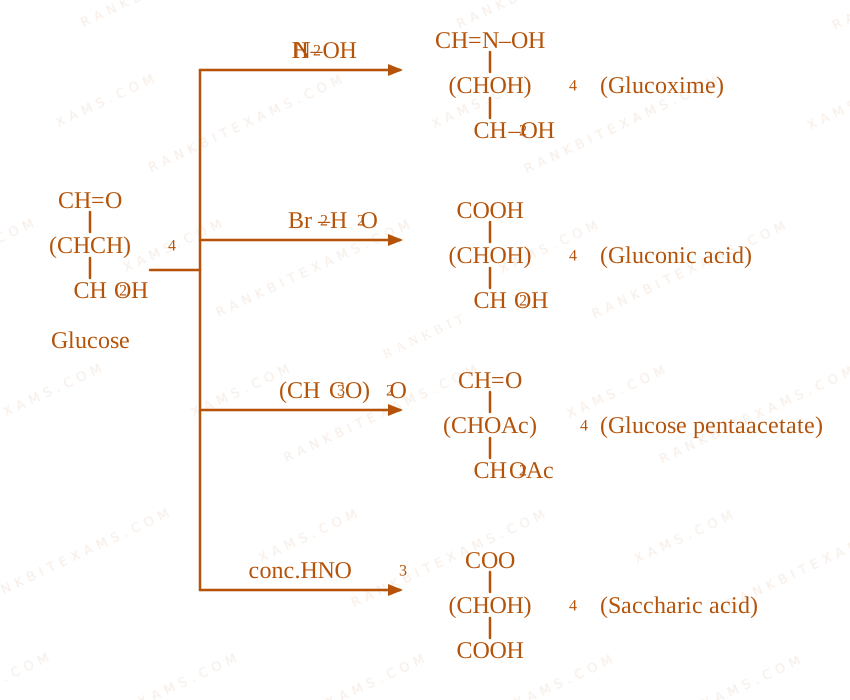
### Related Formula textGlucose + textNH_2textOH rightarrow textGlucoxime textGlucose + textBr_2/textH_2textO rightarrow textGluconic acid textGlucose + (textCH_3textCO)_2textO rightarrow textGlucose pentaacetate textGlucose + textconc. HNO_3 rightarrow textSaccharic acid ### Core Logic Step 1: Match each reagent with its specific reaction product on glucose: - Hydroxylamine (A) reacts with carbonyl to form Glucoxime (IV). - textBr_2 water (B) mildly oxidizes -textCHO to -textCOOH forming Gluconic acid (I). - Acetic anhydride (C) acetylates 5 hydroxyl groups to form Glucose pentaacetate (II). - Conc. textHNO_3 (D) oxidizes both -textCHO and primary -textCH_2textOH to form Saccharic acid (III). Step 2: Correct matching pair is A-IV, B-I, C-II, D-III.
Chemical reactions chart for glucose for Q60 - JEE Main 2026 Evening
### Pattern Recognition Sees: Classic NCERT Glucose chemical test reaction matches. Shortcut: Mild oxidant textBr_2/textH_2textO rightarrow Gluconic acid; Strong oxidant textHNO_3 rightarrow Saccharic acid. ### Evaluation Rubric / Model Answer null ### Chapter Mix Class 12 Chemistry: Biomolecules
Q44 jee_main_2025_02_april_evening Proteins and Amino Acid Sequences
A tetrapeptide "x" on complete hydrolysis produced glycine (Gly), alanine (Ala), valine (Val), leucine (Leu) in equimolar proportion each. The number of tetrapeptides (sequences) possible involving each of these amino acids is
  • A. 16
  • B. 32
  • C. 8
  • D. 24

Solution

### Related Formula textNumber of unique sequences = n! ### Core Logic A **tetrapeptide** is formed by connecting four amino acids through three peptide linkages. Since the problem specifies that complete hydrolysis of the tetrapeptide produces Gly, Ala, Val, and Leu in *equimolar proportions*, the peptide must contain exactly one molecule of each of these four distinct amino acids. ### Step 1: Calculate the Permutations The number of unique peptide sequences corresponds to the number of ways we can arrange these 4 distinct amino acids: textNumber of permutations = 4! = 4 times 3 times 2 times 1 = 24 ### Pattern Recognition Combinatorics in Chemistry: If we have n unique, non-repeating amino acids, the number of linear isomeric peptides is n!. If repetition were permitted, the number of possible peptides would be n^n (which would be 4^4 = 256 in this case). ### Evaluation Rubric / Model Answer null ### Chapter Mix Class 12 Chemistry: Biomolecules

More Biomolecules Questions — jee_main_2026_22_january_morning

Practice all Biomolecules previous-year questions →

Rankbit System
JEE Physics: Waves (+15.5%) | Electrostatics: Concentric Shells (-29.7%) | Modern Physics: Photoelectric Clones (+34.2%) | Mathematics: Definite Integrals (+18.1%) | Chemistry: Coordination Splitting (-11.4%) | JEE Physics: Waves (+15.5%) | Electrostatics: Concentric Shells (-29.7%) | Modern Physics: Photoelectric Clones (+34.2%) | Mathematics: Definite Integrals (+18.1%) | Chemistry: Coordination Splitting (-11.4%)