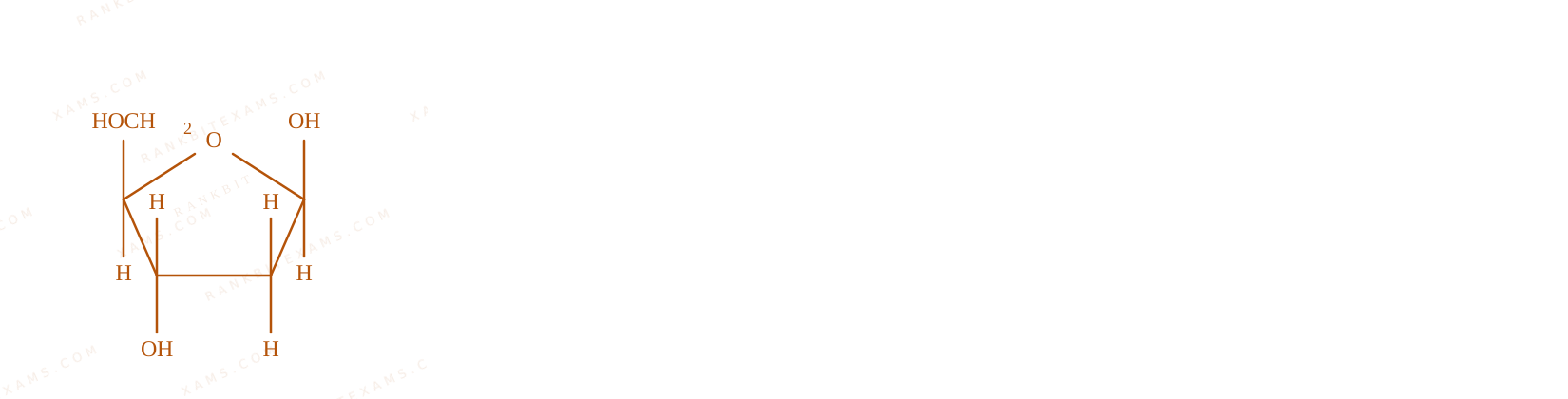
Given below are two statements: Statement I: textD-(+)-glucose + textD-(+)-fructose xrightarrow-mathrmH_2mathrmO textsucrose qquad textsucrose xrightarrowtextHydrolysis textD-(+)-glucose + textD-(+)-fructose Statement II: Invert sugar is formed during sucrose hydrolysis. In the light of given statements, choose the correct answer from the options given below:

Solution & Explanation

### Core Logic Statement I: Sucrose is formed by condensation of textD-(+)-glucose and textD-(-)-fructose (levorotatory fructose, not dextrorotatory as claimed). Hydrolysis of sucrose yields textD-(+)-glucose and textD-(-)-fructose. Thus, Statement I is false. Statement II: Hydrolysis of dextrorotatory sucrose (+66.5^circ) yields a mixture of dextrorotatory glucose (+52.5^circ) and highly levorotatory fructose (-92.4^circ). Because the overall specific rotation of the mixture becomes levorotatory (-39.9^circ), the hydrolyzed mixture is called **invert sugar**. Thus, Statement II is true. ### Pattern Recognition Natural fructose is always levorotatory, textD-(-)-fructose. Dextrorotatory fructose mentioned in Statement I is an immediate giveaway that the statement is false. ### Evaluation Rubric / Model Answer null ### Chapter Mix Class 12 Chemistry: Biomolecules

Reference Study Guides

More Biomolecules Previous-Year Questions — Page 5

Q61 jee_main_2024_01_february_morning Nucleic Acids
If one strand of a DNA has the sequence ATGCTTCA, sequence of the bases in complementary strand is:
  • A. CATTAGCT
  • B. TACGAAGT
  • C. GTACTTAC
  • D. ATGCGACT

Solution

### Core Logic Adenine (A) base pairs with Thymine (T) with 2 hydrogen bonds, and Cytosine (C) base pairs with Guanine (G) with 3 hydrogen bonds. For the given DNA strand: A rightarrow T T rightarrow A G rightarrow C C rightarrow G T rightarrow A T rightarrow A C rightarrow G A rightarrow T ### Step 1: Sequence Matching Given sequence: A T G C T T C A Complementary: T A C G A A G T
Nucleic Acids diagram for Q61 - JEE Main 2024 Morning
### Pattern Recognition DNA base pairing strictly follows Chargaff's rule: A=T and G≡C. Just swap A with T, and C with G in the exact order. ### Evaluation Rubric / Model Answer null ### Chapter Mix Class 12 Chemistry: Biomolecules
Q62 jee_main_2024_29_january_evening Polymers and Monomers
Match List I with List II:
List I (Bio Polymer)List II (Monomer)
A. StarchI. nucleotide
B. CelluloseII. alpha-glucose
C. Nucleic acidIII. beta-glucose
D. ProteinIV. alpha-amino acid
Choose the correct answer from the options given below :
  • A. A-II, B-I, C-III, D-IV
  • B. A-IV, B-II, C-I, D-III
  • C. A-I, B-III, C-IV, D-II
  • D. A-II, B-III, C-I, D-IV

Solution

### Related Formula Factual knowledge of biopolymers and their fundamental repeating units (monomers). ### Core Logic Analyzing each polymer component: * **Starch** is a polymer composed entirely of alpha-glucose units. * **Cellulose** is a linear structural polymer consisting of linear chains of beta-glucose units. * **Nucleic acids** (DNA/RNA) are long chains composed of repeating nucleotide units. * **Proteins** are polypeptides made from combined alpha-amino acid sequences. ### Step 1: Final Match Alignment Matching structural links properly leads cleanly to the configuration: A-II, B-III, C-I, D-IV. ### Pattern Recognition Standard memorization trick: Plants store starch using alpha linkers, but build rigid cell walls via beta linkers. ### Evaluation Rubric / Model Answer null ### Chapter Mix Class 12 Chemistry: Biomolecules
Q61 jee_main_2024_27_jan_morning Nucleic Acids
  • A. Phosphodiester linkage
  • B. Glycosidic linkage
  • C. Disulphide linkage
  • D. Peptide linkage

Solution

### Related Formula Nucleotides bond phosphodiester linkage: textNucleotide_1 - textO - textP(=textO)(textO^-) - textO - textNucleotide_2 ### Core Logic Two nucleotides are joined together by phosphodiester linkage between 5' and 3' carbon atoms of the pentose sugar.
Phosphodiester linkage diagram for Q61 - JEE Main 2024 Morning
### Pattern Recognition Proteins rightarrow Peptide, Carbohydrates rightarrow Glycosidic, Proteins/Cysteine rightarrow Disulphide, Nucleic Acids rightarrow Phosphodiester linkage. ### Evaluation Rubric / Model Answer null ### Chapter Mix Class 12 Chemistry: Biomolecules
Q76 jee_main_2024_29_jan_morning Proteins and Amino Acids
Type of amino acids obtained by hydrolysis of proteins is :
  • A. beta
  • B. alpha
  • C. delta
  • D. gamma

Solution

### Core Logic Proteins are natural biopolymers. The fundamental building blocks (monomers) of all naturally occurring proteins are alpha-amino acids. In these molecules, both the amino group (-NH_2) and the carboxyl group (-COOH) are attached to the exact same carbon atom, designated as the alpha-carbon. Because they are polymers of alpha-amino acids linked by peptide bonds, the hydrolysis of proteins (acidic, basic, or enzymatic) will cleave these peptide bonds to yield the constituent alpha-amino acids. ### Evaluation Rubric / Model Answer null ### Chapter Mix Class 12 Chemistry: Biomolecules
Q84 jee_main_2024_30_january_evening Nucleic Acids (DNA and RNA)
The total number of correct statements, regarding the nucleic acids is A. RNA is regarded as the reserve of genetic information. B. DNA molecule self-duplicates during cell division C. DNA synthesizes proteins in the cell. D. The message for the synthesis of particular proteins is present in DNA E. Identical DNA strands are transferred to daughter cells.
Numerical Answer. Answer: 3 to 3

Solution

### Core Logic A. RNA is regarded as the reserve of genetic information. (False - DNA is the reserve of genetic information). B. DNA molecule self-duplicates during cell division. (True - through replication). C. DNA synthesizes proteins in the cell. (False - RNA molecules synthesize proteins via translation, DNA only provides the code). D. The message for the synthesis of particular proteins is present in DNA. (True - the genetic code lies in the base sequence of DNA). E. Identical DNA strands are transferred to daughter cells. (True - through accurate replication and cell division, genetic continuity is maintained). ### Step 1: Final Conclusion The true statements are B, D, and E. Total number of correct statements is 3. ### Evaluation Rubric / Model Answer null ### Chapter Mix Class 12 Chemistry: Biomolecules

More Biomolecules Questions — jee_main_2025_07_april_morning

Practice all Biomolecules previous-year questions →

Rankbit System
JEE Physics: Waves (+15.5%) | Electrostatics: Concentric Shells (-29.7%) | Modern Physics: Photoelectric Clones (+34.2%) | Mathematics: Definite Integrals (+18.1%) | Chemistry: Coordination Splitting (-11.4%) | JEE Physics: Waves (+15.5%) | Electrostatics: Concentric Shells (-29.7%) | Modern Physics: Photoelectric Clones (+34.2%) | Mathematics: Definite Integrals (+18.1%) | Chemistry: Coordination Splitting (-11.4%)