Given below are two statements:
Statement I: D-(+)-glucose + D-(+)-fructose -H₂O sucrose sucrose Hydrolysis D-(+)-glucose + D-(+)-fructose$\text{D-(+)-glucose} + \text{D-(+)-fructose} \xrightarrow{-\mathrm{H}_2\mathrm{O}} \text{sucrose} \qquad \text{sucrose} \xrightarrow{\text{Hydrolysis}} \text{D-(+)-glucose} + \text{D-(+)-fructose}$
Statement II: Invert sugar is formed during sucrose hydrolysis.
In the light of given statements, choose the correct answer from the options given below:
A.Both Statement I and Statement II are true.$\text{Both Statement I and Statement II are true.}$
B.Statement I is false but Statement II is true.$\text{Statement I is false but Statement II is true.}$
C.Statement I is true but Statement II is false.$\text{Statement I is true but Statement II is false.}$
D.Both Statement I and Statement II are false.$\text{Both Statement I and Statement II are false.}$
Solution & Explanation
Core Logic
Statement I: Sucrose is formed by condensation of D-(+)-glucose$\text{D-(+)-glucose}$ and D-(-)-fructose$\text{D-(-)-fructose}$ (levorotatory fructose, not dextrorotatory as claimed). Hydrolysis of sucrose yields D-(+)-glucose$\text{D-(+)-glucose}$ and D-(-)-fructose$\text{D-(-)-fructose}$. Thus, Statement I is false.
Statement II: Hydrolysis of dextrorotatory sucrose (+66.5°$+66.5^{\circ}$) yields a mixture of dextrorotatory glucose (+52.5°$+52.5^{\circ}$) and highly levorotatory fructose (-92.4°$-92.4^{\circ}$). Because the overall specific rotation of the mixture becomes levorotatory (-39.9°$-39.9^{\circ}$), the hydrolyzed mixture is called invert sugar. Thus, Statement II is true.
Pattern Recognition
Natural fructose is always levorotatory, D-(-)-fructose$\text{D-(-)-fructose}$. Dextrorotatory fructose mentioned in Statement I is an immediate giveaway that the statement is false.
Keywords:#Sucrose hydrolysis products#JEE Main 2025 Morning Q43#Invert sugar specific rotation#Dextrorotatory vs levorotatory sugars
More Biomolecules Previous-Year Questions — Page 3
Qjee_main_2025_02_april_morningMolar Mass Calculations
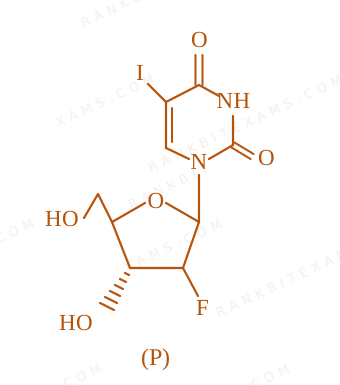
0.1~mol$0.1\mathrm{~mol}$ of the following given antiviral compound (P) will weigh × 10⁻¹~g$\times 10^{-1}\mathrm{~g}$The diagram displays the full multi-cyclic skeletal structure of an antiviral nucleoside molecule featuring explicit iodine and fluorine atomic positions.
(Given : molar mass in g · mol⁻¹$\mathrm{g \cdot mol}^{-1}$ H: 1, C: 12, N: 14, O: 16, F: 19, I: 127)
Numerical Answer.Answer: 372 to 372
Solution
Related Formula
Standard molecular weight calculation formula system:
The diagram displays the full multi-cyclic skeletal structure of an antiviral nucleoside molecule featuring explicit iodine and fluorine atomic positions.
Step 1: Final Mass Scaling
Find the mass of 0.1~mol$0.1\mathrm{~mol}$ of the sample:
Hence, the integer value for the blank box is 372.
Pattern Recognition
When counting atoms in nucleoside structures, remember that each vertex in the ribose sugar ring represents a fully saturated carbon component unless double bonds or heteroatoms are explicitly drawn.
Chapter Mix
Class 12 Chemistry: Biomolecules
Class 11 Chemistry: Some Basic Concepts of Chemistry
Identify the correct statement among the following:
A.(1) All naturally occurring amino acids except glycine contain one chiral centre.$(1)\ \text{All naturally occurring amino acids except glycine contain one chiral centre.}$
B.(2) All naturally occurring amino acids are optically active.$(2)\ \text{All naturally occurring amino acids are optically active.}$
C.(3) Glutamic acid is the only amino acid that contains a -COOH group at the side chain.$(3)\ \text{Glutamic acid is the only amino acid that contains a -COOH group at the side chain.}$
D.(4) Amino acid, cysteine easily undergo dimerization due to the presence of free SH group.$(4)\ \text{Amino acid, cysteine easily undergo dimerization due to the presence of free SH group.}$
Solution
Related Formula
Dimerization of thiol pairs yields a disulfide linkage via an oxidation mechanism:
Let's review each choice item factually layout-by-row:
Option 1 is inaccurate: Isoleucine and threonine contain two distinct chiral centers.
Option 2 is inaccurate: Glycine lacks a asymmetric center, rendering it optically inactive.
Option 3 is inaccurate: Aspartic acid similarly contains a carboxylic acid functional group along its side chain.
Option 4 is correct: Cysteine contains a highly active free functional -SH$-\mathrm{SH}$ group that easily dimerizes to form Cystine through a disulfide loop matrix.
Pattern Recognition
Disulfide bridges formed by cysteine play a crucial role in maintaining the tertiary and quaternary structural configurations of complex protein folds.
Fat soluble vitamins are:
A. Vitamin B₁$\mathrm{B}_1$
B. Vitamin C$\mathrm{C}$
C. Vitamin E$\mathrm{E}$
D. Vitamin B₁₂$\mathrm{B}_{12}$
E. Vitamin K$\mathrm{K}$
Choose the correct answer from the options given below :
A. C & D Only
B. A & B Only
C. B & C Only
D. C & E Only
Solution
Related Formula
Vitamins are classified into two categories based on solubility:
Only C (Vitamin E$\mathrm{E}$) and E (Vitamin K$\mathrm{K}$) are fat-soluble. Thus, the correct option is (4).
Pattern Recognition
Use the mnemonic 'ADEK' to remember the fat-soluble vitamins. All other vitamins (mainly B-complex and C) are water-soluble.
Chapter Mix
Class 12 Chemistry: Biomolecules
Qjee_main_2025_07_april_morningHormones Structure
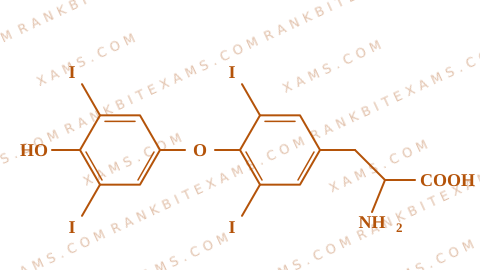
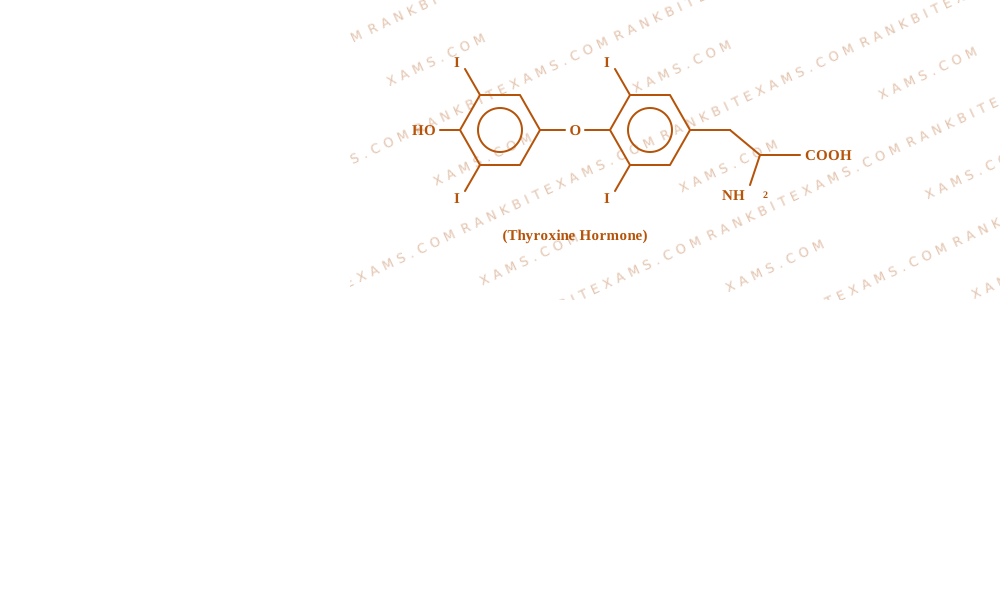
Thyroxine, the hormone has the structure given below:
The structural formula of Thyroxine shows four iodine atoms attached to the aromatic benzene rings.
The percentage of iodine in thyroxine is ______ %. (nearest integer)
(Given molar mass in g mol⁻¹$\mathrm{g\ mol}^{-1}$ of C: 12$\mathrm{C}: 12$, H: 1$\mathrm{H}: 1$, O: 16$\mathrm{O}: 16$, N: 14$\mathrm{N}: 14$, I: 127$\mathrm{I}: 127$)
Hence, the percentage of iodine in thyroxine is 65$65$.
Pattern Recognition
Thyroxine molecular mass (777$777$) is composed mostly of Iodine (508$508$), making up approximately 508/777 ≈ 65%$508/777 \approx 65\%$ of its entire mass. Always carefully account for the four phenyl-bound iodines.
Evaluation Rubric / Model Answer
Accurate molecular weight summation leading to 65%$65\%$ nearest integer Iodine composition.
Chapter Mix
Class 12 Chemistry: Biomolecules
Class 12 Chemistry: Organic Chemistry - Oxygen containing compounds
More Biomolecules Questions — jee_main_2025_07_april_morning
Practice past-year questions one chapter at a time. Pick an exam → subject → chapter and get every PYQ for that topic — pulled together from all past papers — with the chapter's key formulas alongside.
.svg "nucleoside derivative ring, iodinated pyrimidine core, chemical structure mass tracking")