JEE Main · Chemistry ↓ Falling

Biomolecules appeared 35 times across 3 years — 4.1% of Chemistry. This question is from Hydrolysis of Sucrose.

Year 2026 2025 2024 Total
Questions 9 18 8 35

Given below are two statements: Statement I: D-(+)-glucose + D-(+)-fructose -H₂O sucrose sucrose Hydrolysis D-(+)-glucose + D-(+)-fructose Statement II: Invert sugar is formed during sucrose hydrolysis. In the light of given statements, choose the correct answer from the options given below:

Solution & Explanation

Core Logic

Statement I: Sucrose is formed by condensation of D-(+)-glucose and D-(-)-fructose (levorotatory fructose, not dextrorotatory as claimed). Hydrolysis of sucrose yields D-(+)-glucose and D-(-)-fructose. Thus, Statement I is false.

Statement II: Hydrolysis of dextrorotatory sucrose (+66.5°) yields a mixture of dextrorotatory glucose (+52.5°) and highly levorotatory fructose (-92.4°). Because the overall specific rotation of the mixture becomes levorotatory (-39.9°), the hydrolyzed mixture is called invert sugar. Thus, Statement II is true.

Pattern Recognition

Natural fructose is always levorotatory, D-(-)-fructose. Dextrorotatory fructose mentioned in Statement I is an immediate giveaway that the statement is false.

Chapter Mix

Class 12 Chemistry: Biomolecules

Reference Study Guides

More Biomolecules Previous-Year Questions — Page 2

Q54 jee_main_2026_23_january_evening Nucleic Acids
Both human DNA and RNA are chiral molecules. The chirality in DNA and RNA arises due to the presence of
  • A. Base unit
  • B. Chiral phosphate unit
  • C. D-sugar component
  • D. L-sugar component

Solution

Core Logic

Nucleic acids (DNA and RNA) are composed of three fundamental building blocks: nitrogenous bases, a pentose sugar, and phosphate groups. The nitrogenous bases are planar and generally achiral. The phosphate groups are also achiral. The chirality in both DNA and RNA originates strictly from their pentose sugar components, which have multiple chiral carbon centers.

Step 1: Identifying the specific sugar

DNA contains β-D-2-deoxyribose, and RNA contains β-D-ribose. Both of these are chiral D-sugar components.

Pattern Recognition

Any question asking about the source of chirality in nucleic acid backbones always points to the pentose sugar ring (D-sugar component).

Chapter Mix

Class 12 Chemistry: Biomolecules
Q53 jee_main_2026_24_january_evening Proteins and Amino Acids
The number of possible tripeptides formed involving alanine (ala), glycine (gly) and valine (val), where no amino acid has been used more than once is:
  • A. 6
  • B. 3
  • C. 4
  • D. 8

Solution

Core Logic

Since we have 3 distinct amino acids and each must be used exactly once, the number of unique tripeptides corresponds to the number of permutations of these 3 items. Possible sequences:

  • Gly - Ala - Val
  • Gly - Val - Ala
  • Val - Gly - Ala
  • Val - Ala - Gly
  • Ala - Val - Gly
  • Ala - Gly - Val
  • Total tripeptides = 3! = 6

Step 1: Final Conclusion

Total possible tripeptides without repetition is 6.

Pattern Recognition

For n distinct amino acids forming a peptide chain of length n without repetition, the number of distinct isomers is simply n!.

Chapter Mix

Class 12 Chemistry: Biomolecules Class 11 Maths: Permutations and Combinations
Q64 jee_main_2026_28_january_morning Peptide Sequencing
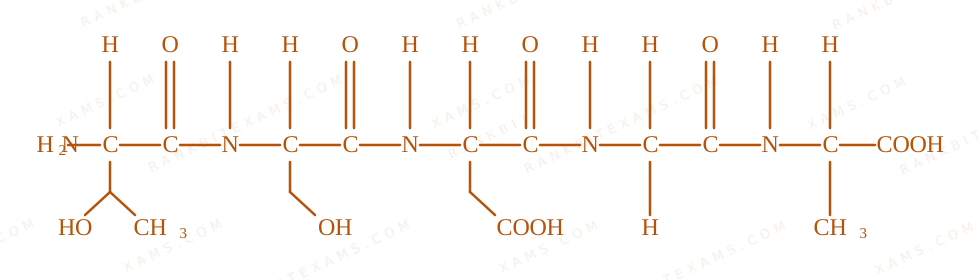
In the given pentapeptide, find out an essential amino acid (Y) and the sequence present in the pentapeptide:
Chemical structure of a pentapeptide
Full structural formula of a polypeptide chain for sequence deduction.
Choose the correct answer from the options given below:
  • A. (Y) Threonine, (Sequence) Ser-Thr-Asp-Gly-Ala
  • B. (Y) Serine, (Sequence) Thr-Ser-Asp-Ala-Gly
  • C. (Y) Threonine, (Sequence) Thr-Ser-Asp-Gly-Ala
  • D. (Y) Serine, (Sequence) Ser-Asp-Thr-Ala-Gly

Solution

Core Logic

Breaking down the peptide sequence from the N-terminal (left) to C-terminal (right):

  • First amino acid side chain is -CH(OH)CH₃. This matches Threonine (Thr).
  • Second amino acid side chain is -CH₂OH. This matches Serine (Ser).
  • Third amino acid side chain is -CH₂COOH. This matches Aspartic Acid (Asp).
  • Fourth amino acid side chain is just -H. This matches Glycine (Gly).
  • Fifth amino acid side chain is -CH₃. This matches Alanine (Ala).
  • Sequence: Thr - Ser - Asp - Gly - Ala.

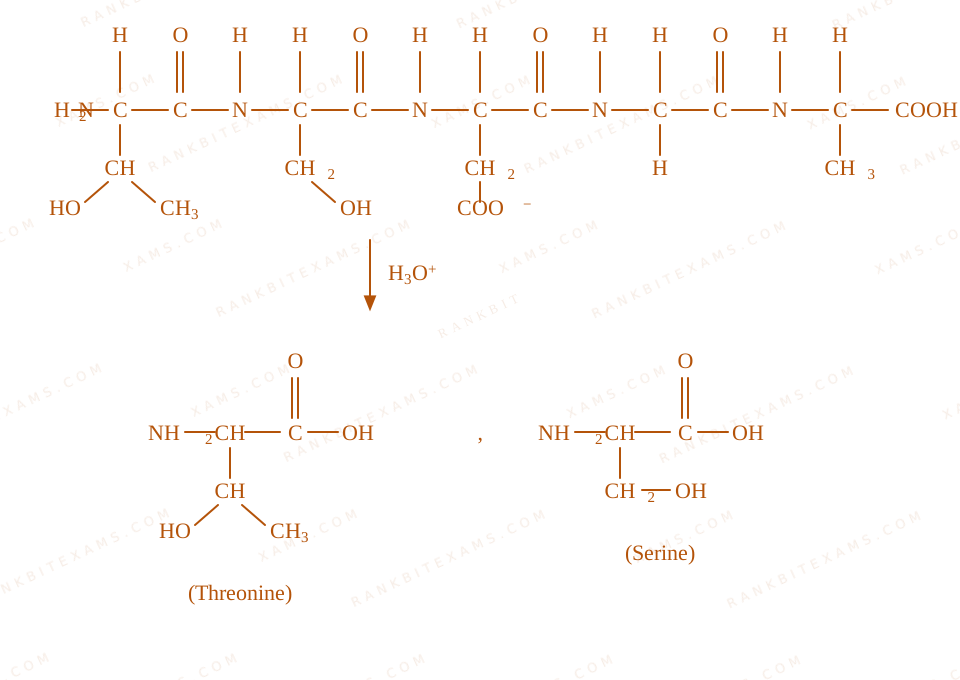
    Hydrolysis of pentapeptide into constituent amino acids
    Full structural formula of a polypeptide chain for sequence deduction.

Step 1: Identify the Essential Amino Acid

Among the constituents (Thr, Ser, Asp, Gly, Ala), Threonine is an essential amino acid (cannot be synthesized by the human body).

Final Conclusion

Essential Amino acid (Y) = Threonine. Sequence = Thr-Ser-Asp-Gly-Ala.

Pattern Recognition

N-terminal reading is standard left-to-right. Memory aid for essential amino acids: 'PVT TIM HALL' (Threonine is the 'T').

Chapter Mix

Class 12 Chemistry: Biomolecules
Q61 jee_main_2026_28_january_evening Reducing And Non Reducing Sugars
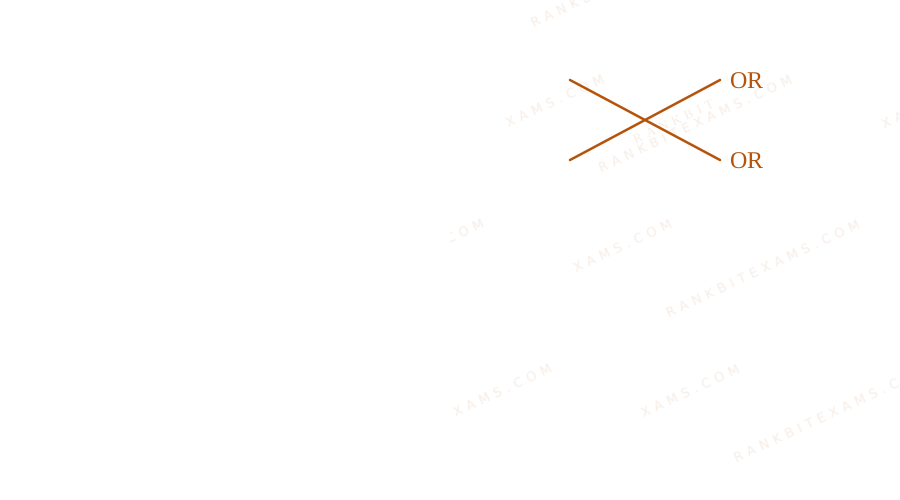
Structures of four disaccharides are given below. Among the given disaccharides, the non-reducing sugar is :
  • A. (1)
  • B. (2)
  • C. (3)
  • D. (4)

Solution

Core Logic

For a sugar to be non-reducing, it must NOT possess a free hemiacetal or hemiketal group. The linkage connecting the monosaccharide units must consume both anomeric carbons via an acetal/ketal linkage. Structure (1) represents Sucrose, which has an α, β -1,2-glycosidic bond. Both anomeric carbons are locked in the glycosidic linkage

Reducing And Non Reducing Sugars
and
Reducing And Non Reducing Sugars
. Structures (2), (3), and (4) are maltose or lactose-type structures containing a free anomeric -OH, thus acting as reducing sugars.

Step 1: Final Conclusion

Structure (1) is sucrose, which lacks a hemiacetal linkage, making it a non-reducing sugar.

Pattern Recognition

Whenever asked for a non-reducing sugar among standard disaccharides, look for Sucrose (linked at C1 of glucose and C2 of fructose). Both anomeric carbons are tied up.

Chapter Mix

Class 12 Chemistry: Biomolecules

Q44 jee_main_2025_02_april_evening Proteins and Amino Acid Sequences
A tetrapeptide "x" on complete hydrolysis produced glycine (Gly), alanine (Ala), valine (Val), leucine (Leu) in equimolar proportion each. The number of tetrapeptides (sequences) possible involving each of these amino acids is
  • A. 16
  • B. 32
  • C. 8
  • D. 24

Solution

Related Formula
Number of unique sequences = n!
Core Logic

A tetrapeptide is formed by connecting four amino acids through three peptide linkages.

Since the problem specifies that complete hydrolysis of the tetrapeptide produces Gly, Ala, Val, and Leu in equimolar proportions, the peptide must contain exactly one molecule of each of these four distinct amino acids.

Step 1: Calculate the Permutations

The number of unique peptide sequences corresponds to the number of ways we can arrange these 4 distinct amino acids:

Number of permutations = 4! = 4 × 3 × 2 × 1 = 24
Pattern Recognition

Combinatorics in Chemistry: If we have n unique, non-repeating amino acids, the number of linear isomeric peptides is n!. If repetition were permitted, the number of possible peptides would be nⁿ (which would be 4⁴ = 256 in this case).

Chapter Mix

Class 12 Chemistry: Biomolecules

More Biomolecules Questions — jee_main_2025_07_april_morning

Practice all Biomolecules previous-year questions →

Rankbit System
JEE Physics: Waves (+15.5%) | Electrostatics: Concentric Shells (-29.7%) | Modern Physics: Photoelectric Clones (+34.2%) | Mathematics: Definite Integrals (+18.1%) | Chemistry: Coordination Splitting (-11.4%) | JEE Physics: Waves (+15.5%) | Electrostatics: Concentric Shells (-29.7%) | Modern Physics: Photoelectric Clones (+34.2%) | Mathematics: Definite Integrals (+18.1%) | Chemistry: Coordination Splitting (-11.4%)