JEE Main · Physics ↓ Falling

Mechanical Properties of Fluids appeared 32 times across 3 years — 3.7% of Physics. This question is from Capillarity.

Year 2026 2025 2024 Total
Questions 9 15 8 32

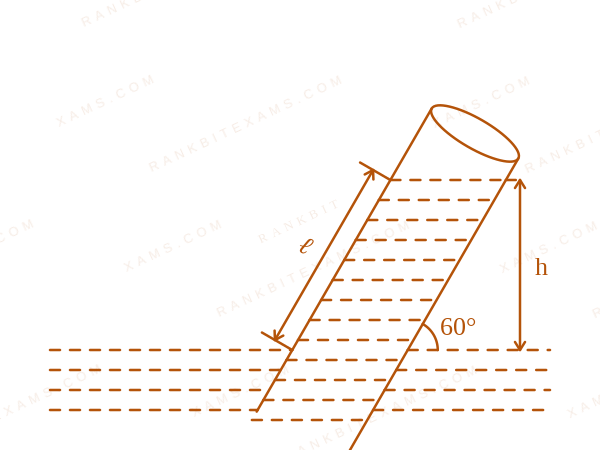
A capillary tube of radius 0.1 mm is partly dipped in water (surface tension 70~dyn/cm and glass water contact angle simeq0circ) with 30circ inclined with vertical. The length of water risen in the capillary is cm. (Take g=9.8~m/s²) [cite: 83, 84]

Solution & Explanation

Related Formula

h = (2T θ)/(ρ g r) [cite: 694]

Core Logic

First, calculate the vertical height h using CGS units: [cite: 694]

  • T = 70 dyn/cm [cite: 83]
  • θ = 0° = 1 [cite: 83]
  • ρ = 1 g/cm³ [cite: 694]
  • g = 980 cm/s² [cite: 694]
  • r = 0.1 mm = 10⁻² cm [cite: 83, 694]
  • h = 2 × 70 × 11 × 980 × 10⁻² = (140)/(9.8) = (100)/(7) cm [cite: 694]

    Since the tube is inclined at 30° to the vertical, the angle it makes with the horizontal is 60°[cite: 83, 694]. The relationship between vertical height h and slant length l is: [cite: 694]

    60° = (h)/(l) l = h 60° = 2h√(3) [cite: 694]

    l = (100)/(7) × 2√(3) = 2007√(3) ≈ 16.49 cm [cite: 696, 697, 698]

    Checking option values, (82)/(5) = 16.4 cm, which is closest[cite: 85, 698].

Pattern Recognition

When a capillary tube is tilted, the vertical height of the fluid column remains constant to maintain hydrostatic pressure balance[cite: 694]. Thus, the length of the liquid along the slant always scales as l = (h)/( α) where α is the tilt angle relative to the vertical line[cite: 83, 694].

Chapter Mix

Class 11 Physics: Mechanical Properties of Fluids

Capillarity diagram for Q8 - JEE Main 2025 Evening

Reference Study Guides

More Mechanical Properties of Fluids Previous-Year Questions — Page 7

Q47 jee_main_2024_31_jan_evening Viscosity and Terminal Velocity
A small spherical ball of radius r, falling through a viscous medium of negligible density has terminal velocity 'v'. Another ball of the same mass but of radius 2r, falling through the same viscous medium will have terminal velocity:
  • A. (v)/(2)
  • B. (v)/(4)
  • C. 4v
  • D. 2v

Solution

Related Formula

At terminal velocity, downward force equals upward drag (assuming negligible buoyancy):

Mg = 6π η r v v = (Mg)/(6π η r)
Core Logic

Since the density of the medium is negligible, we ignore buoyant forces. The mass M of the ball is specified to remain the same in both cases, despite the change in radius (implying the material density of the second ball is lower).

Step 1: Setup Proportionality

Since M, g, and η are all constants:

v ∝ (1)/(r)
Step 2: Evaluating the Ratio

For the second ball, r' = 2r. Therefore, the new terminal velocity v' is:

v' = v × ((r)/(r')) = v × ((r)/(2r)) = (v)/(2)
Pattern Recognition

Read the constraints carefully. Usually, questions keep material density uniform (v ∝ r²). However, this specifically says "same mass". This shifts the formula dependency from v ∝ r² entirely to v ∝ 1/r because M acts as a constant numerator.

Chapter Mix

Class 11 Physics: Mechanical Properties of Fluids
Q jee_main_2024_31_jan_morning Viscosity And Terminal Velocity
A small steel ball is dropped into a long cylinder containing glycerine. Which one of the following is the correct representation of the velocity time graph for the transit of the ball?
  • A.
  • B.
  • C.
  • D.

Solution

Related Formula
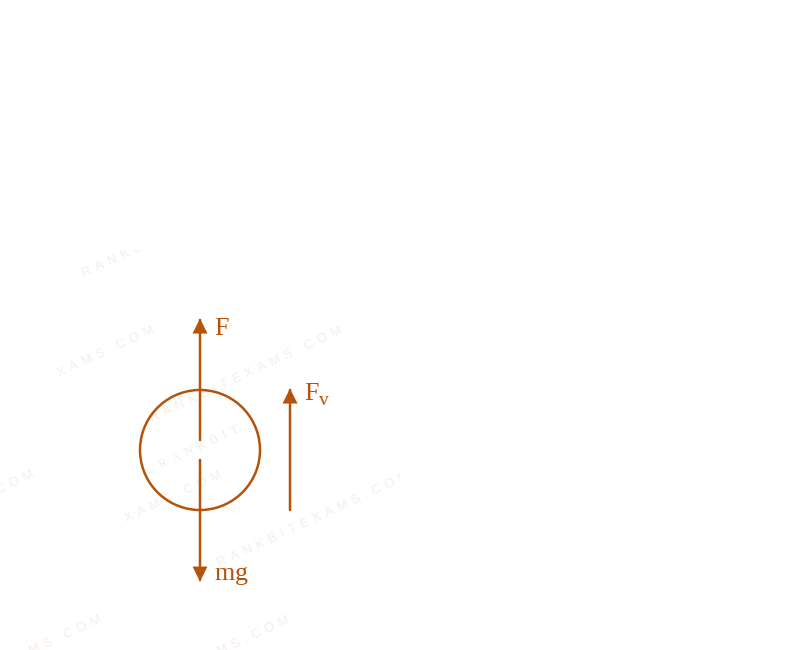
mg - FB - Fv = ma Fv = 6πη r v
Core Logic

Viscosity And Terminal Velocity diagram for Q46 - JEE Main 2024 Morning

When dropped, three forces act on the ball: Gravity downwards, Buoyant force upwards, and Viscous drag upwards.

mg - FB - Fv = m (dv)/(dt) (ρ (4)/(3)π r³)g - (ρL (4)/(3)π r³)g - 6πη rv = m (dv)/(dt)

Let (4π r³ g(ρ - ρL))/(3m) = K₁ and (6πη r)/(m) = K₂.

(dv)/(dt) = K₁ - K₂ v

Integrating from t=0, v=0:

∫₀^v (dv)/(K₁ - K₂ v) = ∫₀^t dt -(1)/(K₂) ln ((K₁ - K₂ v)/(K₁)) = t v = (K₁)/(K₂) ( 1 - e-K₂ t )

This is an exponential curve starting from the origin and asymptotically approaching the terminal velocity VT = K₁ / K₂.

Chapter Mix

Class 11 Physics: Mechanical Properties Of Fluids

More Mechanical Properties of Fluids Questions — jee_main_2025_07_april_evening

Practice all Mechanical Properties of Fluids previous-year questions →

Rankbit System
JEE Physics: Waves (+15.5%) | Electrostatics: Concentric Shells (-29.7%) | Modern Physics: Photoelectric Clones (+34.2%) | Mathematics: Definite Integrals (+18.1%) | Chemistry: Coordination Splitting (-11.4%) | JEE Physics: Waves (+15.5%) | Electrostatics: Concentric Shells (-29.7%) | Modern Physics: Photoelectric Clones (+34.2%) | Mathematics: Definite Integrals (+18.1%) | Chemistry: Coordination Splitting (-11.4%)
