A body of mass m$m$ is suspended by two strings making angles θ1$\theta{1}$ and θ₂$\theta_{2}$ with the horizontal ceiling with tensions T₁$T_{1}$ and T₂$T_{2}$ simultaneously. T₁$T_{1}$ and T₂$T_{2}$ are related by T₁=√(3)T₂$T_{1}=\sqrt{3}T_{2}$ the angles \theta_{1} and \theta_{2} are
A.θ₁=30°, θ₂=60° with T₂=(3mg)/(4)$\theta_{1}=30^{\circ}, \theta_{2}=60^{\circ}\text{ with } T_{2}=\frac{3mg}{4}$
B.θ₁=60°, θ₂=30° with T₂=(mg)/(2)$\theta_{1}=60^{\circ}, \theta_{2}=30^{\circ}\text{ with } T_{2}=\frac{mg}{2}$
C.θ₁=45°, θ₂=45° with T₂=(3mg)/(4)$\theta_{1}=45^{\circ}, \theta_{2}=45^{\circ}\text{ with } T_{2}=\frac{3mg}{4}$
D.θ₁=30°, θ₂=60° with T₂=(4mg)/(5)$\theta_{1}=30^{\circ}, \theta_{2}=60^{\circ}\text{ with } T_{2}=\frac{4mg}{5}$
Lami's Theorem or standard rectangular resolution of forces. When tension is scaled by √(3)$\sqrt{3}$, it directly hints at complementary 30°--60°$30^{\circ}\text{--}60^{\circ}$ geometric alignments.
Evaluation Rubric / Model Answer
Option B: θ₁=60°, θ₂=30° with T₂=(mg)/(2)$\theta_{1}=60^{\circ}, \theta_{2}=30^{\circ}\text{ with } T_{2}=\frac{mg}{2}$
Chapter Mix
Class 11 Physics: Laws of Motion
More Laws of Motion Previous-Year Questions — Page 4
Q22jee_main_2025_24_jan_eveningCircular Motion
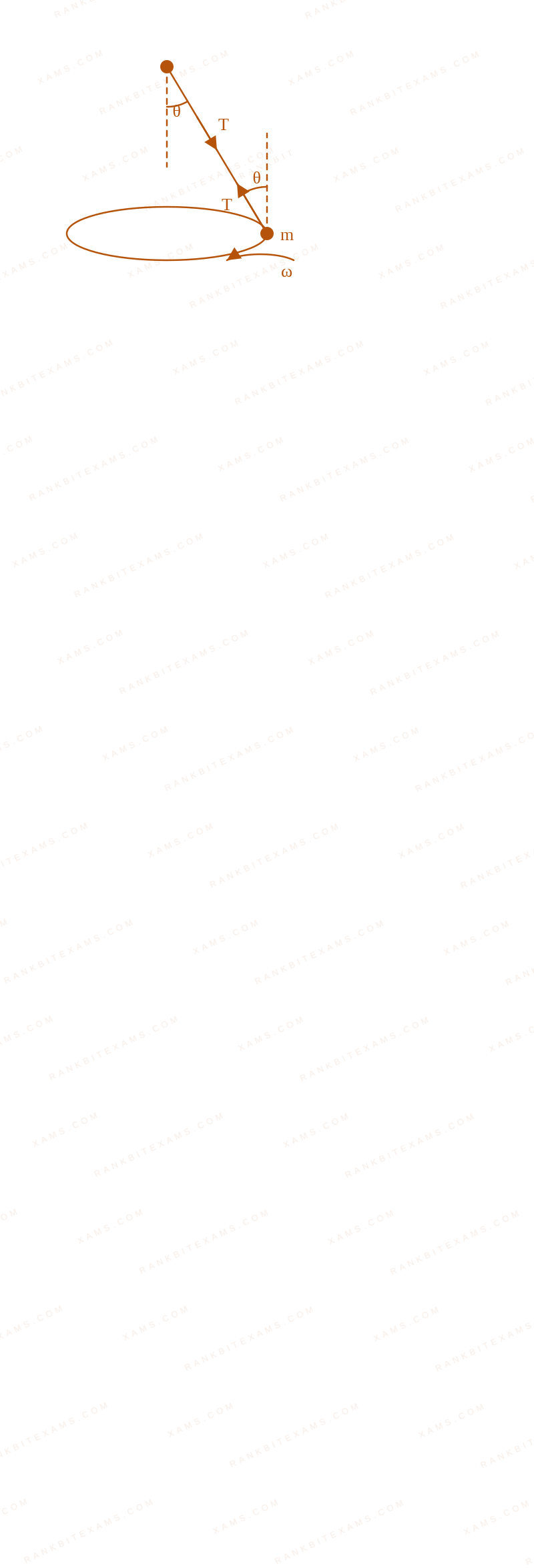
A string of length L is fixed at one end and carries a mass of M at the other end. The mass makes ((3)/(π))$\left(\frac{3}{\pi}\right)$ rotations per second about the vertical axis passing through end of the string as shown. The tension in the string is ____ ML.
Substituting R = L θ$R = L \sin \theta$ into the centripetal equation: Conical pendulum string force vectors diagram Q22
T θ = M ω² (L θ)$$T \sin \theta = M \omega^2 (L \sin \theta)$$T = M ω² L$$T = M \omega^2 L$$
Given rotational frequency: f = (3)/(π) rev/s$f = \frac{3}{\pi}\ \mathrm{rev/s}$
Angular velocity:
ω = 2π f = 2π ((3)/(π)) = 6 rad/s$$\omega = 2\pi f = 2\pi \left(\frac{3}{\pi}\right) = 6\ \mathrm{rad/s}$$
Substituting ω$\omega$ back into the simplified tension equation:
T = M (6)² L = 36 ML$$T = M (6)^2 L = 36\ ML$$
Pattern Recognition
In a conical pendulum, the horizontal projection of tension provides the exact centripetal force. The θ$\sin\theta$ terms cancel out, making string tension independent of the semi-vertical angle.
Chapter Mix
Class 11 Physics: Laws of Motion
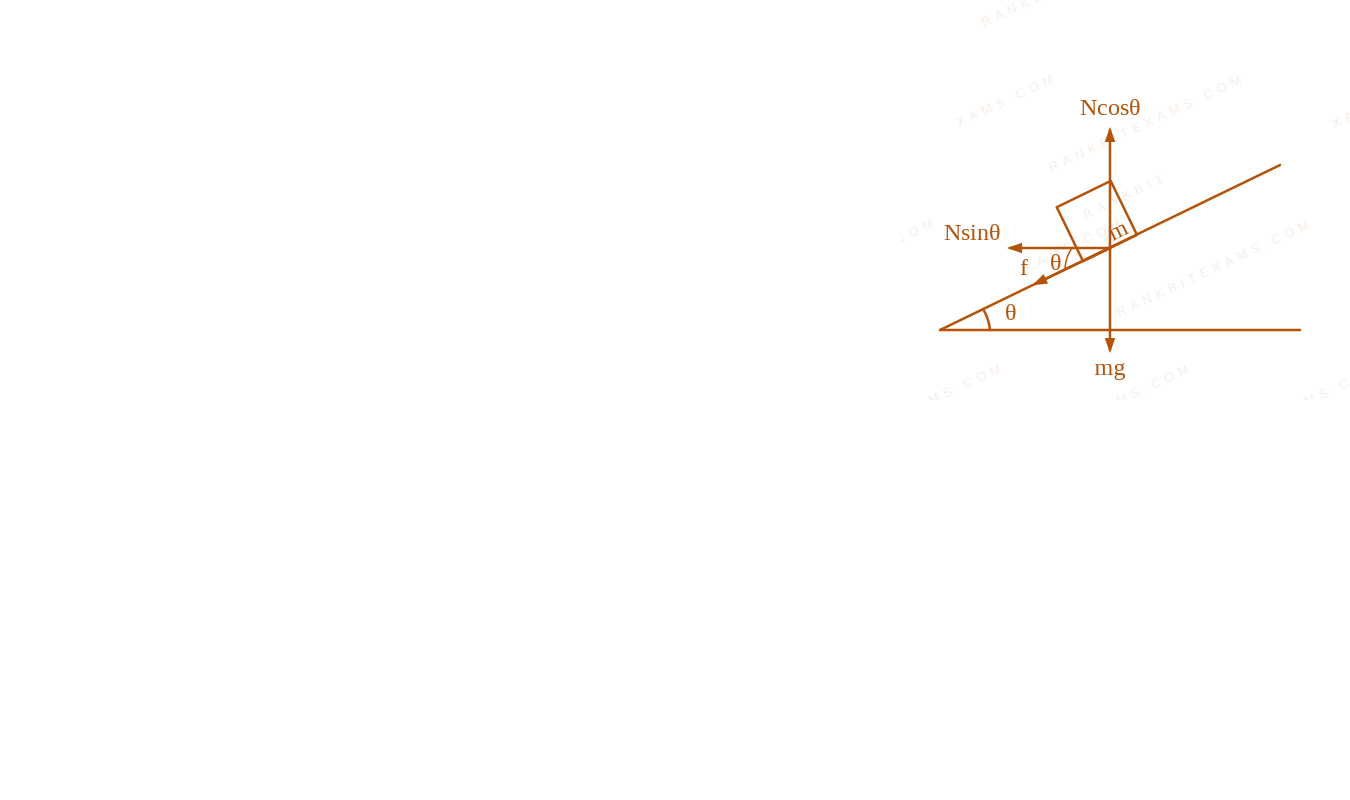
Qjee_main_2025_24_jan_morningCircular Motion and Banking of Roads
A car of mass 'm' moves on a banked road having radius 'r' and banking angle θ$\theta$ To avoid slipping from banked road, the maximum permissible speed of the car is v₀.$v_{0}.$ The coefficient of friction μ$\mu$ between the wheels of the car and the banked road is :-
Maximum limits always balance with plus signs in the numerator fraction. Simply rearrange that template expression directly to map the targeted parameter.
Chapter Mix
Class 11 Physics: Laws of Motion
Q20jee_main_2025_28_jan_eveningNewton Second Law Applications
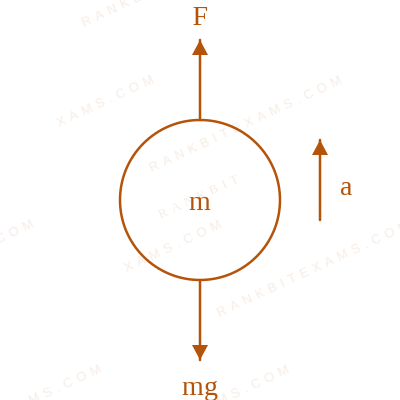
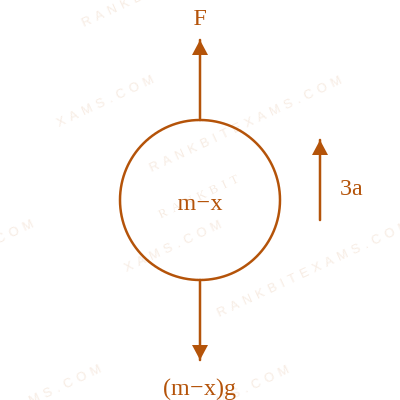
A balloon and its content having mass M is moving up with an acceleration 'a'. The mass that must be released from the content so that the balloon starts moving up with an acceleration '3a' will be : (Take 'g' as acceleration due to gravity) [cite: 174, 175]
Substitute the value of F$F$ from Case 1 into Case 2 [cite: 836, 839]:
M(g + a) - (M - x)g = (M - x)3a$$M(g + a) - (M - x)g = (M - x)3a$$M g + M a - M g + x g = 3 M a - 3 x a$$M g + M a - M g + x g = 3 M a - 3 x a \quad \text{}$$M a + x g = 3 M a - 3 x a$$M a + x g = 3 M a - 3 x a$$x(g + 3a) = 2 M a$$x(g + 3a) = 2 M a$$x = (2 M a)/(3a + g)$$x = \frac{2 M a}{3a + g} \quad \text{}$$
Step 1: Visual Context
The free-body force layout for both accelerating phases is shown below:
Newton Second Law Applications free body diagrams for Q20
Pattern Recognition
Since the upward buoyant force is completely determined by the balloon's volume, it remains constant. Expressing this constant force in terms of the initial conditions allows you to quickly solve for mass changes when acceleration states vary.
Chapter Mix
Class 11 Physics: Laws of Motion
Qjee_main_2024_01_february_morningFriction
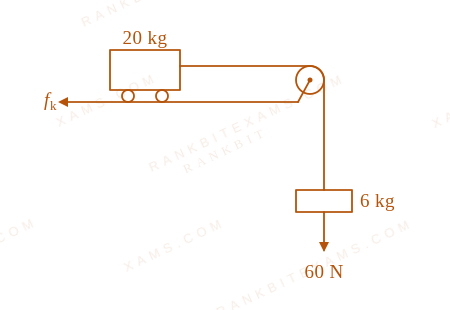
Consider a block and trolley system as shown in figure. If the coefficient of kinetic friction between the trolley and the surface is 0.04, the acceleration of the system in ms⁻²$\mathrm{ms}^{-2}$ is (Consider that the string is massless and unstretchable and the pulley is also massless and frictionless):
A block and trolley mass arrangement demonstrating a horizontal kinetic interface connected over a corner pulley driven by an explicit 60N forcing function loop.
A. 3
B. 4
C. 2
D. 1.2
Solution
Related Formula
Kinetic friction force:
fk = μk N = μk m₁ g$$f_k = \mu_k N = \mu_k m_1 g$$
System acceleration:
a = Fpull - fkmtotal$$a = \frac{F_{\text{pull}} - f_k}{m_{\text{total}}}$$
Core Logic
Given values:
Trolley mass m₁ = 20~kg$m_1 = 20\mathrm{~kg}$, total system mass component in frame mtotal = 26~kg$m_{\text{total}} = 26\mathrm{~kg}$ (from solution fraction (60-8)/(26)$\frac{60-8}{26}$).
Applied pulling force F = 60~N$F = 60\mathrm{~N}$.
μk = 0.04$\mu_k = 0.04$.
Calculate the kinetic friction resisting the trolley:
Practice past-year questions one chapter at a time. Pick an exam → subject → chapter and get every PYQ for that topic — pulled together from all past papers — with the chapter's key formulas alongside.