Solution
Related Formula
The product of slopes of two mutually perpendicular lines is always equal to -1:
m₁ · m₂ = -1Core Logic
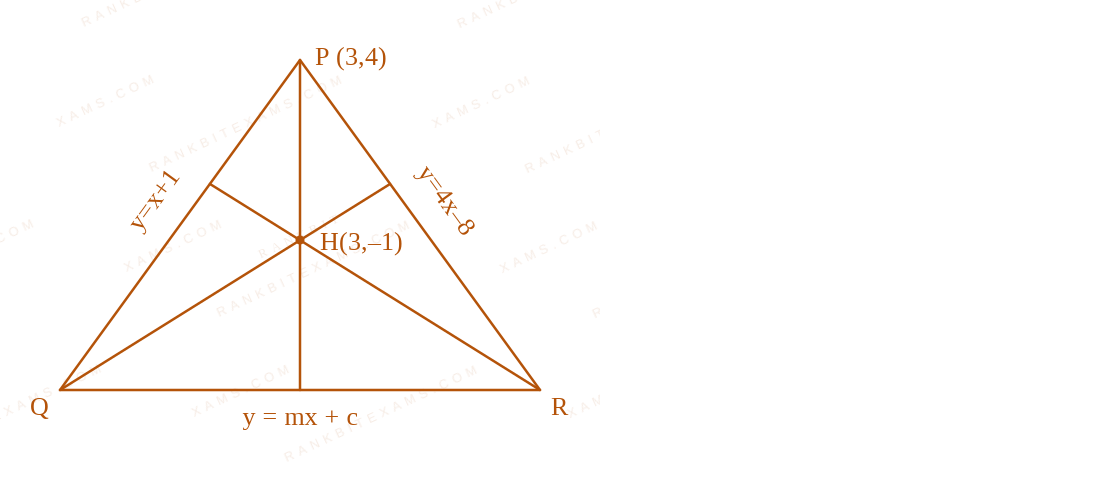
Let the vertices of the triangle be P, Q, and R. The lines given are:
- y = x + 1
- y = 4x - 8
- y = mx + c
Solving lines y = x + 1 and y = 4x - 8 gives the vertex P(3, 4).
The orthocentre is given as H(3, -1). Notice that the x-coordinate of P and H are identical (x = 3). This implies that the altitude from vertex P to the base line y = mx + c is a vertical line along x = 3.
Step 1: Determine the Slopes
Since the altitude from P is vertical, the side opposite to it (which lies on y = mx + c) must be a horizontal line.
Therefore, the slope of the line y = mx + c must be zero:
m = 0
Step 2: Solve for c
Let's find point Q by intersecting y = x + 1 and y = mx + c. Since m = 0, y = c, we get Q(c-1, c).
Using the property that the line segment connecting Q to the opposite side's altitude is perpendicular to line PR (y = 4x - 8):
Slope of QH · Slope of PR = -1 (-1 - c)/(3 - (c - 1)) · 4 = -1 (-4(c + 1))/(4 - c) = -1 4c + 4 = 4 - c 5c = 0 c = 0Step 3: Evaluate m - c
Substituting the values of m and c:
m - c = 0 - 0 = 0Pattern Recognition
When the x-coordinate of a vertex matches the x-coordinate of the orthocentre, the altitude is vertical, forcing the opposite base to be purely horizontal (m=0). This observation cuts down calculation time completely.
Chapter Mix
Class 11 Mathematics: Straight Lines