Q3
jee_main_2026_28_january_evening
Parabola and Triangles
Let A be the focus of the parabola y² = 8x. Let the line y = mx + c intersect the parabola at two distinct points B and C. If the centroid of the triangle ABC is ((7)/(3), (4)/(3)), then (BC)² is equal to :
Solution
Related Formula
Centroid = ((x₁+x₂+x₃)/(3), (y₁+y₂+y₃)/(3)) D² = (x₂-x₁)² + (y₂-y₁)²Core Logic
Focus of y² = 8x is A(2, 0) since 4a = 8 ⇒ a=2. Let points on parabola be B(2t₁², 4t₁) and C(2t₂², 4t₂). The centroid of Δ ABC is given as ((7)/(3), (4)/(3)). Equating coordinates:
(2 + 2t₁² + 2t₂²)/(3) = (7)/(3) ⇒ t₁² + t₂² = (5)/(2) (0 + 4t₁ + 4t₂)/(3) = (4)/(3) ⇒ t₁ + t₂ = 1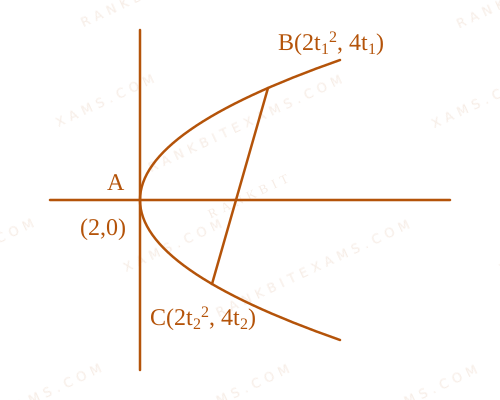
Execution
Square the sum equation:
(t₁ + t₂)² = t₁² + t₂² + 2t₁t₂ 1 = (5)/(2) + 2t₁t₂ ⇒ 2t₁t₂ = -(3)/(2) ⇒ t₁t₂ = -(3)/(4)Find (t₁ - t₂)²:
(t₁ - t₂)² = (t₁ + t₂)² - 4t₁t₂ = 1 - 4(-(3)/(4)) = 4Calculate distance squared for BC:
(BC)² = (2t₁² - 2t₂²)² + (4t₁ - 4t₂)² (BC)² = 4(t₁ - t₂)²(t₁ + t₂)² + 16(t₁ - t₂)² (BC)² = 4(4)(1) + 16(4) = 16 + 64 = 80Pattern Recognition
Using parametric coordinates (at², 2at) systematically reduces algebraic complexity when determining intersections or triangle properties on a parabola.
Chapter Mix
Class 11 Maths: Conic Sections