JEE Main · Physics ↓ Falling

Laws of Motion appeared 34 times across 3 years — 3.9% of Physics. This question is from Friction.

Year 2026 2025 2024 Total
Questions 9 10 15 34

A block of mass 25 kg is pulled along a horizontal surface by a force at an angle 45circ with the horizontal. The friction coefficient between the block and the surface is 0.25. The work done for a displacement of 5 m of the block with uniform velocity is:

Solution & Explanation

Related Formula
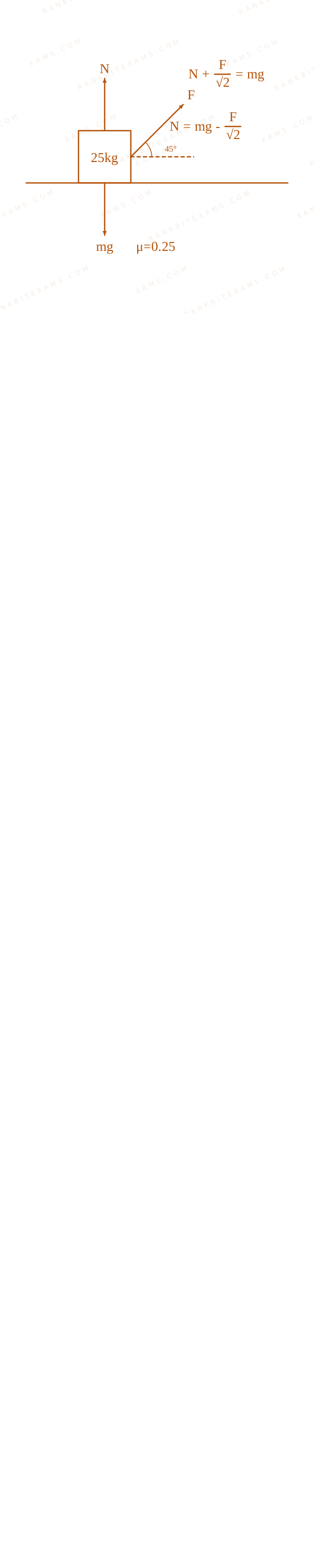
N + F θ = mg N = mg - F θ F θ = fk = μk N W = F · S · θ
Core Logic

Since the block moves with uniform velocity, horizontal acceleration is zero.

F (45^°) = μ [mg - F (45^°)] F√(2) = 0.25 [25 × 9.8 - F√(2)] F√(2) = 61.25 - 0.25 F√(2) 1.25 F√(2) = 61.25
Step 1: Compute Force and Work Done
F√(2) = (61.25)/(1.25) = 49 F = 49√(2) N

The work done by the external force over displacement S=5 m is: W = F S (45^°) = (49√(2)) × 5 × 1√(2) = 245 J

Free body diagram of the block showing external force components and friction

Pattern Recognition

When uniform velocity is sustained, work done by the external pulling component perfectly matches the work consumed against internal friction dissipation (W = fk · S).

Chapter Mix

Class 11 Physics: Laws of Motion
Reference Study Guides

More Laws of Motion Previous-Year Questions — Page 5

Q37 jee_main_2024_01_february_morning Circular Motion
A ball of mass 0.5~kg is attached to a string of length 50~cm. The ball is rotated on a horizontal circular path about its vertical axis. The maximum tension that the string can bear is 400~N. The maximum possible value of angular velocity of the ball in rad/s is:
  • A. 1600
  • B. 40
  • C. 1000
  • D. 20

Solution

Related Formula

Centripetal force configuration for simplified horizontal rotation layout:

T = mω² l

Core Logic

Given values: m = 0.5~kg, l = 50~cm = 0.5~m, Tmax = 400~N.

Equating max tension to centripetal requirement:

400 = 0.5 × ω² × 0.5
Step 1: Compute Angular Velocity
400 = 0.25 ω² ω² = (400)/(0.25) = 1600 ω = √(1600) = 40~rad/s
Pattern Recognition

Ensure units are metric (50~cm → 0.5~m). Direct mapping to horizontal string projection metrics.

Chapter Mix

Class 11 Physics: Laws of Motion
Q36 jee_main_2024_29_january_evening Circular Motion and Tension
A stone of mass 900 g is tied to a string and moved in a vertical circle of radius 1 m making 10 rpm. The tension in the string, when the stone is at the lowest point is (if π² = 9.8 and g = 9.8 m/s²):
  • A. 97 N
  • B. 9.8 N
  • C. 8.82 N
  • D. 17.8 N

Solution

Related Formula

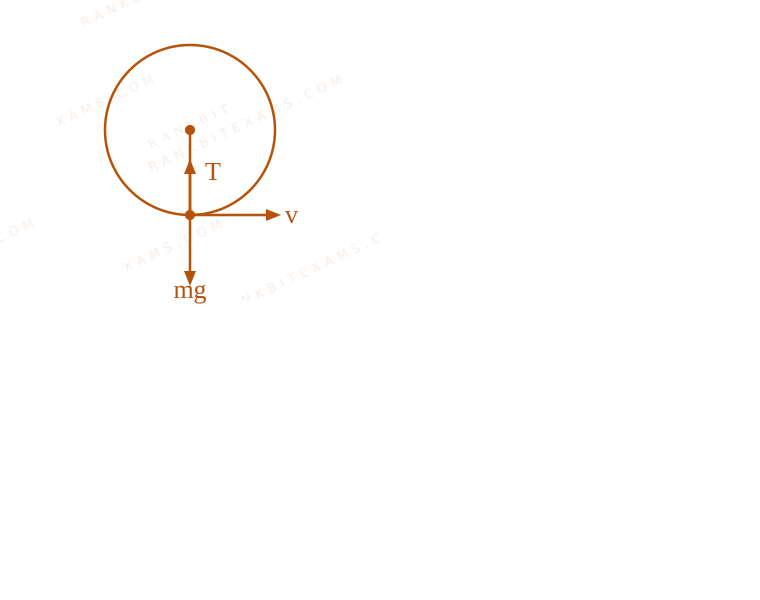
At the lowest point of a vertical circle, the equation of motion for a mass m is:

T - mg = m r ω²

Rearranging to solve for tension T:

T = mg + m r ω²
Core Logic

Given data:

  • Mass, m = 900 g = 0.9 kg
  • Radius, r = 1 m
  • Frequency, N = 10 rpm = (10)/(60) rps = (1)/(6) rps
  • Angular velocity, ω = 2π N = 2π ((1)/(6)) = (π)/(3) rad/s
Step 1: Calculate Force Values

Now we substitute our parameters into the tension equation:

T = (0.9)(9.8) + (0.9)(1)((π)/(3))² T = 8.82 + 0.9 × (π²)/(9)

Since π² = 9.8:

T = 8.82 + 0.1 × 9.8 T = 8.82 + 0.98 = 9.80 N

Free-body diagram of stone at lowest point in vertical circle for Q36

Pattern Recognition

Always convert Mass to kg and rotational speed to rad/s first. Using the prompt constraint π² = 9.8 yields a perfect decimal addition match.

Chapter Mix

Class 11 Physics: Laws of Motion

Q59 jee_main_2024_29_january_evening Non-uniform Circular Motion
A particle is moving in a circle of radius 50 cm in such a way that at any instant the normal and tangential components of its acceleration are equal. If its speed at t = 0 is 4 m/s, the time taken to complete the first revolution will be (1)/(α)[ 1 - e-2π ] s, where α = ________.
Numerical Answer. Answer: 8 to 8

Solution

Related Formula

For a particle in circular motion:

  • Normal (centripetal) acceleration: ac = (v²)/(r)
  • Tangential acceleration: aₜ = (dv)/(dt)
Core Logic

Given ac = aₜ:

(v²)/(r) = (dv)/(dt) ∫v₀v (dv)/(v²) = ∫₀t (dt)/(r) [ -(1)/(v) ]v₀v = (t)/(r) -(1)/(v) + (1)/(v₀) = (t)/(r) (1)/(v) = (1)/(v₀) - (t)/(r) v = (v₀)/(1 - (v₀ t)/(r))
Step 1: Relate Velocity to Position and Integrate

Substitute the parameters v₀ = 4 m/s and r = 50 cm = 0.5 m:

v = (4)/(1 - 8t) = (ds)/(dt)

Integrating this to find the position s(t):

∫₀s ds = ∫₀t (4)/(1 - 8t) dt s = 4 [ (ln(1 - 8t))/(-8) ]₀^t = -(1)/(2) ln(1 - 8t)
Step 2: Solve for Time of First Revolution

To complete the first revolution, the distance covered is:

s = 2π r = 2π (0.5) = π m

Equating the distance:

π = -(1)/(2) ln(1 - 8t) -2π = ln(1 - 8t) 1 - 8t = e-2π 8t = 1 - e-2π t = (1)/(8) [ 1 - e-2π ] s

Comparing this to (1)/(α)[ 1 - e-2π ] s, we get:

α = 8

Pattern Recognition

The condition aₜ = ac v (dv)/(ds) = (v²)/(r) (dv)/(v) = (ds)/(r). Integrating directly gives v = v₀ es/r. Substituting this back into v = ds/dt makes the final time integral much more intuitive.

Chapter Mix

Class 11 Physics: Laws of Motion

Q36 jee_main_2024_27_jan_morning Banking of Tracks
A train is moving with a speed of 12 m/s on rails which are 1.5 m apart. To negotiate a curve of radius 400 m, the height by which the outer rail should be raised with respect to the inner rail is (Given, g = 10 m/s²):
  • A. 6.0 cm
  • B. 5.4 cm
  • C. 4.8 cm
  • D. 4.2 cm

Solution

Related Formula
θ = (v²)/(Rg)

For small angles, θ ≈ θ = (h)/(d), where h is the raised height and d is the separation between the tracks.

Core Logic

Equating the two relationships:

(h)/(d) = (v²)/(Rg) (h)/(1.5) = (12 × 12)/(400 × 10)
Step 1: Compute height value
h = 1.5 × (144)/(4000) = 1.5 × 0.036 = 0.054 m

Converting to centimeters:

h = 0.054 × 100 = 5.4 cm
Pattern Recognition

Whenever θ is small, geometry permits approximating θ with hwidth, vastly reducing computational transcendental overhead.

Chapter Mix

Class 11 Physics: Laws of Motion

Q45 jee_main_2024_27_jan_morning Conservation of Linear Momentum
A body of mass 1000 kg is moving horizontally with a velocity 6 m/s. If 200 kg extra mass is added, the final velocity (in m/s) is:
  • A. 6
  • B. 2
  • C. 3
  • D. 5

Solution

Related Formula
m₁ v₁ = m₂ v₂
Core Logic

Since there is no external horizontal force acting on the body, linear momentum along the horizontal axis is conserved.

Initial mass m₁ = 1000 kg, initial velocity v₁ = 6 m/s. Final mass m₂ = 1000 + 200 = 1200 kg.

Step 1: Balance conservation equation
1000 × 6 = 1200 × v₂ 6000 = 1200 v₂ v₂ = (6000)/(1200) = 5 m/s
Pattern Recognition

Inelastic mass addition transitions are classic momentum-balance equations, scaling velocity inversely with total expanded mass profiles.

Chapter Mix

Class 11 Physics: Laws of Motion

More Laws of Motion Questions — jee_main_2025_04_april_evening

Practice all Laws of Motion previous-year questions →

Rankbit System
JEE Physics: Waves (+15.5%) | Electrostatics: Concentric Shells (-29.7%) | Modern Physics: Photoelectric Clones (+34.2%) | Mathematics: Definite Integrals (+18.1%) | Chemistry: Coordination Splitting (-11.4%) | JEE Physics: Waves (+15.5%) | Electrostatics: Concentric Shells (-29.7%) | Modern Physics: Photoelectric Clones (+34.2%) | Mathematics: Definite Integrals (+18.1%) | Chemistry: Coordination Splitting (-11.4%)