JEE Main · Chemistry → Steady

Alcohols Phenols and Ethers appeared 23 times across 3 years — 2.7% of Chemistry. This question is from Commercial Preparation and Reactions.

Year 2026 2025 2024 Total
Questions 7 5 11 23

A toxic compound “A” when reacted with NaCN in aqueous acidic medium yields an edible cooking component and food preservative “B”. “B” is converted to “C” by diborane and can be used as an additive to petrol to reduce emission. “C” upon reaction with oleum at 140°C yields an inhalable anesthetic “D”. Identify “A”, “B”, “C” and “D”, respectively.

Solution & Explanation

Core Logic

Let's track the conversions row by row based on the description:

  • Toxic compound A is methanol (CH₃OH). Reacting it via acidic NaCN sequences effectively converts it eventually into acetic acid (CH₃COOH), which is an edible cooking component and food preservative (vinegar) B.
  • Reduction of acetic acid (B) with diborane (B₂H₆) yields ethanol (CH₃CH₂OH) C. Ethanol is used as a biofuel additive in petrol.
  • Ethanol (C) upon heating with oleum/concentrated sulfuric acid at 140°C undergoes intermolecular dehydration to yield diethyl ether (C₂H₅-O-C₂H₅) D, which functions as an inhalable anesthetic.
Step 1: Chemical Reaction Sequence Flow

Chemical flow chart for sequential ether preparation

The full sequential progression corresponds exactly to:

Methanol (A) arrow Acetic Acid (B) arrow Ethanol (C) arrow Diethyl ether (D)
Pattern Recognition

Key temperature indicator: Dehydration of ethanol at 140°C yields diethyl ether (ether synthesis), whereas 170°C yields ethene gas. Combined with the food preservative clue (acetic acid), the sequence locks instantly to option (3).

Chapter Mix

Class 12 Chemistry: Alcohols, Phenols and Ethers

Reference Study Guides

More Alcohols, Phenols and Ethers Previous-Year Questions — Page 4

Q63 jee_main_2024_29_january_evening pKa of Phenols
Match List I with List II:
List-I (Compound)List-II (pKₐ value)
A. EthanolI. 10.0
B. PhenolII. 15.9
C. m-NitrophenolIII. 7.1
D. p-NitrophenolIV. 8.3
Choose the correct answer from the options given below :
  • A. A-I, B-II, C-III, D-IV
  • B. A-IV, B-I, C-II, D-III
  • C. A-III, B-IV, C-I, D-II
  • D. A-II, B-I, C-IV, D-III

Solution

Related Formula
pKₐ = - ₁₀ Kₐ Higher acidity Higher Kₐ Lower pKₐ
Core Logic

Comparing the acidic strength among given compounds:

  • Ethanol is least acidic due to lack of resonance stabilization in ethoxide ion pKₐ = 15.9 (II).
  • Phenol forms resonance-stabilized phenoxide pKₐ = 10.0 (I).
  • m-Nitrophenol experiences -I effect of -NO₂ group pKₐ = 8.3 (IV).
  • p-Nitrophenol experiences both strong -R and -I effects, maximizing structural stability pKₐ = 7.1 (III).
Step 1: Assembly

This yields the complete matching pattern: A-II, B-I, C-IV, D-III.

Pattern Recognition

Para nitro substitued positions create maximal charge delocalization through resonance, giving it the lowest pKₐ value out of the options.

Chapter Mix

Class 12 Chemistry: Organic Compounds Containing Oxygen
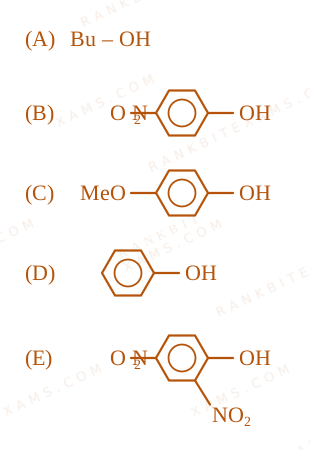
Q jee_main_2024_27_jan_morning Acidity Trends in Phenols
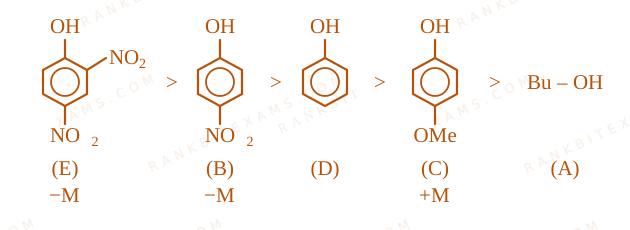
The ascending order of acidity of -OH group in the following compounds is: Choose the correct answer from the options given below:
Acidity compounds structural forms for Q72 - JEE Main 2024 Morning
Structures of molecules P, Q, R, S assigned letters A through E.
Acidity compounds structural forms for Q72 - JEE Main 2024 Morning
Structures of molecules P, Q, R, S assigned letters A through E.
  • A. (A) < (D) < (C) < (B) < (E)
  • B. (C) < (A) < (D) < (B) < (E)
  • C. (C) < (D) < (B) < (A) < (E)
  • D. (A) < (C) < (D) < (B) < (E)

Solution

Core Logic

Aliphatic alcohols (Bu-OH) are least acidic due to +I effects. Among phenols, electron-donating groups like -OMe (+M effect) reduce acidity relative to plain phenol, while electron-withdrawing groups (-NO₂, -M and -I effects) significantly enhance stability of the conjugate phenoxide base. Two -NO₂ groups heighten acidity maximally.

Acidity progression schematic overview for Q72 - JEE Main 2024 Morning
Structures of molecules P, Q, R, S assigned letters A through E.

Step 1: Order verification
Bu-OH (A) < p-methoxyphenol (C) < phenol (D) < p-nitrophenol (B) < 2,4-dinitrophenol (E)
Pattern Recognition

+M groups lower acidity; -M groups raise it. Alcohols are always less acidic than resonant phenols.

Chapter Mix

Class 12 Chemistry: Alcohols, Phenols and Ethers

Q71 jee_main_2024_27_jan_morning Acidity of Phenols and Lucas Test
Given below are two statements: Statement (I): p-nitrophenol is more acidic than m-nitrophenol and o-nitrophenol. Statement (II) : Ethanol will give immediate turbidity with Lucas reagent. In the light of the above statements, choose the correct answer from the options given below :
  • A. Statement I is true but Statement II is false
  • B. Both Statement I and Statement II are true
  • C. Both Statement I and Statement II are false
  • D. Statement I is false but Statement II is true

Solution

Core Logic

Statement I is correct: At the para-position, the -NO₂ group exerts both powerful -I and -M effects, maximizing electron withdrawal from the phenoxide ion. Intramolecular hydrogen bonding reduces the acidity of o-nitrophenol.

Statement II is incorrect: Lucas reagent (conc. HCl + anhydrous ZnCl₂) reacts instantly with tertiary alcohols to give immediate turbidity. Primary alcohols like ethanol do not show turbidity at room temperature without prolonged heating.

Pattern Recognition

Para-nitrophenol acidity maximization vs Lucas test thresholds (3° > 2° > 1°). Primary alcohols react very slowly.

Chapter Mix

Class 12 Chemistry: Alcohols, Phenols and Ethers

Q jee_main_2024_29_jan_morning Cleavage of C-O Bond in Ethers
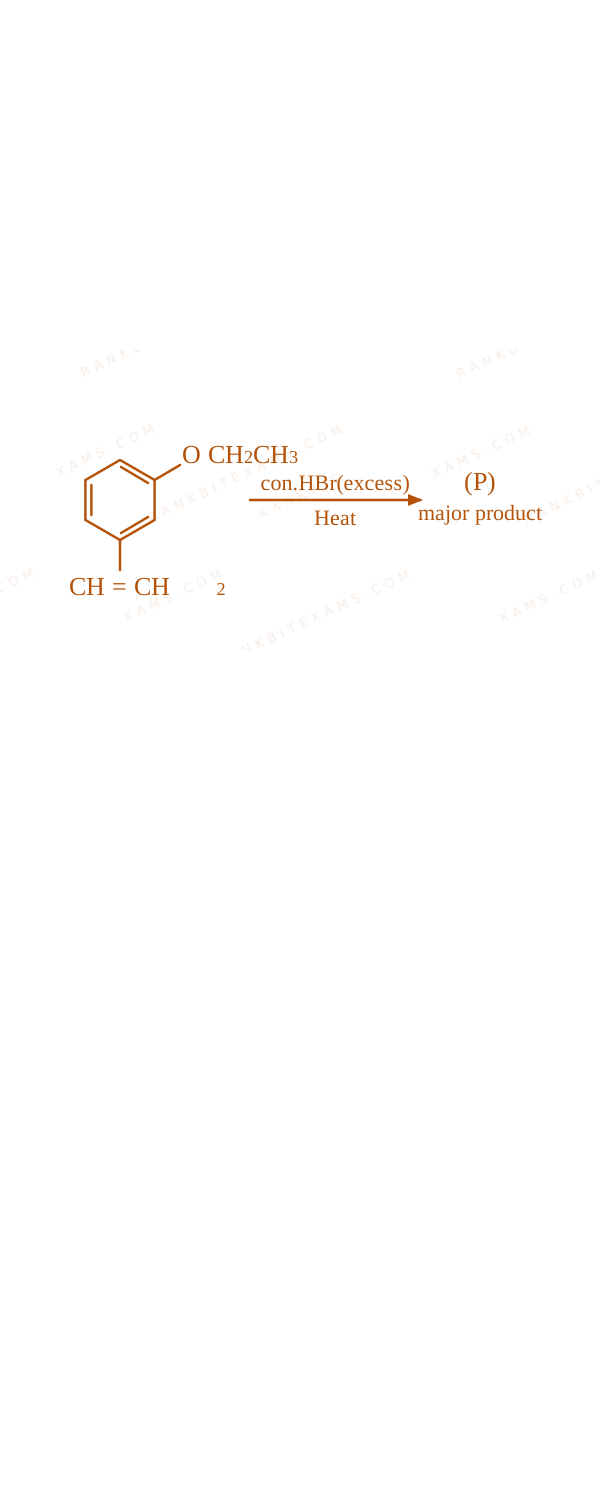
The major product(P) in the following reaction is
Cleavage of C-O Bond in Ethers diagram for Q67 - JEE Main 2024 Morning
Reaction showing an aromatic ether with a vinyl group reacting with excess HBr.
  • A. ""
  • B. ""
  • C. ""
  • D. ""

Solution

Core Logic

The substrate has two reactive functional groups towards HBr (in excess):

  • An aromatic ether (anisole-type) linkage: -O-CH₂-CH₃
  • An isolated alkene (vinyl) group attached to the aromatic ring: -CH=CH₂
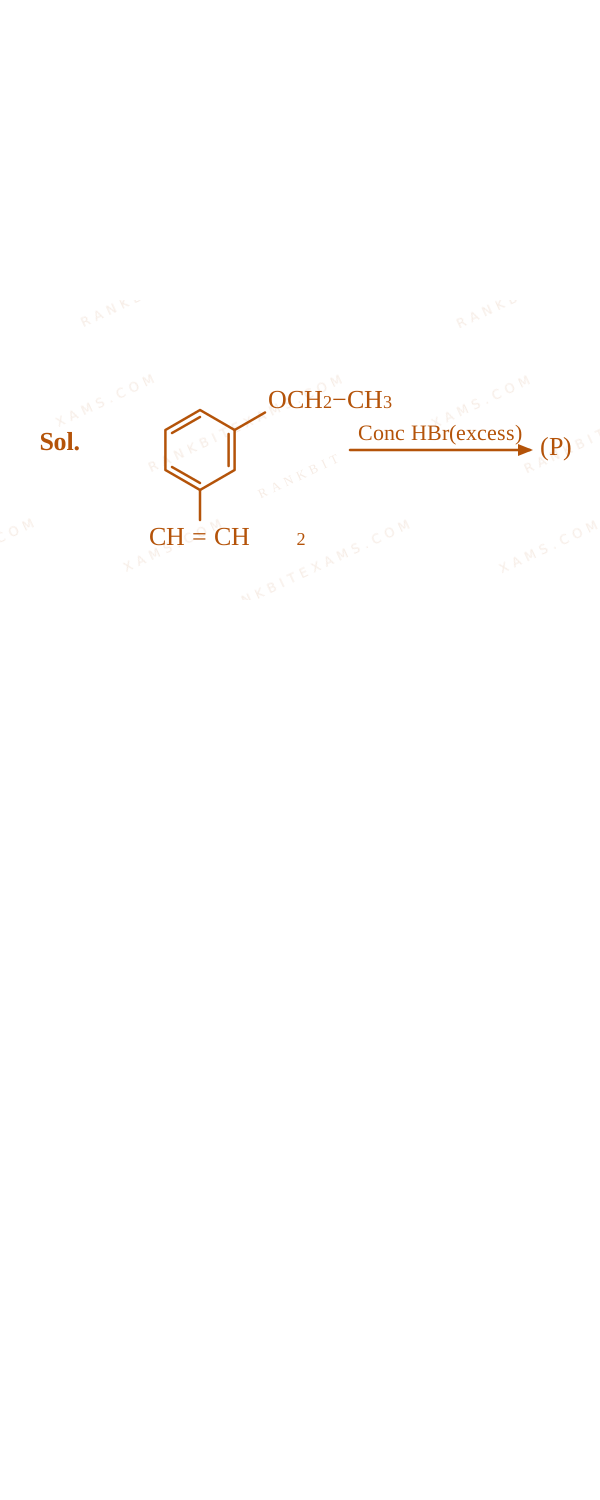
  • Reaction 1: Ether Cleavage The ether linkage reacts with HBr. Protonation of the ether oxygen occurs first, forming an oxonium ion. The Br^- ion then attacks the less hindered (and sp³ hybridized) alkyl group (SN2 mechanism), specifically the ethyl group. The C(aryl)-O bond is much stronger due to partial double bond character from resonance, so it does NOT break. This yields a phenol group on the ring and ethyl bromide (CH₃-CH₂-Br).

    Reaction 2: Electrophilic Addition to Alkene The vinyl group (-CH=CH₂) undergoes electrophilic addition with HBr. Protonation yields the more stable secondary benzylic carbocation (Markovnikov's rule). The Br^- then attacks this carbocation to form a 1-bromoethyl group attached to the ring.

Step 1: Detailed Mechanism

Cleavage of C-O Bond in Ethers diagram for Q67 - JEE Main 2024 Morning
Reaction showing an aromatic ether with a vinyl group reacting with excess HBr.

Cleavage of C-O Bond in Ethers diagram for Q67 - JEE Main 2024 Morning
Reaction showing an aromatic ether with a vinyl group reacting with excess HBr.

Final product: The ring retains an -OH group (phenol) at the original ether position, and the vinyl group is converted into a -CH(Br)-CH₃ group.

Pattern Recognition

Excess HBr with an aryl-alkyl ether always cleaves the alkyl C-O bond to give phenol + alkyl bromide. Never break the aryl C-O bond.

Chapter Mix

Class 12 Chemistry: Alcohols Phenols and Ethers Class 11 Chemistry: Hydrocarbons

Q jee_main_2024_30_january_evening Reactions of Phenols
Salicylaldehyde is synthesized from phenol, when reacted with
  • A.
  • B. CO₂ , NaOH
  • C. CCl₄ , NaOH
  • D. HCCl₃ , NaOH

Solution

Core Logic

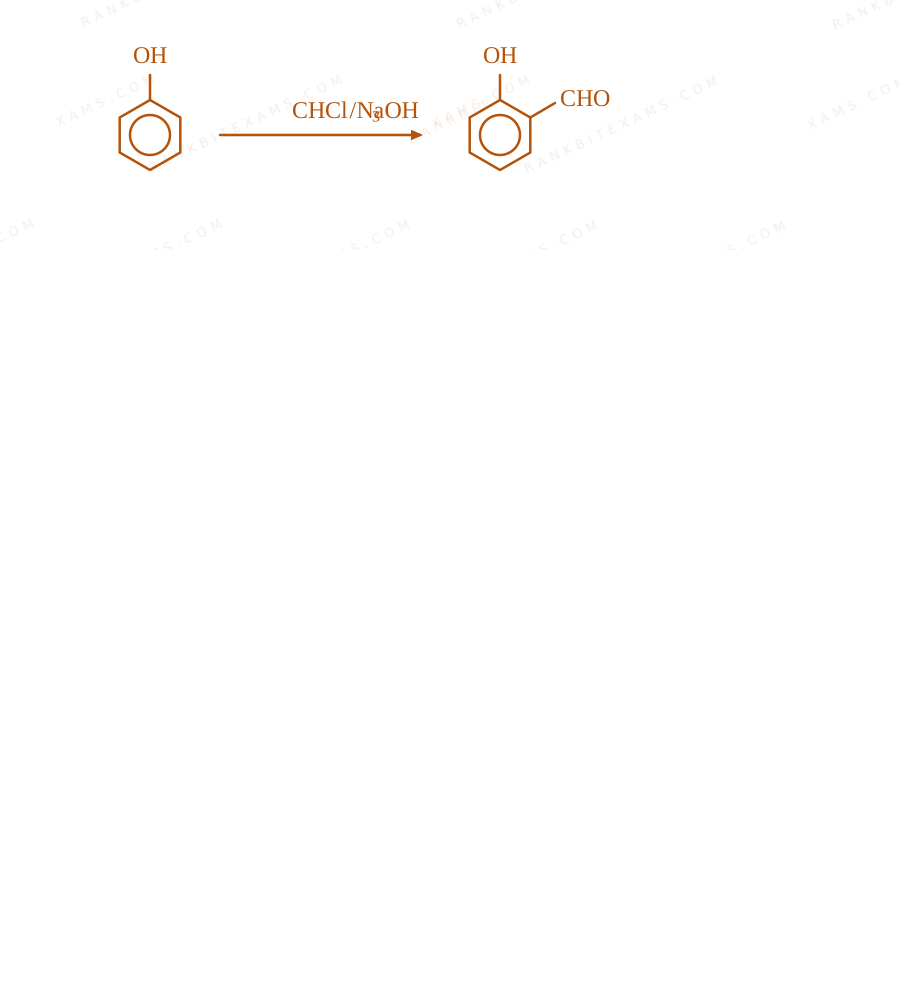
Salicylaldehyde is synthesized from phenol via the Reimer-Tiemann reaction.

In this reaction, phenol is treated with chloroform (CHCl₃ or HCCl₃) and aqueous sodium hydroxide (NaOH) to introduce an aldehyde group (-CHO) at the ortho position of the benzene ring.

Reimer Tiemann reaction mechanism diagram for Q62 - JEE Main 2024 Evening

Pattern Recognition

Reimer-Tiemann = Phenol + CHCl₃ + NaOH arrow Salicylaldehyde. Kolbe's = Phenol + CO₂ + NaOH arrow Salicylic acid.

Chapter Mix

Class 12 Chemistry: Alcohols Phenols and Ethers

More Alcohols, Phenols and Ethers Questions — jee_main_2025_04_april_evening

Practice all Alcohols, Phenols and Ethers previous-year questions →

Rankbit System
JEE Physics: Waves (+15.5%) | Electrostatics: Concentric Shells (-29.7%) | Modern Physics: Photoelectric Clones (+34.2%) | Mathematics: Definite Integrals (+18.1%) | Chemistry: Coordination Splitting (-11.4%) | JEE Physics: Waves (+15.5%) | Electrostatics: Concentric Shells (-29.7%) | Modern Physics: Photoelectric Clones (+34.2%) | Mathematics: Definite Integrals (+18.1%) | Chemistry: Coordination Splitting (-11.4%)