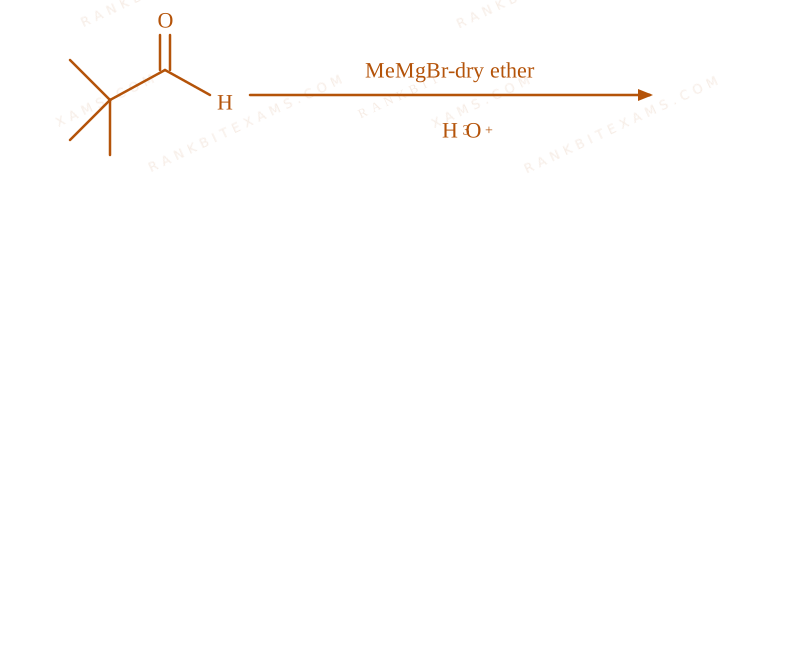
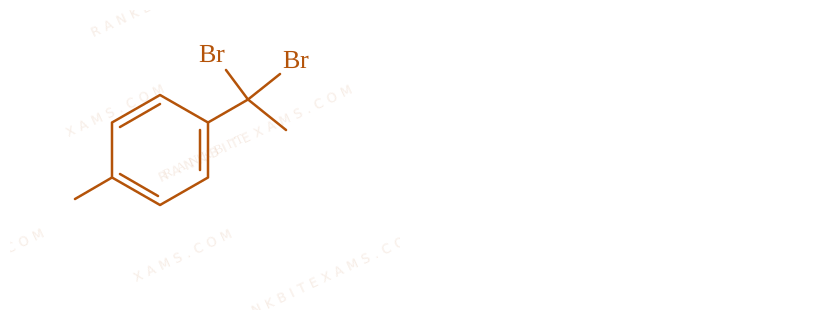
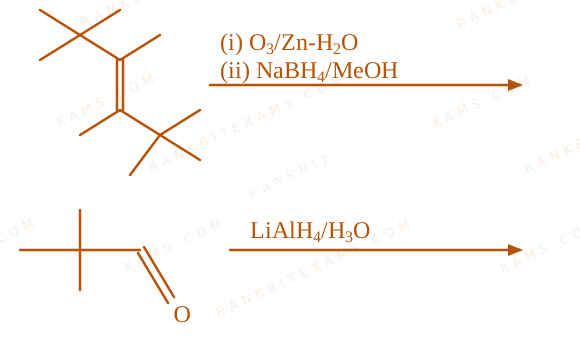
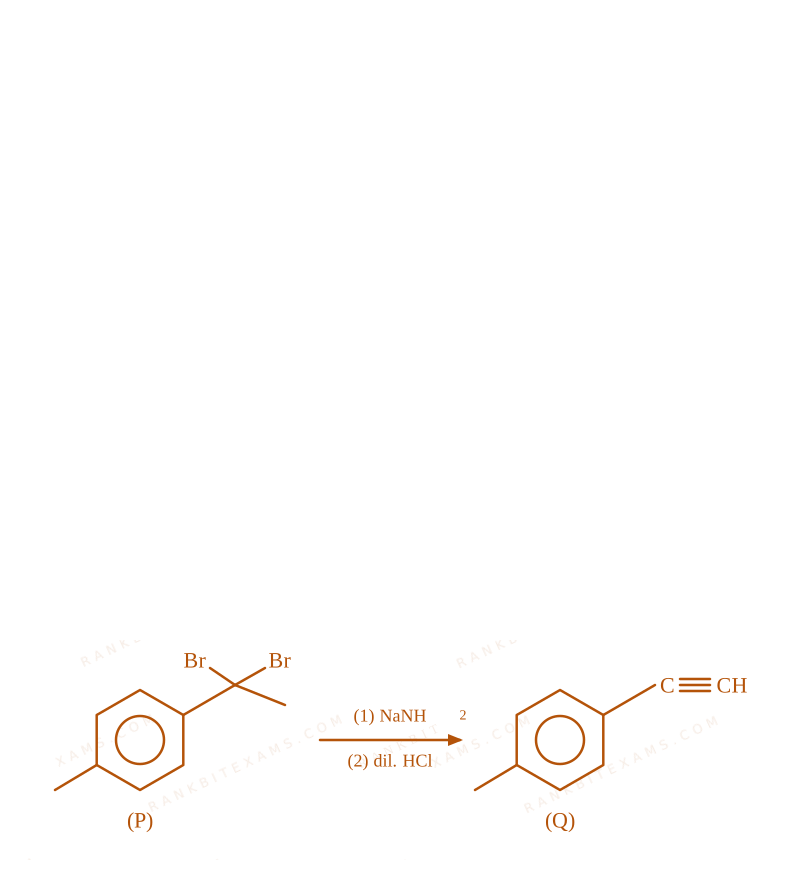
3,3-Dimethyl-2-butanol cannot be prepared by:
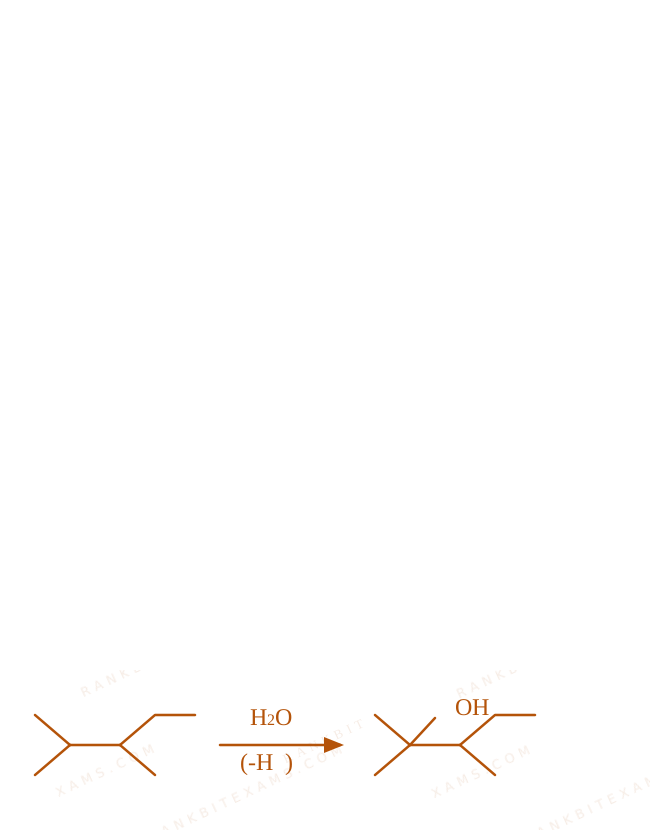
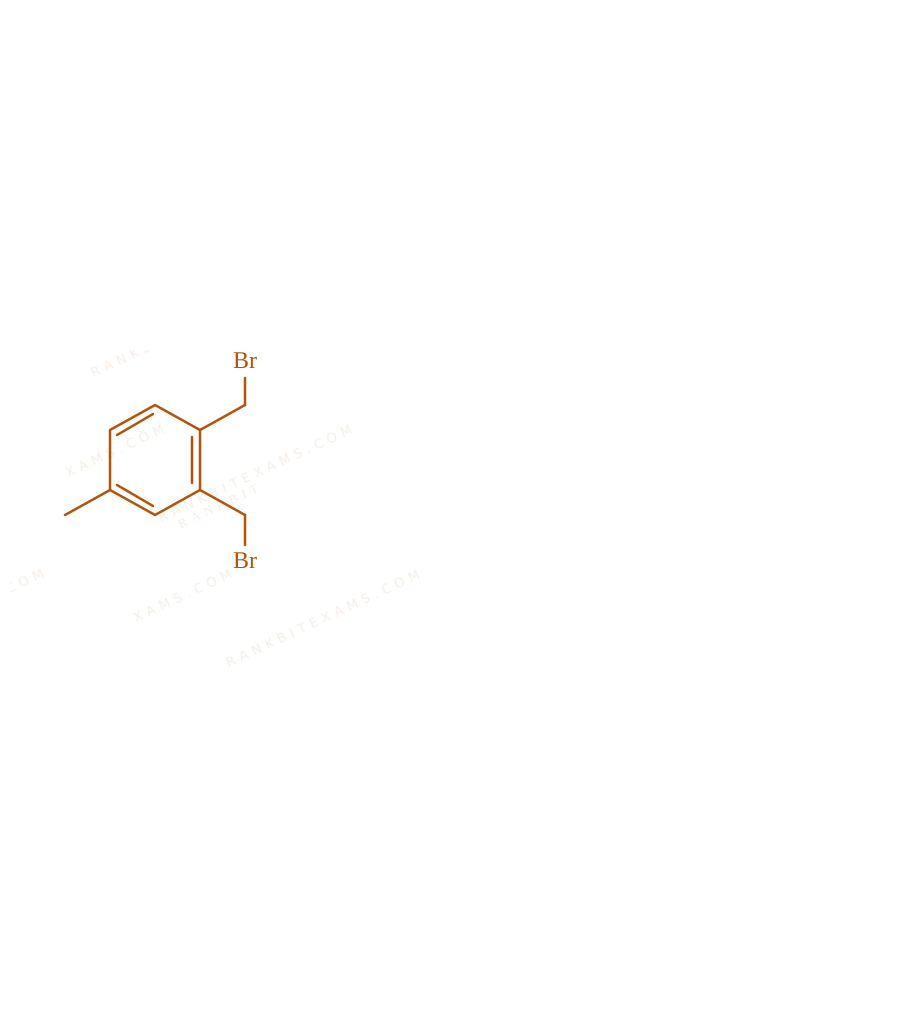
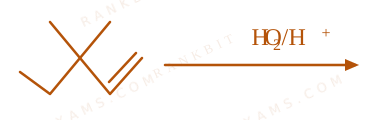
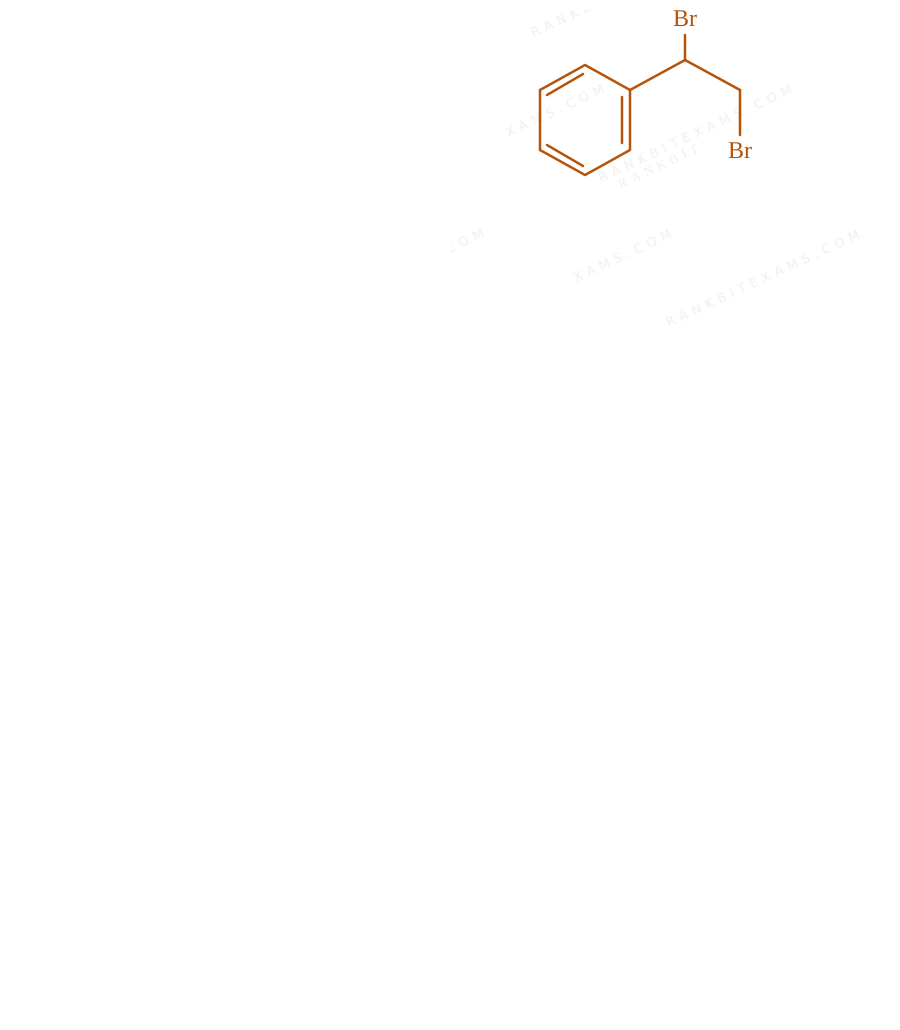
A. Displays five synthetic routes to evaluate preparation of 3,3-dimethyl-2-butanol.
B. Displays five synthetic routes to evaluate preparation of 3,3-dimethyl-2-butanol.
C. Displays five synthetic routes to evaluate preparation of 3,3-dimethyl-2-butanol.
D. Displays five synthetic routes to evaluate preparation of 3,3-dimethyl-2-butanol.
E. Displays five synthetic routes to evaluate preparation of 3,3-dimethyl-2-butanol.
Choose the correct answer from the options given below:
A.B only
B.B and E only
C.B and C only
D.B, C and E only
Solution & Explanation
### Related Formula
textAcid-catalyzed hydration: Carbocation formation rightarrow textEthyl/Methyl Shift$$\text{Acid-catalyzed hydration: Carbocation formation } \rightarrow \text{Ethyl/Methyl Shift}$$textOxymercuration-Demercuration: Markovnikov addition without carbocation rearrangement$$\text{Oxymercuration-Demercuration: Markovnikov addition without carbocation rearrangement}$$
### Core Logic
Step 1: Evaluate Route B:
Acid catalyzed hydration of 3,3-dimethyl-1-butene involves carbocation formation followed by 1,2-methyl shift to give 2,3-dimethyl-2-butanol as major product instead of 3,3-dimethyl-2-butanol.
Step 2: Evaluate Route E:
Oxymercuration-demercuration or specific hydration route E fails to give the targeted alcohol structural framework.
Hence, 3,3-Dimethyl-2-butanol CANNOT be prepared by routes B and E.
Displays five synthetic routes to evaluate preparation of 3,3-dimethyl-2-butanol.Displays five synthetic routes to evaluate preparation of 3,3-dimethyl-2-butanol.Displays five synthetic routes to evaluate preparation of 3,3-dimethyl-2-butanol.Displays five synthetic routes to evaluate preparation of 3,3-dimethyl-2-butanol.
### Pattern Recognition
Sees: Carbocation rearrangement during acid hydration.
Shortcut: Acid-catalyzed hydration of (CH_3)_3C-CH=CH_2$(CH_3)_3C-CH=CH_2$ undergoes methyl shift yielding 2,3-dimethyl-2-butanol, failing to produce 3,3-dimethyl-2-butanol.
### Evaluation Rubric / Model Answer
null
### Chapter Mix
Class 12 Chemistry: Alcohols, Phenols and Ethers
Class 11 Chemistry: Hydrocarbons
Keywords:#3 3-Dimethyl-2-butanol cannot be prepared by#JEE Main 2026 Evening Q69#Alcohols Phenols and Ethers JEE Main 2026#Carbocation Rearrangement JEE Main 2026#Organic Synthesis Pathways#Grignard Reaction#Hydration Rearrangement
More Alcohols, Phenols and Ethers Previous-Year Questions
Given below are two statements:
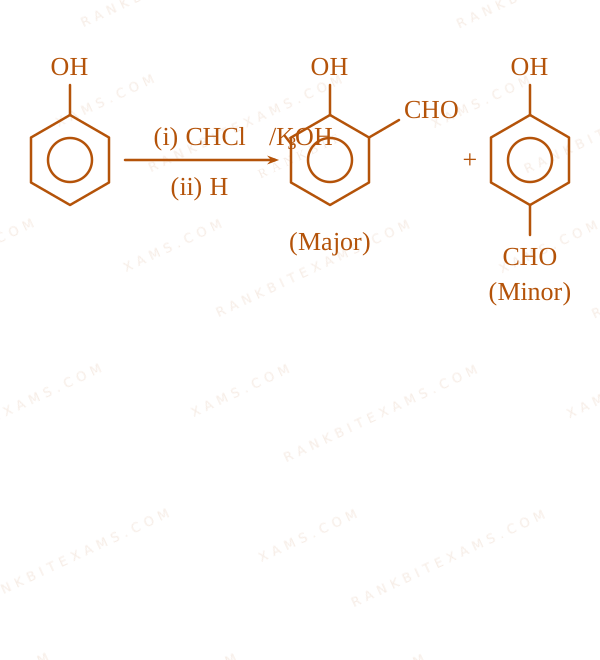
Statement I: Phenol on treatment with CHCl_3/aq$CHCl_{3}/aq$. KOH under refluxing condition, followed by acidification produces p-hydroxy benzaldehyde as the major product and o-hydroxy benzaldehyde as the minor product.
Statement II: The mixture of p-hydroxybenzaldehyde and o-hydroxybenzaldehyde can be easily separated through steam distillation.
In the light of the above statements, choose the correct answer from the options given below:
A.textBoth Statement I and Statement II are false$\text{Both Statement I and Statement II are false}$
B.textStatement I is true but Statement II is false$\text{Statement I is true but Statement II is false}$
C.textBoth Statement I and Statement II are true$\text{Both Statement I and Statement II are true}$
D.textStatement I is false but Statement II is true$\text{Statement I is false but Statement II is true}$
Solution
### Related Formula
Reimer-Tiemann Reaction: Phenol xrightarrowCHCl_3, KOH$\xrightarrow{CHCl_3, KOH}$ o-hydroxybenzaldehyde (Salicylaldehyde) as major product.
### Core Logic
Statement I claims that p-hydroxybenzaldehyde is the major product. This is incorrect. In the Reimer-Tiemann reaction, ortho-hydroxybenzaldehyde (salicylaldehyde) is the major product due to the stabilization of the intermediate and product via intramolecular hydrogen bonding.
Reimer-Tiemann reaction mechanism diagram
Statement II states that the mixture of p-hydroxybenzaldehyde and o-hydroxybenzaldehyde can be separated by steam distillation. This is true. Ortho-hydroxybenzaldehyde forms intramolecular hydrogen bonds, making it more volatile (steam volatile), whereas the para-isomer forms intermolecular hydrogen bonds, increasing its boiling point and making it non-steam volatile.
### Step 1: Final Conclusion
Therefore, Statement I is false but Statement II is true.
### Pattern Recognition
Always remember: Ortho-isomers capable of intramolecular H-bonding are steam volatile. Para-isomers exhibit intermolecular H-bonding and are not steam volatile.
### Evaluation Rubric / Model Answer
null
### Chapter Mix
Class 12 Chemistry: Alcohols Phenols and Ethers
Qjee_main_2025_07_april_morningAcidity of Phenols
Which of the following compounds is least likely to give effervescence of mathrmCO_2$\mathrm{CO}_{2}$ in presence of aq. mathrmNaHCO_3$\mathrm{NaHCO}_{3}$ ?
### Core Logic
For a compound to release mathrmCO_2$\mathrm{CO}_2$ upon reaction with aqueous mathrmNaHCO_3$\mathrm{NaHCO}_3$, its acidity must be strictly greater than that of carbonic acid (mathrmH_2CO_3$\mathrm{H_2CO_3}$).
Let's evaluate the acidity of the options:
1. **Picric Acid** (2,4,6-trinitrophenol - Option A): Extremely acidic (pK_a approx 0.38$pK_a \approx 0.38$) due to three strong electron-withdrawing nitro groups. Reacts with mathrmNaHCO_3$\mathrm{NaHCO}_3$ easily.
2. **4-Nitrobenzoic Acid** (Option B): Carboxylic acids generally have pK_a approx 4text--5$pK_a \approx 4\text{--}5$. More acidic than carbonic acid (pK_a approx 6.3$pK_a \approx 6.3$). Reacts with mathrmNaHCO_3$\mathrm{NaHCO}_3$.
3. **Anilinium Chloride** (Option 3): A salt of a strong acid and weak base. The anilinium ion is quite acidic (pK_a approx 4.6$pK_a \approx 4.6$) and easily decomposes mathrmNaHCO_3$\mathrm{NaHCO}_3$.
4. **4-Nitrophenol** (Option D): Only one nitro group is present. Its acidity (pK_a approx 7.15$pK_a \approx 7.15$) is weaker than carbonic acid. Hence, it does not react with sodium bicarbonate to yield effervescence of mathrmCO_2$\mathrm{CO}_2$.
### Pattern Recognition
Acid-bicarbonate test shortcut:
- All carboxylic acids and picric acid give a positive bicarbonate test.
- Normal phenols and mono/di-nitrophenols are too weak to decompose bicarbonate.
### Evaluation Rubric / Model Answer
null
### Chapter Mix
Class 12 Chemistry: Alcohols, Phenols and Ethers
Class 12 Chemistry: Carboxylic Acids
Q31jee_main_2025_07_april_morningPhysical Properties of Ethers
Given below are two statements:
Statement I: Dimethyl ether is completely soluble in water. However, diethyl ether is soluble in water to a very small extent.
Statement II: Sodium metal can be used to dry diethyl ether and not ethyl alcohol.
In the light of given statements, choose the correct answer from the options given below:
A.textStatement I is false but Statement II is true$\text{Statement I is false but Statement II is true}$
B.textBoth Statement I and Statement II are false$\text{Both Statement I and Statement II are false}$
C.textStatement I is true but Statement II is false$\text{Statement I is true but Statement II is false}$
D.textBoth Statement I and Statement II are true$\text{Both Statement I and Statement II are true}$
Solution
### Core Logic
Statement I: Dimethyl ether (CH_3OCH_3$CH_3OCH_3$) is highly soluble in water because its smaller alkyl chain allows substantial hydrogen bonding with water molecules. In contrast, diethyl ether has a larger hydrophobic ethyl group which drastically reduces its water solubility (to about 7.5text g$7.5\text{ g}$ per 100text mL$100\text{ mL}$). Thus, Statement I is true.
Statement II: Sodium metal (Na$Na$) reacts violently with alcohols like ethyl alcohol to release hydrogen gas:
2textC_2textH_5textOH + 2textNa rightarrow 2textC_2textH_5textONa + textH_2uparrow$$2\text{C}_2\text{H}_5\text{OH} + 2\text{Na} \rightarrow 2\text{C}_2\text{H}_5\text{ONa} + \text{H}_2\uparrow$$
Since diethyl ether has no active acidic hydrogen, it does not react with sodium metal. Hence, sodium can dry diethyl ether but cannot be used for ethyl alcohol. Statement II is true.
### Pattern Recognition
Ethers are miscible with water primarily when the non-polar alkyl parts are very small. Active hydrogen presence (-textOH$-\text{OH}$ group in alcohols) prevents the use of alkali metals like sodium for moisture removal.
### Evaluation Rubric / Model Answer
null
### Chapter Mix
Class 12 Chemistry: Alcohols, Phenols and Ethers
Which one of the following reactions will not lead to the desired ether formation in major proportion?
(Given labels: textiso-Bu Rightarrow textisobutyl$\text{iso-Bu} \Rightarrow \text{isobutyl}$, textsec-Bu Rightarrow textsec-butyl$\text{sec-Bu} \Rightarrow \text{sec-butyl}$, textn-Pr Rightarrow textn-propyl$\text{n-Pr} \Rightarrow \text{n-propyl}$, ^ttextBu Rightarrow texttert-butyl${}^t\text{Bu} \Rightarrow \text{tert-butyl}$, textEt Rightarrow textethyl$\text{Et} \Rightarrow \text{ethyl}$)
### Core Logic
Williamson Ether Synthesis operates strictly via an **S_N2$S_N2$ mechanism**. To optimize ether formation yields, the alkyl halide component MUST be primary (1^circ$1^\circ$) or methyl to evade spatial shielding restrictions.
Let us review the alkyl halide across the options:
* Option 1: Ethyl bromide (textEtBr$\text{EtBr}$) is 1^circ$1^\circ$rightarrow$\rightarrow$ Excellent ether yield via substitution.
* Option 2: Methyl bromide (textCH_3textBr$\text{CH}_3\text{Br}$) is a unhindered methyl halide rightarrow$\rightarrow$ High substitution efficiency.
* Option 3: n-Propyl bromide (textn-PrBr$\text{n-PrBr}$) is 1^circ$1^\circ$rightarrow$\rightarrow$ Clean substitution pathway.
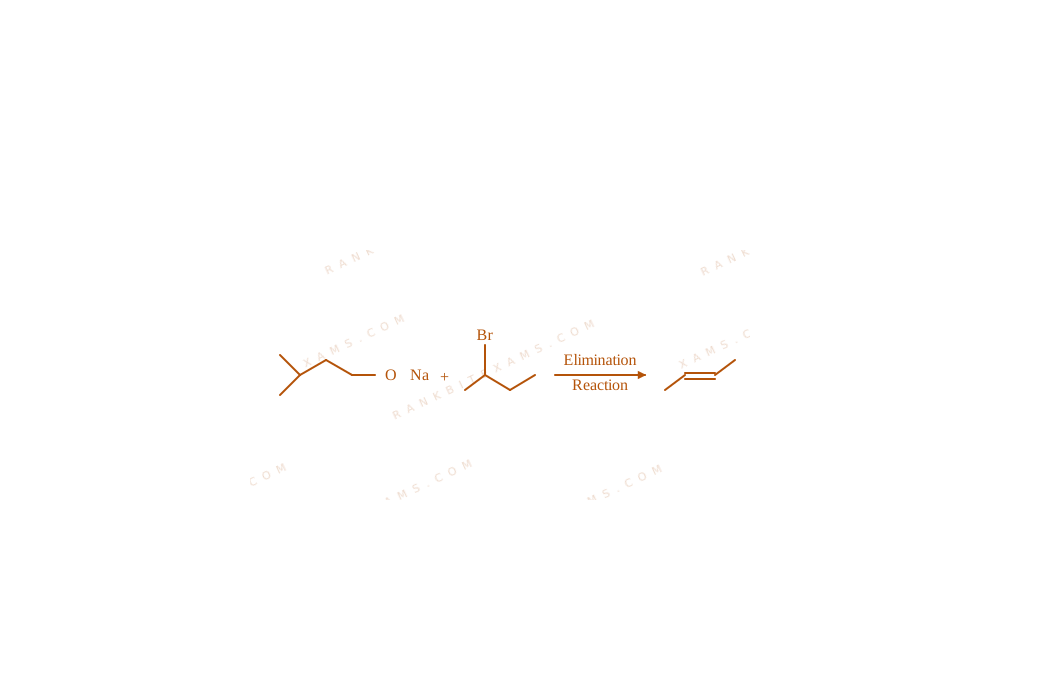
* Option 4: sec-Butyl bromide (textsec-BuBr$\text{sec-BuBr}$) is a secondary (2^circ$2^\circ$) alkyl halide. When a sterically hindered 2^circ$2^\circ$ halide is treated with a strongly basic alkoxide reagent like isobutoxide, **alkene elimination (E2$E2$) competes aggressively and dominates** as the major pathway over nucleophilic substitution (S_N2$S_N2$). Competing elimination reaction mechanism layout for Q37
### Pattern Recognition
Williamson Synthesis Rule: Alkoxide can be as massive and complex as desired (3^circ$3^\circ$ or branched), but the Alkyl Halide MUST be unhindered (1^circ$1^\circ$ or methyl). If the halide is 2^circ$2^\circ$ or 3^circ$3^\circ$, elimination wins, forming an alkene instead of an ether.
### Evaluation Rubric / Model Answer
null
### Chapter Mix
Class 12 Chemistry: Alcohols, Phenols and Ethers
More Alcohols, Phenols and Ethers Questions — jee_main_2026_22_january_evening
We Map Every Repeating Question in Competitive Exams.
Say goodbye to generic mock test fatigue. RankBit uses smart analysis to group past exam questions into their foundational Repeating Question Types. Find chapter weightage, track repeating questions, and score higher with targeted practice.
Select Your Target Exam
Choose an exam track below to find formulas per chapter and patterns.
Syncing Exam Intelligence
Mapping formulas and patterns across all tracks…
PATH A — FULL LENGTH PRACTICE
Full Mock Test Hub
Simulate real NTA exam conditions with fully tracked mocks. Time yourself against past papers.
Practice past-year questions one chapter at a time. Pick an exam → subject → chapter and get every PYQ for that topic — pulled together from all past papers — with the chapter's key formulas alongside.