
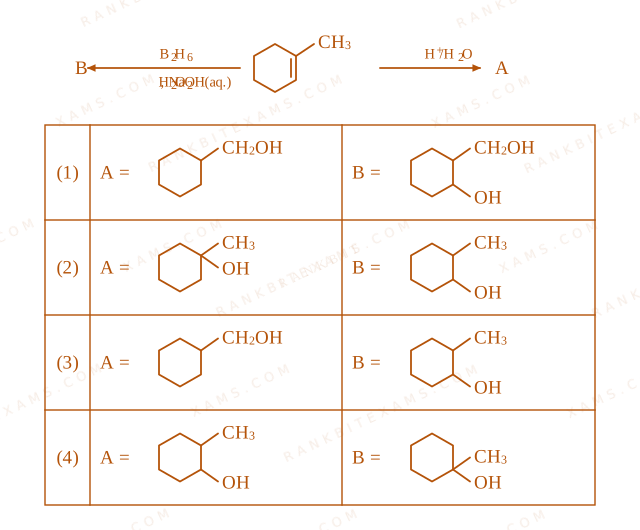
Solution
Core Logic
The given substrate is an alkene attached to a benzene ring (styrene derivative).
Reaction 1: Acid-catalyzed hydration (H^+ / H₂O) This proceeds via Markovnikov's rule. The proton attacks the alkene to form the most stable carbocation (benzyllic and secondary). Water then attacks this carbocation to yield the alcohol at the substituted position (product A: Ph-CH(OH)-CH₃).
Reaction 2: Hydroboration-Oxidation (B₂H₆, then H₂O₂/NaOH) This proceeds via anti-Markovnikov addition of water across the double bond without carbocation rearrangement. The OH group adds to the less substituted carbon atom of the alkene (product B: Ph-CH₂-CH₂-OH).

Pattern Recognition
H^+/H₂O = Markovnikov hydration (carbocation intermediate). B₂H₆ / H₂O₂, OH^- = Anti-Markovnikov hydration (concerted, no rearrangement).
Chapter Mix
Class 12 Chemistry: Alcohols Phenols and Ethers Class 11 Chemistry: Hydrocarbons
