JEE Main · Chemistry → Steady

Alcohols Phenols and Ethers appeared 20 times across 3 years — 2.3% of Chemistry. This question is from Cleavage of Ethers by Halogen Acids.

Year 2026 2025 2024 Total
Questions 7 5 8 20

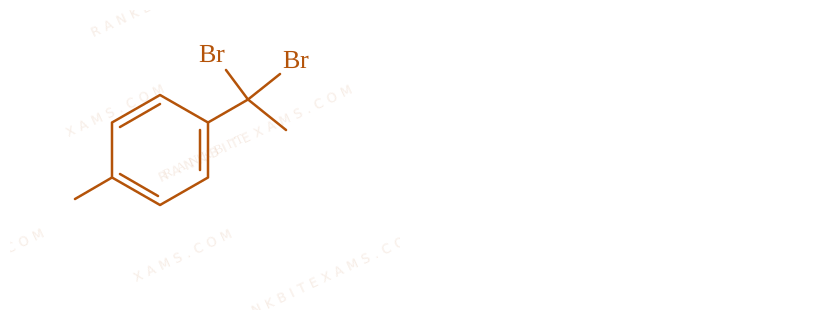
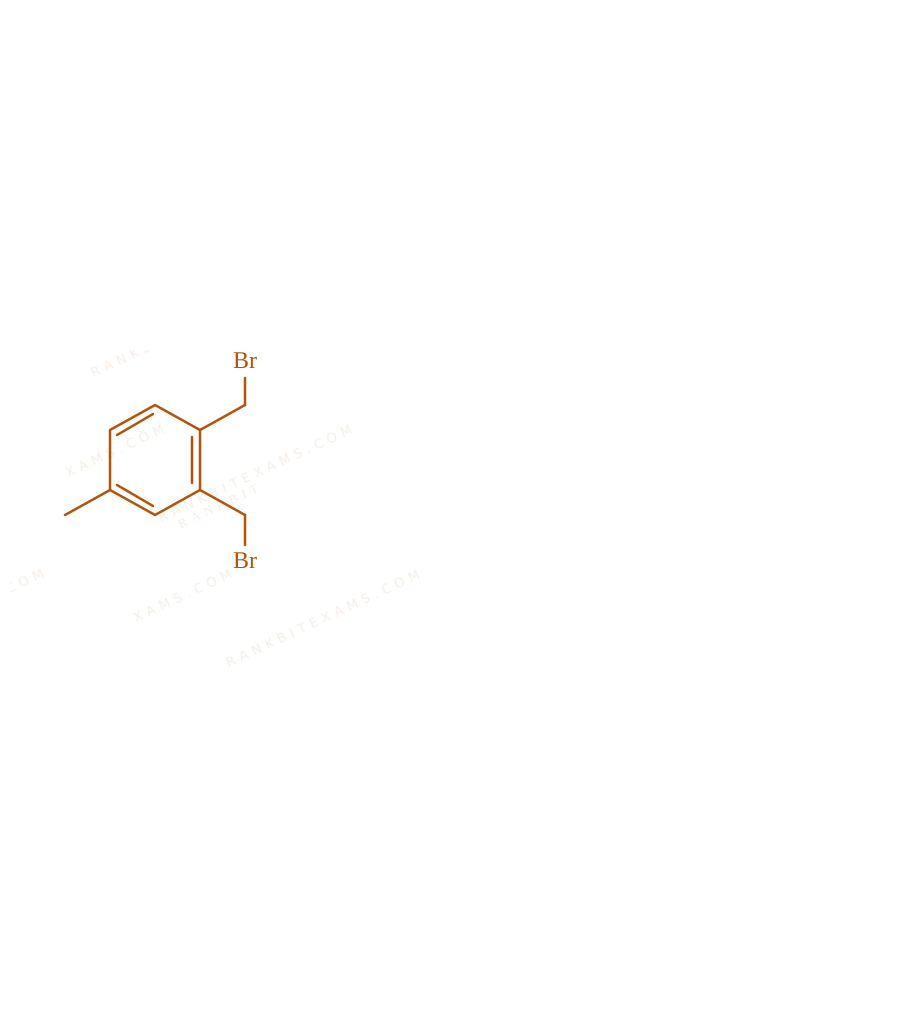
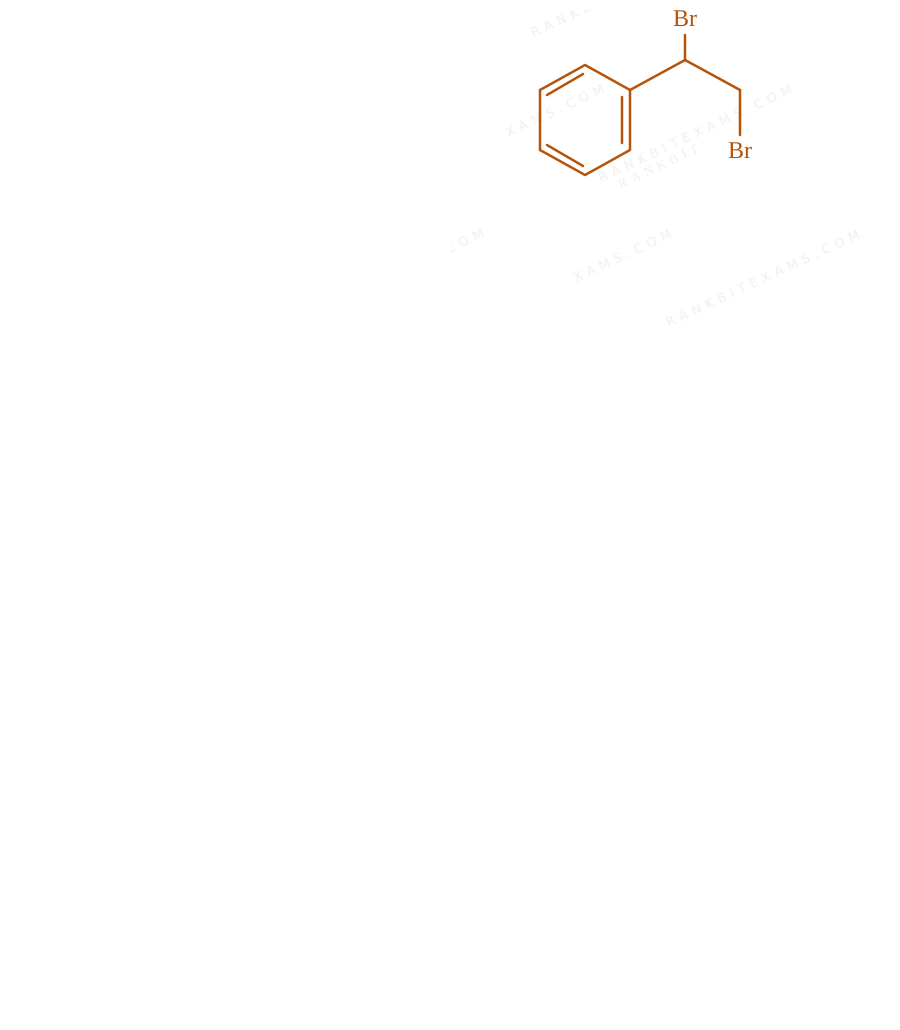
Which one of the following, with HBr will give a phenol?

Solution & Explanation

Core Logic

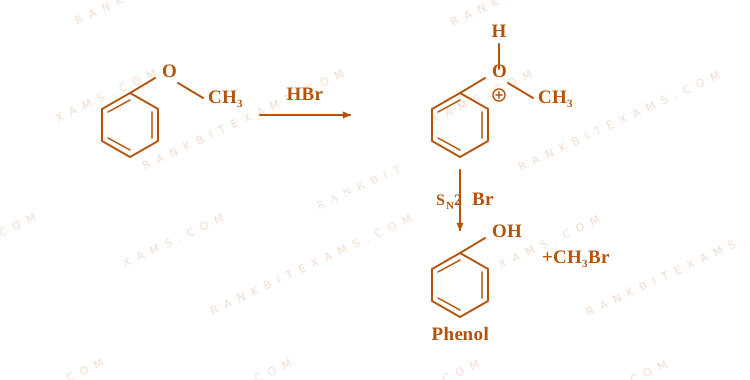
Anisole (Ph-O-CH₃) contains an aryl-oxygen bond which possesses partial double bond character due to resonance stabilization with the aromatic ring. When treated with HBr, protonation yields an oxonium ion. The nucleophile Br⁻ attacks via an SN2 pathway at the smaller, less hindered methyl group, cleaving the O-CH₃ bond to form Phenol (PhOH) and CH₃Br.

Cleavage of Ethers by Halogen Acids diagram for Q45 - JEE Main 2025 Evening

Pattern Recognition

Aromatic sp² C-O bonds are exceptionally strong and cannot be cleaved by nucleophilic attack from Hal⁻. Therefore, the oxygen always stays attached to the benzene ring, yielding phenol.

Chapter Mix

Class 12 Chemistry: Alcohols, Phenols and Ethers

Reference Study Guides

More Alcohols, Phenols and Ethers Previous-Year Questions

Q53 jee_main_2026_22_january_morning Reimer Tiemann Reaction
Given below are two statements: Statement I: Phenol on treatment with CHCl₃/aq. KOH under refluxing condition, followed by acidification produces p-hydroxy benzaldehyde as the major product and o-hydroxy benzaldehyde as the minor product. Statement II: The mixture of p-hydroxybenzaldehyde and o-hydroxybenzaldehyde can be easily separated through steam distillation. In the light of the above statements, choose the correct answer from the options given below:
  • A. Both Statement I and Statement II are false
  • B. Statement I is true but Statement II is false
  • C. Both Statement I and Statement II are true
  • D. Statement I is false but Statement II is true

Solution

Related Formula

Reimer-Tiemann Reaction: Phenol CHCl₃, KOH o-hydroxybenzaldehyde (Salicylaldehyde) as major product.

Core Logic

Statement I claims that p-hydroxybenzaldehyde is the major product. This is incorrect. In the Reimer-Tiemann reaction, ortho-hydroxybenzaldehyde (salicylaldehyde) is the major product due to the stabilization of the intermediate and product via intramolecular hydrogen bonding.
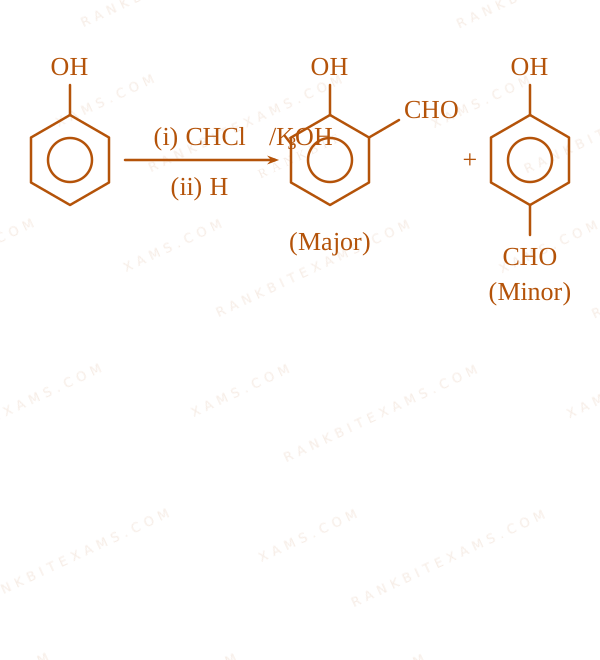
Reimer-Tiemann reaction mechanism diagram

Statement II states that the mixture of p-hydroxybenzaldehyde and o-hydroxybenzaldehyde can be separated by steam distillation. This is true. Ortho-hydroxybenzaldehyde forms intramolecular hydrogen bonds, making it more volatile (steam volatile), whereas the para-isomer forms intermolecular hydrogen bonds, increasing its boiling point and making it non-steam volatile.

Step 1: Final Conclusion

Therefore, Statement I is false but Statement II is true.

Pattern Recognition

Always remember: Ortho-isomers capable of intramolecular H-bonding are steam volatile. Para-isomers exhibit intermolecular H-bonding and are not steam volatile.

Chapter Mix

Class 12 Chemistry: Alcohols Phenols and Ethers
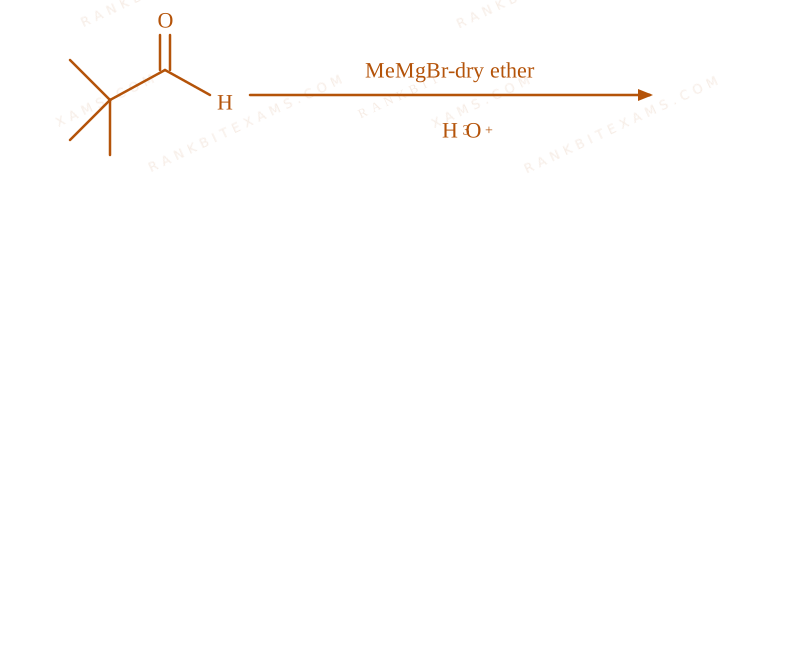
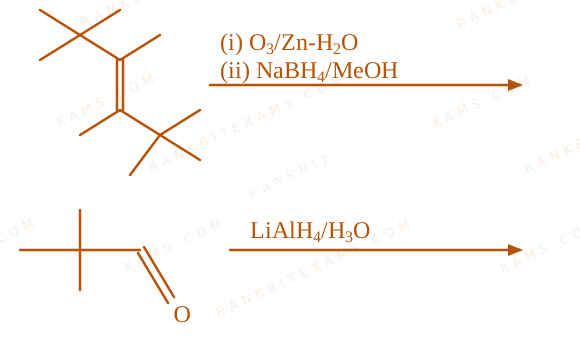
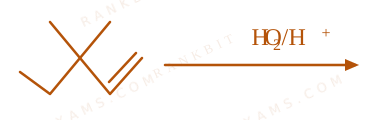
Q69 jee_main_2026_22_january_evening Synthesis of 3,3-Dimethyl-2-butanol
3,3-Dimethyl-2-butanol cannot be prepared by: A.
Reaction paths scheme A for Q69 - JEE Main 2026 Evening
Displays five synthetic routes to evaluate preparation of 3,3-dimethyl-2-butanol.
B.
Reaction paths scheme A for Q69 - JEE Main 2026 Evening
Displays five synthetic routes to evaluate preparation of 3,3-dimethyl-2-butanol.
C.
Reaction paths scheme A for Q69 - JEE Main 2026 Evening
Displays five synthetic routes to evaluate preparation of 3,3-dimethyl-2-butanol.
D.
Reaction paths scheme A for Q69 - JEE Main 2026 Evening
Displays five synthetic routes to evaluate preparation of 3,3-dimethyl-2-butanol.
E.
Reaction paths scheme A for Q69 - JEE Main 2026 Evening
Displays five synthetic routes to evaluate preparation of 3,3-dimethyl-2-butanol.
Choose the correct answer from the options given below:
  • A. B only
  • B. B and E only
  • C. B and C only
  • D. B, C and E only

Solution

Related Formula
Acid-catalyzed hydration: Carbocation formation arrow Ethyl/Methyl Shift Oxymercuration-Demercuration: Markovnikov addition without carbocation rearrangement
Core Logic

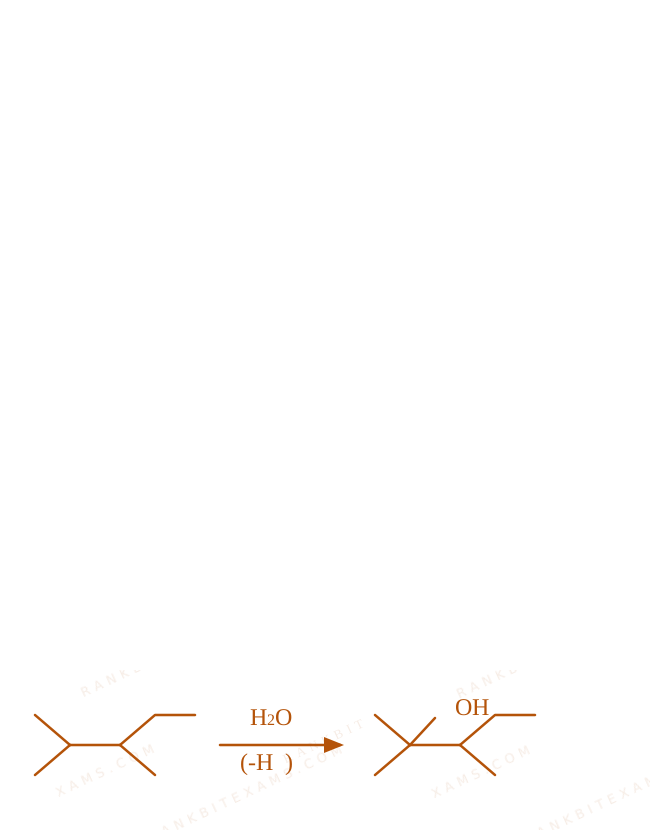
Step 1: Evaluate Route B: Acid catalyzed hydration of 3,3-dimethyl-1-butene involves carbocation formation followed by 1,2-methyl shift to give 2,3-dimethyl-2-butanol as major product instead of 3,3-dimethyl-2-butanol.

Step 2: Evaluate Route E: Oxymercuration-demercuration or specific hydration route E fails to give the targeted alcohol structural framework.

Hence, 3,3-Dimethyl-2-butanol CANNOT be prepared by routes B and E.

Carbocation rearrangement mechanism for Q69 - JEE Main 2026 Evening
Displays five synthetic routes to evaluate preparation of 3,3-dimethyl-2-butanol.

Carbocation rearrangement mechanism for Q69 - JEE Main 2026 Evening
Displays five synthetic routes to evaluate preparation of 3,3-dimethyl-2-butanol.

Carbocation rearrangement mechanism for Q69 - JEE Main 2026 Evening
Displays five synthetic routes to evaluate preparation of 3,3-dimethyl-2-butanol.

Carbocation rearrangement mechanism for Q69 - JEE Main 2026 Evening
Displays five synthetic routes to evaluate preparation of 3,3-dimethyl-2-butanol.

Pattern Recognition

Sees: Carbocation rearrangement during acid hydration. Shortcut: Acid-catalyzed hydration of (CH₃)₃C-CH=CH₂ undergoes methyl shift yielding 2,3-dimethyl-2-butanol, failing to produce 3,3-dimethyl-2-butanol.

Chapter Mix

Class 12 Chemistry: Alcohols, Phenols and Ethers Class 11 Chemistry: Hydrocarbons

Q66 jee_main_2026_23_january_evening Reactions of Ethers
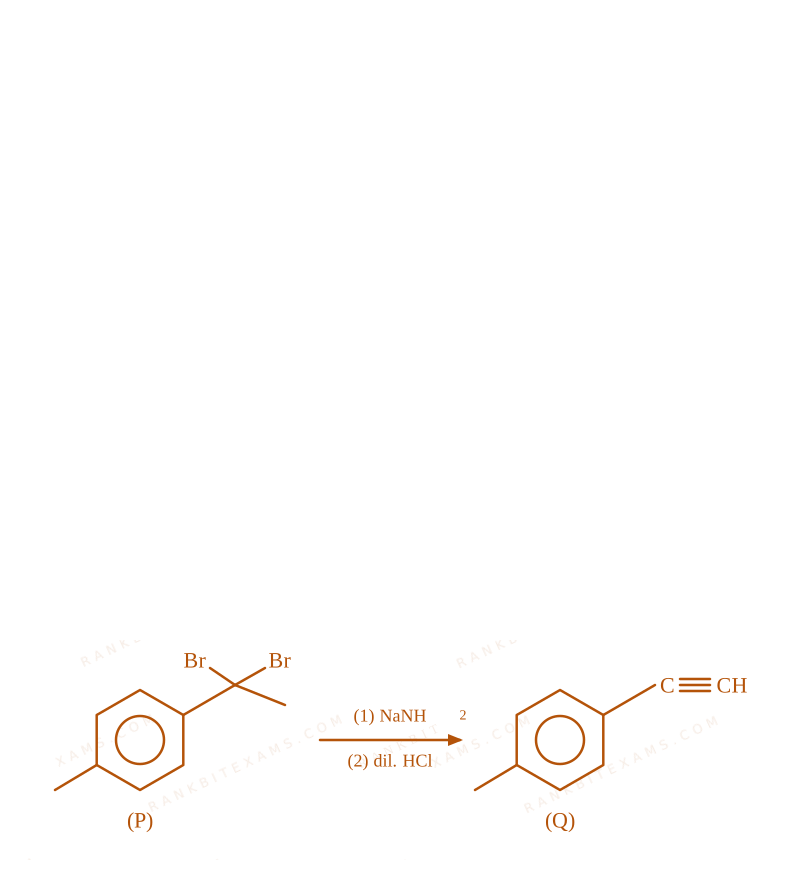
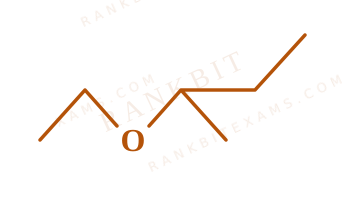
A mixed ether (P), when heated with excess of hot concentrated hydrogen iodide produces two different alkyl iodides which when treated with aq. NaOH give compounds (Q) and (R). Both (Q) and (R) give yellow precipitate with NaOI. Identify the mixed ether (P):
Reactions of Ethers diagram for Q66 - JEE Main 2026 Evening
A schematic diagram showing the transformation sequence from ether (P) to products (Q) and (R) giving a yellow precipitate.
  • A. Option 1
  • B. Option 2
  • C. Option 3
  • D. Option 4

Solution

Core Logic

We work backwards. Both (Q) and (R) give a positive iodoform test (yellow precipitate with NaOI). Since (Q) and (R) are obtained by treating alkyl iodides with aq. NaOH, they must be alcohols.

Alcohols that give a positive iodoform test must possess the structural unit CH₃-CH(OH)-. Therefore, both alkyl iodides must contain the CH₃-CH(I)- group.

The precursor mixed ether (P) was treated with excess concentrated HI to yield these two alkyl iodides. For both sides of the ether to produce iodides capable of forming secondary alcohols with terminal methyls upon hydrolysis, the ether must be composed of two branches that look like -CH(CH₃)-.

Let's evaluate the correct option (1): Structure (P) is an ether linking a sec-butyl group and a secondary-pentyl group (or similar structure). Excess HI cleaves the ether to give two secondary alkyl iodides. Hydrolysis with aq. NaOH converts both alkyl iodides into secondary alcohols. Both secondary alcohols have a methyl group directly adjacent to the hydroxyl-bearing carbon, fully satisfying the iodoform test requirement.

Pattern Recognition

Excess hot HI cleaves ethers (R-O-R') into two moles of alkyl iodides (R-I and R'-I). Only secondary alcohols with a methyl group or ethanol itself give positive iodoform tests. Look for an ether containing CH₃-CH(O-)- branching on BOTH sides.

Chapter Mix

Class 12 Chemistry: Alcohols, Phenols and Ethers Class 12 Chemistry: Haloalkanes and Haloarenes Class 12 Chemistry: Aldehydes, Ketones and Carboxylic Acids

Q65 jee_main_2026_24_january_morning Acetylation of Hydroxyl Groups
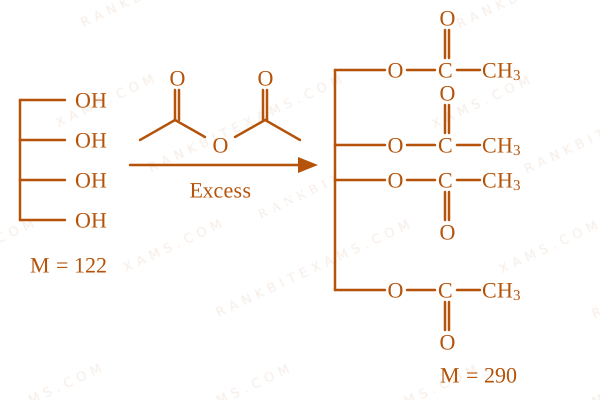
A hydroxy compound (X) with molar mass 122 g mol⁻¹ is acetylated with acetic anhydride, using a large excess of the reagent ensuring complete acetylation of all hydroxyl groups. The product obtained has a molar mass of 290 g mol⁻¹. The number of hydroxyl groups present in compound (X) is :
  • A. 3
  • B. 5
  • C. 2
  • D. 4

Solution

Core Logic

During the acetylation of an alcohol, an -H atom (molar mass = 1) is replaced by an acetyl group (-COCH₃, molar mass = 43). Therefore, the net increase in molar mass per hydroxyl group acetylated is:

Δ M = 43 - 1 = 42 g/mol

Given: Molar mass of starting compound (X) = 122 g/mol Molar mass of completely acetylated product = 290 g/mol

Total increase in molar mass:

290 - 122 = 168 g/mol
Step 1: Calculate Number of Hydroxyl Groups
Number of -OH groups = Total Mass IncreaseIncrease per group = (168)/(42) = 4

Acetylation mechanism showing mass increase

Pattern Recognition

Acetylation replaces H with COCH₃. Always divide the mass difference by 42 to find the number of -OH (or -NH₂) groups.

Chapter Mix

Class 12 Chemistry: Alcohols, Phenols and Ethers Class 12 Chemistry: Biomolecules

Q68 jee_main_2026_24_january_morning Reactions with Active Metals and Bicarbonate
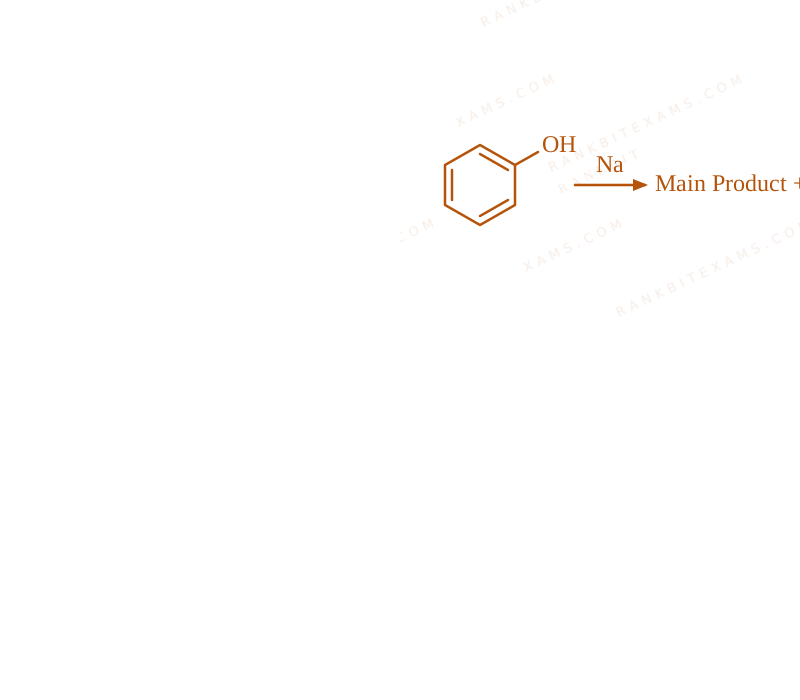
Consider the following two reactions A and B. (A) Phenol Na Main Product + gas (x) (B) Benzoic acid NaHCO₃ Main Product + gas (y) Numerical value of [molar mass of x+ molar mass of y] is
  • A. 4
  • B. 88
  • C. 46
  • D. 160

Solution

Core Logic

Reaction (A): Phenol + Sodium metal Phenol reacts with active metals like Sodium to form sodium phenoxide and evolve hydrogen gas.

2 C₆H₅OH + 2 Na arrow 2 C₆H₅O^-Na^+ + H₂

Gas (x) is H₂. Molar mass of H₂ = 2 g/mol.

Reaction (B): Benzoic acid + Sodium bicarbonate Benzoic acid is a sufficiently strong acid to react with weak bases like NaHCO₃, undergoing decarboxylation to evolve carbon dioxide gas.

C₆H₅COOH + NaHCO₃ arrow C₆H₅COO^-Na^+ + H₂O + CO₂

Gas (y) is CO₂. Molar mass of CO₂ = 44 g/mol.

Step 1: Final Calculation
Sum of molar mass = M(H₂) + M(CO₂) Sum = 2 + 44 = 46
Pattern Recognition

Active metals + acids/alcohols = H₂ gas. Bicarbonates + acids (stronger than carbonic acid) = CO₂ effervescence.

Chapter Mix

Class 12 Chemistry: Alcohols, Phenols and Ethers Class 12 Chemistry: Aldehydes, Ketones and Carboxylic Acids

More Alcohols, Phenols and Ethers Questions — jee_main_2025_29_jan_evening

Practice all Alcohols, Phenols and Ethers previous-year questions →

Rankbit System
JEE Physics: Waves (+15.5%) | Electrostatics: Concentric Shells (-29.7%) | Modern Physics: Photoelectric Clones (+34.2%) | Mathematics: Definite Integrals (+18.1%) | Chemistry: Coordination Splitting (-11.4%) | JEE Physics: Waves (+15.5%) | Electrostatics: Concentric Shells (-29.7%) | Modern Physics: Photoelectric Clones (+34.2%) | Mathematics: Definite Integrals (+18.1%) | Chemistry: Coordination Splitting (-11.4%)