A toxic compound “A” when reacted with NaCN in aqueous acidic medium yields an edible cooking component and food preservative “B”. “B” is converted to “C” by diborane and can be used as an additive to petrol to reduce emission. “C” upon reaction with oleum at 140°C$140^{\circ}\mathrm{C}$ yields an inhalable anesthetic “D”. Identify “A”, “B”, “C” and “D”, respectively.
Let's track the conversions row by row based on the description:
Toxic compound A is methanol (CH₃OH$CH_3OH$). Reacting it via acidic NaCN sequences effectively converts it eventually into acetic acid (CH₃COOH$CH_3COOH$), which is an edible cooking component and food preservative (vinegar) B.
Reduction of acetic acid (B) with diborane (B₂H₆$B_2H_6$) yields ethanol (CH₃CH₂OH$CH_3CH_2OH$) C. Ethanol is used as a biofuel additive in petrol.
Ethanol (C) upon heating with oleum/concentrated sulfuric acid at 140°C$140^{\circ}\mathrm{C}$ undergoes intermolecular dehydration to yield diethyl ether (C₂H₅-O-C₂H₅$C_2H_5-O-C_2H_5$) D, which functions as an inhalable anesthetic.
Step 1: Chemical Reaction Sequence Flow
Chemical flow chart for sequential ether preparation
The full sequential progression corresponds exactly to:
Key temperature indicator: Dehydration of ethanol at 140°C$140^{\circ}\mathrm{C}$ yields diethyl ether (ether synthesis), whereas 170°C$170^{\circ}\mathrm{C}$ yields ethene gas. Combined with the food preservative clue (acetic acid), the sequence locks instantly to option (3).
Keywords:#toxic alcohol conversion sequence#JEE Main 2025 Evening Q35#dehydration of ethanol at 140 C#diethyl ether inhalable anesthetic
More Alcohols, Phenols and Ethers Previous-Year Questions — Page 2
Q66jee_main_2026_24_january_eveningClassification of Alcohols
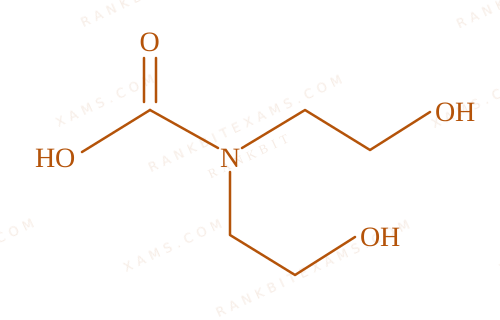
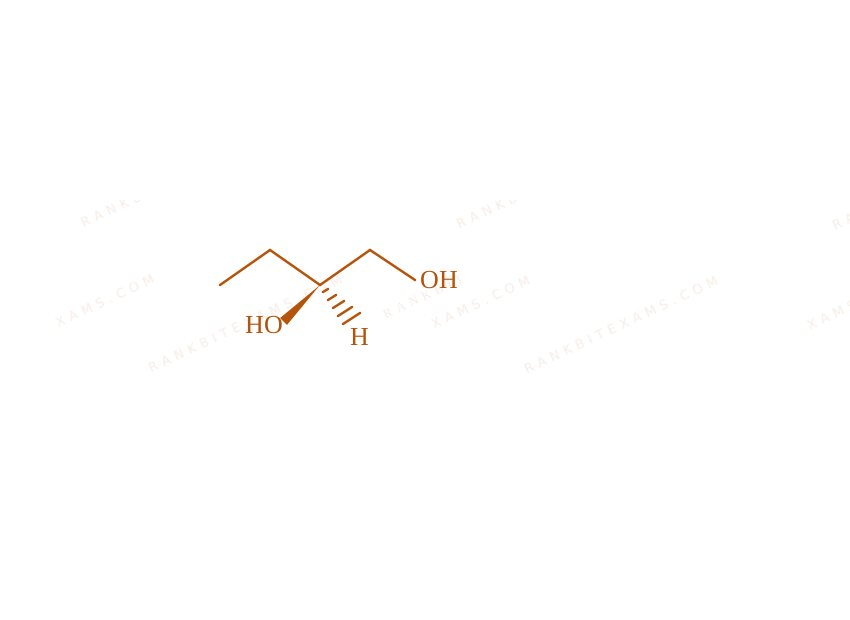
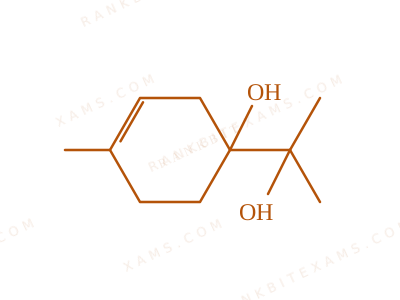
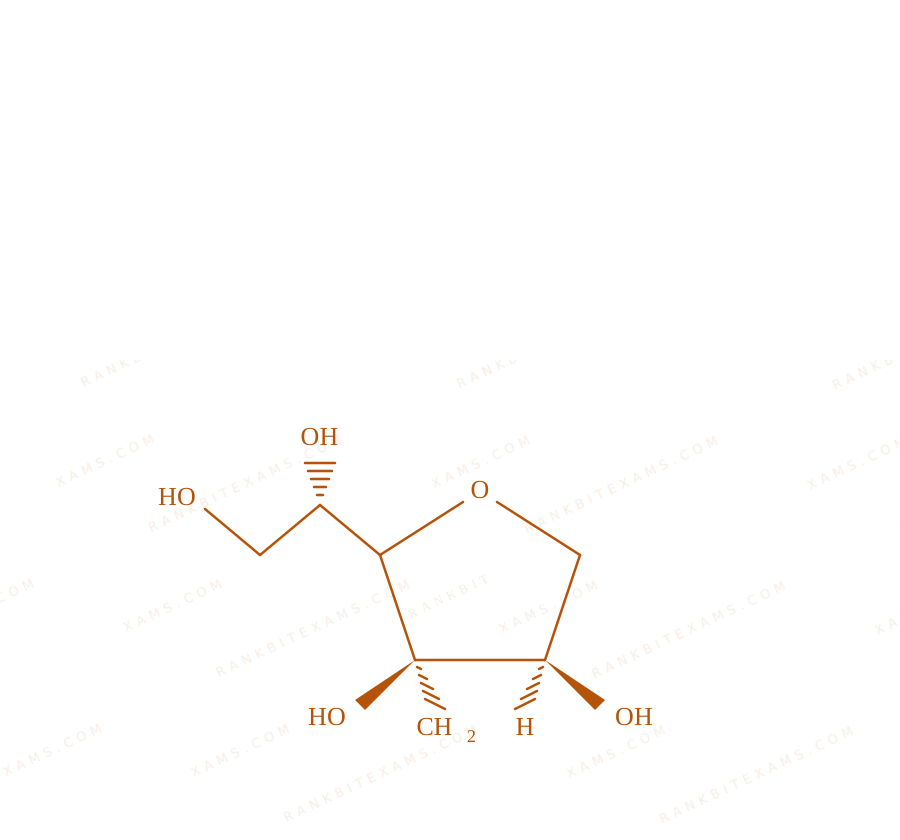
From the following, how many compounds contain at least one secondary alcohol?
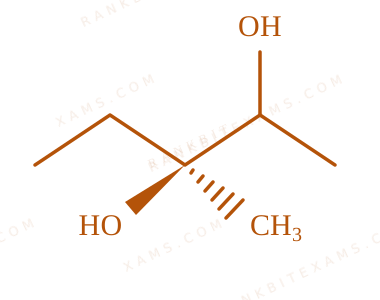
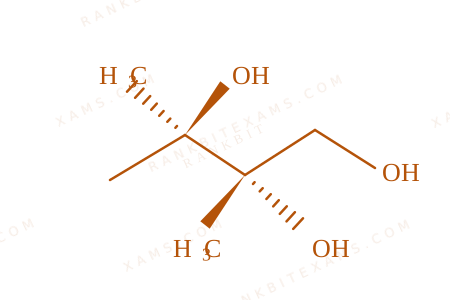
(I) Various organic structures displaying alcohol functional groups.
(II) Various organic structures displaying alcohol functional groups.
(III) Various organic structures displaying alcohol functional groups.
(IV) Various organic structures displaying alcohol functional groups.
(V) Various organic structures displaying alcohol functional groups.
(VI) Various organic structures displaying alcohol functional groups.
Choose the correct answer from the options given below:
A. Five
B. Three
C. Four
D. two
Solution
Core Logic
A secondary alcohol features a hydroxyl group (-OH) attached to a carbon atom that is bonded to two other carbon atoms (2°$2^{\circ}$ carbon).
Evaluating the structures based on visual analysis:
Compounds II, IV, and V contain at least one hydroxyl group on a 2°$2^{\circ}$ carbon.
Therefore, 3 compounds feature a secondary alcohol.
Pattern Recognition
Spot the carbon carrying the -OH group. Count the C-C bonds attached to it. 1 = Primary, 2 = Secondary, 3 = Tertiary. Phenols are aromatic and distinct from secondary alcohols.
Consider the following reaction sequence
Compound (x) [76.6%C, 6.38%H, vapour density 47] (i)CO₂,NaOH,120°C,high pressure (ii)H₃O⁺$\xrightarrow{\text{(i)}\mathrm{CO}_{2},\mathrm{NaOH},120^{\circ}\mathrm{C},\text{high pressure}} \xrightarrow{\text{(ii)}\mathrm{H}_{3}\mathrm{O}^{+}}$ Compound (y) (Major Product)
Compound (y) develops characteristic colour with neutral FeCl₃$\mathrm{FeCl}_3$ solution.
Identify the INCORRECT statement from the following for the above sequence.
A. Both compounds x and y will dissolve in NaOH.
B. Compound y will dissolve in NaHCO₃$\mathrm{NaHCO}_3$ and evolve a gas.
C. Compound x is more acidic than compound y.
D. Both compounds x and y will burn with sooty flame.
Solution
Core Logic
Based on empirical data for (x):
Molar Mass = 2 × Vapour Density = 2 × 47 = 94~g/mol$\text{Molar Mass} = 2 \times \text{Vapour Density} = 2 \times 47 = 94\mathrm{~g/mol}$.
C = 76.6% (76.6/12) ≈ 6.38$\text{C} = 76.6\% \implies (76.6/12) \approx 6.38$H = 6.38% (6.38/1) ≈ 6.38$\text{H} = 6.38\% \implies (6.38/1) \approx 6.38$O = 17.02% (17.02/16) ≈ 1.06$\text{O} = 17.02\% \implies (17.02/16) \approx 1.06$
Ratio C:H:O ≈ 6:6:1 C₆H₆O$\text{C:H:O} \approx 6:6:1 \implies \mathrm{C_6H_6O}$ (Phenol).
Step 1: Identifying Compounds
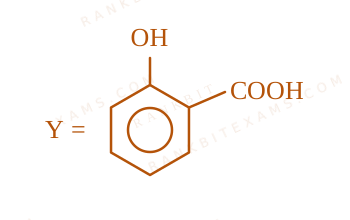
Compound (x) is Phenol. It reacts with CO₂/NaOH$\mathrm{CO}_2/\mathrm{NaOH}$ via Kolbe-Schmitt reaction to form Salicylic Acid as the major product (Compound y).
Kolbe Schmitt Reaction of Phenol to Salicylic Acid
Step 2: Checking Options
(1) Both Phenol and Salicylic acid dissolve in NaOH$\mathrm{NaOH}$. (True)
(2) Salicylic acid (y) has a -COOH$-COOH$ group and dissolves in NaHCO₃$\mathrm{NaHCO}_3$, evolving CO₂$\mathrm{CO}_2$ gas. (True)
(3) Salicylic acid (y) is much more acidic than Phenol (x) due to the presence of the carboxylic acid group and intramolecular hydrogen bonding in its conjugate base. Therefore, the statement "x is more acidic than y" is INCORRECT.
(4) Being highly aromatic compounds, both burn with a sooty flame. (True)
Pattern Recognition
The reaction sequence Phenol + CO₂/NaOH arrow Salicylic acid$\mathrm{Phenol} + \mathrm{CO_2/NaOH} \rightarrow \mathrm{Salicylic \; acid}$ is a staple (Kolbe's Reaction). Always test functional group properties: Phenols dissolve in NaOH$\mathrm{NaOH}$ but not NaHCO₃$\mathrm{NaHCO}_3$, while Carboxylic acids dissolve in both.
Chapter Mix
Class 12 Chemistry: Alcohols Phenols and Ethers
Class 11 Chemistry: Organic Chemistry Some Basic Principles and Techniques
Qjee_main_2025_07_april_morningAcidity of Phenols
Which of the following compounds is least likely to give effervescence of CO₂$\mathrm{CO}_{2}$ in presence of aq. NaHCO₃$\mathrm{NaHCO}_{3}$ ?
For a compound to release CO₂$\mathrm{CO}_2$ upon reaction with aqueous NaHCO₃$\mathrm{NaHCO}_3$, its acidity must be strictly greater than that of carbonic acid (H₂CO₃$\mathrm{H_2CO_3}$).
Let's evaluate the acidity of the options:
Picric Acid (2,4,6-trinitrophenol - Option A): Extremely acidic (pKₐ ≈ 0.38$pK_a \approx 0.38$) due to three strong electron-withdrawing nitro groups. Reacts with NaHCO₃$\mathrm{NaHCO}_3$ easily.
4-Nitrobenzoic Acid (Option B): Carboxylic acids generally have pKₐ ≈ 4--5$pK_a \approx 4\text{--}5$. More acidic than carbonic acid (pKₐ ≈ 6.3$pK_a \approx 6.3$). Reacts with NaHCO₃$\mathrm{NaHCO}_3$.
Anilinium Chloride (Option 3): A salt of a strong acid and weak base. The anilinium ion is quite acidic (pKₐ ≈ 4.6$pK_a \approx 4.6$) and easily decomposes NaHCO₃$\mathrm{NaHCO}_3$.
4-Nitrophenol (Option D): Only one nitro group is present. Its acidity (pKₐ ≈ 7.15$pK_a \approx 7.15$) is weaker than carbonic acid. Hence, it does not react with sodium bicarbonate to yield effervescence of CO₂$\mathrm{CO}_2$.
Pattern Recognition
Acid-bicarbonate test shortcut:
All carboxylic acids and picric acid give a positive bicarbonate test.
Normal phenols and mono/di-nitrophenols are too weak to decompose bicarbonate.
Chapter Mix
Class 12 Chemistry: Alcohols, Phenols and Ethers
Class 12 Chemistry: Carboxylic Acids
Q31jee_main_2025_07_april_morningPhysical Properties of Ethers
Given below are two statements:
Statement I: Dimethyl ether is completely soluble in water. However, diethyl ether is soluble in water to a very small extent.
Statement II: Sodium metal can be used to dry diethyl ether and not ethyl alcohol.
In the light of given statements, choose the correct answer from the options given below:
A.Statement I is false but Statement II is true$\text{Statement I is false but Statement II is true}$
B.Both Statement I and Statement II are false$\text{Both Statement I and Statement II are false}$
C.Statement I is true but Statement II is false$\text{Statement I is true but Statement II is false}$
D.Both Statement I and Statement II are true$\text{Both Statement I and Statement II are true}$
Solution
Core Logic
Statement I: Dimethyl ether (CH₃OCH₃$CH_3OCH_3$) is highly soluble in water because its smaller alkyl chain allows substantial hydrogen bonding with water molecules. In contrast, diethyl ether has a larger hydrophobic ethyl group which drastically reduces its water solubility (to about 7.5 g$7.5\text{ g}$ per 100 mL$100\text{ mL}$). Thus, Statement I is true.
Statement II: Sodium metal (Na$Na$) reacts violently with alcohols like ethyl alcohol to release hydrogen gas:
Since diethyl ether has no active acidic hydrogen, it does not react with sodium metal. Hence, sodium can dry diethyl ether but cannot be used for ethyl alcohol. Statement II is true.
Pattern Recognition
Ethers are miscible with water primarily when the non-polar alkyl parts are very small. Active hydrogen presence (-OH$-\text{OH}$ group in alcohols) prevents the use of alkali metals like sodium for moisture removal.
Which one of the following reactions will not lead to the desired ether formation in major proportion?
(Given labels: iso-Bu ⇒ isobutyl$\text{iso-Bu} \Rightarrow \text{isobutyl}$, sec-Bu ⇒ sec-butyl$\text{sec-Bu} \Rightarrow \text{sec-butyl}$, n-Pr ⇒ n-propyl$\text{n-Pr} \Rightarrow \text{n-propyl}$, ^tBu ⇒ tert-butyl${}^t\text{Bu} \Rightarrow \text{tert-butyl}$, Et ⇒ ethyl$\text{Et} \Rightarrow \text{ethyl}$)
Williamson Ether Synthesis operates strictly via an SN2$S_N2$ mechanism. To optimize ether formation yields, the alkyl halide component MUST be primary (1^°$1^\circ$) or methyl to evade spatial shielding restrictions.
Let us review the alkyl halide across the options:
Option 1: Ethyl bromide (EtBr$\text{EtBr}$) is 1^°$1^\circ$arrow$\rightarrow$ Excellent ether yield via substitution.
Option 2: Methyl bromide (CH₃Br$\text{CH}_3\text{Br}$) is a unhindered methyl halide arrow$\rightarrow$ High substitution efficiency.
Option 3: n-Propyl bromide (n-PrBr$\text{n-PrBr}$) is 1^°$1^\circ$arrow$\rightarrow$ Clean substitution pathway.
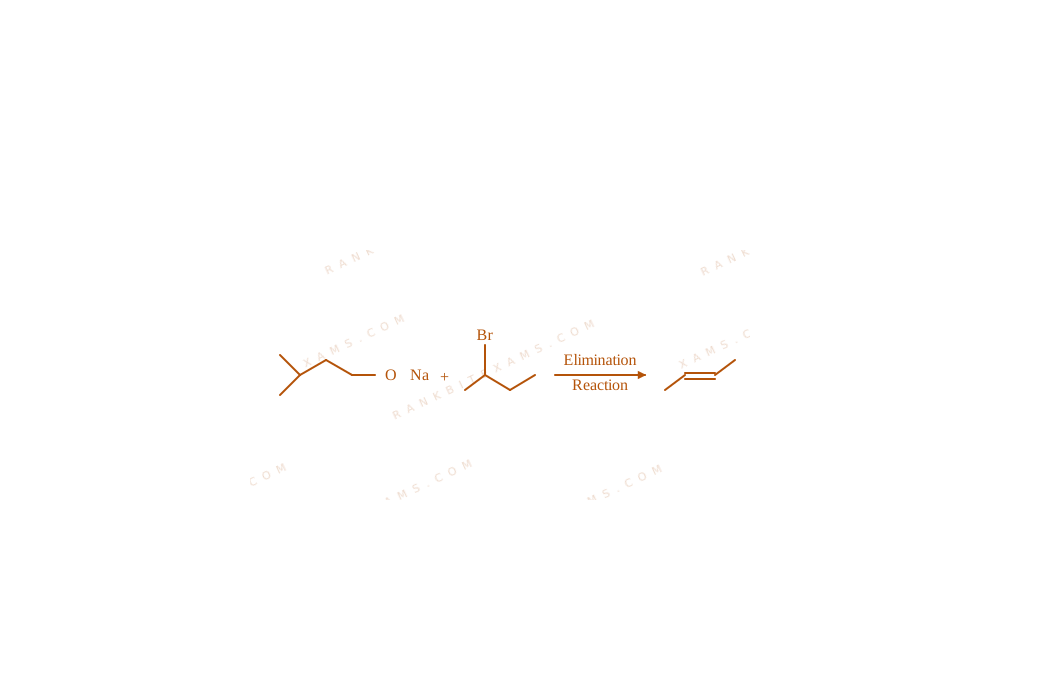
Option 4: sec-Butyl bromide (sec-BuBr$\text{sec-BuBr}$) is a secondary (2^°$2^\circ$) alkyl halide. When a sterically hindered 2^°$2^\circ$ halide is treated with a strongly basic alkoxide reagent like isobutoxide, alkene elimination (E2$E2$) competes aggressively and dominates as the major pathway over nucleophilic substitution (SN2$S_N2$). Competing elimination reaction mechanism layout for Q37
Pattern Recognition
Williamson Synthesis Rule: Alkoxide can be as massive and complex as desired (3^°$3^\circ$ or branched), but the Alkyl Halide MUST be unhindered (1^°$1^\circ$ or methyl). If the halide is 2^°$2^\circ$ or 3^°$3^\circ$, elimination wins, forming an alkene instead of an ether.
Chapter Mix
Class 12 Chemistry: Alcohols, Phenols and Ethers
More Alcohols, Phenols and Ethers Questions — jee_main_2025_04_april_evening
Practice past-year questions one chapter at a time. Pick an exam → subject → chapter and get every PYQ for that topic — pulled together from all past papers — with the chapter's key formulas alongside.