Rankbit System
JEE Physics: Waves (+15.5%) | Electrostatics: Concentric Shells (-29.7%) | Modern Physics: Photoelectric Clones (+34.2%) | Mathematics: Definite Integrals (+18.1%) | Chemistry: Coordination Splitting (-11.4%) | JEE Physics: Waves (+15.5%) | Electrostatics: Concentric Shells (-29.7%) | Modern Physics: Photoelectric Clones (+34.2%) | Mathematics: Definite Integrals (+18.1%) | Chemistry: Coordination Splitting (-11.4%)

A toxic compound “A” when reacted with NaCN in aqueous acidic medium yields an edible cooking component and food preservative “B”. “B” is converted to “C” by diborane and can be used as an additive to petrol to reduce emission. “C” upon reaction with oleum at 140^circmathrmC yields an inhalable anesthetic “D”. Identify “A”, “B”, “C” and “D”, respectively.

Solution & Explanation

### Core Logic Let's track the conversions row by row based on the description: 1. Toxic compound **A** is methanol (CH_3OH). Reacting it via acidic NaCN sequences effectively converts it eventually into acetic acid (CH_3COOH), which is an edible cooking component and food preservative (vinegar) **B**. 2. Reduction of acetic acid (**B**) with diborane (B_2H_6) yields ethanol (CH_3CH_2OH) **C**. Ethanol is used as a biofuel additive in petrol. 3. Ethanol (**C**) upon heating with oleum/concentrated sulfuric acid at 140^circmathrmC undergoes intermolecular dehydration to yield diethyl ether (C_2H_5-O-C_2H_5) **D**, which functions as an inhalable anesthetic. ### Step 1: Chemical Reaction Sequence Flow
Chemical flow chart for sequential ether preparation
The full sequential progression corresponds exactly to: textMethanol (A) rightarrow textAcetic Acid (B) rightarrow textEthanol (C) rightarrow textDiethyl ether (D) ### Pattern Recognition Key temperature indicator: Dehydration of ethanol at 140^circmathrmC yields diethyl ether (ether synthesis), whereas 170^circmathrmC yields ethene gas. Combined with the food preservative clue (acetic acid), the sequence locks instantly to option (3). ### Evaluation Rubric / Model Answer null ### Chapter Mix Class 12 Chemistry: Alcohols, Phenols and Ethers

Reference Study Guides

More Alcohols, Phenols and Ethers Previous-Year Questions

Q 2025 Acidity of Phenols
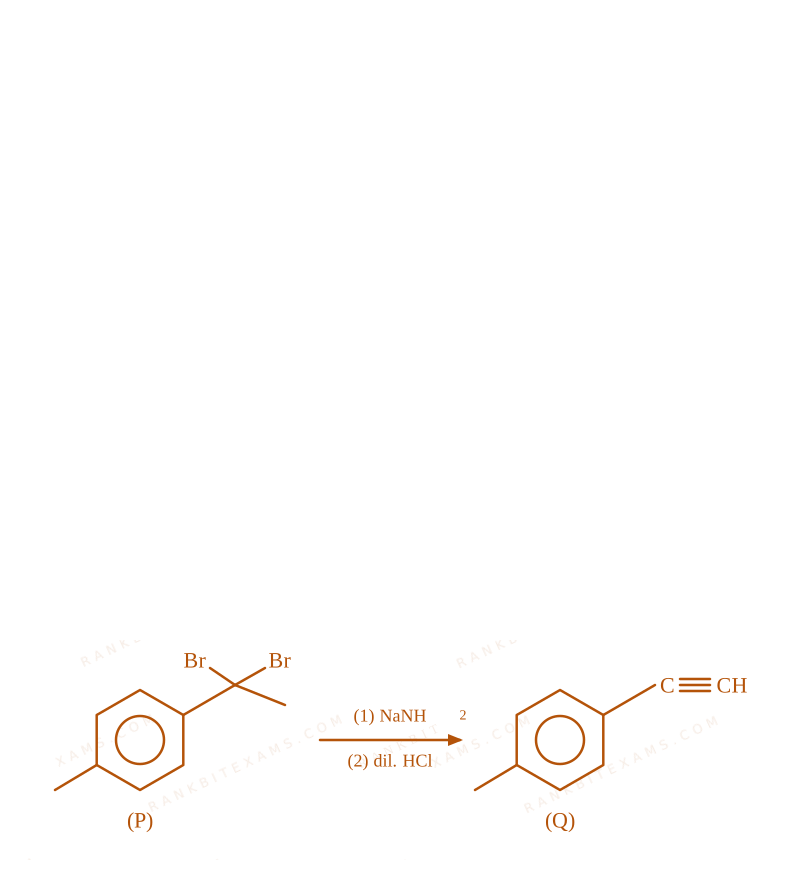
Which of the following compounds is least likely to give effervescence of mathrmCO_2 in presence of aq. mathrmNaHCO_3 ?
  • A.
  • B.
  • C. mathrmPh - NH_3^(+) Cl^(-)
  • D.

Solution

### Core Logic For a compound to release mathrmCO_2 upon reaction with aqueous mathrmNaHCO_3, its acidity must be strictly greater than that of carbonic acid (mathrmH_2CO_3). Let's evaluate the acidity of the options: 1. **Picric Acid** (2,4,6-trinitrophenol - Option A): Extremely acidic (pK_a approx 0.38) due to three strong electron-withdrawing nitro groups. Reacts with mathrmNaHCO_3 easily. 2. **4-Nitrobenzoic Acid** (Option B): Carboxylic acids generally have pK_a approx 4text--5. More acidic than carbonic acid (pK_a approx 6.3). Reacts with mathrmNaHCO_3. 3. **Anilinium Chloride** (Option 3): A salt of a strong acid and weak base. The anilinium ion is quite acidic (pK_a approx 4.6) and easily decomposes mathrmNaHCO_3. 4. **4-Nitrophenol** (Option D): Only one nitro group is present. Its acidity (pK_a approx 7.15) is weaker than carbonic acid. Hence, it does not react with sodium bicarbonate to yield effervescence of mathrmCO_2. ### Pattern Recognition Acid-bicarbonate test shortcut: - All carboxylic acids and picric acid give a positive bicarbonate test. - Normal phenols and mono/di-nitrophenols are too weak to decompose bicarbonate. ### Evaluation Rubric / Model Answer null ### Chapter Mix Class 12 Chemistry: Alcohols, Phenols and Ethers Class 12 Chemistry: Carboxylic Acids
Q31 2025 Physical Properties of Ethers
Given below are two statements: Statement I: Dimethyl ether is completely soluble in water. However, diethyl ether is soluble in water to a very small extent. Statement II: Sodium metal can be used to dry diethyl ether and not ethyl alcohol. In the light of given statements, choose the correct answer from the options given below:
  • A. textStatement I is false but Statement II is true
  • B. textBoth Statement I and Statement II are false
  • C. textStatement I is true but Statement II is false
  • D. textBoth Statement I and Statement II are true

Solution

### Core Logic Statement I: Dimethyl ether (CH_3OCH_3) is highly soluble in water because its smaller alkyl chain allows substantial hydrogen bonding with water molecules. In contrast, diethyl ether has a larger hydrophobic ethyl group which drastically reduces its water solubility (to about 7.5text g per 100text mL). Thus, Statement I is true. Statement II: Sodium metal (Na) reacts violently with alcohols like ethyl alcohol to release hydrogen gas: 2textC_2textH_5textOH + 2textNa rightarrow 2textC_2textH_5textONa + textH_2uparrow Since diethyl ether has no active acidic hydrogen, it does not react with sodium metal. Hence, sodium can dry diethyl ether but cannot be used for ethyl alcohol. Statement II is true. ### Pattern Recognition Ethers are miscible with water primarily when the non-polar alkyl parts are very small. Active hydrogen presence (-textOH group in alcohols) prevents the use of alkali metals like sodium for moisture removal. ### Evaluation Rubric / Model Answer null ### Chapter Mix Class 12 Chemistry: Alcohols, Phenols and Ethers
Q37 2025 Williamson Ether Synthesis
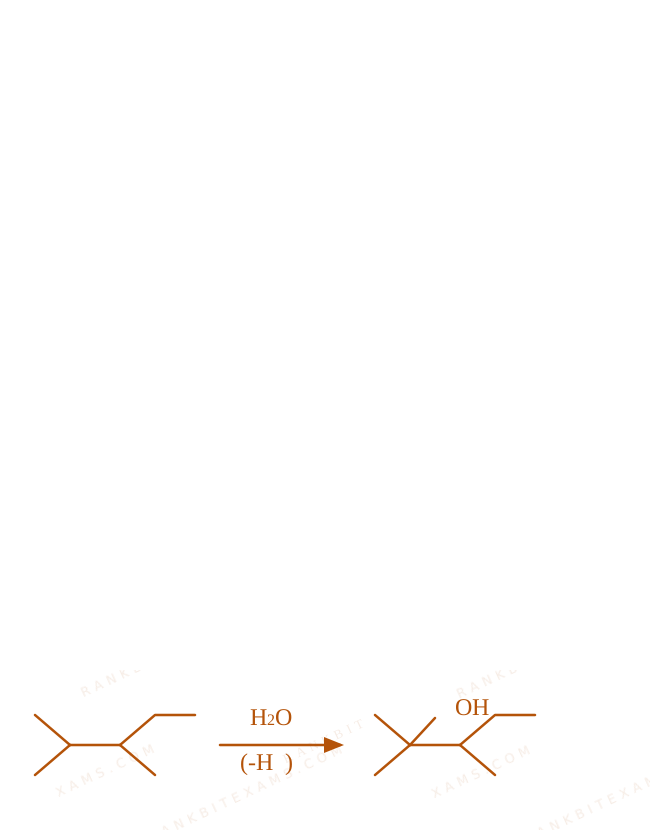
Which one of the following reactions will not lead to the desired ether formation in major proportion? (Given labels: textiso-Bu Rightarrow textisobutyl, textsec-Bu Rightarrow textsec-butyl, textn-Pr Rightarrow textn-propyl, text^tBu Rightarrow texttert-butyl, textEt Rightarrow textethyl)
  • A. text^tBuO^-textNa^+ + textEtBr longrightarrow text^tBu-O-Et
  • B. textPhO^-textNa^+ + textCH_3textBr longrightarrow textPh-O-CH_3
  • C. textPhO^-textNa^+ + textn-PrBr longrightarrow textn-Pr-O-Ph
  • D. textiso-BuO^-textNa^+ + textsec-BuBr longrightarrow textsec-Bu-O-iso-Bu

Solution

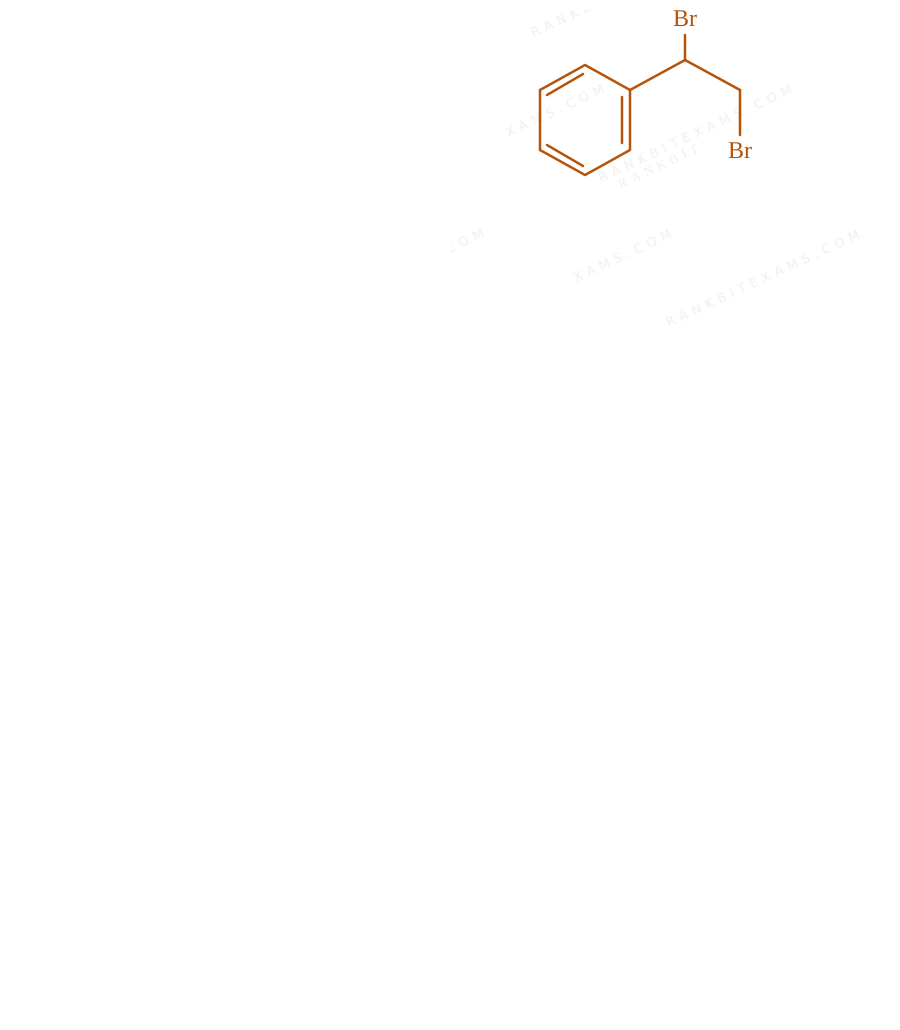
### Core Logic Williamson Ether Synthesis operates strictly via an **S_N2 mechanism**. To optimize ether formation yields, the alkyl halide component MUST be primary (1^circ) or methyl to evade spatial shielding restrictions. Let us review the alkyl halide across the options: * Option 1: Ethyl bromide (textEtBr) is 1^circ rightarrow Excellent ether yield via substitution. * Option 2: Methyl bromide (textCH_3textBr) is a unhindered methyl halide rightarrow High substitution efficiency. * Option 3: n-Propyl bromide (textn-PrBr) is 1^circ rightarrow Clean substitution pathway. * Option 4: sec-Butyl bromide (textsec-BuBr) is a secondary (2^circ) alkyl halide. When a sterically hindered 2^circ halide is treated with a strongly basic alkoxide reagent like isobutoxide, **alkene elimination (E2) competes aggressively and dominates** as the major pathway over nucleophilic substitution (S_N2).
Competing elimination reaction mechanism layout for Q37
### Pattern Recognition Williamson Synthesis Rule: Alkoxide can be as massive and complex as desired (3^circ or branched), but the Alkyl Halide MUST be unhindered (1^circ or methyl). If the halide is 2^circ or 3^circ, elimination wins, forming an alkene instead of an ether. ### Evaluation Rubric / Model Answer null ### Chapter Mix Class 12 Chemistry: Alcohols, Phenols and Ethers
Q45 2025 Cleavage of Ethers by Halogen Acids
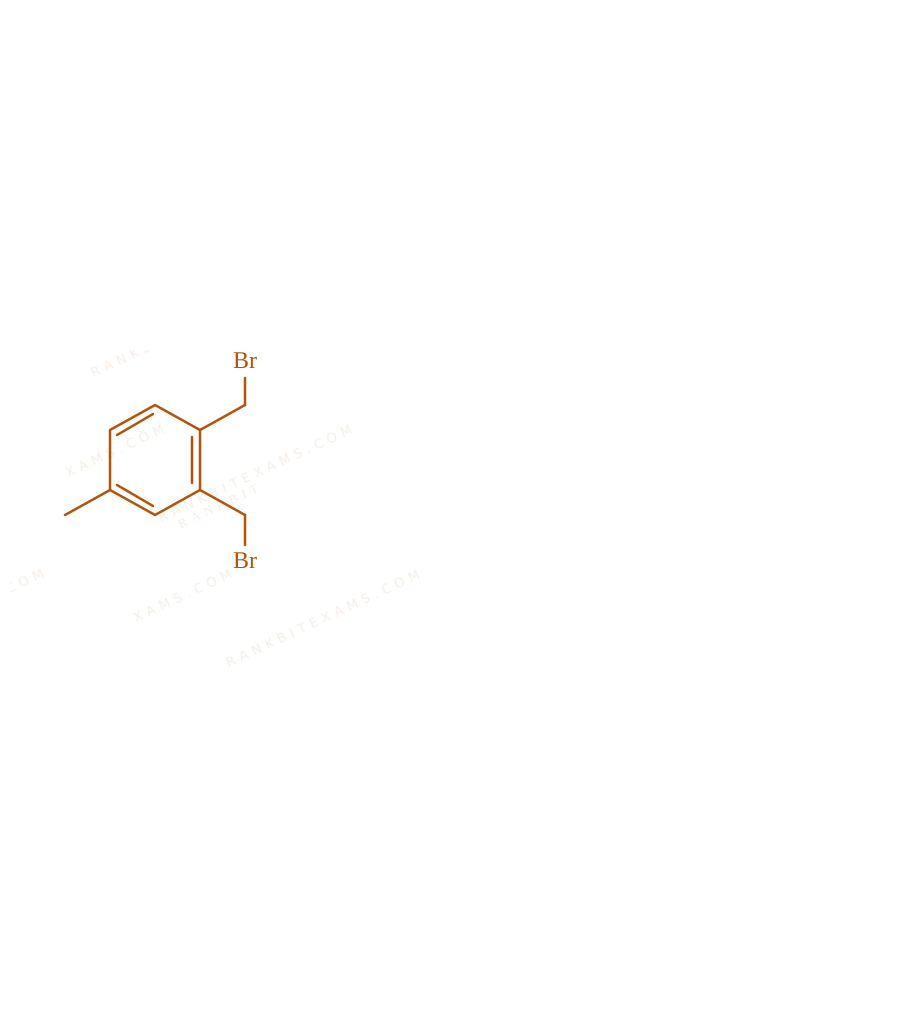
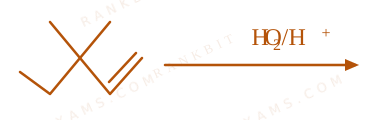
Which one of the following, with HBr will give a phenol?
  • A. Benzyl methyl ether option (1)
  • B. Anisole (Methoxybenzene) option (2)
  • C. Dimethyl ether option (3)
  • D. Methyl phenyl ether derivative option (4)

Solution

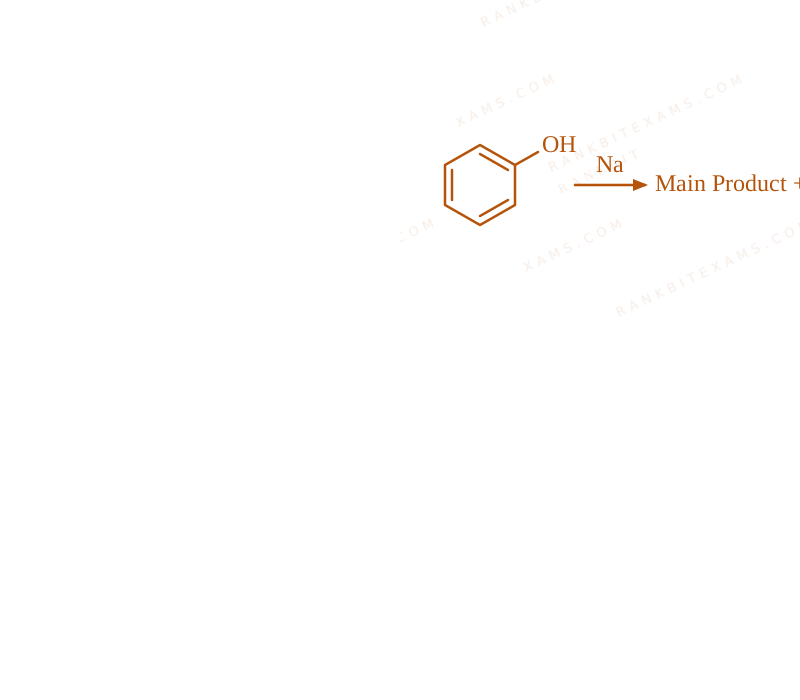
### Core Logic Anisole (Ph-O-CH_3) contains an aryl-oxygen bond which possesses partial double bond character due to resonance stabilization with the aromatic ring. When treated with HBr, protonation yields an oxonium ion. The nucleophile Br^- attacks via an S_N2 pathway at the smaller, less hindered methyl group, cleaving the O-CH_3 bond to form Phenol (PhOH) and CH_3Br.
Cleavage of Ethers by Halogen Acids diagram for Q45 - JEE Main 2025 Evening
### Pattern Recognition Aromatic sp^2 C-O bonds are exceptionally strong and cannot be cleaved by nucleophilic attack from Hal^-. Therefore, the oxygen always stays attached to the benzene ring, yielding phenol. ### Evaluation Rubric / Model Answer null ### Chapter Mix Class 12 Chemistry: Alcohols, Phenols and Ethers

More Alcohols, Phenols and Ethers Questions — jee_main_2025_04_april_evening

Practice all Alcohols, Phenols and Ethers previous-year questions →

YOUR FIRST PREP STEP STARTS HERE

We Map Every Repeating Question in Competitive Exams.

Say goodbye to generic mock test fatigue. RankBit uses smart analysis to group past exam questions into their foundational Repeating Question Types. Find chapter weightage, track repeating questions, and score higher with targeted practice.

Select Your Target Exam

Choose an exam track below to find formulas per chapter and patterns.

Syncing Exam Intelligence

Mapping formulas and patterns across all tracks…

PATH A — FULL LENGTH PRACTICE

Full Mock Test Hub

Simulate real NTA exam conditions with fully tracked mocks. Time yourself against past papers.

Under Development
PATH B — TARGETED PRACTICE

Topic-wise Practice Hub

Practice past-year questions one chapter at a time. Pick an exam → subject → chapter and get every PYQ for that topic — pulled together from all past papers — with the chapter's key formulas alongside.

Loading Questions... Browse Topics
Latest from the Blog
View all →

Loading articles...