Two cylindrical vessels of equal cross sectional area of 2~m²$2\mathrm{~m}^{2}$ contain water upto height 10~m$10\mathrm{~m}$ and 6~m$6\mathrm{~m}$, respectively. If the vessels are connected at their bottom then the work done by the force of gravity is :
(Density of water is 10³~kg/m³$10^{3}\mathrm{~kg/m}^{3}$ and g=10~m/s²$g=10\mathrm{~m/s}^{2}$)
A.1 × 10⁵~J$1 \times 10^{5}\mathrm{~J}$
B.4 × 10⁴~J$4 \times 10^{4}\mathrm{~J}$
C.6 × 10⁴~J$6 \times 10^{4}\mathrm{~J}$
D.8 × 10⁴~J$8 \times 10^{4}\mathrm{~J}$
Solution & Explanation
Related Formula
The gravitational potential energy U$U$ of a liquid column of mass m$m$ and height h$h$ is evaluated relative to its bottom by placing its total mass at its center of mass (h/2$h/2$):
U = m g ((h)/(2)) = (ρ A h) g ((h)/(2)) = (1)/(2) ρ A g h²$$U = m g \left(\frac{h}{2}\right) = (\rho A h) g \left(\frac{h}{2}\right) = \frac{1}{2} \rho A g h^2$$
Work done by the force of gravity (W$W$) equals the negative change in potential energy:
W = -Δ U = Uᵢ - Uf$$W = -\Delta U = U_i - U_f$$
Core Logic
Since the vessels are identical and connected at the bottom, water flows from the higher column to the lower one until their final heights equalize at:
Step 1: Calculate Initial Potential Energy (Uᵢ$U_i$)
Let the reference level U=0$U=0$ be at the bottom:
Uᵢ = U₁ + U₂ = (1)/(2) ρ A g h₁² + (1)/(2) ρ A g h₂²$$U_i = U_1 + U_2 = \frac{1}{2} \rho A g h_1^2 + \frac{1}{2} \rho A g h_2^2$$Uᵢ = (1)/(2) ρ A g (10² + 6²) = (1)/(2) ρ A g (100 + 36) = 68 ρ A g$$U_i = \frac{1}{2} \rho A g \left(10^2 + 6^2\right) = \frac{1}{2} \rho A g (100 + 36) = 68 \rho A g$$
Work Done by Gravity in Connecting Vessels
Step 2: Calculate Final Potential Energy (Uf$U_f$)
Both vessels equalize to hf = 8~m$h_f = 8\mathrm{~m}$:
Uf = 2 × [ (1)/(2) ρ A g hf² ] = ρ A g (8²) = 64 ρ A g$$U_f = 2 \times \left[ \frac{1}{2} \rho A g h_f^2 \right] = \rho A g (8^2) = 64 \rho A g$$
Step 3: Work Done by Gravity (W$W$)
W = Uᵢ - Uf = 68 ρ A g - 64 ρ A g = 4 ρ A g$$W = U_i - U_f = 68 \rho A g - 64 \rho A g = 4 \rho A g$$
Substitute the given values (ho = 10³~kg/m³$
ho = 10^3\mathrm{~kg/m}^3$, A = 2~m²$A = 2\mathrm{~m}^2$, g = 10~m/s²$g = 10\mathrm{~m/s}^2$):
For leveling liquids between two identical connected columns, the shift in center of mass always simplifies. The loss in potential energy is given by
$
Pattern Recognition
For leveling liquids between two identical connected columns, the shift in center of mass always simplifies. The loss in potential energy is given by $
\Delta U = \frac{1}{4} \rho A g (h_1 - h_2)^2. Applying this directly:$. Applying this directly:
$Δ U = (1)/(4) × 10³ × 2 × 10 × (10 - 6)² = 5000 × 16 = 8 × 10⁴~J$\Delta U = \frac{1}{4} \times 10^3 \times 2 \times 10 \times (10 - 6)^2 = 5000 \times 16 = 8 \times 10^4\mathrm{~J}$$
Chapter Mix
Class 11 Physics: Mechanical Properties of Fluids
More Mechanical Properties of Fluids Previous-Year Questions — Page 7
Q47jee_main_2024_31_jan_eveningViscosity and Terminal Velocity
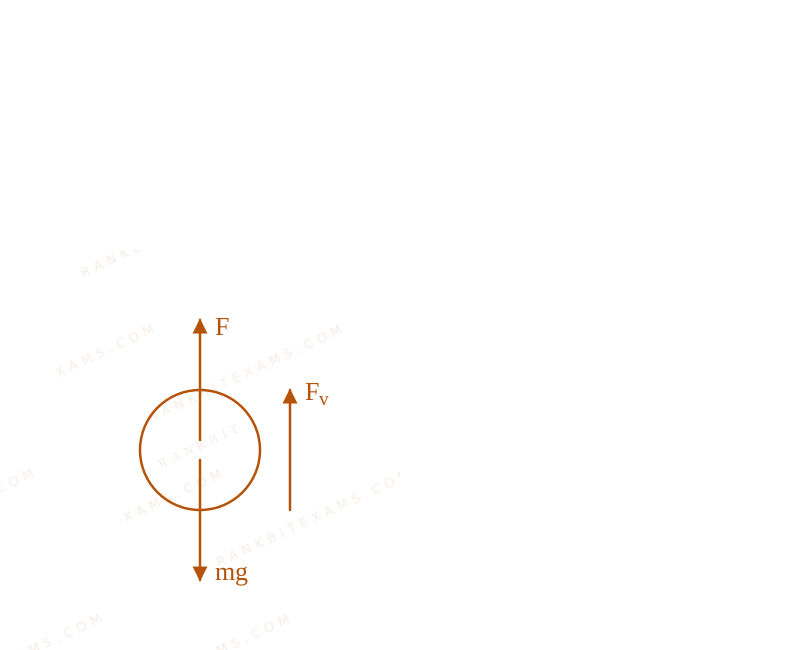
A small spherical ball of radius r$r$, falling through a viscous medium of negligible density has terminal velocity 'v'. Another ball of the same mass but of radius 2r$2r$, falling through the same viscous medium will have terminal velocity:
A.(v)/(2)$\frac{v}{2}$
B.(v)/(4)$\frac{v}{4}$
C.4v$4v$
D.2v$2v$
Solution
Related Formula
At terminal velocity, downward force equals upward drag (assuming negligible buoyancy):
Mg = 6π η r v$$Mg = 6\pi \eta r v$$v = (Mg)/(6π η r)$$v = \frac{Mg}{6\pi \eta r}$$
Core Logic
Since the density of the medium is negligible, we ignore buoyant forces.
The mass M$M$ of the ball is specified to remain the same in both cases, despite the change in radius (implying the material density of the second ball is lower).
Step 1: Setup Proportionality
Since M$M$, g$g$, and η$\eta$ are all constants:
v ∝ (1)/(r)$$v \propto \frac{1}{r}$$
Step 2: Evaluating the Ratio
For the second ball, r' = 2r$r' = 2r$.
Therefore, the new terminal velocityv'$v'$ is:
v' = v × ((r)/(r')) = v × ((r)/(2r)) = (v)/(2)$$v' = v \times \left(\frac{r}{r'}\right) = v \times \left(\frac{r}{2r}\right) = \frac{v}{2}$$
Pattern Recognition
Read the constraints carefully. Usually, questions keep material density uniform (v ∝ r²$v \propto r^2$). However, this specifically says "same mass". This shifts the formula dependency from v ∝ r²$v \propto r^2$ entirely to v ∝ 1/r$v \propto 1/r$ because M$M$ acts as a constant numerator.
Chapter Mix
Class 11 Physics: Mechanical Properties of Fluids
Qjee_main_2024_31_jan_morningViscosity And Terminal Velocity
A small steel ball is dropped into a long cylinder containing glycerine. Which one of the following is the correct representation of the velocity time graph for the transit of the ball?
Practice past-year questions one chapter at a time. Pick an exam → subject → chapter and get every PYQ for that topic — pulled together from all past papers — with the chapter's key formulas alongside.