Two cells of emf 1V and 2V and internal resistance 2Omega$2\Omega$ and 1Omega$1\Omega$, respectively, are connected in series with an external resistance of 6Omega$6\Omega$. The total current in the circuit is I_1$I_{1}$ Now the same two cells in parallel configuration are connected to same external resistance. In this case, the total current drawn is I_2$I_{2}$. The value of (fracI_1I_2)$(\frac{I_{1}}{I_{2}})$ is fracx3$\frac{x}{3}$. The value of x is ________.
Numerical Answer Type:
Enter a numerical valueAnswer: 4 to 4+4 marks
Solution & Explanation
### Related Formula
- Series cell configuration:
varepsilon_texteq = varepsilon_1 + varepsilon_2, quad r_texteq = r_1 + r_2$$\varepsilon_{\text{eq}} = \varepsilon_1 + \varepsilon_2, \quad r_{\text{eq}} = r_1 + r_2$$
- Parallel cell configuration (for unequal cells in parallel):
varepsilon_texteq = fracfracvarepsilon_1r_1 + fracvarepsilon_2r_2frac1r_1 + frac1r_2, quad frac1r_texteq = frac1r_1 + frac1r_2$$\varepsilon_{\text{eq}} = \frac{\frac{\varepsilon_1}{r_1} + \frac{\varepsilon_2}{r_2}}{\frac{1}{r_1} + \frac{1}{r_2}}, \quad \frac{1}{r_{\text{eq}}} = \frac{1}{r_1} + \frac{1}{r_2}$$
- Circuit current:
I = fracvarepsilon_texteqr_texteq + R$$I = \frac{\varepsilon_{\text{eq}}}{r_{\text{eq}} + R}$$
### Core Logic
Given parameters:
- Cell 1: $
### Core Logic
Given parameters:
- Cell 1: $\varepsilon_1 = 1\mathrm{~V}, $, $r_1 = 2\Omega
- Cell 2: $
- Cell 2: $\varepsilon_2 = 2\mathrm{~V}, $, $r_2 = 1\Omega
- External resistance $
- External resistance $R = 6\Omega
### Step 1: Calculate $
### Step 1: Calculate $I_1 (Series Configuration)Grouping of Cells$ (Series Configuration)Grouping of Cells
$varepsilon_texteq = 1 + 2 = 3mathrm~V$\varepsilon_{\text{eq}} = 1 + 2 = 3\mathrm{~V}$$
$r_texteq = 2 + 1 = 3Omega$r_{\text{eq}} = 2 + 1 = 3\Omega$$
$I_1 = frac33 + 6 = frac39 = frac13mathrm~A$I_1 = \frac{3}{3 + 6} = \frac{3}{9} = \frac{1}{3}\mathrm{~A}$
### Step 2: Calculate $I_2$ (Parallel Configuration)Grouping of Cells$$
### Step 2: Calculate $I_2$ (Parallel Configuration)Grouping of Cells
$$\varepsilon_{\text{eq}} = \frac{\frac{1}{2} + \frac{2}{1}}{\frac{1}{2} + \frac{1}{1}} = \frac{0.5 + 2}{1.5} = \frac{2.5}{1.5} = \frac{5}{3}\mathrm{~V}$$
$$r_{\text{eq}} = \frac{r_1 r_2}{r_1 + r_2} = \frac{2 \times 1}{2 + 1} = \frac{2}{3}\Omega$$
$$I_2 = \frac{\varepsilon_{\text{eq}}}{r_{\text{eq}} + R} = \frac{\frac{5}{3}}{\frac{2}{3} + 6} = \frac{\frac{5}{3}}{\frac{20}{3}} = \frac{5}{20} = \frac{1}{4}\mathrm{~A}$
### Step 3: Find ratio and evaluate $x$
$$$
### Step 3: Find ratio and evaluate $x$
$$\frac{I_1}{I_2} = \frac{\frac{1}{3}}{\frac{1}{4}} = \frac{4}{3}$
Comparing with $
Comparing with $\frac{x}{3}:
$:
$x = 4
### Pattern Recognition
For cells connected in parallel, the formula for equivalent EMF $
### Pattern Recognition
For cells connected in parallel, the formula for equivalent EMF $\varepsilon_{\text{eq}}$ can be viewed as a weighted average. Connecting cells in series maximizes EMF but increases internal resistance, while parallel configuration limits EMF to an intermediate value while reducing equivalent internal resistance.
### Evaluation Rubric / Model Answer
null
### Chapter Mix
Class 12 Physics: Current Electricity
More Current Electricity Previous-Year Questions — Page 2
Q14jee_main_2025_28_jan_morningCombination of Resistors
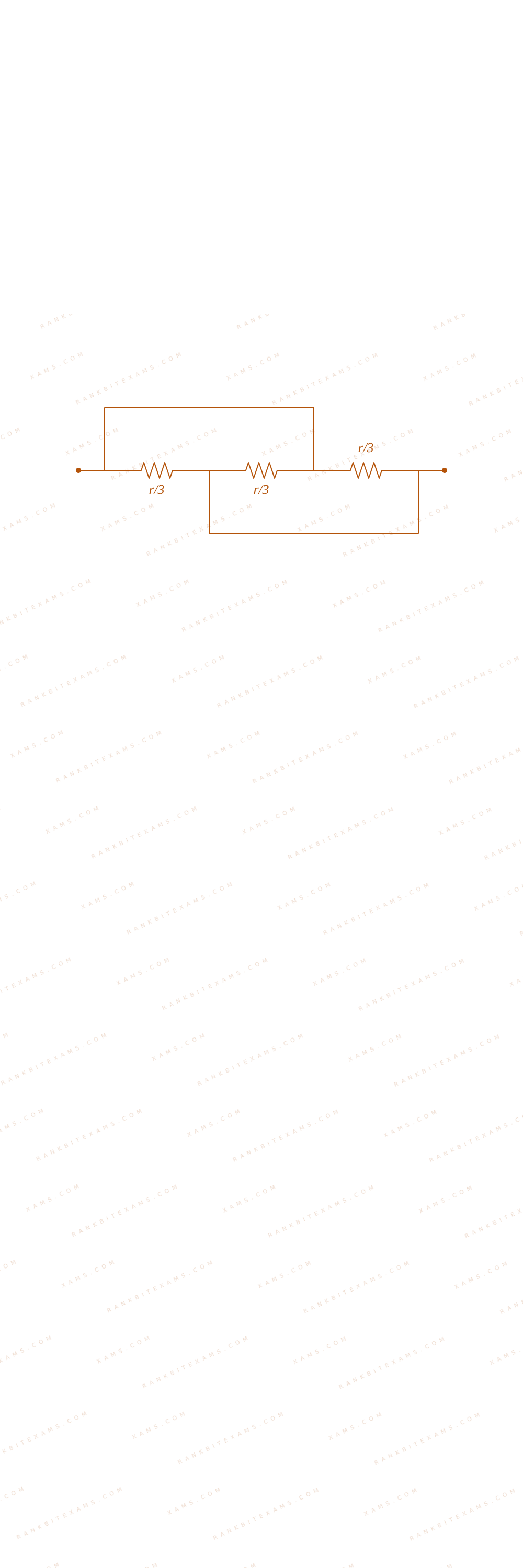
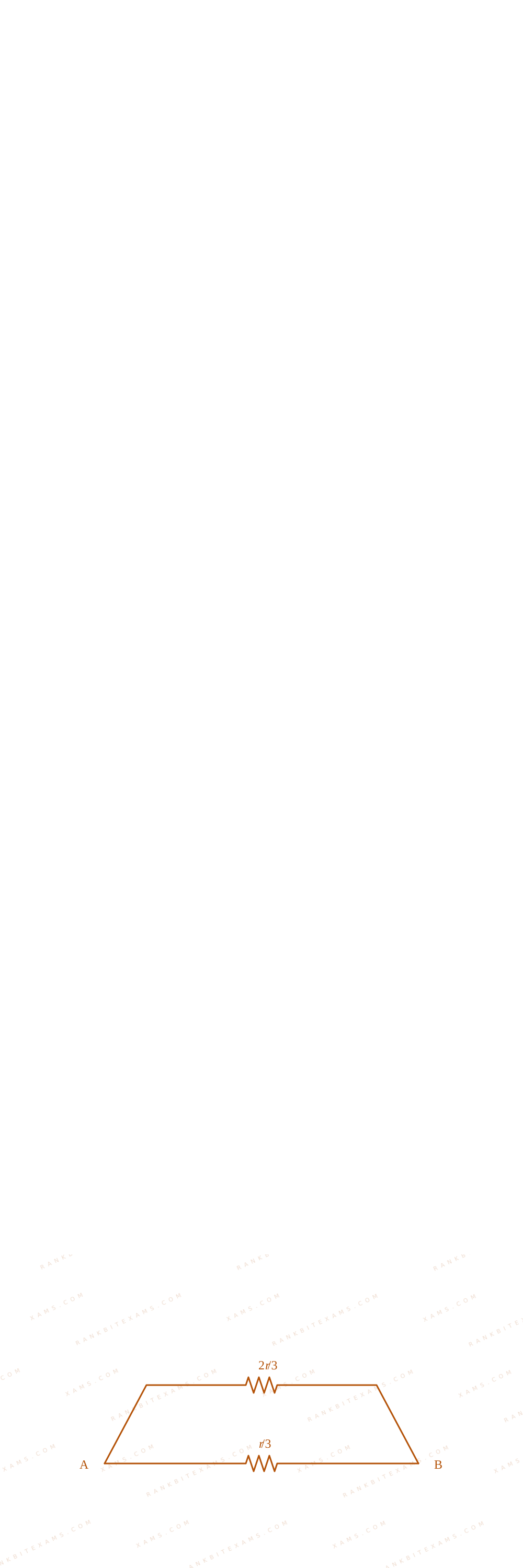
Find the equivalent resistance between two ends of the following circuit.
A complex looking resistive mesh whose node potentials reveal a simple symmetrical pattern.
A.mathrmr$\mathrm{r}$
B.fracmathrmr6$\frac{\mathrm{r}}{6}$
C.fracmathrmr9$\frac{\mathrm{r}}{9}$
D.fracmathrmr3$\frac{\mathrm{r}}{3}$
Solution
### Core Logic
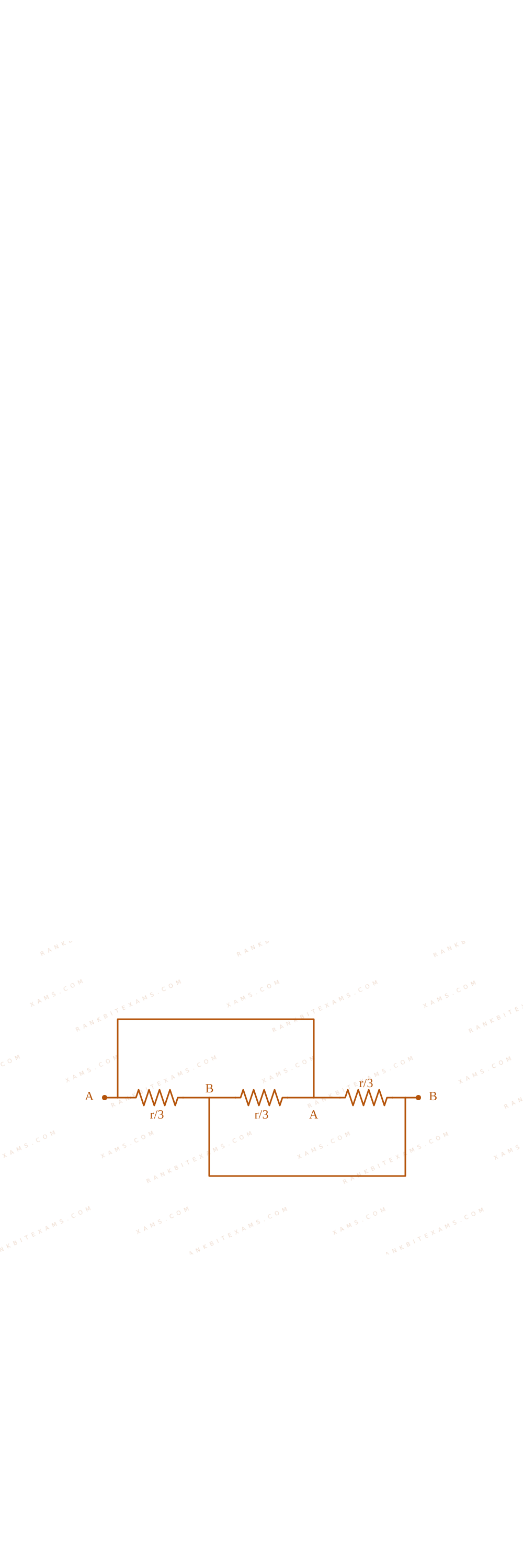
Label the circuit nodes carefully to see how the elements are connected across terminal zones:
A complex looking resistive mesh whose node potentials reveal a simple symmetrical pattern.A complex looking resistive mesh whose node potentials reveal a simple symmetrical pattern.
Tracing parallel loops reveals all inner subsets share identical path boundaries.
mathrmR_texteq = fracmathrmr/33 = fracmathrmr9$$\mathrm{R}_{\text{eq}} = \frac{\mathrm{r}/3}{3} = \frac{\mathrm{r}}{9}$$
### Step 1: Final Expression
The overall simplified system network value equals fracmathrmr9$\frac{\mathrm{r}}{9}$, matching option (3).
### Pattern Recognition
Short-circuit tracking lines allow collapsing complex meshes into basic parallel branches. If all nodes connect symmetrically, apply simple division: mathrmR/mathrmN$\mathrm{R}/\mathrm{N}$.
### Evaluation Rubric / Model Answer
null
### Chapter Mix
Class 12 Physics: Current Electricity
Q15jee_main_2025_28_jan_morningCombination of Resistors
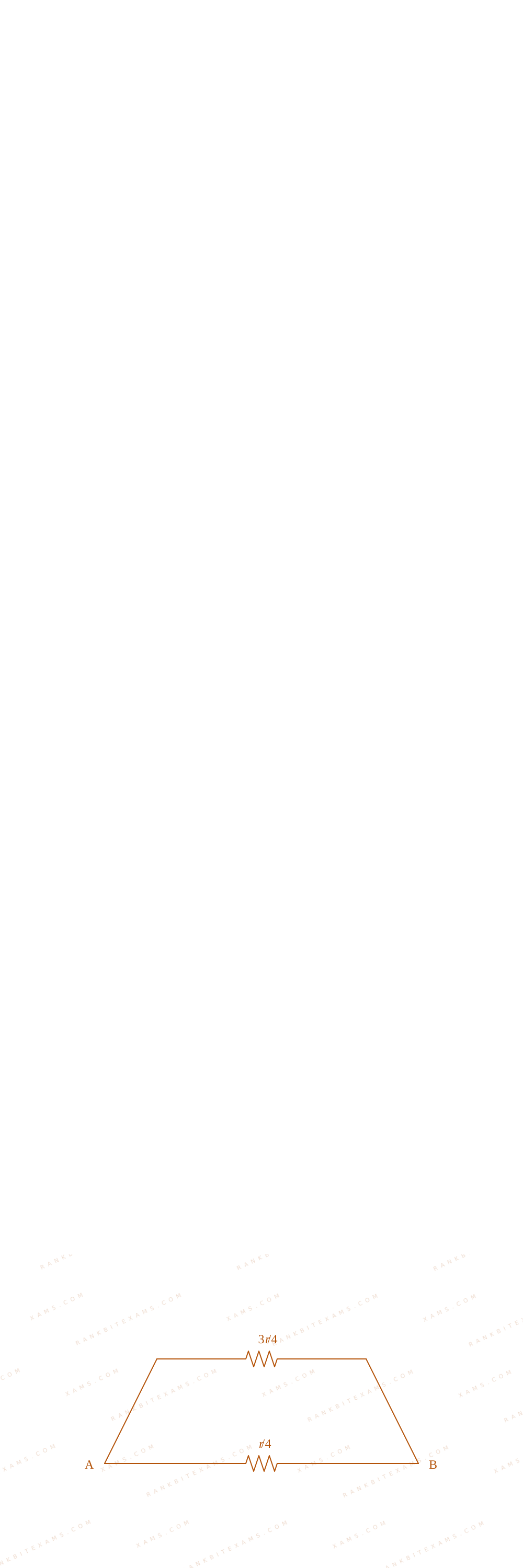
A wire of resistance R$R$ is bent into an equilateral triangle and an identical wire is bent into a square. The ratio of resistance between the two end points of an edge of the triangle to that of the square is
A.9 / 8$9 / 8$
B.8 / 9$8 / 9$
C. 27/32
D. 32/27
Solution
### Related Formula
mathrmR = fracrhoellmathrmA implies mathrmR propto ell$$\mathrm{R} = \frac{\rho\ell}{\mathrm{A}} \implies \mathrm{R} \propto \ell$$
### Core Logic
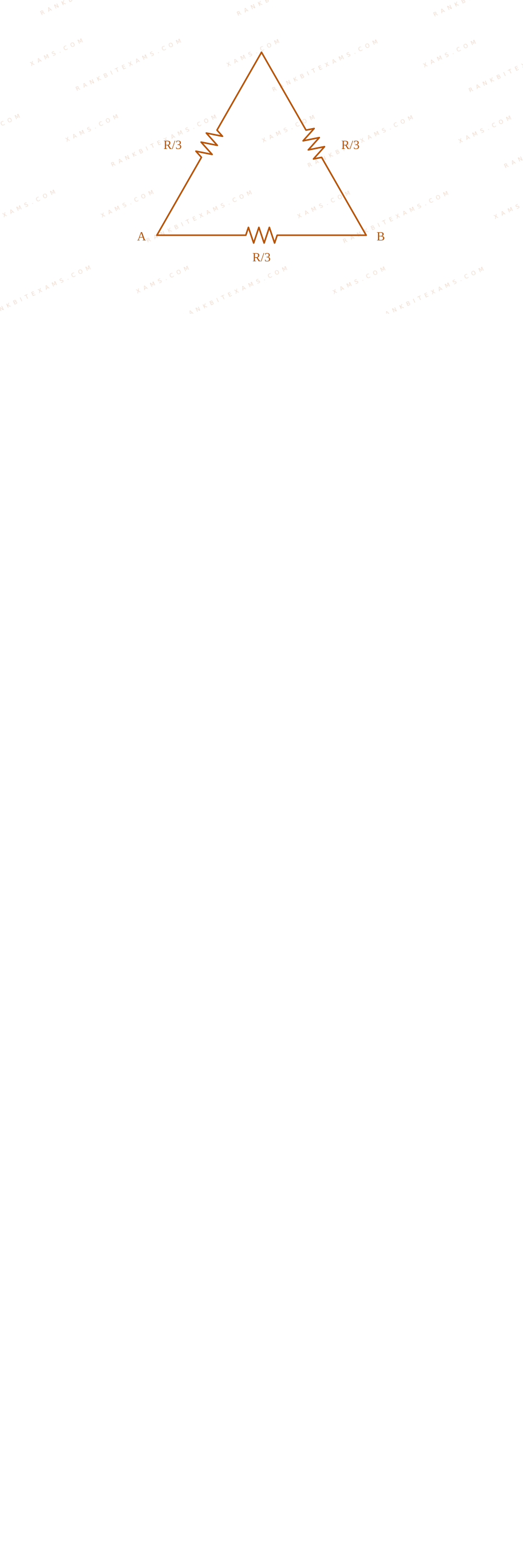
For the equilateral triangle, the total resistance mathrmR$\mathrm{R}$ is divided into three equal line parts of value fracmathrmR3$\frac{\mathrm{R}}{3}$ each:
Visual representation of triangle and square edge divisions for Q15Visual representation of triangle and square edge divisions for Q15
An edge configuration places one part in parallel with the other two series steps:
left(mathrmR_texteqright)_1 = frac(frac2mathrmR3) cdot (fracmathrmR3)frac2mathrmR3 + fracmathrmR3 = frac29mathrmR$$\left(\mathrm{R}_{\text{eq}}\right)_1 = \frac{(\frac{2\mathrm{R}}{3}) \cdot (\frac{\mathrm{R}}{3})}{\frac{2\mathrm{R}}{3} + \frac{\mathrm{R}}{3}} = \frac{2}{9}\mathrm{R}$$
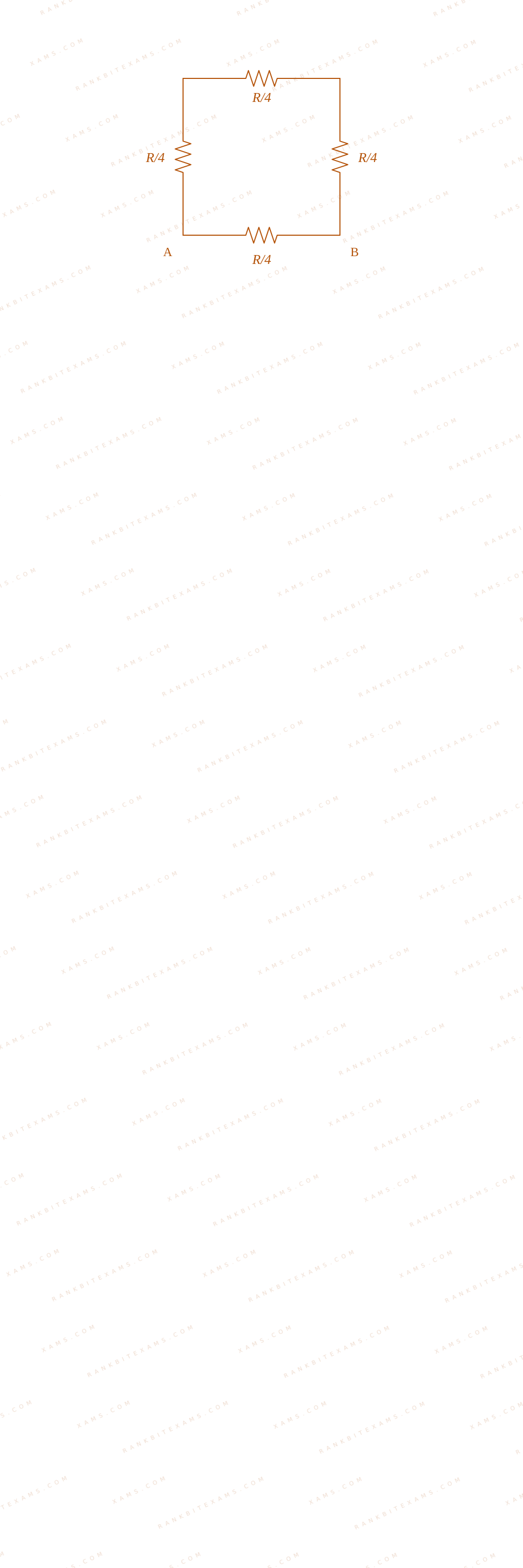
For the square, the wire resistance mathrmR$\mathrm{R}$ divides into four parts of fracmathrmR4$\frac{\mathrm{R}}{4}$ each:
Visual representation of triangle and square edge divisions for Q15Visual representation of triangle and square edge divisions for Q15
An edge calculation pairs one section in parallel with the remaining three loops in series:
left(mathrmR_texteqright)_2 = frac(frac3mathrmR4) cdot (fracmathrmR4)frac3mathrmR4 + fracmathrmR4 = frac316mathrmR$$\left(\mathrm{R}_{\text{eq}}\right)_2 = \frac{(\frac{3\mathrm{R}}{4}) \cdot (\frac{\mathrm{R}}{4})}{\frac{3\mathrm{R}}{4} + \frac{\mathrm{R}}{4}} = \frac{3}{16}\mathrm{R}$$
Taking the ratio between these geometric layouts:
### Step 1: Final Ratio Calculation
fracleft(mathrmR_texteqright)_1left(mathrmR_texteqright)_2 = fracfrac29mathrmRfrac316mathrmR = frac3227$$\frac{\left(\mathrm{R}_{\text{eq}}\right)_1}{\left(\mathrm{R}_{\text{eq}}\right)_2} = \frac{\frac{2}{9}\mathrm{R}}{\frac{3}{16}\mathrm{R}} = \frac{32}{27}$$
This selects option (4).
### Pattern Recognition
For a regular polygon with mathrmN$\mathrm{N}$ identical sides formed from a wire of resistance mathrmR$\mathrm{R}$, the resistance across one edge is always given by frac(mathrmN-1)mathrmN^2mathrmR$\frac{(\mathrm{N}-1)}{\mathrm{N}^2}\mathrm{R}$.
### Evaluation Rubric / Model Answer
null
### Chapter Mix
Class 12 Physics: Current Electricity
Q5jee_main_2025_03_april_morningResistance of a Circular Wire
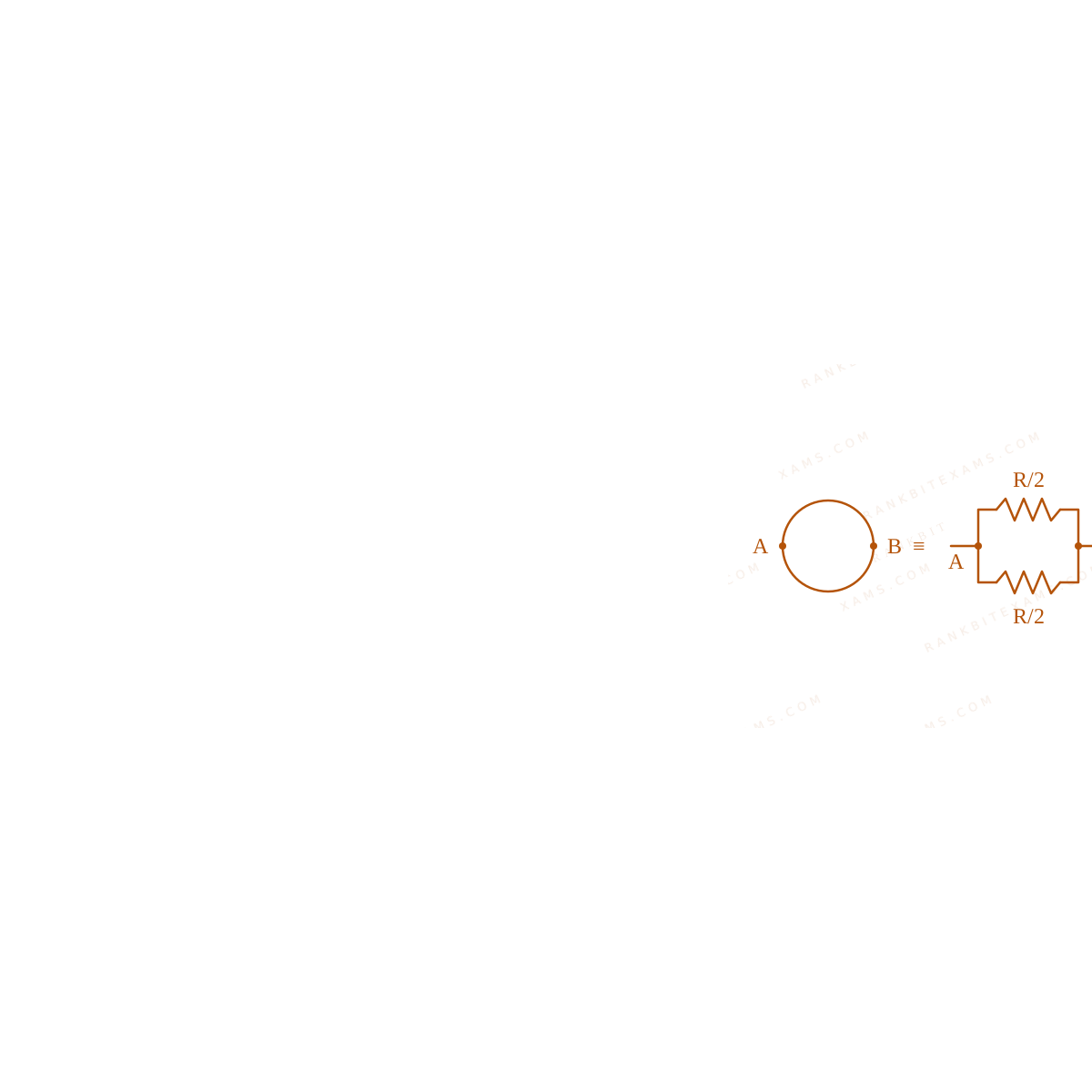
A wire of length 25mathrm~m$25\mathrm{~m}$ and cross-sectional area 5mathrm~mm^2$5\mathrm{~mm}^2$ having resistivity of 2times 10^-6Omegamathrm~m$2\times 10^{-6}\Omega\mathrm{~m}$ is bent into a complete circle. The resistance between diametrically opposite points will be:
A.12.5Omega$12.5\Omega$
B.50Omega$50\Omega$
C.100Omega$100\Omega$
D.25Omega$25\Omega$
Solution
### Related Formula
Resistance of a uniform wire:
R = fracrho LA$$R = \frac{\rho L}{A}$$
Equivalent resistance of two identical resistors in parallel:
R_texteq = fracR_1 R_2R_1 + R_2 = fracR_texthalf2$$R_{\text{eq}} = \frac{R_1 R_2}{R_1 + R_2} = \frac{R_{\text{half}}}{2}$$
### Core Logic
First, find the total resistance R_texttotal$R_{\text{total}}$ of the straight wire:
- Length of wire, L = 25mathrm~m$L = 25\mathrm{~m}$
- Area of cross-section, A = 5mathrm~mm^2 = 5 times 10^-6mathrm~m^2$A = 5\mathrm{~mm}^2 = 5 \times 10^{-6}\mathrm{~m}^2$
- Resistivity, rho = 2 times 10^-6Omegamathrm~m$\rho = 2 \times 10^{-6}\Omega\mathrm{~m}$R_texttotal = fracrho LA = frac2 times 10^-6 times 255 times 10^-6 = 10Omega$$R_{\text{total}} = \frac{\rho L}{A} = \frac{2 \times 10^{-6} \times 25}{5 \times 10^{-6}} = 10\Omega$$
### Step 1: Splitting into Semicircles
When the wire is bent into a complete circle, measuring the resistance between two diametrically opposite points splits the wire into two parallel halves of equal length.
Each semicircle has a resistance of:
R_textsemi = fracR_texttotal2 = frac102 = 5Omega$$R_{\text{semi}} = \frac{R_{\text{total}}}{2} = \frac{10}{2} = 5\Omega$$
These two halves are connected in parallel between the diametric terminals:
R_texteq = fracR_textsemi2 = frac52 = 2.5Omega$$R_{\text{eq}} = \frac{R_{\text{semi}}}{2} = \frac{5}{2} = 2.5\Omega$$Circular loop splitting resistance across diameter for Q5
### Step 2: Conclusion & Discrepancy
The actual mathematically rigorous answer is 2.5Omega$2.5\Omega$. Since 2.5Omega$2.5\Omega$ is not present in the given options, the question is marked as a **Bonus** question by standard key evaluation guidelines. If forced to choose a theoretical option due to printing mistakes, some keys may relate it to 10Omega / 4 = 2.5Omega$10\Omega / 4 = 2.5\Omega$, but scientifically it stands as a bonus.
### Pattern Recognition
Shortcut: A wire of total resistance R$R$ bent into a circle has an effective resistance across its diameter equal to R_texteq = R/4$R_{\text{eq}} = R/4$. Memorize this ratio! Here R = 10Omega$R = 10\Omega$, so R_texteq = 10/4 = 2.5Omega$R_{\text{eq}} = 10/4 = 2.5\Omega$.
### Evaluation Rubric / Model Answer
null
### Chapter Mix
Class 12 Physics: Current Electricity
Q25jee_main_2025_03_april_morningGalvanometer/Ammeter with Shunt Resistance
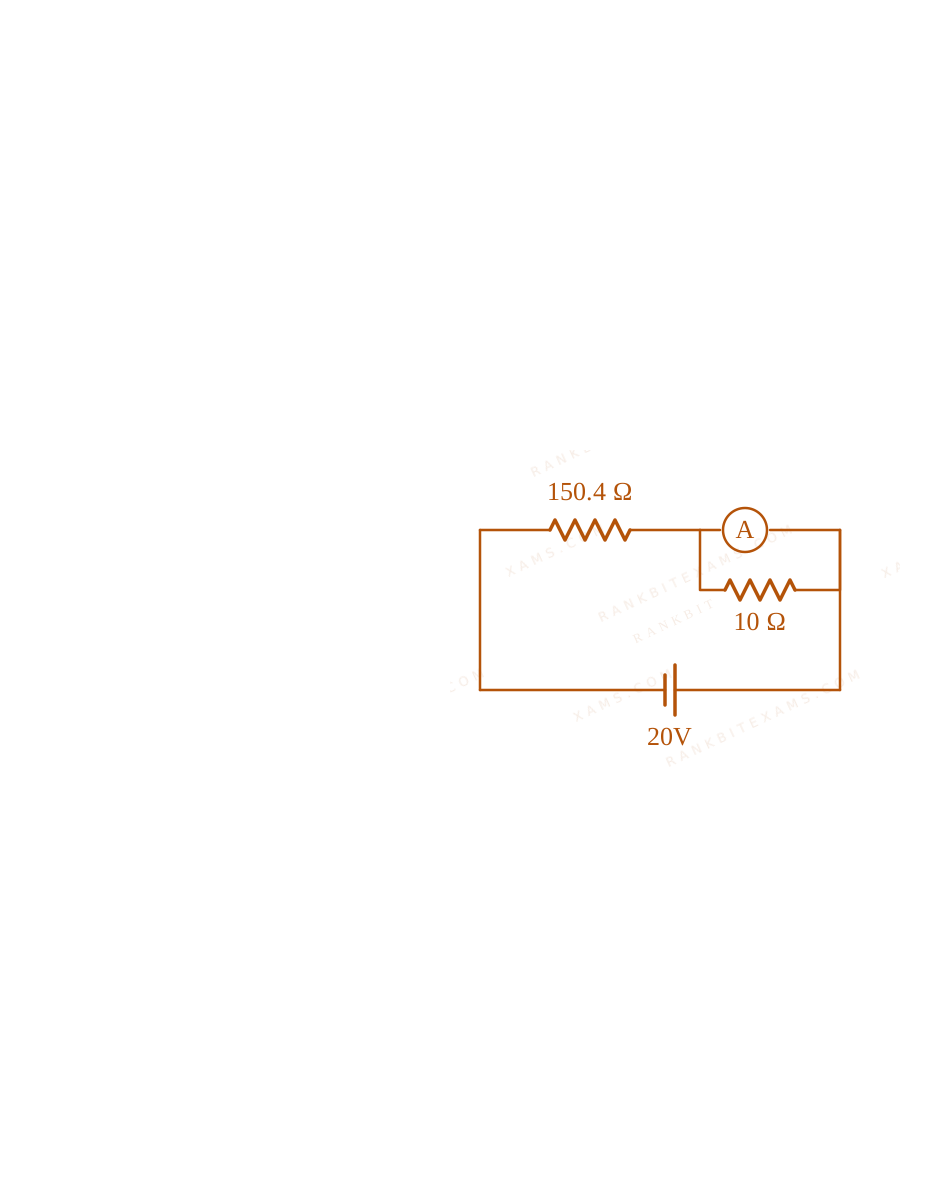
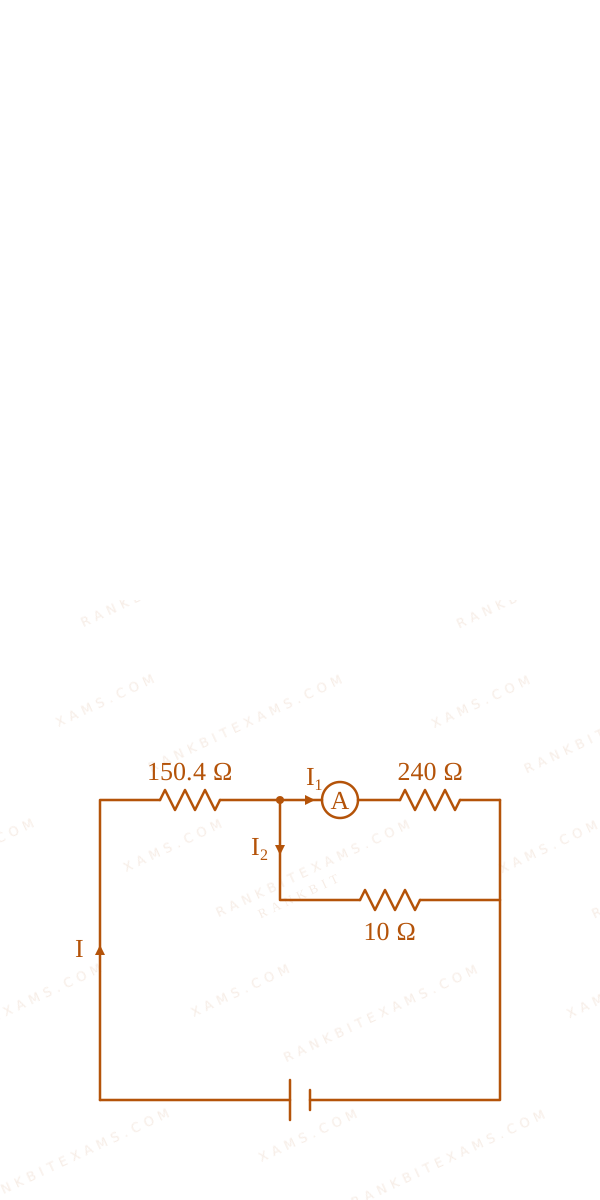
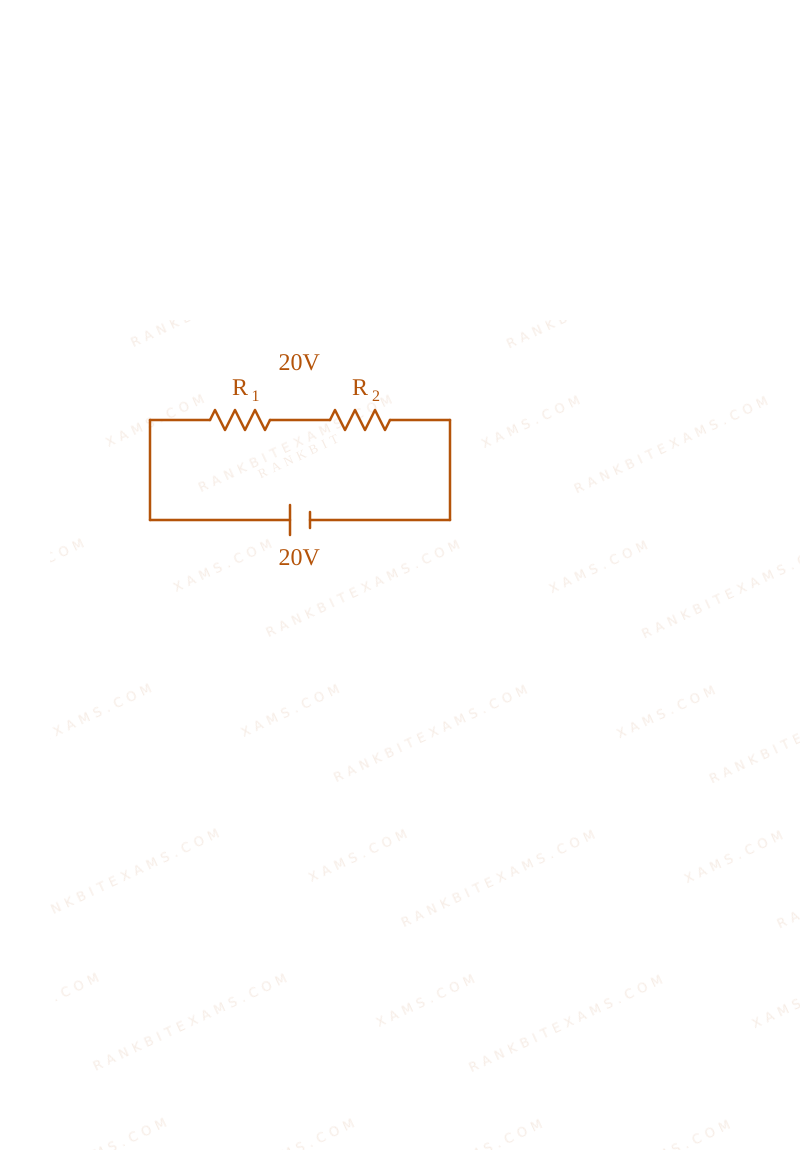
In the figure shown below, a resistance of 150.4Omega$150.4\Omega$ is connected in series to an ammeter A of resistance 240Omega$240\Omega$. A shunt resistance of 10Omega$10\Omega$ is connected in parallel with the ammeter. The reading of the ammeter is ________ mathrmmA$\mathrm{mA}$.
A circuit schematic containing a 20V battery connected in series with a 150.4 ohm resistor and a parallel combination of a 240 ohm ammeter and a 10 ohm shunt resistor.
Numerical Answer.Answer: 5 to 5
Solution
### Related Formula
Parallel combination of ammeter (R_G = 240Omega$R_G = 240\Omega$) and shunt (S = 10Omega$S = 10\Omega$):
R_textparallel = fracR_G cdot SR_G + S$$R_{\text{parallel}} = \frac{R_G \cdot S}{R_G + S}$$
Total equivalent resistance:
R_texteq = R_textseries + R_textparallel$$R_{\text{eq}} = R_{\text{series}} + R_{\text{parallel}}$$
Current Divider Rule:
I_textammeter = I_texttotal cdot left(fracSR_G + Sright)$$I_{\text{ammeter}} = I_{\text{total}} \cdot \left(\frac{S}{R_G + S}\right)$$
### Core Logic
Let's first calculate the equivalent resistance of the parallel branch (ammeter + shunt):
R_textparallel = frac240 times 10240 + 10 = frac2400250 = 9.6Omega$$R_{\text{parallel}} = \frac{240 \times 10}{240 + 10} = \frac{2400}{250} = 9.6\Omega$$
Now, add the series resistance (150.4Omega$150.4\Omega$) to find the total equivalent resistance of the circuit:
R_texteq = 150.4 + 9.6 = 160Omega$$R_{\text{eq}} = 150.4 + 9.6 = 160\Omega$$
### Step 1: Finding Total Current
Use Ohm's Law to calculate the total current I_texttotal$I_{\text{total}}$ drawn from the 20mathrm~V$20\mathrm{~V}$ battery:
I_texttotal = fracVR_texteq = frac20160 = 0.125mathrm~A$$I_{\text{total}} = \frac{V}{R_{\text{eq}}} = \frac{20}{160} = 0.125\mathrm{~A}$$
### Step 2: Calculating Ammeter Current
Using the Current Divider Rule, calculate the current I_textammeter$I_{\text{ammeter}}$ flowing through the 240Omega$240\Omega$ ammeter branch:
I_textammeter = I_texttotal times frac10240 + 10 = 0.125 times frac10250$$I_{\text{ammeter}} = I_{\text{total}} \times \frac{10}{240 + 10} = 0.125 \times \frac{10}{250}$$I_textammeter = 0.125 times frac125 = 0.005mathrm~A$$I_{\text{ammeter}} = 0.125 \times \frac{1}{25} = 0.005\mathrm{~A}$$
Convert this into milliamperes (mathrmmA$\mathrm{mA}$):
I_textammeter = 0.005 times 1000 = 5mathrm~mA$$I_{\text{ammeter}} = 0.005 \times 1000 = 5\mathrm{~mA}$$
Therefore, the reading of the ammeter is 5mathrm~mA$5\mathrm{~mA}$.
A circuit schematic containing a 20V battery connected in series with a 150.4 ohm resistor and a parallel combination of a 240 ohm ammeter and a 10 ohm shunt resistor.A circuit schematic containing a 20V battery connected in series with a 150.4 ohm resistor and a parallel combination of a 240 ohm ammeter and a 10 ohm shunt resistor.
### Pattern Recognition
Notice how nicely the numbers are set up in JEE Mains questions! The parallel combination of 240Omega$240\Omega$ and 10Omega$10\Omega$ yields exactly 9.6Omega$9.6\Omega$, which beautifully combines with 150.4Omega$150.4\Omega$ to form a perfect integer sum of 160Omega$160\Omega$. This tells you that your intermediate steps are absolutely correct!
### Evaluation Rubric / Model Answer
null
### Chapter Mix
Class 12 Physics: Current Electricity: Measuring Devices
Q2jee_main_2025_04_april_eveningElectric Power
There are 'n' number of identical electric bulbs, each is designed to draw a power p independently from the mains supply. They are now joined in series across the main supply. The total power drawn by the combination is:
A.np$np$
B.fracpn^2$\frac{p}{n^{2}}$
C.fracpn$\frac{p}{n}$
D.p$p$
Solution
### Related Formula
P = fracV^2R$$P = \frac{V^2}{R}$$
For series combination:
R_s = R_1 + R_2 + dots + R_n$$R_s = R_1 + R_2 + \dots + R_n$$
### Core Logic
Since the bulbs are identical, each has a resistance R = fracV^2p$R = \frac{V^2}{p}$.
When n$n$ identical bulbs are connected in series, the total equivalent resistance becomes:
R_s = nR$R_s = nR$
### Step 1: Calculate Combined Power
The total power drawn across the same mains supply V$V$ is:
P_s = fracV^2R_s = fracV^2nR = frac1n left(fracV^2Rright) = fracpn$$P_s = \frac{V^2}{R_s} = \frac{V^2}{nR} = \frac{1}{n} \left(\frac{V^2}{R}\right) = \frac{p}{n}$$
### Pattern Recognition
Identical appliances connected in series scale down their combined power inversely with count (P_net = P/n$P_{net} = P/n$), identical appliances in parallel scale up combined power linearly (P_net = nP$P_{net} = nP$).
### Evaluation Rubric / Model Answer
null
### Chapter Mix
Class 12 Physics: Current Electricity
More Current Electricity Questions — jee_main_2025_03_april_evening
We Map Every Repeating Question in Competitive Exams.
Say goodbye to generic mock test fatigue. RankBit uses smart analysis to group past exam questions into their foundational Repeating Question Types. Find chapter weightage, track repeating questions, and score higher with targeted practice.
Select Your Target Exam
Choose an exam track below to find formulas per chapter and patterns.
Syncing Exam Intelligence
Mapping formulas and patterns across all tracks…
PATH A — FULL LENGTH PRACTICE
Full Mock Test Hub
Simulate real NTA exam conditions with fully tracked mocks. Time yourself against past papers.
Practice past-year questions one chapter at a time. Pick an exam → subject → chapter and get every PYQ for that topic — pulled together from all past papers — with the chapter's key formulas alongside.
.svg)
.svg)