Two cells of emf 1V and 2V and internal resistance 2Omega$2\Omega$ and 1Omega$1\Omega$, respectively, are connected in series with an external resistance of 6Omega$6\Omega$. The total current in the circuit is I_1$I_{1}$ Now the same two cells in parallel configuration are connected to same external resistance. In this case, the total current drawn is I_2$I_{2}$. The value of (fracI_1I_2)$(\frac{I_{1}}{I_{2}})$ is fracx3$\frac{x}{3}$. The value of x is ________.
Numerical Answer Type:
Enter a numerical valueAnswer: 4 to 4+4 marks
Solution & Explanation
### Related Formula
- Series cell configuration:
varepsilon_texteq = varepsilon_1 + varepsilon_2, quad r_texteq = r_1 + r_2$$\varepsilon_{\text{eq}} = \varepsilon_1 + \varepsilon_2, \quad r_{\text{eq}} = r_1 + r_2$$
- Parallel cell configuration (for unequal cells in parallel):
varepsilon_texteq = fracfracvarepsilon_1r_1 + fracvarepsilon_2r_2frac1r_1 + frac1r_2, quad frac1r_texteq = frac1r_1 + frac1r_2$$\varepsilon_{\text{eq}} = \frac{\frac{\varepsilon_1}{r_1} + \frac{\varepsilon_2}{r_2}}{\frac{1}{r_1} + \frac{1}{r_2}}, \quad \frac{1}{r_{\text{eq}}} = \frac{1}{r_1} + \frac{1}{r_2}$$
- Circuit current:
I = fracvarepsilon_texteqr_texteq + R$$I = \frac{\varepsilon_{\text{eq}}}{r_{\text{eq}} + R}$$
### Core Logic
Given parameters:
- Cell 1: $
### Core Logic
Given parameters:
- Cell 1: $\varepsilon_1 = 1\mathrm{~V}, $, $r_1 = 2\Omega
- Cell 2: $
- Cell 2: $\varepsilon_2 = 2\mathrm{~V}, $, $r_2 = 1\Omega
- External resistance $
- External resistance $R = 6\Omega
### Step 1: Calculate $
### Step 1: Calculate $I_1 (Series Configuration)Grouping of Cells$ (Series Configuration)Grouping of Cells
$varepsilon_texteq = 1 + 2 = 3mathrm~V$\varepsilon_{\text{eq}} = 1 + 2 = 3\mathrm{~V}$$
$r_texteq = 2 + 1 = 3Omega$r_{\text{eq}} = 2 + 1 = 3\Omega$$
$I_1 = frac33 + 6 = frac39 = frac13mathrm~A$I_1 = \frac{3}{3 + 6} = \frac{3}{9} = \frac{1}{3}\mathrm{~A}$
### Step 2: Calculate $I_2$ (Parallel Configuration)Grouping of Cells$$
### Step 2: Calculate $I_2$ (Parallel Configuration)Grouping of Cells
$$\varepsilon_{\text{eq}} = \frac{\frac{1}{2} + \frac{2}{1}}{\frac{1}{2} + \frac{1}{1}} = \frac{0.5 + 2}{1.5} = \frac{2.5}{1.5} = \frac{5}{3}\mathrm{~V}$$
$$r_{\text{eq}} = \frac{r_1 r_2}{r_1 + r_2} = \frac{2 \times 1}{2 + 1} = \frac{2}{3}\Omega$$
$$I_2 = \frac{\varepsilon_{\text{eq}}}{r_{\text{eq}} + R} = \frac{\frac{5}{3}}{\frac{2}{3} + 6} = \frac{\frac{5}{3}}{\frac{20}{3}} = \frac{5}{20} = \frac{1}{4}\mathrm{~A}$
### Step 3: Find ratio and evaluate $x$
$$$
### Step 3: Find ratio and evaluate $x$
$$\frac{I_1}{I_2} = \frac{\frac{1}{3}}{\frac{1}{4}} = \frac{4}{3}$
Comparing with $
Comparing with $\frac{x}{3}:
$:
$x = 4
### Pattern Recognition
For cells connected in parallel, the formula for equivalent EMF $
### Pattern Recognition
For cells connected in parallel, the formula for equivalent EMF $\varepsilon_{\text{eq}}$ can be viewed as a weighted average. Connecting cells in series maximizes EMF but increases internal resistance, while parallel configuration limits EMF to an intermediate value while reducing equivalent internal resistance.
### Evaluation Rubric / Model Answer
null
### Chapter Mix
Class 12 Physics: Current Electricity
More Current Electricity Previous-Year Questions — Page 3
Q6jee_main_2025_04_april_eveningCombination of Resistors
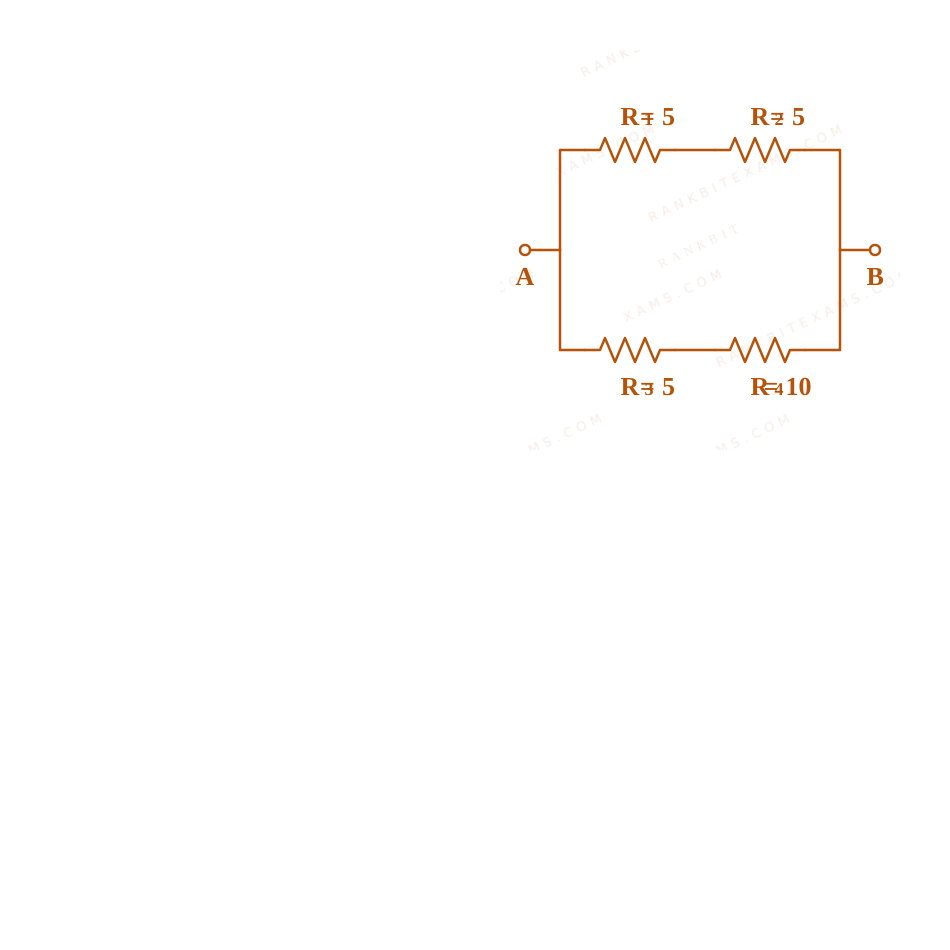
From the combination of resistors with resistance valuesR_1=R_2=R_3=5\ Omega$R_{1}=R_{2}=R_{3}=5\ \Omega$ and R_4=10\ Omega$R_{4}=10\ \Omega$, which of the following combination is the best circuit to get an equivalent resistance of 6\ Omega$6\ \Omega$?
A.
B.
C.
D.
Solution
### Related Formula
Series combination:
R_s = R_a + R_b$R_s = R_a + R_b$
Parallel combination:
frac1R_p = frac1R_1 + frac1R_2 implies R_p = fracR_1 R_2R_1 + R_2$$\frac{1}{R_p} = \frac{1}{R_1} + \frac{1}{R_2} \implies R_p = \frac{R_1 R_2}{R_1 + R_2}$$
### Core Logic
Let's check option (1):
Top branch has R_1$R_1$ and R_2$R_2$ in series: R_texttop = 5 + 5 = 10\ Omega$R_{\text{top}} = 5 + 5 = 10\ \Omega$.
Bottom branch has R_3$R_3$ and R_4$R_4$ in series: R_textbottom = 5 + 10 = 15\ Omega$R_{\text{bottom}} = 5 + 10 = 15\ \Omega$.
### Step 1: Calculate Equivalent Parallel Resistance
These two branches are connected in parallel, so the total equivalent resistance is:
R_p = frac10 times 1510 + 15 = frac15025 = 6\ Omega$$R_p = \frac{10 \times 15}{10 + 15} = \frac{150}{25} = 6\ \Omega$$
This matches the target value of 6\ Omega$6\ \Omega$ perfectly. Circuit diagram analysis for 6 ohm equivalent resistance
### Pattern Recognition
Look for symmetric partitions. Standard combinations of values like 10\ Omega$10\ \Omega$ and 15\ Omega$15\ \Omega$ yield exactly 6\ Omega$6\ \Omega$ in parallel.
### Evaluation Rubric / Model Answer
null
### Chapter Mix
Class 12 Physics: Current Electricity
Q13jee_main_2025_04_april_morningElectric Current and Charge Flow
Current passing through a wire as function of time is given as I(t)=0.02t+0.01mathrm~A$I(t)=0.02t+0.01\mathrm{~A}$. The charge that will flow through the wire from t=1mathrm~s$t=1\mathrm{~s}$ to t=2mathrm~s$t=2\mathrm{~s}$ is:
### Core Logic
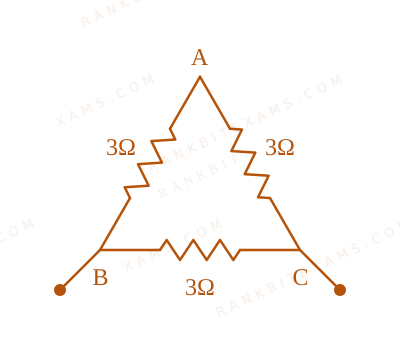
The total resistance of the continuous uniform wire loop is 9Omega$9\Omega$. When bent into an equilateral triangle, it is split into three equal length sections. The resistance of each individual side is:
R_textside = frac9Omega3 = 3Omega$$R_{\text{side}} = \frac{9\Omega}{3} = 3\Omega$$
### Step 1: Calculating Equivalent Series and Parallel Resistance
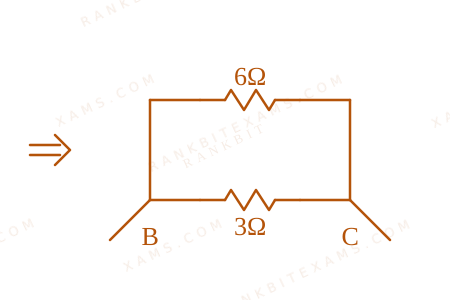
As shown in the circuit diagrams Combination of Resistors diagram for Q23 - JEE Main 2025 Morning and Combination of Resistors diagram for Q23 - JEE Main 2025 Morning, measuring across any two vertices means one branch contains a single side resistor (3Omega$3\Omega$), while the other branch contains the remaining two sides connected in series :
R_textseries = 3Omega + 3Omega = 6Omega$$R_{\text{series}} = 3\Omega + 3\Omega = 6\Omega$$
Now, calculate the parallel equivalent between these two branches:
R_texteq = fracR_textside times R_textseriesR_textside + R_textseries = frac3 times 63 + 6 = frac189 = 2Omega$$R_{\text{eq}} = \frac{R_{\text{side}} \times R_{\text{series}}}{R_{\text{side}} + R_{\text{series}}} = \frac{3 \times 6}{3 + 6} = \frac{18}{9} = 2\Omega$$
### Pattern Recognition
For a closed uniform loop with N$N$ equal sides, the parallel resistance measured across adjacent corners always simplifies to fracN-1N^2 cdot R_texttotal$\frac{N-1}{N^2} \cdot R_{\text{total}}$.
### Evaluation Rubric / Model Answer
null
### Chapter Mix
Class 12 Physics: Current Electricity
Q24jee_main_2025_28_jan_eveningWheatstone Bridge
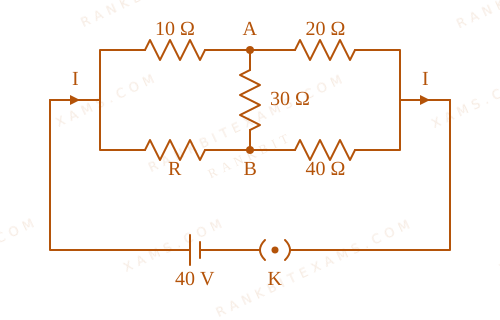
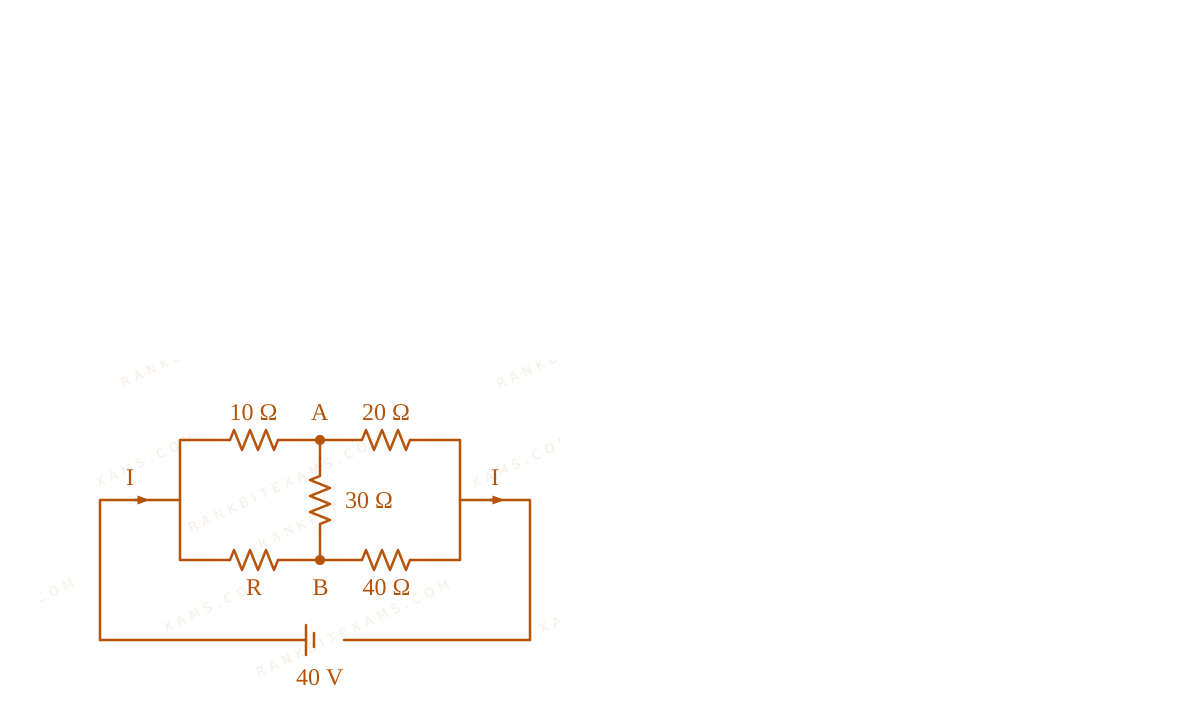
The value of current I in the electrical circuit as given below, when potential at A is equal to the potential at B, will be ________ A.
A bridge resistor network supplied by a 40V DC voltage source terminal layout.
Numerical Answer.Answer: 2
Solution
### Related Formula
For a balanced Wheatstone bridge network, if the potentials at opposite nodes are equal (V_A = V_B$V_A = V_B$), no current flows through the central branch. The resistance arms satisfy the balance ratio:
fracR_1R_2 = fracR_3R_4$$\frac{R_1}{R_2} = \frac{R_3}{R_4}$$
Total current from the source is calculated using Ohm's law:
I = fracV_textsourceR_textequivalent$$I = \frac{V_{\text{source}}}{R_{\text{equivalent}}}$$
### Core Logic
Given conditions :
V_A = V_B implies textBalanced condition$$V_A = V_B \implies \text{Balanced condition}$$
From the circuit network diagram [cite: 817, 818, 826, 828]:
* Left-top arm = 10 \ Omega$= 10 \ \Omega$
* Left-bottom arm = R$= R$
* Right-top arm = 20 \ Omega$= 20 \ \Omega$
* Right-bottom arm = 40 \ Omega$= 40 \ \Omega$
Apply the balance condition to solve for unknown resistor R$R$ :
frac10R = frac2040 implies frac10R = frac12 implies R = 20 \ Omega quad text[cite: 837, 838]$$\frac{10}{R} = \frac{20}{40} \implies \frac{10}{R} = \frac{1}{2} \implies R = 20 \ \Omega \quad \text{[cite: 837, 838]}$$
Now restructure the equivalent network :
Since the central 30 \ Omega$30 \ \Omega$ resistor branch carries zero current, it can be removed from the calculation [cite: 820, 834].
* Top \parallel branch: 10 \ Omega + 20 \ Omega = 30 \ Omega$10 \ \Omega + 20 \ \Omega = 30 \ \Omega$
* Bottom \parallel branch: 20 \ Omega + 40 \ Omega = 60 \ Omega$20 \ \Omega + 40 \ \Omega = 60 \ \Omega$
Calculate total equivalent resistance R_texteq$R_{\text{eq}}$:
R_texteq = frac30 times 6030 + 60 = frac180090 = 20 \ Omega$$R_{\text{eq}} = \frac{30 \times 60}{30 + 60} = \frac{1800}{90} = 20 \ \Omega$$
Calculate total current I$I$ drawn from the 40textV$40\text{V}$ source:
I = frac40 text V20 \ Omega = 2 text A$$I = \frac{40 \text{ V}}{20 \ \Omega} = 2 \text{ A}$$
### Step 1: Circuit Solution
The balanced bridge network layout with branch currents is shown below:
A bridge resistor network supplied by a 40V DC voltage source terminal layout.
### Pattern Recognition
When a question states that two nodes are at equal potential (V_A = V_B$V_A = V_B$), immediately identify it as a balanced Wheatstone bridge. This allows you to remove the central branch and simplify the circuit into basic series-\parallel resistor combinations.
### Evaluation Rubric / Model Answer
null
### Chapter Mix
Class 12 Physics: Current Electricity
Q34jee_main_2024_01_february_morningCells and EMF
The reading in the ideal voltmeter (V) shown in the given circuit diagram is:
A schematic showing a symmetric loop containing multiple identical 5V sources with 0.2 Ohm internal resistances coupled across an ideal voltmeter terminal.
A.5mathrm~V$5\mathrm{~V}$
B.10mathrm~V$10\mathrm{~V}$
C.0mathrm~V$0\mathrm{~V}$
D.3mathrm~V$3\mathrm{~V}$
Solution
### Related Formula
Total effective loop EMF and internal resistance:
I = fracE_textnetr_textnet$$I = \frac{E_{\text{net}}}{r_{\text{net}}}$$
Terminal potential difference across a discharging cell:
V = E - Ir$V = E - Ir$
### Core Logic
The loop has a set of 8 cells all aiding the same current flow sequence direction.
E_texteq = 8 times 5 = 40mathrm~V$$E_{\text{eq}} = 8 \times 5 = 40\mathrm{~V}$$r_texteq = 8 times 0.2 = 1.6mathrm~Omega$$r_{\text{eq}} = 8 \times 0.2 = 1.6\mathrm{~\Omega}$$
The circulating loop current is:
I = frac40mathrm~V1.6mathrm~Omega = 25mathrm~A$$I = \frac{40\mathrm{~V}}{1.6\mathrm{~\Omega}} = 25\mathrm{~A}$$
### Step 1: Terminal Voltage Calculation
The ideal voltmeter measures the potential drop across the localized parallel branch configuration:
V = E - Ir = 5 - (25 times 0.2) = 5 - 5 = 0mathrm~V$$V = E - Ir = 5 - (25 \times 0.2) = 5 - 5 = 0\mathrm{~V}$$
### Pattern Recognition
A closed loop composed entirely of identical series active cells short circuits itself perfectly relative to the localized node drop points, reducing the net external voltage drop to zero.
### Evaluation Rubric / Model Answer
null
### Chapter Mix
Class 12 Physics: Current Electricity
More Current Electricity Questions — jee_main_2025_03_april_evening
We Map Every Repeating Question in Competitive Exams.
Say goodbye to generic mock test fatigue. RankBit uses smart analysis to group past exam questions into their foundational Repeating Question Types. Find chapter weightage, track repeating questions, and score higher with targeted practice.
Select Your Target Exam
Choose an exam track below to find formulas per chapter and patterns.
Syncing Exam Intelligence
Mapping formulas and patterns across all tracks…
PATH A — FULL LENGTH PRACTICE
Full Mock Test Hub
Simulate real NTA exam conditions with fully tracked mocks. Time yourself against past papers.
Practice past-year questions one chapter at a time. Pick an exam → subject → chapter and get every PYQ for that topic — pulled together from all past papers — with the chapter's key formulas alongside.
.svg)
.svg)