Two cells of emf 1V and 2V and internal resistance 2Omega$2\Omega$ and 1Omega$1\Omega$, respectively, are connected in series with an external resistance of 6Omega$6\Omega$. The total current in the circuit is I_1$I_{1}$ Now the same two cells in parallel configuration are connected to same external resistance. In this case, the total current drawn is I_2$I_{2}$. The value of (fracI_1I_2)$(\frac{I_{1}}{I_{2}})$ is fracx3$\frac{x}{3}$. The value of x is ________.
Numerical Answer Type:
Enter a numerical valueAnswer: 4 to 4+4 marks
Solution & Explanation
### Related Formula
- Series cell configuration:
varepsilon_texteq = varepsilon_1 + varepsilon_2, quad r_texteq = r_1 + r_2$$\varepsilon_{\text{eq}} = \varepsilon_1 + \varepsilon_2, \quad r_{\text{eq}} = r_1 + r_2$$
- Parallel cell configuration (for unequal cells in parallel):
varepsilon_texteq = fracfracvarepsilon_1r_1 + fracvarepsilon_2r_2frac1r_1 + frac1r_2, quad frac1r_texteq = frac1r_1 + frac1r_2$$\varepsilon_{\text{eq}} = \frac{\frac{\varepsilon_1}{r_1} + \frac{\varepsilon_2}{r_2}}{\frac{1}{r_1} + \frac{1}{r_2}}, \quad \frac{1}{r_{\text{eq}}} = \frac{1}{r_1} + \frac{1}{r_2}$$
- Circuit current:
I = fracvarepsilon_texteqr_texteq + R$$I = \frac{\varepsilon_{\text{eq}}}{r_{\text{eq}} + R}$$
### Core Logic
Given parameters:
- Cell 1: $
### Core Logic
Given parameters:
- Cell 1: $\varepsilon_1 = 1\mathrm{~V}, $, $r_1 = 2\Omega
- Cell 2: $
- Cell 2: $\varepsilon_2 = 2\mathrm{~V}, $, $r_2 = 1\Omega
- External resistance $
- External resistance $R = 6\Omega
### Step 1: Calculate $
### Step 1: Calculate $I_1 (Series Configuration)Grouping of Cells$ (Series Configuration)Grouping of Cells
$varepsilon_texteq = 1 + 2 = 3mathrm~V$\varepsilon_{\text{eq}} = 1 + 2 = 3\mathrm{~V}$$
$r_texteq = 2 + 1 = 3Omega$r_{\text{eq}} = 2 + 1 = 3\Omega$$
$I_1 = frac33 + 6 = frac39 = frac13mathrm~A$I_1 = \frac{3}{3 + 6} = \frac{3}{9} = \frac{1}{3}\mathrm{~A}$
### Step 2: Calculate $I_2$ (Parallel Configuration)Grouping of Cells$$
### Step 2: Calculate $I_2$ (Parallel Configuration)Grouping of Cells
$$\varepsilon_{\text{eq}} = \frac{\frac{1}{2} + \frac{2}{1}}{\frac{1}{2} + \frac{1}{1}} = \frac{0.5 + 2}{1.5} = \frac{2.5}{1.5} = \frac{5}{3}\mathrm{~V}$$
$$r_{\text{eq}} = \frac{r_1 r_2}{r_1 + r_2} = \frac{2 \times 1}{2 + 1} = \frac{2}{3}\Omega$$
$$I_2 = \frac{\varepsilon_{\text{eq}}}{r_{\text{eq}} + R} = \frac{\frac{5}{3}}{\frac{2}{3} + 6} = \frac{\frac{5}{3}}{\frac{20}{3}} = \frac{5}{20} = \frac{1}{4}\mathrm{~A}$
### Step 3: Find ratio and evaluate $x$
$$$
### Step 3: Find ratio and evaluate $x$
$$\frac{I_1}{I_2} = \frac{\frac{1}{3}}{\frac{1}{4}} = \frac{4}{3}$
Comparing with $
Comparing with $\frac{x}{3}:
$:
$x = 4
### Pattern Recognition
For cells connected in parallel, the formula for equivalent EMF $
### Pattern Recognition
For cells connected in parallel, the formula for equivalent EMF $\varepsilon_{\text{eq}}$ can be viewed as a weighted average. Connecting cells in series maximizes EMF but increases internal resistance, while parallel configuration limits EMF to an intermediate value while reducing equivalent internal resistance.
### Evaluation Rubric / Model Answer
null
### Chapter Mix
Class 12 Physics: Current Electricity
More Current Electricity Previous-Year Questions
Qjee_main_2026_21_jan_morningHeating Effect of Current
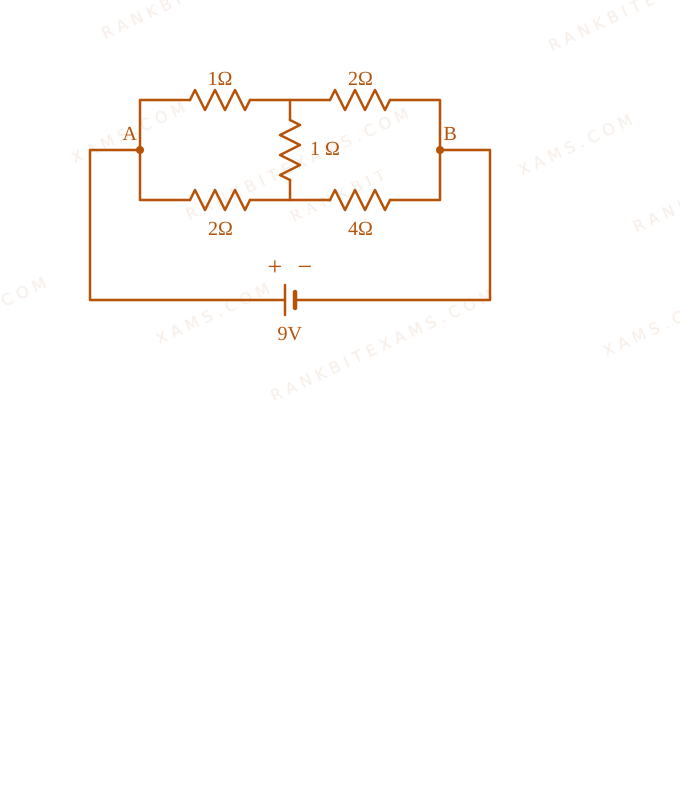
The heat generated in 1 minute between points A and B in the given circuit, when a battery of 9V with internal resistance of 1 Omega$1 \Omega$ is connected across these points is ____ J.
A bridge network with resistors 1 ohm, 2 ohms, 2 ohms, and 4 ohms forming the arms.
Numerical Answer.Answer: 1080 to 1080
Solution
### Related Formula
R_texteq = fracR_1 R_2R_1 + R_2 text (parallel)$$R_{\text{eq}} = \frac{R_1 R_2}{R_1 + R_2} \text{ (parallel)}$$H = I^2 R t$H = I^2 R t$I = fracVR_texteq + r$$I = \frac{V}{R_{\text{eq}} + r}$$
### Core Logic
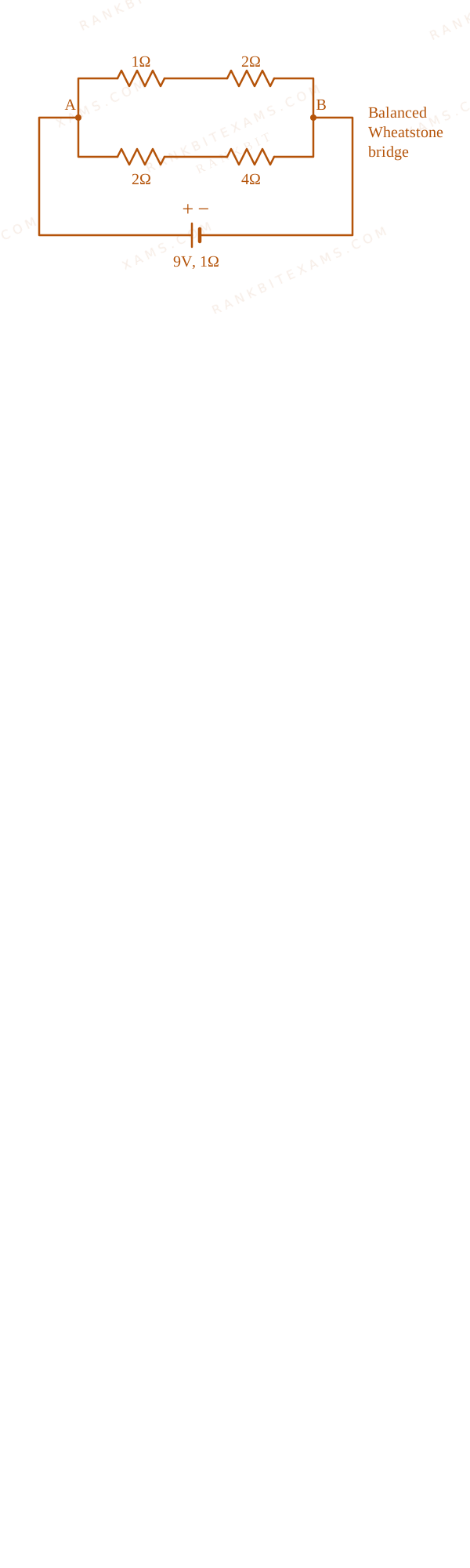
The circuit is a balanced Wheatstone bridge between A and B, because the ratio of adjacent arms is frac12 = frac24$\frac{1}{2} = \frac{2}{4}$. Thus, the middle 1\,Omega$1\,\Omega$ resistor (if there is one connecting the middle nodes) is ineffective.
A bridge network with resistors 1 ohm, 2 ohms, 2 ohms, and 4 ohms forming the arms.
The equivalent resistance across AB (R_AB$R_{AB}$) involves the upper branch (1+2 = 3\,Omega$1+2 = 3\,\Omega$) and the lower branch (2+4 = 6\,Omega$2+4 = 6\,\Omega$) in parallel.
A bridge network with resistors 1 ohm, 2 ohms, 2 ohms, and 4 ohms forming the arms.R_AB = frac3 times 63 + 6 = frac189 = 2\,Omega$$R_{AB} = \frac{3 \times 6}{3 + 6} = \frac{18}{9} = 2\,\Omega$$
### Step 1: Calculate Current and Heat
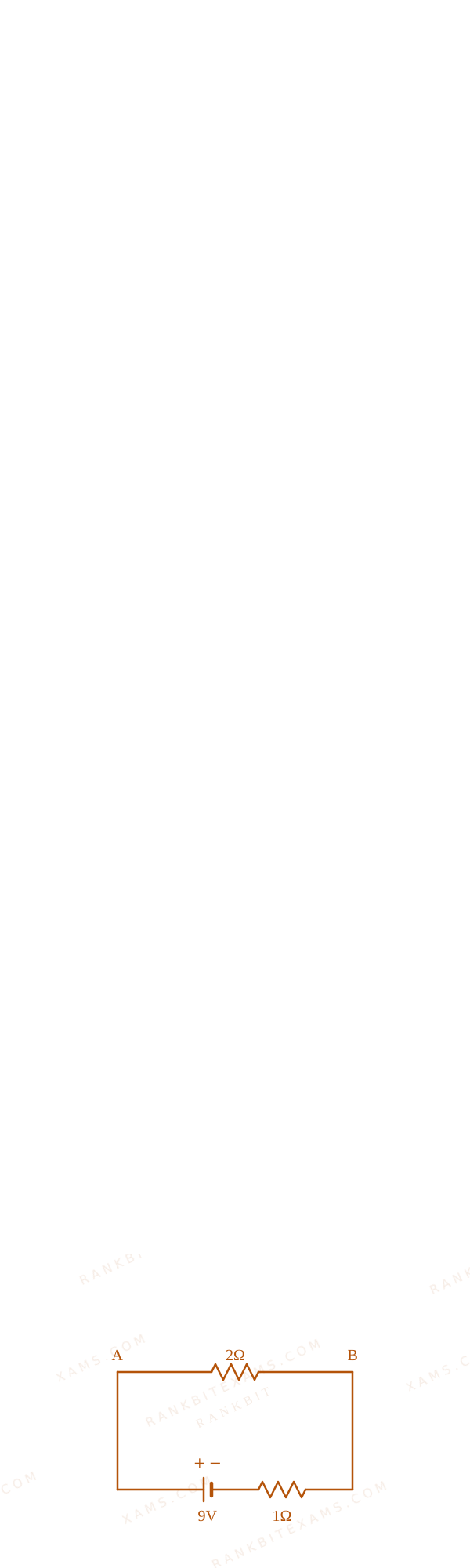
Total resistance in the circuit = R_AB + r_textinternal = 2 + 1 = 3\,Omega$R_{AB} + r_{\text{internal}} = 2 + 1 = 3\,\Omega$.
Total current from the battery i = frac9textV3\,Omega = 3textA$i = \frac{9\text{V}}{3\,\Omega} = 3\text{A}$.
The heat generated specifically between points A and B in 1 minute (60 seconds) is:
H_AB = i^2 R_AB t = (3)^2 times 2 times 60$$H_{AB} = i^2 R_{AB} t = (3)^2 \times 2 \times 60$$H_AB = 9 times 120 = 1080text J$$H_{AB} = 9 \times 120 = 1080\text{ J}$$
### Pattern Recognition
Check for balanced Wheatstone bridge first. Then use H = i^2 R t$H = i^2 R t$ strictly with the equivalent resistance of just the section AB$AB$ to find heat specifically generated across AB$AB$.
### Evaluation Rubric / Model Answer
null
### Chapter Mix
Class 12 Physics: Current Electricity
Q28jee_main_2026_21_jan_eveningPotentiometer
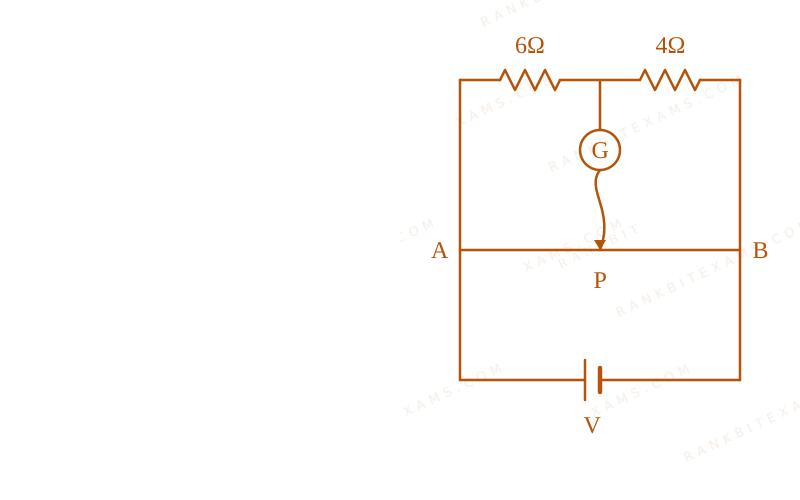
The total length of potentiometer wire AB is 50 text cm$50 \text{ cm}$ in the arrangement as shown in figure. If P is the point where the galvanometer shows zero reading then the length AP is ________ cm.
Potentiometer circuit with a 50 cm wire AB, a galvanometer, and standard bridge resistors of 6 ohms and 4 ohms.
A.15$15$
B.30$30$
C.25$25$
D.20$20$
Solution
### Related Formula
For a balanced Wheatstone bridge configuration:
fracR_1R_2 = fracl_1l_2$$\frac{R_1}{R_2} = \frac{l_1}{l_2}$$
### Core Logic
When the galvanometer shows zero reading, it implies that the bridge is balanced. The resistance of the wire segments is proportional to their lengths.
Let the length of segment AP be l_AP$l_{AP}$ and PB be l_PB$l_{PB}$.
frac6\,OmegaR_AP = frac4\,OmegaR_PB$$\frac{6\,\Omega}{R_{AP}} = \frac{4\,\Omega}{R_{PB}}$$
Since R propto l$R \propto l$:
fracR_APR_PB = fracl_APl_PB = frac64 = frac32$$\frac{R_{AP}}{R_{PB}} = \frac{l_{AP}}{l_{PB}} = \frac{6}{4} = \frac{3}{2}$$
### Step 1: Applying Total Length Constraint
We are given the total length:
l_AP + l_PB = 50 text cm$$l_{AP} + l_{PB} = 50 \text{ cm}$$
Using the ratio l_AP = frac32 l_PB$l_{AP} = \frac{3}{2} l_{PB}$:
frac32l_PB + l_PB = 50$$\frac{3}{2}l_{PB} + l_{PB} = 50$$frac52l_PB = 50 implies l_PB = 20 text cm$$\frac{5}{2}l_{PB} = 50 \implies l_{PB} = 20 \text{ cm}$$
### Step 2: Final Conclusion
Solving for l_AP$l_{AP}$:
l_AP = 50 - 20 = 30 text cm$$l_{AP} = 50 - 20 = 30 \text{ cm}$$
Alternatively, l_AP = frac33+2 times 50 = frac35 times 50 = 30 text cm$l_{AP} = \frac{3}{3+2} \times 50 = \frac{3}{5} \times 50 = 30 \text{ cm}$.
### Pattern Recognition
Null deflection over a uniform wire directly translates resistance ratios into length ratios. Standard Wheatstone bridge application wrapped in potentiometer geometry.
### Evaluation Rubric / Model Answer
null
### Chapter Mix
Class 12 Physics: Current Electricity
Q35jee_main_2026_21_jan_eveningMaximum Power Transfer Theorem
### Related Formula
P = I^2 R = left(fracER+rright)^2 R$$P = I^2 R = \left(\frac{E}{R+r}\right)^2 R$$
### Core Logic
To maximize power across the load resistance R$R$, we apply the Maximum Power Transfer Theorem. The power transferred to the load is maximum when the load resistance equals the internal resistance of the battery.
Setting fracdPdR = 0$\frac{dP}{dR} = 0$ yields:
R = r$R = r$
### Step 1: Final Conclusion
Power is maximum when the external resistance is strictly equal to the internal resistance (R=r$R=r$).
### Pattern Recognition
Direct theoretical application of the Maximum Power Transfer Theorem.
### Evaluation Rubric / Model Answer
null
### Chapter Mix
Class 12 Physics: Current Electricity
Q40jee_main_2026_21_jan_eveningCombination of Resistors
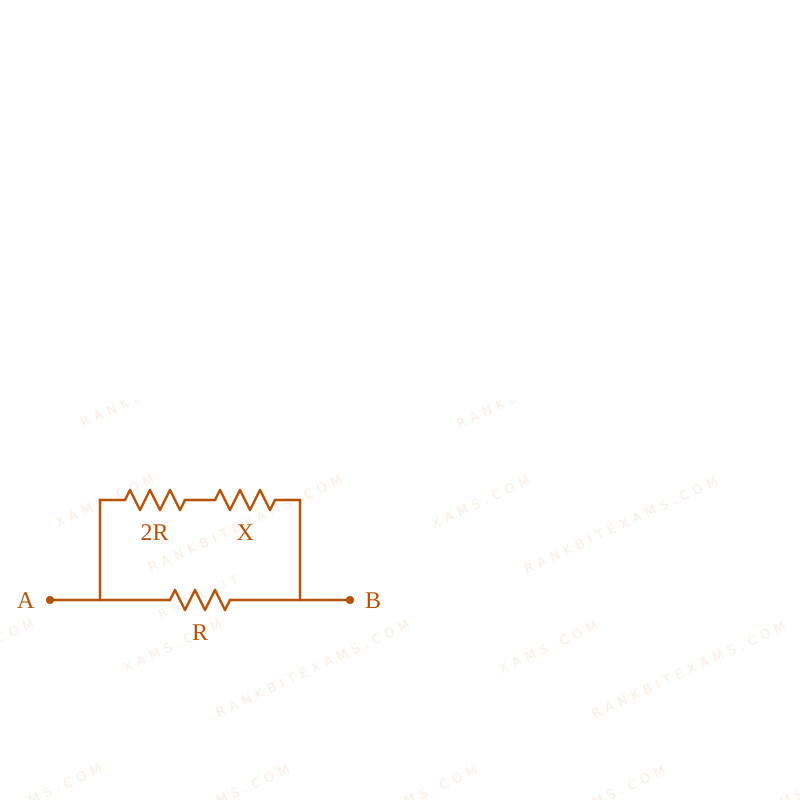
Two known resistance of R\,Omega$R\,\Omega$ and 2R\,Omega$2R\,\Omega$ and one unknown resistance X\,Omega$X\,\Omega$ are connected in a circuit as shown in the figure. If the equivalent resistance between points A and B in the circuit is X\,Omega$X\,\Omega$, then the value of X is ________ Omega$\Omega$.
Bridge-like resistor circuit containing unknown resistance X and known resistances R and 2R.
A.(sqrt3-1)R$(\sqrt{3}-1)R$
B.R$R$
C.2(sqrt3-1)R$2(\sqrt{3}-1)R$
D.(sqrt3+1)R$(\sqrt{3}+1)R$
Solution
### Related Formula
For parallel combination: R_texteq = fracR_1 R_2R_1 + R_2$R_{\text{eq}} = \frac{R_1 R_2}{R_1 + R_2}$
For series combination: R_texteq = R_1 + R_2$R_{\text{eq}} = R_1 + R_2$
### Core Logic
Based on the circuit topology, the 2R$2R$ and X$X$ resistors are in series. This combination is in parallel with the R$R$ resistor.
The total equivalent resistance across A and B is given as X$X$.
R_texteq = frac(2R + X) cdot (R)(2R + X) + R$$R_{\text{eq}} = \frac{(2R + X) \cdot (R)}{(2R + X) + R}$$
### Step 1: Setting up the Quadratic
Set the equivalent resistance equal to X$X$:
X = frac(2R + X)R3R + X$$X = \frac{(2R + X)R}{3R + X}$$
Cross-multiplying yields:
X(3R + X) = 2R^2 + XR$$X(3R + X) = 2R^2 + XR$$3RX + X^2 = 2R^2 + XR$$3RX + X^2 = 2R^2 + XR$$X^2 + 2RX - 2R^2 = 0$$X^2 + 2RX - 2R^2 = 0$$
### Step 2: Solving for X
Using the quadratic formula to solve for X$X$:
X = frac-2R pm sqrt(2R)^2 - 4(1)(-2R^2)2$$X = \frac{-2R \pm \sqrt{(2R)^2 - 4(1)(-2R^2)}}{2}$$X = frac-2R pm sqrt4R^2 + 8R^22 = frac-2R pm sqrt12R^22$$X = \frac{-2R \pm \sqrt{4R^2 + 8R^2}}{2} = \frac{-2R \pm \sqrt{12R^2}}{2}$$X = frac-2R pm 2Rsqrt32 = -R pm Rsqrt3$$X = \frac{-2R \pm 2R\sqrt{3}}{2} = -R \pm R\sqrt{3}$$
Since resistance must be positive:
X = (sqrt3 - 1)R$$X = (\sqrt{3} - 1)R$$
### Pattern Recognition
Self-referential equivalent resistance problems always collapse into a quadratic equation x^2 + ax + b = 0$x^2 + ax + b = 0$. Solve strictly for the positive root.
### Evaluation Rubric / Model Answer
null
### Chapter Mix
Class 12 Physics: Current Electricity
Q31jee_main_2026_22_january_morningMeter Bridge
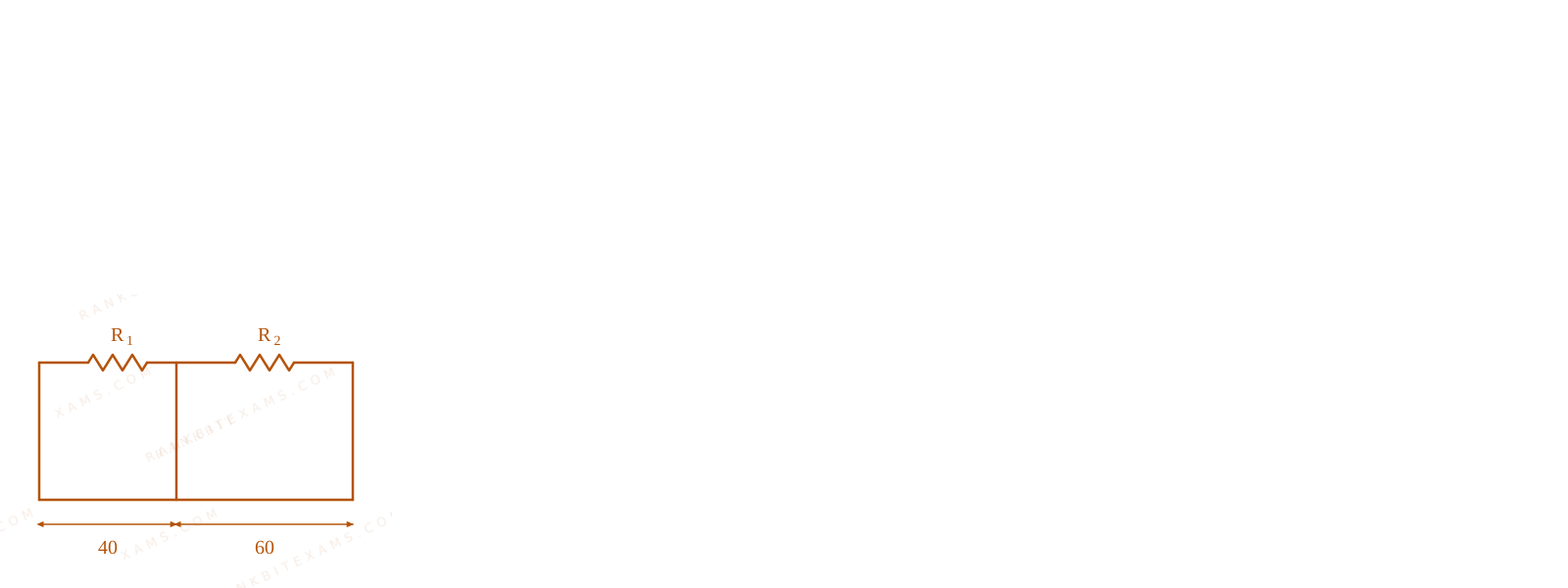
A meter bridge with two resistances R_1$R_{1}$ and R_2$R_{2}$ as shown in figure was balanced (null point) at 40 cm from the point P. The null point changed to 50 cm from the point P, when 16~Omega$16~\Omega$ resistance is connected in parallel to R_2$R_{2}$. The values of resistances R_1$R_{1}$ and R_2$R_{2}$ are \_\_\_\_.
Meter bridge circuit with resistances R1 and R2 and balancing lengths.
We Map Every Repeating Question in Competitive Exams.
Say goodbye to generic mock test fatigue. RankBit uses smart analysis to group past exam questions into their foundational Repeating Question Types. Find chapter weightage, track repeating questions, and score higher with targeted practice.
Select Your Target Exam
Choose an exam track below to find formulas per chapter and patterns.
Syncing Exam Intelligence
Mapping formulas and patterns across all tracks…
PATH A — FULL LENGTH PRACTICE
Full Mock Test Hub
Simulate real NTA exam conditions with fully tracked mocks. Time yourself against past papers.
Practice past-year questions one chapter at a time. Pick an exam → subject → chapter and get every PYQ for that topic — pulled together from all past papers — with the chapter's key formulas alongside.
.svg)
.svg)