Consider the lines x(3lambda + 1) + y(7lambda + 2) = 17lambda + 5$x(3\lambda + 1) + y(7\lambda + 2) = 17\lambda + 5$, lambda$\lambda$ being a parameter, all passing through a point P$P$. One of these lines (say L$L$) is farthest from the origin. If the distance of L$L$ from the point (3, 6)$(3, 6)$ is d$d$, then the value of d^2$d^2$ is
A.20$20$
B.30$30$
C.10$10$
D.15$15$
Solution & Explanation
### Related Formula
A family of lines passing through the intersection of L_1 = 0$L_1 = 0$ and L_2 = 0$L_2 = 0$ is expressed as:
L_1 + lambda L_2 = 0$$L_1 + \lambda L_2 = 0$$
For a point P$P$ through which a family of lines passes, the line in the family that is at the maximum distance from origin O$O$ is the line perpendicular to OP$OP$ passing through P$P$.
### Core Logic
Rearranging the equation of the given lines in terms of lambda$\lambda$:
(x + 2y - 5) + lambda(3x + 7y - 17) = 0$$(x + 2y - 5) + \lambda(3x + 7y - 17) = 0$$
To find point P$P$, solve the system:
1. x + 2y = 5 implies x = 5 - 2y$x + 2y = 5 \implies x = 5 - 2y$
2. 3x + 7y = 17$3x + 7y = 17$
### Step 1: Finding P$P$ and Line L$L$
Substitute x = 5-2y$x = 5-2y$ into the second equation:
3(5 - 2y) + 7y = 17 implies 15 + y = 17 implies y = 2$$3(5 - 2y) + 7y = 17 \implies 15 + y = 17 \implies y = 2$$x = 5 - 2(2) = 1$$x = 5 - 2(2) = 1$$
Thus, the common intersection point is P(1, 2)$P(1, 2)$.
The line farthest from the origin is perpendicular to the segment OP$OP$ joining the origin O(0,0)$O(0,0)$ to P(1,2)$P(1,2)$.
- Slope of OP = frac2 - 01 - 0 = 2$OP = \frac{2 - 0}{1 - 0} = 2$
- Slope of L$L$ (m$m$) = -frac12$= -\frac{1}{2}$
Equation of line L$L$ passing through P(1,2)$P(1,2)$:
y - 2 = -frac12(x - 1) implies 2y - 4 = -x + 1 implies x + 2y - 5 = 0$$y - 2 = -\frac{1}{2}(x - 1) \implies 2y - 4 = -x + 1 \implies x + 2y - 5 = 0$$
### Step 2: Distance calculation from (3,6)$(3,6)$
The distance d$d$ of point Q(3,6)$Q(3,6)$ from line x + 2y - 5 = 0$x + 2y - 5 = 0$ is:
d = left| frac3 + 2(6) - 5sqrt1^2 + 2^2 right| = left| frac10sqrt5 right| = 2sqrt5$$d = \left| \frac{3 + 2(6) - 5}{\sqrt{1^2 + 2^2}} \right| = \left| \frac{10}{\sqrt{5}} \right| = 2\sqrt{5}$$
Calculating d^2$d^2$:
d^2 = (2sqrt5)^2 = 20$$d^2 = (2\sqrt{5})^2 = 20$$
### Pattern Recognition
Short Shortcut: The maximum distance of a family of lines passing through P$P$ from the origin is simply the length OP$OP$. The line perpendicular to OP$OP$ at P$P$ is the unique farthest line.
### Evaluation Rubric / Model Answer
null
### Chapter Mix
Class 11 Mathematics: Straight Lines
Keywords:#family of straight lines passing through P#JEE Main 2025 Evening Q55#Straight Lines JEE Main 2025#line farthest from origin
More Straight Lines Previous-Year Questions — Page 5
Q2jee_main_2024_31_jan_eveningCentroid and Orthocentre
Let A (a, b)$A (a, b)$, B(3, 4)$B(3, 4)$ and (-6, -8)$(-6, -8)$ respectively denote the centroid, circumcentre and orthocentre of a triangle. Then, the distance of the point P(2a + 3, 7b + 5)$P(2a + 3, 7b + 5)$ from the line 2x + 3y - 4 = 0$2x + 3y - 4 = 0$ measured parallel to the line x - 2y - 1 = 0$x - 2y - 1 = 0$ is
A.frac15 sqrt57$\frac{15 \sqrt{5}}{7}$
B.frac17sqrt56$\frac{17\sqrt{5}}{6}$
C.frac17 sqrt57$\frac{17 \sqrt{5}}{7}$
D.fracsqrt517$\frac{\sqrt{5}}{17}$
Solution
### Related Formula
textCentroid divides the line joining Orthocentre and Circumcentre in 2:1$$\text{Centroid divides the line joining Orthocentre and Circumcentre in } 2:1$$
Distance in parametric form: x = x_1 + rcostheta, y = y_1 + rsintheta$x = x_1 + r\cos\theta, y = y_1 + r\sin\theta$
### Core Logic
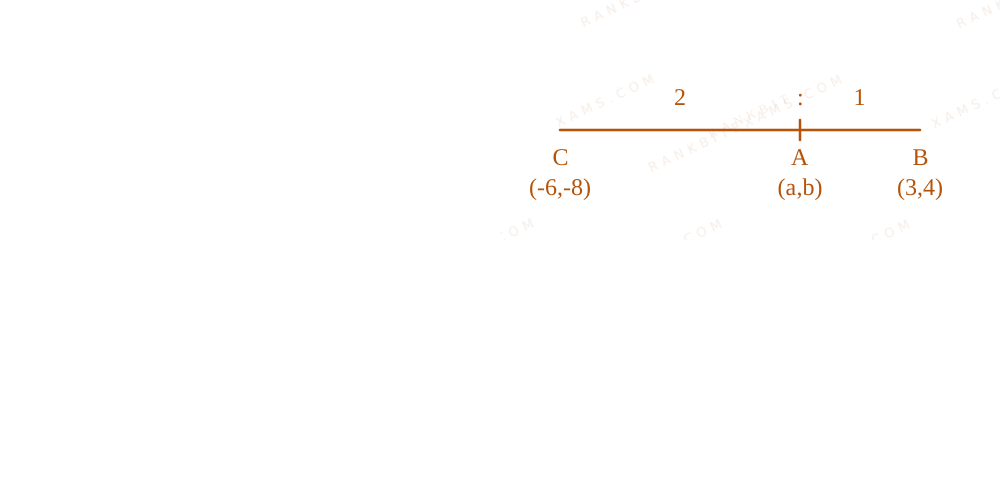
Centroid and Orthocentre diagram for Q2 - JEE Main 2024 Evening
Let Orthocentre C(-6, -8)$C(-6, -8)$ and Circumcentre B(3, 4)$B(3, 4)$. Centroid A(a, b)$A(a, b)$ divides CB$CB$ in 2:1$2:1$.
a = frac2(3) + 1(-6)2+1 = 0$$a = \frac{2(3) + 1(-6)}{2+1} = 0$$b = frac2(4) + 1(-8)2+1 = 0$$b = \frac{2(4) + 1(-8)}{2+1} = 0$$
So, P(2a+3, 7b+5) = (3, 5)$P(2a+3, 7b+5) = (3, 5)$.
The line along which distance is measured is parallel to x - 2y - 1 = 0$x - 2y - 1 = 0$, giving slope m = tantheta = frac12$m = \tan\theta = \frac{1}{2}$.
Using parametric coordinates from P(3,5)$P(3,5)$:
x = 3 + rcostheta, quad y = 5 + rsintheta$$x = 3 + r\cos\theta, \quad y = 5 + r\sin\theta$$
Substitute into the target line 2x + 3y - 4 = 0$2x + 3y - 4 = 0$:
2(3 + rcostheta) + 3(5 + rsintheta) - 4 = 0$$2(3 + r\cos\theta) + 3(5 + r\sin\theta) - 4 = 0$$r(2costheta + 3sintheta) = -17$$r(2\cos\theta + 3\sin\theta) = -17$$
From tantheta = 1/2$\tan\theta = 1/2$, we get sintheta = frac1sqrt5$\sin\theta = \frac{1}{\sqrt{5}}$ and costheta = frac2sqrt5$\cos\theta = \frac{2}{\sqrt{5}}$.
rleft(2left(frac2sqrt5right) + 3left(frac1sqrt5right)right) = -17$$r\left(2\left(\frac{2}{\sqrt{5}}\right) + 3\left(\frac{1}{\sqrt{5}}\right)\right) = -17$$rleft(frac7sqrt5right) = -17 implies |r| = frac17sqrt57$$r\left(\frac{7}{\sqrt{5}}\right) = -17 \implies |r| = \frac{17\sqrt{5}}{7}$$
### Pattern Recognition
Standard Euler line property: O, G, C$O, G, C$ are collinear and G$G$ divides OC$OC$ in 2:1$2:1$. Use parametric equation to find intersection distance directly without finding the intersection point.
### Evaluation Rubric / Model Answer
null
### Chapter Mix
Class 11 Maths: Straight Lines
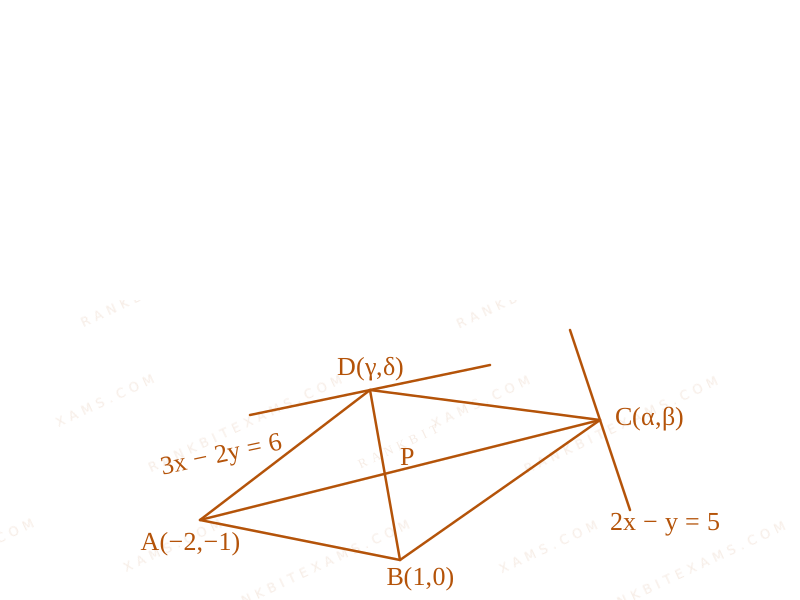
Let A(-2, -1)$A(-2, -1)$, B(1, 0)$B(1, 0)$, C(alpha, beta)$C(\alpha, \beta)$ and D(gamma, delta)$D(\gamma, \delta)$ be the vertices of a parallelogram ABCD. If the point C lies on 2x - y = 5$2x - y = 5$ and the point D lies on 3x - 2y = 6$3x - 2y = 6$, then the value of |alpha + beta + gamma + delta|$|\alpha + \beta + \gamma + \delta|$ is equal to
Q10jee_main_2024_31_jan_morningProperties of Parallelogram
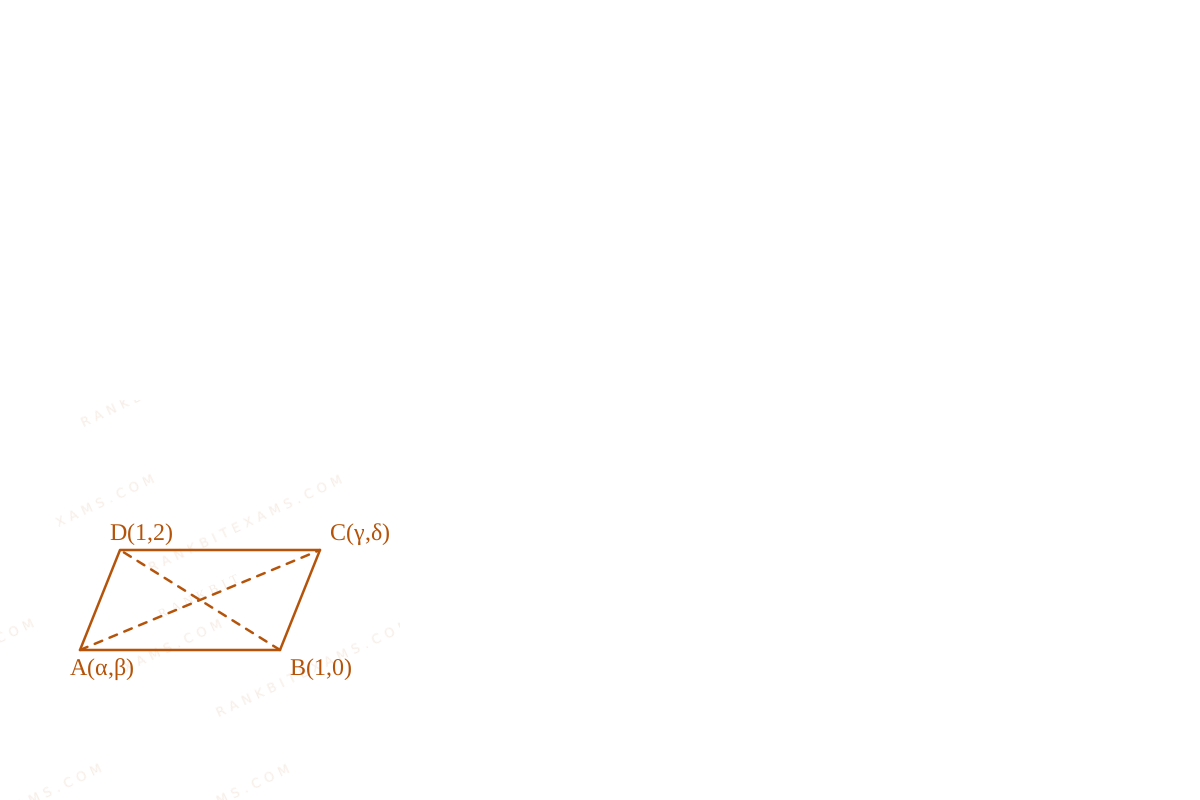
Let alpha, beta, gamma, delta in Z$\alpha, \beta, \gamma, \delta \in Z$ and let A (alpha, beta)$A (\alpha, \beta)$, B (1, 0)$B (1, 0)$, C (gamma, delta)$C (\gamma, \delta)$ and D (1, 2)$D (1, 2)$ be the vertices of a parallelogram ABCD$ABCD$. If AB = sqrt10$AB = \sqrt{10}$ and the points A$A$ and C$C$ lie on the line 3y = 2x + 1$3y = 2x + 1$, then 2(alpha + beta + gamma + delta)$2(\alpha + \beta + \gamma + \delta)$ is equal to
A.10$10$
B.5$5$
C.12$12$
D.8$8$
Solution
### Core Logic
Let E$E$ be the midpoint of the diagonals AC$AC$ and BD$BD$.
Since ABCD$ABCD$ is a parallelogram, the diagonals bisect each other.
Properties of Parallelogram diagram for Q10 - JEE Main 2024 Morning
Midpoint E$E$ from BD$BD$: left( frac1+12, frac0+22 right) = (1, 1)$\left( \frac{1+1}{2}, \frac{0+2}{2} \right) = (1, 1)$.
### Step 1: Apply Midpoint on AC
Midpoint E$E$ from AC$AC$: left( fracalpha+gamma2, fracbeta+delta2 right)$\left( \frac{\alpha+\gamma}{2}, \frac{\beta+\delta}{2} \right)$.
Equating both:
fracalpha+gamma2 = 1 implies alpha + gamma = 2$$\frac{\alpha+\gamma}{2} = 1 \implies \alpha + \gamma = 2$$fracbeta+delta2 = 1 implies beta + delta = 2$$\frac{\beta+\delta}{2} = 1 \implies \beta + \delta = 2$$
### Step 2: Final Value
The expression requires 2(alpha + beta + gamma + delta)$2(\alpha + \beta + \gamma + \delta)$.
2(2 + 2) = 2(4) = 8$$2(2 + 2) = 2(4) = 8$$
*(Note: Additional conditions like AB = sqrt10$AB = \sqrt{10}$ and the line equation are extraneous data not needed to find the sum).*
### Evaluation Rubric / Model Answer
null
### Chapter Mix
Class 11 Maths: Straight Lines
More Straight Lines Questions — jee_main_2025_03_april_evening
We Map Every Repeating Question in Competitive Exams.
Say goodbye to generic mock test fatigue. RankBit uses smart analysis to group past exam questions into their foundational Repeating Question Types. Find chapter weightage, track repeating questions, and score higher with targeted practice.
Select Your Target Exam
Choose an exam track below to find formulas per chapter and patterns.
Syncing Exam Intelligence
Mapping formulas and patterns across all tracks…
PATH A — FULL LENGTH PRACTICE
Full Mock Test Hub
Simulate real NTA exam conditions with fully tracked mocks. Time yourself against past papers.
Practice past-year questions one chapter at a time. Pick an exam → subject → chapter and get every PYQ for that topic — pulled together from all past papers — with the chapter's key formulas alongside.