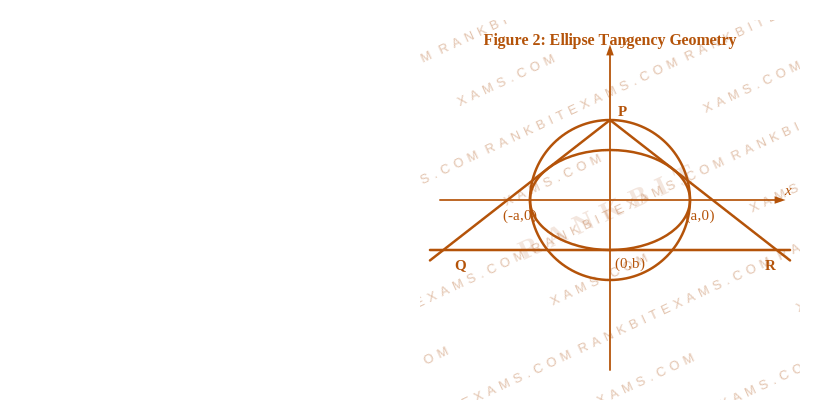
Let C$C$ be the circle of minimum area enclosing the ellipse E: (x²)/(a²) + (y²)/(b²) = 1$E: \frac{x^2}{a^2} + \frac{y^2}{b^2} = 1$ with eccentricity (1)/(2)$\frac{1}{2}$ and foci (pm 2, 0)$(pm 2, 0)$. Let PQR$PQR$ be a variable triangle, whose vertex P$P$ is on the circle C$C$ and the side QR$QR$ of length 8$8$ is parallel to the major axis of E$E$ and contains the point of intersection of E$E$ with the negative y$y$-axis. Then the maximum area of the triangle PQR$PQR$ is:
A.6(3 + √(2))$6(3 + \sqrt{2})$
B.8(3 + √(2))$8(3 + \sqrt{2})$
C.6(2 + √(3))$6(2 + \sqrt{3})$
D.8(2 + √(3))$8(2 + \sqrt{3})$
Solution & Explanation
Related Formula
For an ellipse E$E$:
Foci: (± ae, 0)$(\pm ae, 0)$
Eccentricity: b² = a²(1 - e²)$b^2 = a^2(1 - e^2)$
The circle of minimum area enclosing a centered ellipse has diameter equal to the major axis of the ellipse (R = a$R = a$).
Area of triangle: Area = (1)/(2) · base · height$\text{Area} = \frac{1}{2} \cdot \text{base} \cdot \text{height}$
Core Logic
Let's first find coordinates a$a$ and b$b$:
ae = 2$ae = 2$
e = (1)/(2) a((1)/(2)) = 2 a = 4$e = \frac{1}{2} \implies a\left(\frac{1}{2}\right) = 2 \implies a = 4$
The enclosing circle C$C$ has radius R = a = 4$R = a = 4$, centered at (0,0)$(0,0)$. Thus, its equation is:
x² + y² = 16 P = (4 θ, 4 θ)$$x^2 + y^2 = 16 \implies P = (4\cos\theta, 4\sin\theta)$$
The intersection of the ellipse with the negative y$y$-axis is (0, -b) = (0, -2√(3))$(0, -b) = (0, -2\sqrt{3})$.
Since side QR$QR$ (length = 8$= 8$) is parallel to the major axis (x$x$-axis) and contains (0, -2√(3))$(0, -2\sqrt{3})$, the equation of the line containing QR$QR$ is:
y = -2√(3)$y = -2\sqrt{3}$
Enclosing circle diagram for Q67 - JEE Main 2025 Evening Shift
Step 2: Maximizing Area of Δ PQR$\Delta PQR$
The perpendicular height of vertex P(4 θ, 4 θ)$P(4\cos\theta, 4\sin\theta)$ from the base line y = -2√(3)$y = -2\sqrt{3}$ is:
The enclosing circle with minimum area is called the auxiliary circle. Its radius is equal to the semi-major axis a$a$. Max height of a triangle with a base fixed at line y=-k$y=-k$ and vertex on the circle is R + k$R + k$. This directly gives Area = (1)/(2) · base · (a+b)$\text{Area} = \frac{1}{2} \cdot \text{base} \cdot (a+b)$.
Keywords:#minimum area enclosing circle ellipse#JEE Main 2025 Evening Q67#Conic Sections JEE Main 2025#auxiliary circle elliptical geometry
More Conic Sections Previous-Year Questions — Page 6
Q3jee_main_2026_28_january_eveningParabola and Triangles
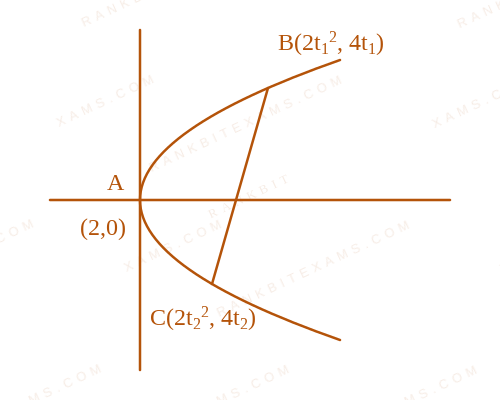
Let A$A$ be the focus of the parabolay² = 8x$y^{2} = 8x$. Let the line y = mx + c$y = mx + c$ intersect the parabola at two distinct points B$B$ and C$C$. If the centroid of the triangle ABC$ABC$ is ((7)/(3), (4)/(3))$\left(\frac{7}{3}, \frac{4}{3}\right)$, then (BC)²$(BC)^{2}$ is equal to :
Focus of y² = 8x$y^2 = 8x$ is A(2, 0)$A(2, 0)$ since 4a = 8 ⇒ a=2$4a = 8 \Rightarrow a=2$.
Let points on parabola be B(2t₁², 4t₁)$B(2t_1^2, 4t_1)$ and C(2t₂², 4t₂)$C(2t_2^2, 4t_2)$.
The centroid of Δ ABC$\Delta ABC$ is given as ((7)/(3), (4)/(3))$\left(\frac{7}{3}, \frac{4}{3}\right)$.
Equating coordinates:
Using parametric coordinates (at², 2at)$(at^2, 2at)$ systematically reduces algebraic complexity when determining intersections or triangle properties on a parabola.
Chapter Mix
Class 11 Maths: Conic Sections
Q9jee_main_2026_28_january_eveningEllipse Parameters and Latus Rectum
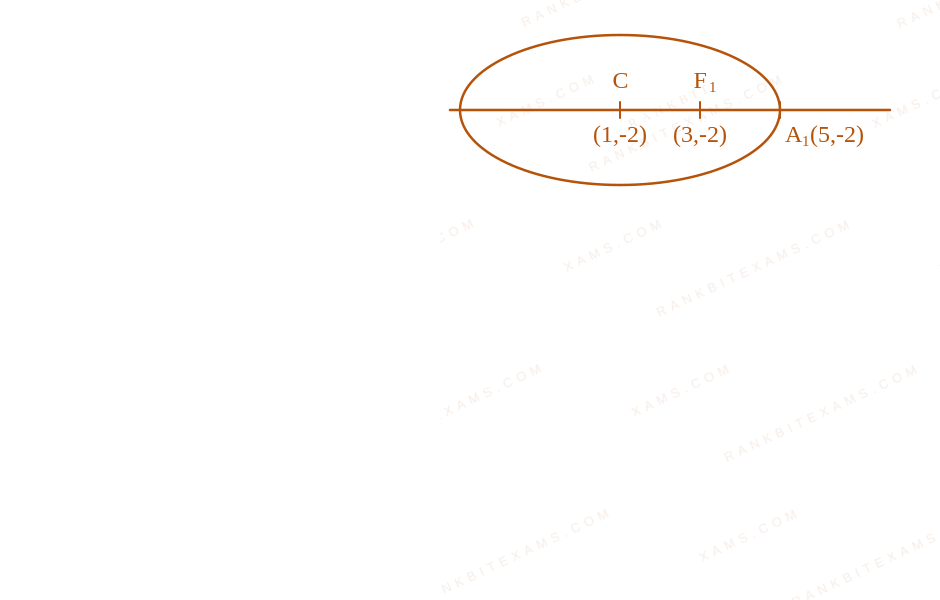
An ellipse has its center at (1,-2)$(1,-2)$, one focus at (3,-2)$(3,-2)$ and one vertex at (5, - 2)$(5, - 2)$. Then the length of its latus rectum is :
From the given coordinates on the major axis (y = -2$y = -2$):
Center C(1, -2)$C(1, -2)$, Focus F₁(3, -2)$F_1(3, -2)$, Vertex A₁(5, -2)$A_1(5, -2)$.
Distance from center to vertex, CA₁ = a = 5 - 1 = 4$CA_1 = a = 5 - 1 = 4$.
Distance from center to focus, CF₁ = ae = 3 - 1 = 2$CF_1 = ae = 3 - 1 = 2$.
Ellipse dimensions mapped to coordinates
Execution
Calculate eccentricity e$e$:
ae = 2 ⇒ 4e = 2 ⇒ e = (1)/(2)$$ae = 2 \Rightarrow 4e = 2 \Rightarrow e = \frac{1}{2}$$
Aligning focus, center, and vertex along a constant y-axis implies a standard shifted ellipse where absolute differences in x-coordinates yield standard parameters (a$a$ and ae$ae$) directly.
Chapter Mix
Class 11 Maths: Conic Sections

Q10jee_main_2026_28_january_eveningConfocal Ellipse and Hyperbola
Let the ellipse E: x²144 + y²169 = 1$E: \frac{x^{2}}{144} + \frac{y^{2}}{169} = 1$ and the hyperbola H: x²16 - y²λ² = -1$H: \frac{x^{2}}{16} - \frac{y^{2}}{\lambda^{2}} = -1$have the same foci. If e$e$ and L$L$ respectively denote the eccentricity and the length of the latus rectum of H$H$, then the value of 24(e + L)$24(e + L)$ is:
Eccentricity of hyperbola, e = (5)/(3)$e = \frac{5}{3}$.
Length of latus rectum of hyperbola, L = (2(16))/(λ) = (32)/(3)$L = \frac{2(16)}{\lambda} = \frac{32}{3}$.
Confocal conics usually align along the same major axis. Notice the -1$-1$ on the RHS of the hyperbola equation indicates a conjugate hyperbola orienting it vertically to match the b>a$b>a$ ellipse.
Chapter Mix
Class 11 Maths: Conic Sections
Q12jee_main_2026_28_january_eveningParametric Form and Chord Intersections
Let the circle x² + y² = 4$x^{2} + y^{2} = 4$ intersect x-axis at the points A(a, 0), a > 0$A(a, 0), a > 0$ and B(b, 0)$B(b, 0)$. Let P(2 α, 2 α), 0 < α < (π)/(2)$P(2 \cos\alpha, 2 \sin\alpha), 0 < \alpha < \frac{\pi}{2}$ and Q(2 β, 2 β)$Q(2 \cos\beta, 2 \sin\beta)$ be two points such that (α - β) = (π)/(2)$(\alpha - \beta) = \frac{\pi}{2}$. Then the point of intersection of AQ$AQ$ and BP$BP$ lies on:
Intersection of circle with x-axis provides A(2,0)$A(2,0)$ and B(-2,0)$B(-2,0)$.
Let the point of intersection of AQ$AQ$ and BP$BP$ be R(h, k)$R(h, k)$.
Since R$R$ lies on BP$BP$, the slope mBR = mBP$m_{BR} = m_{BP}$:
Locus of R$R$ is x² + y² - 4y - 4 = 0$x^2 + y^2 - 4y - 4 = 0$.
Pattern Recognition
Connecting chords from extreme diameter vertices to points whose parametric angles differ by π/2$\pi/2$ reliably generates perpendicular-like slope products or standard tangent angle identities, mapping directly to a circular locus.
Chapter Mix
Class 11 Maths: Circles
Q55jee_main_2025_02_april_eveningEllipse
If the length of the minor axis of an ellipse is equal to one fourth of the distance between the foci, then the eccentricity of the ellipse is :
A.4√(17)$\frac{4}{\sqrt{17}}$
B.√(3)16$\frac{\sqrt{3}}{16}$
C.3√(19)$\frac{3}{\sqrt{19}}$
D.√(5)7$\frac{\sqrt{5}}{7}$
Solution
Related Formula
Length of minor axis = 2b$$\text{Length of minor axis} = 2b$$Distance between foci = 2ae$$\text{Distance between foci} = 2ae$$Eccentricity: e = √(1 - (b²)/(a²))$$\text{Eccentricity: } e = \sqrt{1 - \frac{b^2}{a^2}}$$
Core Logic
We set up an algebraic equation relating b$b$, a$a$, and e$e$ from the given geometric condition, then substitute it into the eccentricity identity.
Step 1: Set up the geometric relation
Given that 2b = (1)/(4) (2ae)$2b = \frac{1}{4} (2ae)$:
Standard Ellipse relations: For standard ellipses, the ratio of axes and the eccentricity are coupled quadratic equations. Expressing b/a$b/a$ as a function of e$e$ allows direct solving of the eccentricity.
Chapter Mix
Class 11 Mathematics: Conic Sections
More Conic Sections Questions — jee_main_2025_03_april_evening
Practice past-year questions one chapter at a time. Pick an exam → subject → chapter and get every PYQ for that topic — pulled together from all past papers — with the chapter's key formulas alongside.