Solution
Related Formula
For an ellipse E:
- Foci: (± ae, 0)
- Eccentricity: b² = a²(1 - e²)
- The circle of minimum area enclosing a centered ellipse has diameter equal to the major axis of the ellipse (R = a).
- Area of triangle: Area = (1)/(2) · base · height
Core Logic
Let's first find coordinates a and b:
- ae = 2
- e = (1)/(2) a((1)/(2)) = 2 a = 4
- b² = a²(1 - e²) = 16(1 - (1)/(4)) = 12 b = 2√(3)
Step 1: Setting Circle and Triangle geometry
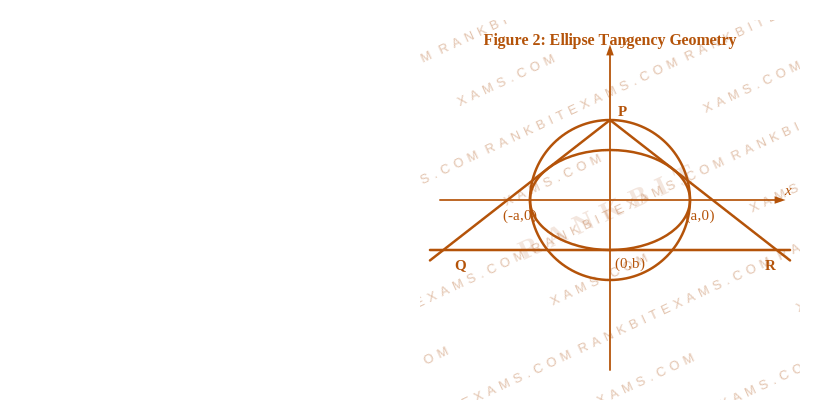
The enclosing circle C has radius R = a = 4, centered at (0,0). Thus, its equation is:
x² + y² = 16 P = (4 θ, 4 θ)The intersection of the ellipse with the negative y-axis is (0, -b) = (0, -2√(3)).
Since side QR (length = 8) is parallel to the major axis (x-axis) and contains (0, -2√(3)), the equation of the line containing QR is: y = -2√(3)
Step 2: Maximizing Area of Δ PQR
The perpendicular height of vertex P(4 θ, 4 θ) from the base line y = -2√(3) is:
H = 4 θ - (-2√(3)) = 4 θ + 2√(3)To maximize the area, we maximize height H by choosing θ = 1:
Hmax = 4 + 2√(3) Maximum Area = (1)/(2) · base QR · Hmax Maximum Area = (1)/(2) · 8 · (4 + 2√(3)) = 4(4 + 2√(3)) = 8(2 + √(3))Pattern Recognition
The enclosing circle with minimum area is called the auxiliary circle. Its radius is equal to the semi-major axis a. Max height of a triangle with a base fixed at line y=-k and vertex on the circle is R + k. This directly gives Area = (1)/(2) · base · (a+b).
Chapter Mix
Class 11 Mathematics: Conic Sections