Solution
Related Formula
The gravitational potential energy U of a liquid column of mass m and height h is evaluated relative to its bottom by placing its total mass at its center of mass (h/2):
U = m g ((h)/(2)) = (ρ A h) g ((h)/(2)) = (1)/(2) ρ A g h²Work done by the force of gravity (W) equals the negative change in potential energy:
W = -Δ U = Uᵢ - UfCore Logic
Since the vessels are identical and connected at the bottom, water flows from the higher column to the lower one until their final heights equalize at:
hf = (10 + 6)/(2) = 8~mStep 1: Calculate Initial Potential Energy (Uᵢ)
Let the reference level U=0 be at the bottom:
Uᵢ = U₁ + U₂ = (1)/(2) ρ A g h₁² + (1)/(2) ρ A g h₂² Uᵢ = (1)/(2) ρ A g (10² + 6²) = (1)/(2) ρ A g (100 + 36) = 68 ρ A g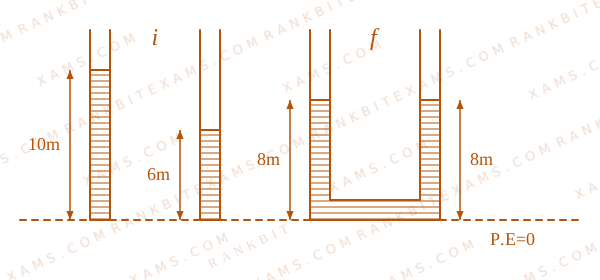
Step 2: Calculate Final Potential Energy (Uf)
Both vessels equalize to hf = 8~m:
Uf = 2 × [ (1)/(2) ρ A g hf² ] = ρ A g (8²) = 64 ρ A gStep 3: Work Done by Gravity (W)
W = Uᵢ - Uf = 68 ρ A g - 64 ρ A g = 4 ρ A gSubstitute the given values (ho = 10³~kg/m³, A = 2~m², g = 10~m/s²):
W = 4 × 10³ × 2 × 10 = 8 × 10⁴~JPattern Recognition
For leveling liquids between two identical connected columns, the shift in center of mass always simplifies. The loss in potential energy is given by
\Delta U = \frac{1}{4} \rho A g (h_1 - h_2)^2. Applying this directly:Δ U = (1)/(4) × 10³ × 2 × 10 × (10 - 6)² = 5000 × 16 = 8 × 10⁴~J$Chapter Mix
Class 11 Physics: Mechanical Properties of Fluids
