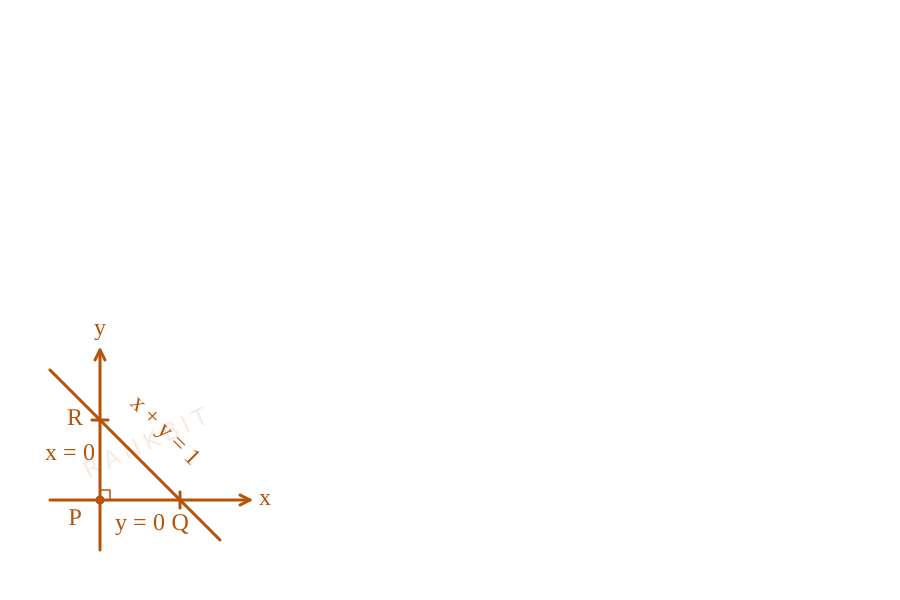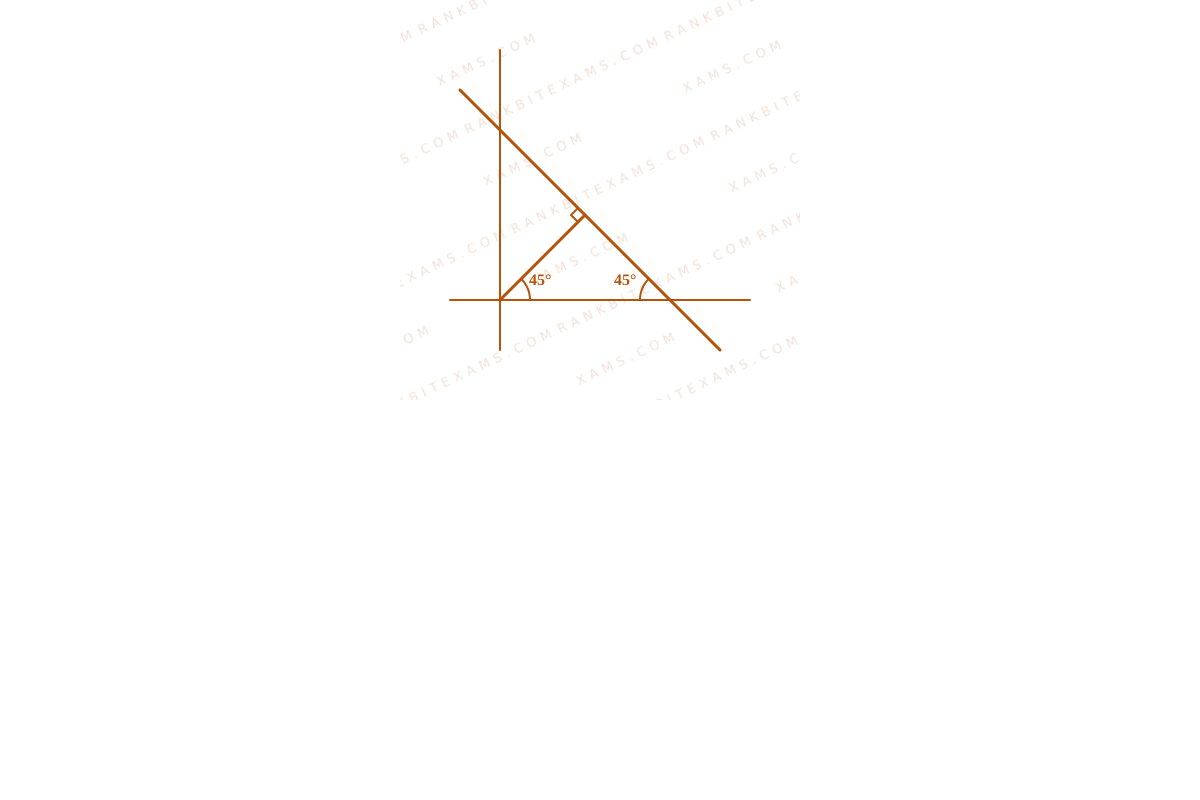
Let the area of the triangle formed by a straight Line L: x + by + c = 0 with co-ordinate axes be 48 square units. If the perpendicular drawn from the origin to the line L makes an angle of 45^circ with the positive x-axis, then the value of b^2 + c^2 is:

Solution & Explanation

### Related Formula textNormal form of a straight line: x cos alpha + y sin alpha = p textArea of right-angled triangle formed with axes: A = frac12 left| x_textintercept cdot y_textintercept right| ### Core Logic We write down the normal equation of the straight line using the given polar normal angle alpha = 45^circ, find its intercept coordinates, and use the area constraint to solve for the coefficients. ### Step 1: Write down normal form The perpendicular drawn from the origin makes an angle of 45^circ with the positive x-axis, so alpha = 45^circ. The line equation is: x cos 45^circ + y sin 45^circ = p implies fracxsqrt2 + fracysqrt2 = p x + y = psqrt2 implies x + y - psqrt2 = 0 Comparing this with the given format x + by + c = 0, we find: b = 1 quad textand quad c = -psqrt2 ### Step 2: Solve for the parameters using the area constraint The line equation is x + y = psqrt2. The intercepts are: - x_textintercept = psqrt2 - y_textintercept = psqrt2 The area of the right-angled triangle formed with the axes is: textArea = frac12 left| psqrt2 cdot psqrt2 right| = p^2 Since the area is given as 48 square units: p^2 = 48 ### Step 3: Calculate the requested value We have: b^2 = 1^2 = 1 c^2 = (-psqrt2)^2 = 2p^2 = 2(48) = 96 Therefore, we find: b^2 + c^2 = 1 + 96 = 97 ### Pattern Recognition Normal equation coupling: Normal equations of lines xcosalpha+ysinalpha = p are extremely powerful when normal angles are specified. For alpha=45^circ, the coordinate intercepts are identical, making the area relation A=p^2 exceptionally simple. ### Evaluation Rubric / Model Answer null ### Chapter Mix Class 11 Mathematics: Straight Lines
Normal form of straight line coordinate triangle

Reference Study Guides

More Straight Lines Previous-Year Questions — Page 2

Q57 jee_main_2025_08_april_evening Properties of Square and Diagonals
Let a be the length of a side of a square OABC with O being the origin. Its side OA makes an acute angle alpha with the positive x-axis and the equations of its diagonals are (sqrt3 + 1)x + (sqrt3 - 1)y = 0 quad textand (sqrt3 - 1)x - (sqrt3 + 1)y + 8sqrt3 = 0. Then a^2 is equal to
  • A. 48
  • B. 32
  • C. 16
  • D. 24

Solution

### Related Formula textSlope m = -fracAB ### Core Logic Identify which diagonal passes through the origin. Use its directional configuration slope to determine the exact angle orientation layout map of the geometric system elements. ### Step 1: Determine Diagonal Orientation The line passing through the origin is diagonal OB: m_OB = -fracsqrt3+1sqrt3-1 = tan 105^circ Since diagonals of a square split the vertex paths evenly at 45^circ, the side OA makes an angle: alpha = 105^circ - 45^circ = 60^circ ### Step 2: Coordinate Vector Definition Coordinates of vertex A matching side value a are: A(acos 60^circ, asin 60^circ) = left( fraca2, fracsqrt3a2 right) ### Step 3: Diagonal Intersection Point Solver Vertex A lies upon the alternative structural path line: (sqrt3-1)fraca2 - (sqrt3+1)fracsqrt3a2 + 8sqrt3 = 0 a left[ fracsqrt3 - 1 - 3 - sqrt32 right] = -8sqrt3 implies -2a = -8sqrt3 implies a = 4sqrt3 a^2 = 48 {{SOL_IMG_57}} ### Pattern Recognition Slopes involving sqrt3 pm 1 explicitly alert you to geometric orientations built on multiples of 15^circ or 75^circ configurations. ### Evaluation Rubric / Model Answer null ### Chapter Mix Class 11 Mathematics: Straight Lines
Q58 jee_main_2025_29_jan_evening Area of Triangles and Inscribed Shapes
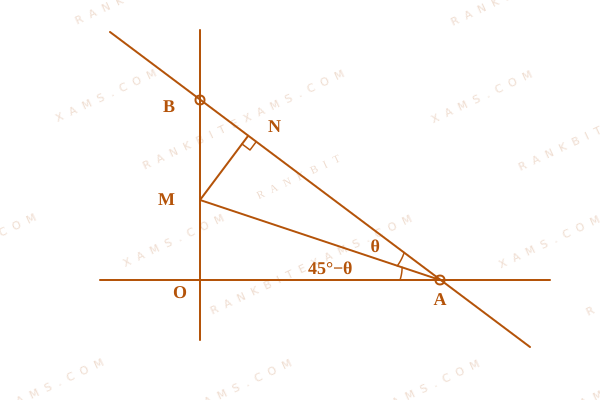
Let the line x + y = 1 meet the axes of x and y at A and B, respectively. A right angled triangle AMN is inscribed in the triangle OAB, where O is the origin and the points M and N lie on the lines OB and AB, respectively. If the area of the triangle AMN is frac49 of the area of the triangle OAB and AN: NB = \lambda : 1, then the sum of all possible value(s) of lambda is :
  • A. frac12
  • B. frac136
  • C. frac52
  • D. 2

Solution

### Related Formula Area of a right-angled triangle: textArea = frac12 times textbase times textheight ### Core Logic The line equation is x + y = 1, giving intercept coordinates A(1, 0) and B(0, 1).
Area of Triangles and Inscribed Shapes diagram for Q58 - JEE Main 2025 Evening
Area of Delta OAB = frac12 times 1 times 1 = frac12. Given area condition: textArea of Delta AMN = frac49 times frac12 = frac29 ### Step 1: Set up Trigonometric Tracing Let angle MAO = 45^circ - theta. Since Delta OAB is isosceles right-angled at O, angle OAB = 45^circ. This establishes: OA = 1, quad AM = sec(45^circ - theta) AN = sec(45^circ - theta)costheta MN = sec(45^circ - theta)sintheta ### Step 2: Solve for Angles and Ratios textArea(Delta AMN) = frac12 times sec^2(45^circ - theta)sinthetacostheta = frac29 Solving the trigonometric ratio yields: tantheta = 2 quad textor quad frac12 Rejecting tantheta = 2 based on physical boundaries within the triangle limits: fracANNB = fraclambda1 = cottheta = 2 Thus, the valid evaluation matches the option sequence value of 2. ### Pattern Recognition When dealing with inscribed right triangles inside symmetric linear bounds, parameterizing coordinates with angles matching the axis slope simplifies configuration variables dramatically. ### Evaluation Rubric / Model Answer null ### Chapter Mix Class 11 Mathematics: Straight Lines
Q72 jee_main_2025_28_jan_morning Distance of a Point from a Line
If alpha = 1 + sum_r=1^6 (-3)^r-1 ^12 C_2r-1, then the distance of the point (12, sqrt3) from the line alpha x - sqrt3 y + 1 = 0 is
Numerical Answer. Answer: 5 to 5

Solution

### Related Formula Perpendicular distance from a point (x_1, y_1) to a line Ax + By + C = 0: d = frac|Ax_1 + By_1 + C|sqrtA^2 + B^2 ### Core Logic Rewrite the summation for alpha by embedding complex roots to isolate alternating terms: alpha = 1 + frac1sqrt3i left[ frac(1 + sqrt3i)^12 - (1 - sqrt3i)^122 right] Using complex cube roots of unity conversions (1 + sqrt3i = -2omega^2), this simplifies directly to alpha = 1. ### Step 1: Calculating Perpendicular Distance Substitute alpha = 1 into the line equation, yielding x - sqrt3y + 1 = 0. Evaluating the distance from point (12, sqrt3): d = frac|12 - sqrt3(sqrt3) + 1|sqrt1^2 + (-sqrt3)^2 = frac|12 - 3 + 1|2 = frac102 = 5 ### Pattern Recognition Binomial series containing terms like sqrt3^2r-1 collapse neatly into simple geometric forms using standard complex rotations (e^ipi/3). ### Evaluation Rubric / Model Answer null ### Chapter Mix Class 11 Maths: Binomial Theorem Class 11 Maths: Straight Lines
Q63 jee_main_2025_03_april_morning Distance between Parallel Lines
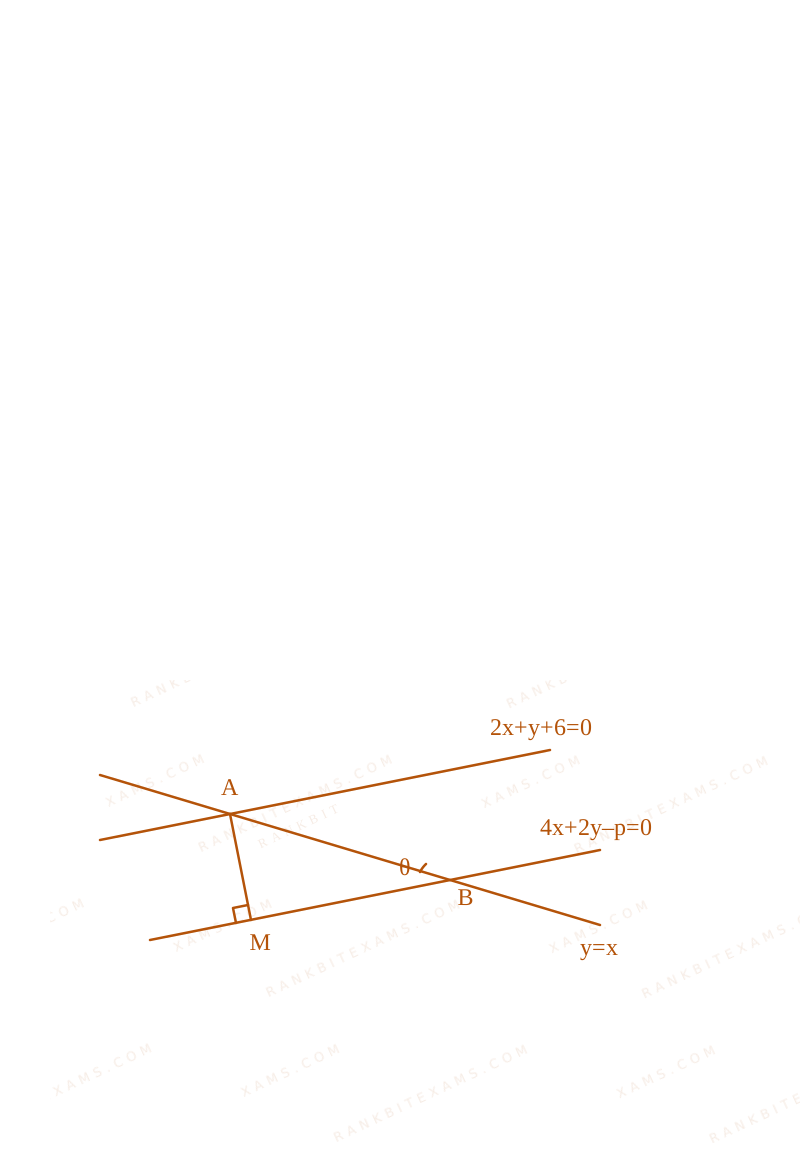
A line passes through the origin and makes equal angles with the positive coordinate axes[cite: 602]. It intersects the lines L_1:2x+y+6=0 and L_2:4x+2y-p=0, p>0, at the points A and B, respectively[cite: 603]. If AB = frac9sqrt2 [cite: 605] and the foot of the perpendicular from the point A on the line L_2 is M [cite: 606, 607], then fracAMBM is equal to[cite: 619, 620]:
  • A. 5
  • B. 4
  • C. 2
  • D. 3

Solution

### Related Formula Slope angle interaction tracking: In right triangle triangle AMB, the tangent of inclination satisfies: tan theta = fracAMBM
Distance between Parallel Lines diagram for Q63 - JEE Main 2025 Morning
### Core Logic A line tracking equal angles through positive coordinate frames has equation y=x [cite: 1353]. Its slope parameter is m_1 = 1 [cite: 1353]. The parallel boundary lines L_1 and L_2 have a uniform slope value of m_2 = -2 [cite: 1353]. Let theta represent the precise geometric crossing angle matching the line y=x intersecting line L_2[cite: 1353]. ### Step 1: Finding the requested ratio Using the slope interaction formula to calculate the tangent angle metric[cite: 1353]: tan theta = left| fracm_1 - m_21 + m_1 m_2 right| [cite: 1353] tan theta = left| frac1 - (-2)1 + (1)(-2) right| = left| frac3-1 right| = 3 [cite: 1353] By observing right-angled geometry configuration triangle AMB [cite: 1353]: fracAMBM = tan theta = 3 [cite: 1353] ### Pattern Recognition Ratios of side projections of lines intersecting parallel setups depend completely on direction orientations, bypassing raw variable solving steps entirely. ### Evaluation Rubric / Model Answer null ### Chapter Mix Class 11 Mathematics: Straight Lines
Q65 jee_main_2025_04_april_morning Orthocentre of a Triangle
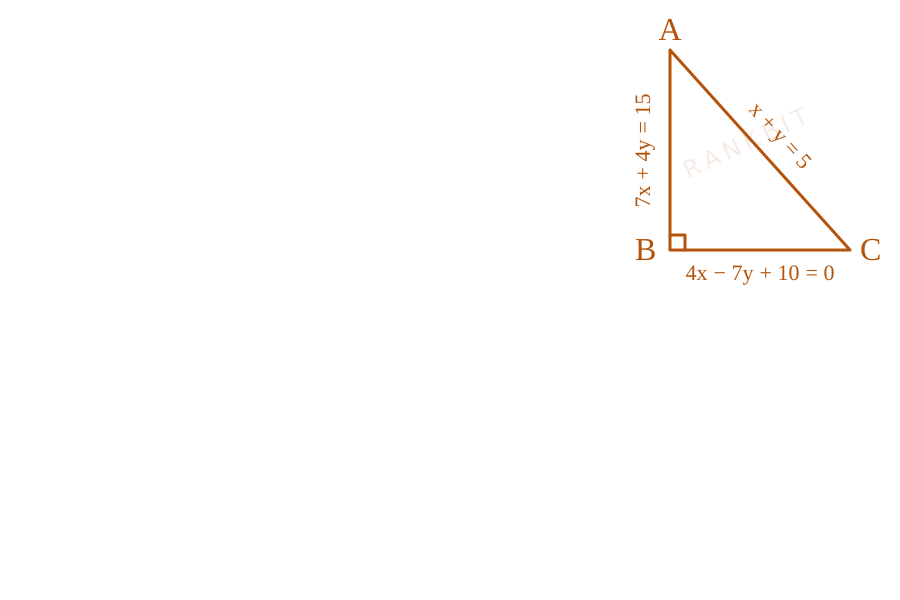
Let the three sides of a triangle be on the lines 4x - 7y + 10 = 0, x + y = 5 and 7x + 4y = 15. Then the distance of its orthocentre from the orthocentre of the triangle formed by the lines x = 0, y = 0 and x + y = 1 is
  • A. 5
  • B. sqrt5
  • C. sqrt20
  • D. 20

Solution

### Related Formula For any right-angled triangle, the orthocentre lies exactly at the vertex containing the 90^circ right angle. Distance formula: d = sqrt(x_2 - x_1)^2 + (y_2 - y_1)^2 ### Core Logic Analyze slopes of lines forming Triangle 1: L_1: 4x - 7y + 10 = 0 implies m_1 = frac47 L_2: 7x + 4y - 15 = 0 implies m_2 = -frac74 Notice m_1 cdot m_2 = left(frac47right)left(-frac74right) = -1. Thus, Triangle 1 is a right-angled triangle. Its orthocentre B is the intersection point of L_1 and L_2: Solving 4x - 7y = -10 and 7x + 4y = 15: Multiplying first by 4, second by 7, and adding yields x = 1, y = 2 implies B(1, 2).
Orthocentre of a Triangle diagram for Q65 - JEE Main 2025 Morning
### Step 1: Locate Second Orthocentre Triangle 2 is formed by x = 0, y = 0, and x + y = 1. This is a right triangle with vertices at (0,0), (1,0), (0,1). The right-angled vertex is at the origin P(0, 0). Thus, its orthocentre is P(0, 0).
Orthocentre of a Triangle diagram for Q65 - JEE Main 2025 Morning
### Step 2: Distance Computation Find the distance between B(1,2) and P(0,0): d = sqrt(1 - 0)^2 + (2 - 0)^2 = sqrt1 + 4 = sqrt5 ### Pattern Recognition Always check for mutually perpendicular side orientations (m_1 cdot m_2 = -1) when finding orthocentres in competitive math papers. This completely cuts out lengthy altitude equation derivation tracks. ### Evaluation Rubric / Model Answer null ### Chapter Mix Class 11 Mathematics: Straight Lines
More Straight Lines Questions — jee_main_2025_02_april_evening

Practice all Straight Lines previous-year questions →

Rankbit System
JEE Physics: Waves (+15.5%) | Electrostatics: Concentric Shells (-29.7%) | Modern Physics: Photoelectric Clones (+34.2%) | Mathematics: Definite Integrals (+18.1%) | Chemistry: Coordination Splitting (-11.4%) | JEE Physics: Waves (+15.5%) | Electrostatics: Concentric Shells (-29.7%) | Modern Physics: Photoelectric Clones (+34.2%) | Mathematics: Definite Integrals (+18.1%) | Chemistry: Coordination Splitting (-11.4%)