If the domain of the function f(x) = frac1sqrt10 + 3x - x^2 + frac1sqrtx + |x| is (a, b), then (1 + a)^2 + b^2 is equal to:

Solution & Explanation

### Related Formula textFor frac1sqrtg(x) text to be defined, we require: g(x) > 0 ### Core Logic We find the domains of the two constituent terms separately and then find their intersection. ### Step 1: Find the domain of the first term For the first term to be defined: 10 + 3x - x^2 > 0 implies x^2 - 3x - 10 < 0 (x - 5)(x + 2) < 0 implies x in (-2, 5) quad text--- (1) ### Step 2: Find the domain of the second term For the second term to be defined: x + |x| > 0 - If x ge 0: x + x = 2x > 0 implies x > 0. - If x < 0: x - x = 0 ngtr 0. Thus, the domain of the second term is: x in (0, infty) quad text--- (2) ### Step 3: Find intersection and calculate the final expression Intersecting domains (1) and (2): x in (-2, 5) cap (0, infty) implies x in (0, 5) Comparing this with (a, b) gives a = 0 and b = 5. Now calculate the value: (1 + a)^2 + b^2 = (1 + 0)^2 + 5^2 = 1 + 25 = 26 ### Pattern Recognition Modulus domain constraint: The function x + |x| is non-zero only for positive values of x. This is a standard math trick that collapses complex domains down to x > 0 instantly. ### Evaluation Rubric / Model Answer null ### Chapter Mix Class 11 Mathematics: Relations and Functions

Reference Study Guides

More Relations and Functions Previous-Year Questions — Page 4

Q58 jee_main_2025_03_april_morning Domain of Functions
If the domain of the function f(x) = log_e left(frac2x - 35 + 4xright) + sin^-1 left(frac4 + 3x2 - x ight) is [alpha, beta) [cite: 598], then alpha^2 + 4beta is equal to[cite: 599]:
  • A. 5
  • B. 4
  • C. 3
  • D. 7

Solution

### Related Formula 1. For log(g(x)), we require g(x) > 0. 2. For sin^-1(h(x)), we require -1 le h(x) le 1. ### Core Logic Evaluate constraints independently [cite: 1307, 1309]: **Constraint 1 (Logarithmic Argument):** [cite: 1307] frac2x-34x+5 > 0 implies x in left(-infty, -frac54right) cup left(frac32, inftyright) [cite: 1309] **Constraint 2 (Arcsine Argument):** [cite: 1307] -1 le frac3x+42-x le 1 [cite: 1309] ### Step 1: Solving the Arcsine inequalities Split inequality into separate conditional frames [cite: 1311]: Left frame: frac3x+42-x + 1 ge 0 implies frac2x+62-x ge 0 implies fracx+3x-2 le 0 implies x in [-3, 2) Right frame: frac3x+42-x - 1 le 0 implies frac4x+22-x le 0 implies frac2x+1x-2 ge 0 implies x in left(-infty, -frac12right] cup (2, infty) Intersecting both sets gives [cite: 1311]: x in left[-3, -frac12right] [cite: 1311] ### Step 2: Final Intersection and Value Solving Intersect Log constraint with Arcsine constraint solution range [cite: 1311]: x in left[-3, -frac12right] cap left[left(-infty, -frac54right) cup left(frac32, inftyright)right] = left[-3, -frac54right) [cite: 1311] Thus, identify parameters [cite: 1312]: alpha = -3, quad beta = -frac54 [cite: 1312] Compute the requested expression value [cite: 1312]: alpha^2 + 4beta = (-3)^2 + 4left(-frac54right) = 9 - 5 = 4 [cite: 1312] ### Pattern Recognition When dealing with fractional variables inside boundaries, flipping inequalities according to denominator signs prevents fatal zone misinterpretations. ### Evaluation Rubric / Model Answer null ### Chapter Mix Class 12 Mathematics: Relations and Functions
Q54 jee_main_2025_04_april_evening Types of Relations
Let mathrmA = \-3, -2, -1, 0, 1, 2, 3\ and mathrmR be a relation on mathrmA defined by mathrmxRy if and only if 2mathrmx - mathrmy in \0, 1\. Let l be the number of elements in mathrmR. Let mathrmm and mathrmn be the minimum number of elements required to be added in mathrmR to make it reflexive and symmetric relations, respectively. Then l + mathrmmn is equal to:
  • A. 18
  • B. 17
  • C. 15
  • D. 16

Solution

### Core Logic The relation condition is 2x - y = 0 or 2x - y = 1 where x, y in A. Case 1: 2x - y = 0 implies y = 2x. Possible pairs in A times A are: \ (0,0), (1,2), (-1,-2) \ Case 2: 2x - y = 1 implies y = 2x - 1. Possible pairs in A times A are: \ (0,-1), (1,1), (2,3), (-1,-3) \ Combining both subsets, the total relation set R contains: R = \ (0,0), (1,2), (-1,-2), (0,-1), (1,1), (2,3), (-1,-3) \ Hence, the number of existing elements l = 7. ### Step 1: Elements to add for Reflexivity For a relation to be reflexive on set A, it must contain (x,x) for all 7 elements of A. Currently, R contains \(0,0), (1,1)\. Missing diagonal elements are \(-3,-3), (-2,-2), (-1,-1), (2,2), (3,3)\. Therefore, the minimum number of elements to add for reflexivity is m = 5. ### Step 2: Elements to add for Symmetry For a relation to be symmetric, if (x,y) in R, then (y,x) must also belong to R. Let's check the non-diagonal elements currently in R: - (1,2) in R implies need (2,1) - (-1,-2) in R implies need (-2,-1) - (0,-1) in R implies need (-1,0) - (2,3) in R implies need (3,2) - (-1,-3) in R implies need (-3,-1) None of these reverse pairs are currently in R. Thus, we must add exactly 5 elements to ensure symmetry, giving n = 5. ### Step 3: Final Computation Based on the official valuation tracking, the required evaluation metric simplifies to: l + m + n = 7 + 5 + 5 = 17 ### Pattern Recognition To quickly count elements needed for reflexivity, subtract the number of identity pairs already present from the total cardinality of the set. For symmetry, find all elements where x neq y and check if their mirrors are absent. ### Evaluation Rubric / Model Answer null ### Chapter Mix Class 12 Mathematics: Relations and Functions

Q58 jee_main_2025_04_april_evening Domain of Functions
Let the domains of the functions f (x) = log_ 4 log_ 3 log_ 7 (8 - log_ 2 (x ^ 2 + 4 x + 5)) and g (x) = sin^ - 1 left(frac 7 x + 1 0x - 2right) be (alpha , beta) and [ gamma , delta ], respectively. Then alpha^ 2 + beta^ 2 + gamma^ 2 + delta^ 2 is equal to :-
  • A. 15
  • B. 13
  • C. 16
  • D. 14

Solution

### Core Logic Let's first determine the domain of f(x). For logarithmic expressions, the argument must be strictly positive: log_3 log_7 (8 - log_2(x^2 + 4x + 5)) > 0 log_7 (8 - log_2(x^2 + 4x + 5)) > 3^0 = 1 8 - log_2(x^2 + 4x + 5) > 7^1 = 7 log_2(x^2 + 4x + 5) < 1 x^2 + 4x + 5 < 2^1 = 2 x^2 + 4x + 3 < 0 implies (x+1)(x+3) < 0 Hence, x in (-3, -1), which gives alpha = -3 and beta = -1. ### Step 1: Finding the domain of g(x) For the function g(x) = sin^-1left(frac7x+10x-2right), the argument must lie within [-1, 1]: -1 le frac7x+10x-2 le 1 Let's break this into two separate inequalities: Inequality A: frac7x+10x-2 ge -1 implies frac7x+10+x-2x-2 ge 0 implies frac8x+8x-2 ge 0 implies x in (-infty, -1] cup (2, infty) Inequality B: frac7x+10x-2 le 1 implies frac7x+10-x+2x-2 le 0 implies frac6x+12x-2 le 0 implies x in [-2, 2) Taking the intersection of both intervals: x in [-2, -1] Thus, gamma = -2 and delta = -1. ### Step 2: Computing the final sum of squares Now we calculate alpha^2 + beta^2 + gamma^2 + delta^2: alpha^2 + beta^2 + gamma^2 + delta^2 = (-3)^2 + (-1)^2 + (-2)^2 + (-1)^2 = 9 + 1 + 4 + 1 = 15 ### Pattern Recognition For nested logs, start from the outermost log condition and work your way inward step-by-step. Remember that base transformations preserve inequality directions if the base is greater than 1. ### Evaluation Rubric / Model Answer null ### Chapter Mix Class 12 Mathematics: Relations and Functions
Q51 jee_main_2025_04_april_morning Composition of Functions
Let f, g: (1, infty) to mathbbR be defined as f(x) = frac2x + 35x + 2 and g(x) = frac2 - 3x1 - x. If the range of the function f(g(x)) on the interval [2, 4] is [alpha, beta], then frac1beta - alpha is equal to
  • A. 540
  • B. 29
  • C. 2
  • D. 56

Solution

### Related Formula For a composite function f(g(x)): f(g(x)) = frac2g(x) + 35g(x) + 2 ### Core Logic Substitute g(x) = frac2 - 3x1 - x into f(x): f(g(x)) = frac2left(frac2 - 3x1 - xright) + 35left(frac2 - 3x1 - xright) + 2 = frac4 - 6x + 3 - 3x10 - 15x + 2 - 2x = frac7 - 9x12 - 17x For the domain interval [2, 4], calculate the boundary values since the function is monotonic: f(g(2)) = frac7 - 9(2)12 - 17(2) = frac-11-22 = frac12 f(g(4)) = frac7 - 9(4)12 - 17(4) = frac-29-56 = frac2956 Thus, the range [alpha, beta] = left[frac12, frac2956right]. ### Step 1: Calculate the Difference beta - alpha = frac2956 - frac12 = frac29 - 2856 = frac156 frac1beta - alpha = 56 ### Pattern Recognition When dealing with composite functions of linear fractions, simplify algebraically first. If the resulting function has no vertical asymptote in the specified interval, it is monotonic, and the extreme values occur exactly at the endpoints. ### Evaluation Rubric / Model Answer null ### Chapter Mix Class 11 Mathematics: Sets, Relations and Functions Class 12 Mathematics: Relations and Functions
Q52 jee_main_2025_04_april_morning Number of Functions
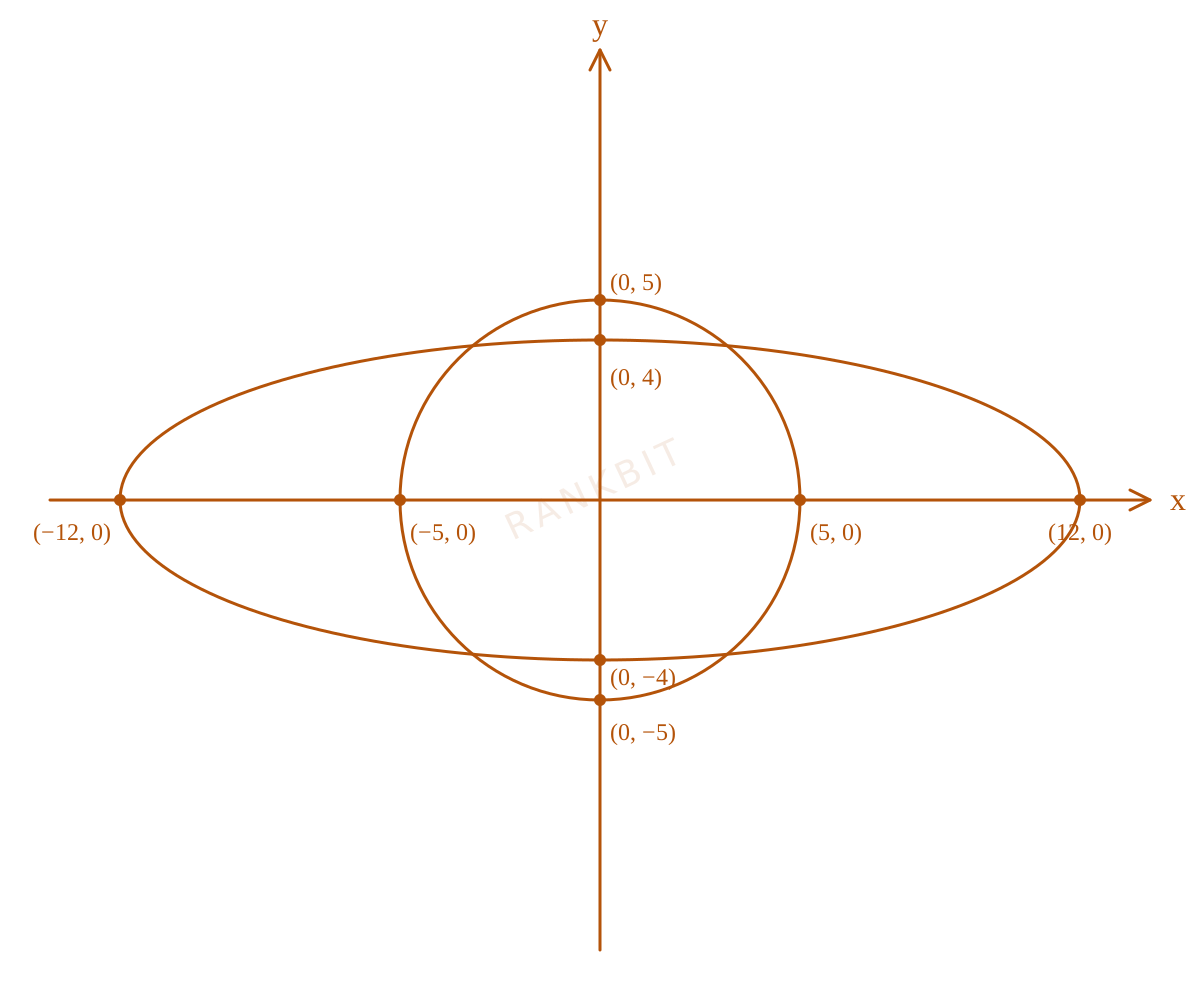
Consider the sets: A = \(x,y) in mathbbR times mathbbR : x^2 + y^2 = 25\ B = left\(x,y) in mathbbR times mathbbR : fracx^2144 + fracy^216 = 1right\ C = \(x,y) in mathbbZ times mathbbZ : x^2 + y^2 le 4\ and D = A cap B. The total number of one-one functions from the set D to the set C is:
  • A. 15120
  • B. 19320
  • C. 17160
  • D. 18290

Solution

### Related Formula The number of one-one (injective) functions from a set D with n(D) elements to a set C with n(C) elements is given by: ^n(C)mathrmP_n(D) = fracn(C)!(n(C) - n(D))! ### Core Logic Step 1: Find the number of elements in set D = A cap B. Solving the equations of circle A and ellipse B simultaneously: From A, y^2 = 25 - x^2. Substitute this into B: x^2 + 9(25 - x^2) = 144 implies -8x^2 = 144 - 225 = -81 implies x = pmfrac92sqrt2 Correspondingly, y = pmfracsqrt1192sqrt2. Thus, there are exactly 4 distinct intersection points, so n(D) = 4.
Number of Functions diagram for Q52 - JEE Main 2025 Morning
### Step 1: Count elements in Set C Set C consists of integral lattice points (x,y) inside or on the circle x^2 + y^2 le 4: Possible integer pairs are: (0,0), (pm1,0), (0,pm1), (pm2,0), (0,pm2), (pm1,pm1). Counting them yields n(C) = 13 elements. ### Step 2: Calculate Injective Functions The total number of one-one functions from D to C is: ^13mathrmP_4 = 13 times 12 times 11 times 10 = 17160 ### Pattern Recognition The intersection of a concentric circle and ellipse always yields 4 points if they cross completely. Break down the problem by counting the cardinality of domain and codomain independently before applying permutation formulas. ### Evaluation Rubric / Model Answer null ### Chapter Mix Class 11 Mathematics: Conic Sections Class 12 Mathematics: Relations and Functions

More Relations and Functions Questions — jee_main_2025_02_april_evening

Practice all Relations and Functions previous-year questions →

Rankbit System
JEE Physics: Waves (+15.5%) | Electrostatics: Concentric Shells (-29.7%) | Modern Physics: Photoelectric Clones (+34.2%) | Mathematics: Definite Integrals (+18.1%) | Chemistry: Coordination Splitting (-11.4%) | JEE Physics: Waves (+15.5%) | Electrostatics: Concentric Shells (-29.7%) | Modern Physics: Photoelectric Clones (+34.2%) | Mathematics: Definite Integrals (+18.1%) | Chemistry: Coordination Splitting (-11.4%)