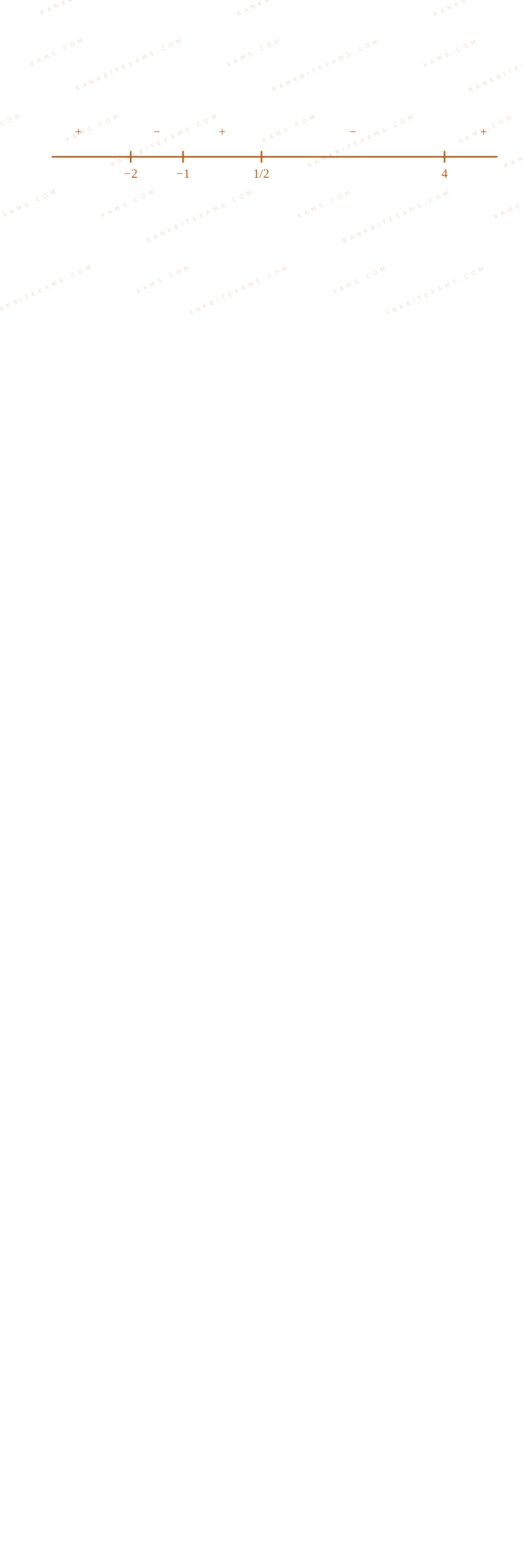
If the domain of the function₅(18x - x² -77)$\log_5\left(18x - x^2 -77\right)$ is (α ,β)$(\alpha ,\beta)$ and the domain of the function(x - 1)((2x² + 3x - 2)/(x² - 3x - 4))$\log_{(x - 1)}\left(\frac{2x^2 + 3x - 2}{x^2 - 3x - 4}\right)$ is (γ ,δ)$(\gamma ,\delta)$, then \alpha^2 +\beta^2 +\gamma^2 is equal to:
A.174$174$
B.179$179$
C.186$186$
D.195$195$
Solution & Explanation
Related Formula
For a logarithmic term b(a)$\log_b(a)$ to be valid:
a > 0, b > 0, b ≠ 1$$a > 0, \quad b > 0, \quad b \neq 1$$
Core Logic
Analyzing the first function f₁(x) = ₅(18x - x² - 77)$f_1(x) = \log_5(18x - x^2 - 77)$:
For domain intersections involving variables in both the log base and argument, always list base rules (>0, ≠ 1$>0, \neq 1$) first to eliminate invalid sign fields early on.
Keywords:#domain of the function#JEE Main 2025 Evening Q54#Relations and Functions JEE Main 2025#Domain of a Function JEE Main 2025
More Relations and Functions Previous-Year Questions
Q1jee_main_2026_21_jan_morningDomain and Range of Inverse Trigonometric Functions
If the domain of the functionf(x) = ⁻¹((2x - 5)/(11 - 3x)) + ⁻¹(2x² - 3x + 1)$f(x) = \cos^{-1}\left(\frac{2x - 5}{11 - 3x}\right) + \sin^{-1}(2x^2 - 3x + 1)$ is the interval [α, β]$[\alpha, \beta]$ , then α + 2β$\alpha + 2\beta$ is equal to :
A. 1
B. 3
C. 5
D. 2
Solution
### Related Formula
For inverse trigonometric functions ⁻¹(g(x))$\sin^{-1}(g(x))$ and ⁻¹(h(x))$\cos^{-1}(h(x))$, the arguments must satisfy:
-1 ≤ g(x) ≤ 1$$-1 \leq g(x) \leq 1$$-1 ≤ h(x) ≤ 1$$-1 \leq h(x) \leq 1$$
### Core Logic
Given f(x) = ⁻¹((2x - 5)/(11 - 3x)) + ⁻¹(2x² - 3x + 1)$f(x) = \cos^{-1}\left(\frac{2x - 5}{11 - 3x}\right) + \sin^{-1}(2x^2 - 3x + 1)$
We establish two simultaneous inequalities for the domain:
1) -1 ≤ (2x - 5)/(11 - 3x) ≤ 1$-1 \leq \frac{2x - 5}{11 - 3x} \leq 1$
2) -1 ≤ 2x² - 3x + 1 ≤ 1$-1 \leq 2x^2 - 3x + 1 \leq 1$
### Step 1: Solve the Quadratic Inequality
From -1 ≤ 2x² - 3x + 1 ≤ 1$-1 \leq 2x^2 - 3x + 1 \leq 1$:
Split into two parts:
2x² - 3x + 2 ≥ 0$2x^2 - 3x + 2 \geq 0$ (This is always true as discriminant D < 0, a > 0$D < 0, a > 0$)
2x² - 3x ≤ 0 ⇒ x(2x - 3) ≤ 0$2x^2 - 3x \leq 0 \Rightarrow x(2x - 3) \leq 0$x in [0, (3)/(2)] (i)$$x \in \left[0, \frac{3}{2}\right] \dots(i)$$
### Step 2: Solve the Rational Inequality
From -1 ≤ (2x - 5)/(11 - 3x) ≤ 1$-1 \leq \frac{2x - 5}{11 - 3x} \leq 1$:
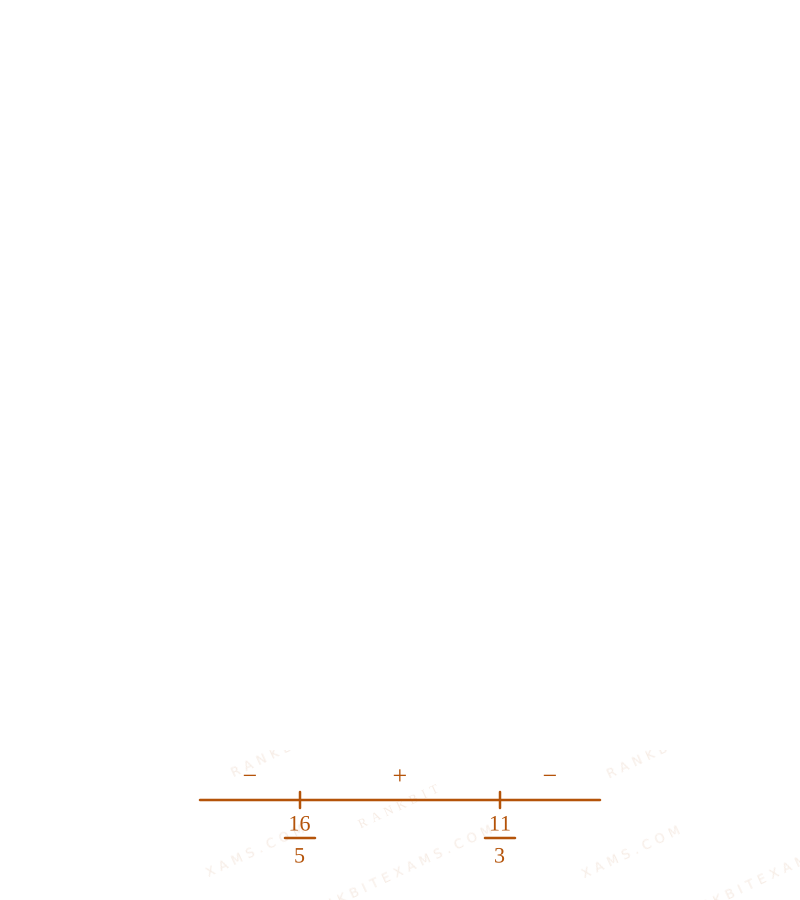
Part A: (2x - 5)/(11 - 3x) + 1 ≥ 0 ⇒ (2x - 5 + 11 - 3x)/(11 - 3x) ≥ 0 ⇒ (6 - x)/(11 - 3x) ≥ 0$\frac{2x - 5}{11 - 3x} + 1 \geq 0 \Rightarrow \frac{2x - 5 + 11 - 3x}{11 - 3x} \geq 0 \Rightarrow \frac{6 - x}{11 - 3x} \geq 0$Domain interval number line diagram for Q1 - JEE Main 2026 Morningx in (-∞, (11)/(3)) [6, ∞)$$x \in \left(-\infty, \frac{11}{3}\right) \cup [6, \infty)$$
Part B: (2x - 5)/(11 - 3x) - 1 ≤ 0 ⇒ (5x - 16)/(11 - 3x) ≤ 0 ⇒ x in (-∞, (16)/(5)] ((11)/(3), ∞)$\frac{2x - 5}{11 - 3x} - 1 \leq 0 \Rightarrow \frac{5x - 16}{11 - 3x} \leq 0 \Rightarrow x \in \left(-\infty, \frac{16}{5}\right] \cup \left(\frac{11}{3}, \infty\right)$
Intersection of Part A and Part B:
x in (-∞, (16)/(5)] [6, ∞) (ii)$$x \in \left(-\infty, \frac{16}{5}\right] \cup [6, \infty) \dots(ii)$$
### Step 3: Final Intersection
Taking the intersection of (i)$(i)$ and (ii)$(ii)$:
x in [0, (3)/(2)]$$x \in \left[0, \frac{3}{2}\right]$$
Comparing this with [α, β]$[\alpha, \beta]$, we have α = 0, β = (3)/(2)$\alpha = 0, \beta = \frac{3}{2}$.
Therefore, α + 2β = 0 + 2((3)/(2)) = 3$\alpha + 2\beta = 0 + 2\left(\frac{3}{2}\right) = 3$
### Pattern Recognition
Whenever dealing with dual inverse trig terms, strictly isolate the bounding intervals [-1, 1]$[-1, 1]$ for each argument separately and use a number line intersection to find the strictest common region.
### Evaluation Rubric / Model Answer
null
### Chapter Mix
Class 12 Maths: Functions
Class 11 Maths: Linear Inequalities
Q3jee_main_2026_21_jan_morningNumber of Reflexive and Symmetric Relations
The number of relations, defined on the set a, b, c, d$\{a, b, c, d\}$ , which are both reflexive and symmetric, is equal to:
A. 256
B. 16
C. 1024
D. 64
Solution
### Related Formula
For a set with n$n$ elements, the number of relations that are both reflexive and symmetric is given by:
2(n(n-1))/(2)$$2^{\frac{n(n-1)}{2}}$$
### Core Logic
A reflexive relation must contain all diagonal pairs (x,x)$(x,x)$. There is only 1$1$ way to assign these elements (they MUST be present).
A symmetric relation requires that if (x,y)$(x,y)$ is present, (y,x)$(y,x)$ must also be present. Thus, we only have the freedom to choose whether to include the unordered pairs x, y$\{x, y\}$ where x ≠ y$x \neq y$.
### Step 1: Calculate the available independent pairs
Number of distinct elements n = 4$n = 4$.
Total number of pairs in the cartesian product is n² = 16$n^2 = 16$.
Number of diagonal pairs (reflexive necessity) = n = 4$= n = 4$.
Remaining non-diagonal pairs = 16 - 4 = 12$= 16 - 4 = 12$.
Since symmetry pairs them up (a,b) rightarrow (b,a)$(a,b) \leftrightarrow (b,a)$, there are exactly (12)/(2) = 6$\frac{12}{2} = 6$ independent choices.
### Step 2: Calculate total relations
Each of the 6 independent pairs can either be included or excluded (2$2$ choices).
Total relations = 1⁴ × 2⁶ = 64$= 1^4 \times 2^6 = 64$.
### Pattern Recognition
Memorize the combinatorics of binary relations for n$n$ elements: Total = 2n²$= 2^{n^2}$, Reflexive = 2n(n-1)$= 2^{n(n-1)}$, Symmetric = 2n(n+1)/2$= 2^{n(n+1)/2}$, Reflexive & Symmetric = 2n(n-1)/2$= 2^{n(n-1)/2}$.
### Evaluation Rubric / Model Answer
null
### Chapter Mix
Class 12 Maths: Sets and Relations
Q13jee_main_2026_21_jan_eveningOperations on Sets
Let A = x : |x² - 10| ≤ 6$A = \{x : |x^{2} - 10| \leq 6\}$ and B = x : |x - 2| > 1$B = \{x : |x - 2| > 1\}$. Then
A.A B = (-∞, 1] (2, ∞)$A \cup B = (-\infty, 1] \cup (2, \infty)$
B.A - B = [2, 3)$A - B = [2, 3)$
C.A B = [-4, -2] [3, 4]$A \cap B = [-4, -2] \cup [3, 4]$
### Related Formula
|X| ≤ a -a ≤ X ≤ a$$|X| \leq a \iff -a \leq X \leq a$$|X| > a X < -a or X > a$$|X| > a \iff X < -a \text{ or } X > a$$
### Core Logic
Expand both set definitions onto the real number line to find explicit intervals for A$A$ and B$B$, then apply set operations to verify the options.
### Step 1: Simplify Set A
|x² - 10| ≤ 6$$|x^2 - 10| \leq 6$$-6 ≤ x² - 10 ≤ 6$$-6 \leq x^2 - 10 \leq 6$$4 ≤ x² ≤ 16$$4 \leq x^2 \leq 16$$
This yields x in [-4, -2] [2, 4]$x \in [-4, -2] \cup [2, 4]$. So, A = [-4, -2] [2, 4]$A = [-4, -2] \cup [2, 4]$.
### Step 2: Simplify Set B
|x - 2| > 1$|x - 2| > 1$x - 2 < -1 or x - 2 > 1$$x - 2 < -1 \text{ or } x - 2 > 1$$x < 1 or x > 3$$x < 1 \text{ or } x > 3$$
So, B = (-∞, 1) (3, ∞)$B = (-\infty, 1) \cup (3, \infty)$.
### Step 3: Evaluate Options
A B = (-∞, 1) [2, ∞)$A \cup B = (-\infty, 1) \cup [2, \infty)$ (Option 1 is wrong, has 1]$1]$)
A B = [-4, -2] (3, 4]$A \cap B = [-4, -2] \cup (3, 4]$ (Option 3 is wrong, has [3,4]$[3,4]$)
A - B = A B^c$A - B = A \cap B^c$. B^c = [1, 3]$B^c = [1, 3]$. A [1, 3] = [2, 3]$A \cap [1, 3] = [2, 3]$. (Option 2 is wrong, has [2, 3)$[2, 3)$)
B - A = B A^c$B - A = B \cap A^c$. A^c = (-∞, -4) (-2, 2) (4, ∞)$A^c = (-\infty, -4) \cup (-2, 2) \cup (4, \infty)$.
B A^c = (-∞, -4) (-2, 1) (4, ∞)$B \cap A^c = (-\infty, -4) \cup (-2, 1) \cup (4, \infty)$.
This matches Option 4 perfectly.
### Pattern Recognition
Draw inequalities involving absolute values directly onto a single number line graph to perform union and intersection operations without logic gaps.
### Evaluation Rubric / Model Answer
null
### Chapter Mix
Class 11 Maths: Sets and Relations
Q17jee_main_2026_21_jan_eveningTypes of Relations
Let A = 2, 3, 5, 7, 9$A = \{2, 3, 5, 7, 9\}$. Let R$R$ be the relation on A$A$ defined by xRy$xRy$ if and only if 2x ≤ 3y$2x \leq 3y$. Let $\ell$ be the number of elements in R$R$, and m$m$ be the minimum number of elements required to be added in R$R$ to make it a symmetric relation. Then + m$\ell + m$ is equal to:
A.23$23$
B.25$25$
C.21$21$
D.27$27$
Solution
### Related Formula
A relation R is symmetric if (x,y) in R (y,x) in R.$$\text{A relation } R \text{ is symmetric if } (x,y) \in R \implies (y,x) \in R.$$
### Core Logic
Check condition y ≥ (2x)/(3)$y \geq \frac{2x}{3}$ for each x in A = 2, 3, 5, 7, 9$x \in A = \{2, 3, 5, 7, 9\}$ to generate ordered pairs (x,y)$(x,y)$. Count the pairs to get $\ell$. Then find asymmetric pairs to get m$m$.
### Step 1: Enumerate elements of R
x = 2 y ≥ 4/3 = 1.33 y in 2, 3, 5, 7, 9$x = 2 \implies y \geq 4/3 = 1.33 \implies y \in \{2, 3, 5, 7, 9\}$ (5 elements)
x = 3 y ≥ 6/3 = 2 y in 2, 3, 5, 7, 9$x = 3 \implies y \geq 6/3 = 2 \implies y \in \{2, 3, 5, 7, 9\}$ (5 elements)
x = 5 y ≥ 10/3 = 3.33 y in 5, 7, 9$x = 5 \implies y \geq 10/3 = 3.33 \implies y \in \{5, 7, 9\}$ (3 elements)
x = 7 y ≥ 14/3 = 4.66 y in 5, 7, 9$x = 7 \implies y \geq 14/3 = 4.66 \implies y \in \{5, 7, 9\}$ (3 elements)
x = 9 y ≥ 18/3 = 6 y in 7, 9$x = 9 \implies y \geq 18/3 = 6 \implies y \in \{7, 9\}$ (2 elements)
Total elements in R$R$ is = 5 + 5 + 3 + 3 + 2 = 18$\ell = 5 + 5 + 3 + 3 + 2 = 18$.
### Step 2: Determine Missing Symmetric Pairs
We need to check which reverse pairs (y,x)$(y,x)$ are missing.
(2, 5) in R$(2, 5) \in R$, but (5, 2) R$(5, 2) \notin R$.
(2, 7) in R$(2, 7) \in R$, but (7, 2) R$(7, 2) \notin R$.
(2, 9) in R$(2, 9) \in R$, but (9, 2) R$(9, 2) \notin R$.
(3, 5) in R$(3, 5) \in R$, but (5, 3) R$(5, 3) \notin R$.
(3, 7) in R$(3, 7) \in R$, but (7, 3) R$(7, 3) \notin R$.
(3, 9) in R$(3, 9) \in R$, but (9, 3) R$(9, 3) \notin R$.
(5, 9) in R$(5, 9) \in R$, but (9, 5) R$(9, 5) \notin R$.
These are m = 7$m = 7$ pairs that need to be added.
Thus, + m = 18 + 7 = 25$\ell + m = 18 + 7 = 25$.
### Pattern Recognition
When counting pairs for small sets, list them manually by rows. To make symmetric, any non-diagonal pair (x,y)$(x,y)$ that is present while (y,x)$(y,x)$ is absent counts as 1$1$ missing element.
### Evaluation Rubric / Model Answer
null
### Chapter Mix
Class 11 Maths: Sets and Relations
Let the relation R on the set M = 1, 2, 3, …, 16$M = \{1, 2, 3, \ldots, 16\}$ be given by R = (x, y) : 4y = 5x - 3, x, y in M$R = \{(x, y) : 4y = 5x - 3, x, y \in M\}$. Then the minimum number of elements required to be added in R, in order to make the relation symmetric, is equal to
A.1$1$
B.2$2$
C.4$4$
D.3$3$
Solution
### Related Formula
A relation R is symmetric if (a,b) in R (b,a) in R$$\text{A relation } R \text{ is symmetric if } (a,b) \in R \implies (b,a) \in R$$
### Core Logic
Given 4y = 5x - 3 y = (5x - 3)/(4)$4y = 5x - 3 \implies y = \frac{5x - 3}{4}$. We evaluate this for x in 1, 2, …, 16$x \in \{1, 2, \ldots, 16\}$ such that y$y$ is also an integer in the same set.
- If x = 3 y = (15 - 3)/(4) = 3 (3,3) in R$x = 3 \implies y = \frac{15 - 3}{4} = 3 \implies (3,3) \in R$
- If x = 7 y = (35 - 3)/(4) = 8 (7,8) in R$x = 7 \implies y = \frac{35 - 3}{4} = 8 \implies (7,8) \in R$
- If x = 11 y = (55 - 3)/(4) = 13 (11,13) in R$x = 11 \implies y = \frac{55 - 3}{4} = 13 \implies (11,13) \in R$
- If x = 15 y = (75 - 3)/(4) = 18 M$x = 15 \implies y = \frac{75 - 3}{4} = 18 \notin M$
Therefore, R = (3,3), (7,8), (11,13)$R = \{(3,3), (7,8), (11,13)\}$
### Step 1: Identifying Missing Symmetric Elements
To make the relation symmetric, for every (x,y) in R$(x,y) \in R$, the pair (y,x)$(y,x)$ must also belong to R$R$.
- (3,3)$(3,3)$ is symmetric to itself.
- For (7,8)$(7,8)$, we must add (8,7)$(8,7)$.
- For (11,13)$(11,13)$, we must add (13,11)$(13,11)$.
Thus, the required elements to be added are (8,7)$(8,7)$ and (13,11)$(13,11)$, which totals 2 elements.
### Pattern Recognition
When evaluating linear Diophantine equations over a small finite set, simply substitute modular values (here, 5x - 3 ≡ 0 4$5x - 3 \equiv 0 \pmod 4$) to find the explicit ordered pairs, then mechanically apply the equivalence property criteria.
### Evaluation Rubric / Model Answer
null
### Chapter Mix
Class 11 Maths: Sets, Relations and Functions
More Relations and Functions Questions — jee_main_2025_29_jan_evening
Practice past-year questions one chapter at a time. Pick an exam → subject → chapter and get every PYQ for that topic — pulled together from all past papers — with the chapter's key formulas alongside.