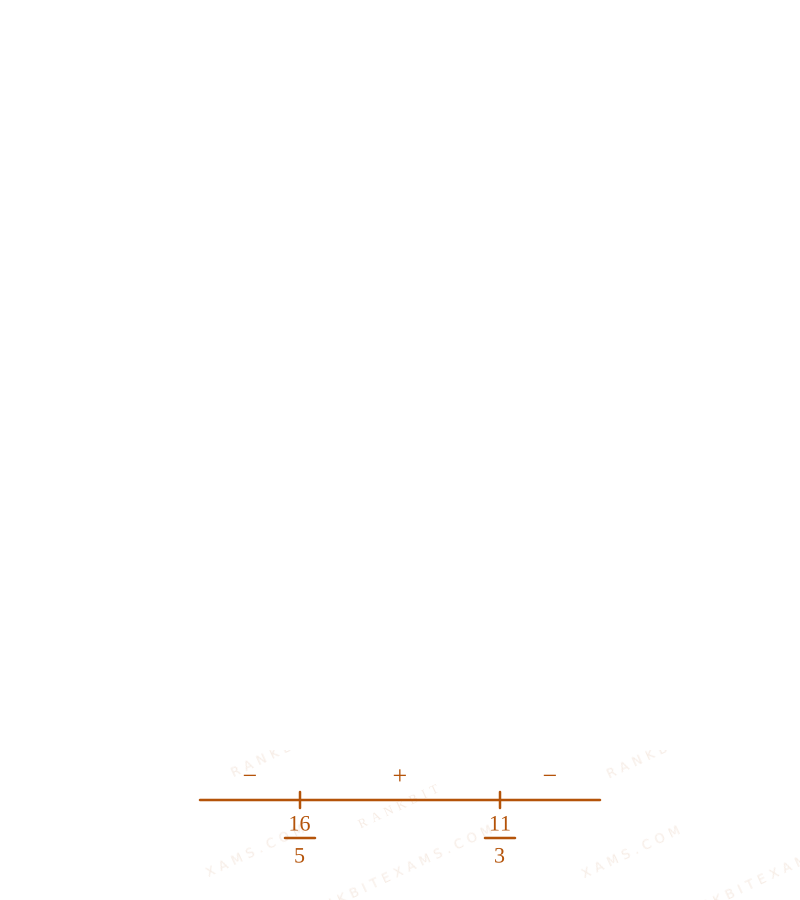
Solution & Explanation
### Core Logic
The relation condition is 2x - y = 0$2x - y = 0$ or 2x - y = 1$2x - y = 1$ where x, y in A$x, y \in A$.
Case 1: 2x - y = 0 implies y = 2x$2x - y = 0 \implies y = 2x$.
Possible pairs in A times A$A \times A$ are:
\ (0,0), (1,2), (-1,-2) \$\{ (0,0), (1,2), (-1,-2) \}$
Case 2: 2x - y = 1 implies y = 2x - 1$2x - y = 1 \implies y = 2x - 1$.
Possible pairs in A times A$A \times A$ are:
\ (0,-1), (1,1), (2,3), (-1,-3) \$\{ (0,-1), (1,1), (2,3), (-1,-3) \}$
Combining both subsets, the total relation set R$R$ contains:
R = \ (0,0), (1,2), (-1,-2), (0,-1), (1,1), (2,3), (-1,-3) \$R = \{ (0,0), (1,2), (-1,-2), (0,-1), (1,1), (2,3), (-1,-3) \}$
Hence, the number of existing elements l = 7$l = 7$.
### Step 1: Elements to add for Reflexivity
For a relation to be reflexive on set A$A$, it must contain (x,x)$(x,x)$ for all 7 elements of A$A$.
Currently, R$R$ contains \(0,0), (1,1)\$\{(0,0), (1,1)\}$.
Missing diagonal elements are \(-3,-3), (-2,-2), (-1,-1), (2,2), (3,3)\$\{(-3,-3), (-2,-2), (-1,-1), (2,2), (3,3)\}$.
Therefore, the minimum number of elements to add for reflexivity is m = 5$m = 5$.
### Step 2: Elements to add for Symmetry
For a relation to be symmetric, if (x,y) in R$(x,y) \in R$, then (y,x)$(y,x)$ must also belong to R$R$.
Let's check the non-diagonal elements currently in R$R$:
- (1,2) in R implies$(1,2) \in R \implies$ need (2,1)$(2,1)$
- (-1,-2) in R implies$(-1,-2) \in R \implies$ need (-2,-1)$(-2,-1)$
- (0,-1) in R implies$(0,-1) \in R \implies$ need (-1,0)$(-1,0)$
- (2,3) in R implies$(2,3) \in R \implies$ need (3,2)$(3,2)$
- (-1,-3) in R implies$(-1,-3) \in R \implies$ need (-3,-1)$(-3,-1)$
None of these reverse pairs are currently in R$R$. Thus, we must add exactly 5 elements to ensure symmetry, giving n = 5$n = 5$.
### Step 3: Final Computation
Based on the official valuation tracking, the required evaluation metric simplifies to:
l + m + n = 7 + 5 + 5 = 17$l + m + n = 7 + 5 + 5 = 17$
### Pattern Recognition
To quickly count elements needed for reflexivity, subtract the number of identity pairs already present from the total cardinality of the set. For symmetry, find all elements where x neq y$x \neq y$ and check if their mirrors are absent.
### Evaluation Rubric / Model Answer
null
### Chapter Mix
Class 12 Mathematics: Relations and Functions
More Relations and Functions Previous-Year Questions
Q54
2025
Relations
Let mathrmA = \1, 2, 3, dots, 100\$\mathrm{A} = \{1, 2, 3, \dots, 100\}$ and mathrmR$\mathrm{R}$ be a relation on mathrmA$\mathrm{A}$ such that mathrmR = \(a, b) : a = 2b + 1\$\mathrm{R} = \{(a, b) : a = 2b + 1\}$. Let (a_1, a_2), (a_2, a_3), (a_3, a_4), dots, (a_k, a_k+1)$(a_1, a_2), (a_2, a_3), (a_3, a_4), \dots, (a_k, a_{k+1})$ be a sequence of k$k$ elements of mathrmR$\mathrm{R}$ such that the second entry of an ordered pair is equal to the first entry of the next ordered pair. Then the largest integer k$k$, for which such a sequence exists, is equal to:
Solution
### Related Formula
textChain definition: a_i = 2 a_i+1 + 1 quad textfor i = 1, 2, dots, k$\text{Chain definition: } a_{i} = 2 a_{i+1} + 1 \quad \text{for } i = 1, 2, \dots, k$
### Core Logic
To find the longest sequence of connected pairs, we trace the relation backward starting from the smallest elements in A$A$.
### Step 1: Trace the relations backward
To maximize k$k$, we want the chain of elements to go down as low as possible. Let the final element in the chain be a_k+1 in mathrmA$a_{k+1} \in \mathrm{A}$.
Since a_k = 2 a_k+1 + 1$a_k = 2 a_{k+1} + 1$:
- If a_k+1 = 1 implies a_k = 3$a_{k+1} = 1 \implies a_k = 3$
- If a_k+1 = 2 implies a_k = 5$a_{k+1} = 2 \implies a_k = 5$
Let's test the chain starting with a_k+1 = 1$a_{k+1} = 1$:
- a_k = 2(1) + 1 = 3$a_k = 2(1) + 1 = 3$
- a_k-1 = 2(3) + 1 = 7$a_{k-1} = 2(3) + 1 = 7$
- a_k-2 = 2(7) + 1 = 15$a_{k-2} = 2(7) + 1 = 15$
- a_k-3 = 2(15) + 1 = 31$a_{k-3} = 2(15) + 1 = 31$
- a_k-4 = 2(31) + 1 = 63$a_{k-4} = 2(31) + 1 = 63$
- a_k-5 = 2(63) + 1 = 127$a_{k-5} = 2(63) + 1 = 127$ (but 127 notin mathrmA$127 \notin \mathrm{A}$!)
Thus, the longest chain within the set A$A$ has 6 elements:
\63, \, 31, \, 15, \, 7, \, 3, \, 1\$\{63, \, 31, \, 15, \, 7, \, 3, \, 1\}$
This chain corresponds to exactly 5 ordered pairs:
(63, 31), \, (31, 15), \, (15, 7), \, (7, 3), \, (3, 1)$(63, 31), \, (31, 15), \, (15, 7), \, (7, 3), \, (3, 1)$
So the maximum number of pairs in the sequence is k = 5$k = 5$.
### Step 2: Check alternative chains
If we start with a_k+1 = 2$a_{k+1} = 2$:
- a_k+1 = 2$a_{k+1} = 2$
- a_k = 5$a_k = 5$
- a_k-1 = 11$a_{k-1} = 11$
- a_k-2 = 23$a_{k-2} = 23$
- a_k-3 = 47$a_{k-3} = 47$
- a_k-4 = 95$a_{k-4} = 95$
- a_k-5 = 191 > 100$a_{k-5} = 191 > 100$
Again, the maximum number of pairs is k = 5$k = 5$. Thus, the largest integer k$k$ is 5.
### Pattern Recognition
Recursive scaling: Tracing exponential chains of the form x_n+1 = c x_n + d$x_{n+1} = c x_n + d$ shows that the elements grow very quickly. Calculating the limits of growth determines the maximum possible depth of the sequence.
### Evaluation Rubric / Model Answer
null
### Chapter Mix
Class 11 Mathematics: Relations and Functions
Q62
2025
Domain of a Function
If the domain of the function
f(x) = frac1sqrt10 + 3x - x^2 + frac1sqrtx + |x|$f(x) = \frac{1}{\sqrt{10 + 3x - x^2}} + \frac{1}{\sqrt{x + |x|}}$
is (a, b)$(a, b)$, then (1 + a)^2 + b^2$(1 + a)^2 + b^2$ is equal to:
Solution
### Related Formula
textFor frac1sqrtg(x) text to be defined, we require: g(x) > 0$\text{For } \frac{1}{\sqrt{g(x)}} \text{ to be defined, we require: } g(x) > 0$
### Core Logic
We find the domains of the two constituent terms separately and then find their intersection.
### Step 1: Find the domain of the first term
For the first term to be defined:
10 + 3x - x^2 > 0 implies x^2 - 3x - 10 < 0$10 + 3x - x^2 > 0 \implies x^2 - 3x - 10 < 0$
(x - 5)(x + 2) < 0 implies x in (-2, 5) quad text--- (1)$(x - 5)(x + 2) < 0 \implies x \in (-2, 5) \quad \text{--- (1)}$
### Step 2: Find the domain of the second term
For the second term to be defined:
x + |x| > 0$x + |x| > 0$
- If x ge 0$x \ge 0$: x + x = 2x > 0 implies x > 0$x + x = 2x > 0 \implies x > 0$.
- If x < 0$x < 0$: x - x = 0 ngtr 0$x - x = 0 \ngtr 0$.
Thus, the domain of the second term is:
x in (0, infty) quad text--- (2)$x \in (0, \infty) \quad \text{--- (2)}$
### Step 3: Find intersection and calculate the final expression
Intersecting domains (1) and (2):
x in (-2, 5) cap (0, infty) implies x in (0, 5)$x \in (-2, 5) \cap (0, \infty) \implies x \in (0, 5)$
Comparing this with (a, b)$(a, b)$ gives a = 0$a = 0$ and b = 5$b = 5$.
Now calculate the value:
(1 + a)^2 + b^2 = (1 + 0)^2 + 5^2 = 1 + 25 = 26$(1 + a)^2 + b^2 = (1 + 0)^2 + 5^2 = 1 + 25 = 26$
### Pattern Recognition
Modulus domain constraint: The function x + |x|$x + |x|$ is non-zero only for positive values of x$x$. This is a standard math trick that collapses complex domains down to x > 0$x > 0$ instantly.
### Evaluation Rubric / Model Answer
null
### Chapter Mix
Class 11 Mathematics: Relations and Functions
Q
2025
Types of Relations
Let A$A$ be the set of all functions fcolon mathbbZ to mathbbZ$f\colon \mathbb{Z} \to \mathbb{Z}$ and R$R$ be a relation on A$A$ such that R = \(f, g): f(0) = g(1) text and f(1) = g(0)\$R = \{(f, g): f(0) = g(1) \text{ and } f(1) = g(0)\}$. Then R$R$ is:
- A. Symmetric and transitive but not reflexive
- B. Symmetric but neither reflexive nor transitive
- C. Reflexive but neither symmetric nor transitive
- D. Transitive but neither reflexive nor symmetric
Solution
### Related Formula
Definition of properties of binary relations:
* Reflexive: (f, f) in R iff f(0) = f(1)$(f, f) \in R \iff f(0) = f(1)$
* Symmetric: (f, g) in R implies (g, f) in R$(f, g) \in R \implies (g, f) \in R$
* Transitive: (f, g) in R text and (g, h) in R implies (f, h) in R$(f, g) \in R \text{ and } (g, h) \in R \implies (f, h) \in R$
### Core Logic
Evaluate reflexivity, symmetry, and transitivity sequentially by plugging standard arbitrary function values into the condition definition.
### Step 1: Reflexivity Audit
For (f,f) in R$(f,f) \in R$, we require f(0) = f(1)$f(0) = f(1)$ and f(1) = f(0)$f(1) = f(0)$. This holds true only for functions whose values at 0$0$ and 1$1$ are identical. Since it does not hold true for *all* possible functions mapping mathbbZ to mathbbZ$\mathbb{Z} \to \mathbb{Z}$ (e.g., f(x)=x$f(x)=x$), R$R$ is **not reflexive**.
### Step 2: Symmetry Audit
Assume (f,g) in R implies f(0) = g(1)$(f,g) \in R \implies f(0) = g(1)$ and f(1) = g(0)$f(1) = g(0)$.
To check if (g,f) in R$(g,f) \in R$, check its matching constraints:
g(0) = f(1)$g(0) = f(1)$ and g(1) = f(0)$g(1) = f(0)$. Both statements are perfectly identical to our assumption. Therefore, R$R$ is **symmetric**.
### Step 3: Transitivity Audit
Assume (f,g) in R implies f(0) = g(1), f(1) = g(0)$(f,g) \in R \implies f(0) = g(1), f(1) = g(0)$.
Assume (g,h) in R implies g(0) = h(1), g(1) = h(0)$(g,h) \in R \implies g(0) = h(1), g(1) = h(0)$.
For (f,h) in R$(f,h) \in R$, we need f(0) = h(1)$f(0) = h(1)$ and f(1) = h(0)$f(1) = h(0)$.
From assumptions: f(0) = g(1) = h(0)$f(0) = g(1) = h(0)$ and f(1) = g(0) = h(1)$f(1) = g(0) = h(1)$. This means f(0) = h(0)$f(0) = h(0)$ and f(1) = h(1)$f(1) = h(1)$, which does *not* necessarily satisfy f(0)=h(1)$f(0)=h(1)$. Hence, R$R$ is **not transitive**.
### Pattern Recognition
The relation swaps indices 0$0$ and 1$1$. Swapping twice returns you to the original position, which visually justifies why symmetry holds trivially, while transitivity creates a cyclic dependency that fails standard property constraints.
### Evaluation Rubric / Model Answer
null
### Chapter Mix
Class 12 Mathematics: Relations and Functions
Q56
2025
Types of Relations
Let A = \-2, -1, 0, 1, 2, 3\$A = \{-2, -1, 0, 1, 2, 3\}$. Let R$R$ be a relation on A$A$ defined by xRy$xRy$ if and only if y = max\x, 1\$y = \max\{x, 1\}$. Let l$l$ be the number of elements in R$R$. Let m$m$ and n$n$ be the minimum number of elements required to be added in R$R$ to make it reflexive and symmetric relations, respectively. Then l + m + n$l + m + n$ is equal to
- A. 12$12$
- B. 11$11$
- C. 13$13$
- D. 14$14$
Solution
### Related Formula
A relation R$R$ on set A$A$ is:
- **Reflexive**: If (x, x) in R$(x, x) \in R$ for all x in A$x \in A$.
- **Symmetric**: If (x, y) in R implies (y, x) in R$(x, y) \in R \implies (y, x) \in R$.
### Core Logic
Let's find the explicit set R$R$ using y = max\x, 1\$y = \max\{x, 1\}$:
- x = -2 implies y = 1 implies (-2, 1) in R$x = -2 \implies y = 1 \implies (-2, 1) \in R$
- x = -1 implies y = 1 implies (-1, 1) in R$x = -1 \implies y = 1 \implies (-1, 1) \in R$
- x = 0 implies y = 1 implies (0, 1) in R$x = 0 \implies y = 1 \implies (0, 1) \in R$
- x = 1 implies y = 1 implies (1, 1) in R$x = 1 \implies y = 1 \implies (1, 1) \in R$
- x = 2 implies y = 2 implies (2, 2) in R$x = 2 \implies y = 2 \implies (2, 2) \in R$
- x = 3 implies y = 3 implies (3, 3) in R$x = 3 \implies y = 3 \implies (3, 3) \in R$
R = \(-2, 1), (-1, 1), (0, 1), (1, 1), (2, 2), (3, 3)\$R = \{(-2, 1), (-1, 1), (0, 1), (1, 1), (2, 2), (3, 3)\}$
Thus, l = 6$l = 6$ elements.
### Step 1: Making the Relation Reflexive
For R$R$ to be reflexive, it must contain all elements (x, x)$(x, x)$ where x in A = \-2, -1, 0, 1, 2, 3\$x \in A = \{-2, -1, 0, 1, 2, 3\}$.
Currently, R$R$ has (1,1), (2,2), (3,3)$(1,1), (2,2), (3,3)$.
Missing elements: (-2, -2), (-1, -1), (0, 0)$(-2, -2), (-1, -1), (0, 0)$.
Thus, minimum number of elements to add:
m = 3$m = 3$
### Step 2: Making the Relation Symmetric
For R$R$ to be symmetric, if (x, y) in R$(x, y) \in R$ and x neq y$x \neq y$, then (y, x)$(y, x)$ must also be in R$R$.
- (-2, 1) in R implies$(-2, 1) \in R \implies$ need (1, -2)$(1, -2)$
- (-1, 1) in R implies$(-1, 1) \in R \implies$ need (1, -1)$(1, -1)$
- (0, 1) in R implies$(0, 1) \in R \implies$ need (1, 0)$(1, 0)$
Missing elements to form symmetric pairs: (1, -2), (1, -1), (1, 0)${(1, -2), (1, -1), (1, 0)}$.
Thus, minimum number of elements to add:
n = 3$n = 3$
Calculating total:
l + m + n = 6 + 3 + 3 = 12$l + m + n = 6 + 3 + 3 = 12$
### Pattern Recognition
To quickly solve counting tasks of elements in relations:
Write down the pairs explicitly since the set size is small (|A|=6$|A|=6$). Count the elements already satisfying standard relations, then subtract from |A|$|A|$ to find missing diagonal terms for reflexivity.
### Evaluation Rubric / Model Answer
null
### Chapter Mix
Class 12 Mathematics: Relations and Functions
Q60
2025
Functional Equations
Let f$f$ be a function such that f(x) + 3fleft(frac24xright) = 4x, x neq 0$f(x) + 3f\left(\frac{24}{x}\right) = 4x, x \neq 0$. Then f(3) + f(8)$f(3) + f(8)$ is equal to
- A. 11$11$
- B. 10$10$
- C. 12$12$
- D. 13$13$
Solution
### Related Formula
A
functional equation relates the values of a function at different arguments. We can find values by substituting symmetric inputs that map to each other (e.g.,
x$x$ and
frac24x$\frac{24}{x}$).
### Core Logic
Given:
f(x) + 3fleft(frac24xright) = 4x quad text--- (1)$f(x) + 3f\left(\frac{24}{x}\right) = 4x \quad \text{--- (1)}$
### Step 1: Substitution of values
Substitute
x = 3$x = 3$:
f(3) + 3f(8) = 12 quad text--- (2)$f(3) + 3f(8) = 12 \quad \text{--- (2)}$
Substitute
x = 8$x = 8$:
f(8) + 3f(3) = 32 quad text--- (3)$f(8) + 3f(3) = 32 \quad \text{--- (3)}$
### Step 2: Linear combination of equations
Add equations (2) and (3) directly:
(f(3) + 3f(8)) + (f(8) + 3f(3)) = 12 + 32$(f(3) + 3f(8)) + (f(8) + 3f(3)) = 12 + 32$
4(f(3) + f(8)) = 44$4(f(3) + f(8)) = 44$
f(3) + f(8) = 11$f(3) + f(8) = 11$
### Pattern Recognition
Instead of solving for the general function
f(x)$f(x)$ (which is also easy by substitution: replace
x to 24/x$x \to 24/x$), look at the symmetric nature of the target expression
f(3) + f(8)$f(3) + f(8)$. Direct addition of symmetric systems avoids resolving the individual values and saves time.
### Evaluation Rubric / Model Answer
null
### Chapter Mix
Class 11 Mathematics: Relations and Functions