If the domain of the function f(x) = frac1sqrt10 + 3x - x^2 + frac1sqrtx + |x| is (a, b), then (1 + a)^2 + b^2 is equal to:

Solution & Explanation

### Related Formula textFor frac1sqrtg(x) text to be defined, we require: g(x) > 0 ### Core Logic We find the domains of the two constituent terms separately and then find their intersection. ### Step 1: Find the domain of the first term For the first term to be defined: 10 + 3x - x^2 > 0 implies x^2 - 3x - 10 < 0 (x - 5)(x + 2) < 0 implies x in (-2, 5) quad text--- (1) ### Step 2: Find the domain of the second term For the second term to be defined: x + |x| > 0 - If x ge 0: x + x = 2x > 0 implies x > 0. - If x < 0: x - x = 0 ngtr 0. Thus, the domain of the second term is: x in (0, infty) quad text--- (2) ### Step 3: Find intersection and calculate the final expression Intersecting domains (1) and (2): x in (-2, 5) cap (0, infty) implies x in (0, 5) Comparing this with (a, b) gives a = 0 and b = 5. Now calculate the value: (1 + a)^2 + b^2 = (1 + 0)^2 + 5^2 = 1 + 25 = 26 ### Pattern Recognition Modulus domain constraint: The function x + |x| is non-zero only for positive values of x. This is a standard math trick that collapses complex domains down to x > 0 instantly. ### Evaluation Rubric / Model Answer null ### Chapter Mix Class 11 Mathematics: Relations and Functions

Reference Study Guides

More Relations and Functions Previous-Year Questions — Page 5

Q60 jee_main_2025_04_april_morning Functional Equations and Series
Let f: mathbbR to mathbbR be a continuous function satisfying f(0) = 1 and f(2x) - f(x) = x for all x in mathbbR. If lim_n to infty left\ f(x) - fleft(fracx2^nright) right\ = G(x), then sum_r=1^10 G(r^2) is equal to
  • A. 540
  • B. 385
  • C. 420
  • D. 215

Solution

### Related Formula Sum of first n squares: sum_r=1^n r^2 = fracn(n+1)(2n+1)6 ### Core Logic From functional relation f(x) - fleft(fracx2right) = fracx2. Write a telescoping sequence by scaling variable down: fleft(fracx2right) - fleft(fracx4right) = fracx4 fleft(fracx4right) - fleft(fracx8right) = fracx8 dots fleft(fracx2^n-1right) - fleft(fracx2^nright) = fracx2^n ### Step 1: Evaluate the Limit Definition Summing all equations creates a telescoping sum on the left side: f(x) - fleft(fracx2^nright) = xleft(frac12 + frac14 + dots + frac12^nright) = xleft(1 - frac12^nright) Taking the limit as n to infty: G(x) = lim_n to infty xleft(1 - frac12^nright) = x ### Step 2: Final Sum Evaluation We need to compute sum_r=1^10 G(r^2) = sum_r=1^10 r^2: sum_r=1^10 r^2 = frac10 times 11 times 216 = 385 ### Pattern Recognition Linear iterative arguments of type f(2x)-f(x)=x naturally condense into geometric progression properties via geometric series limits. Always look for telescoping patterns in infinite limits of difference terms. ### Evaluation Rubric / Model Answer null ### Chapter Mix Class 11 Mathematics: Sequence and Series Class 12 Mathematics: Relations and Functions
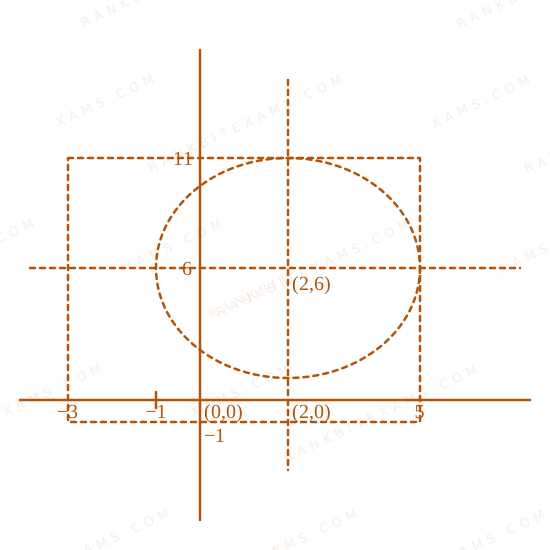
Q53 jee_main_2025_07_april_evening Set Inclusion and Regions
Let A = \(alpha ,beta)in mathbfRtimes mathbfR:|alpha -1|leq 4 text and |beta -5|leq 6\ and B = \(alpha , beta) in mathbfR times mathbfR: 16 (alpha - 2)^2 + 9 (beta - 6)^2 leq 144\. Then
  • A. B subset A
  • B. A cup B = \(x, y) : -4 leq x leq 4, -1 leq y leq 11\
  • C. neither A subset B nor B subset A
  • D. A subset B

Solution

### Related Formula An ellipse equation is structured as: frac(x-h)^2a^2 + frac(y-k)^2b^2 leq 1 ### Core Logic Analyzing set A: |alpha - 1| le 4 implies -4 le alpha - 1 le 4 implies -3 le alpha le 5 |beta - 5| le 6 implies -6 le beta - 5 le 6 implies -1 le beta le 11 Thus, region A forms a rectangle bounded between x in [-3, 5] and y in [-1, 11]. Analyzing set B: 16(alpha - 2)^2 + 9(beta - 6)^2 le 144 Dividing by 144: frac(alpha - 2)^29 + frac(beta - 6)^216 le 1 This represents the interior and boundary of an ellipse centered at (2, 6) with semi-minor axis a = 3 and semi-major axis b = 4. ### Step 1: Spatial Inclusion Check Let's check the extreme horizontal and vertical extents of the ellipse B: Horizontal extent: x in [2 - 3, 2 + 3] = [-1, 5] Vertical extent: y in [6 - 4, 6 + 4] = [2, 10] Comparing with the boundaries of rectangle A (x in [-3, 5] and y in [-1, 11]): [-1, 5] subseteq [-3, 5] [2, 10] subseteq [-1, 11]
Set Inclusion and Regions diagram for Q53 - JEE Main 2025 Evening
Since all points of the ellipse lie perfectly inside the rectangular region, we conclusively find that B subset A. ### Pattern Recognition A bounding box check (finding h pm a and k pm b) for conics is the fastest analytical shortcut to verify set inclusion without plotting extensive coordinates. ### Evaluation Rubric / Model Answer null ### Chapter Mix Class 11 Mathematics: Sets, Relations and Functions Class 11 Mathematics: Conic Sections
Q54 jee_main_2025_07_april_evening Range of Rational Functions
If the range of the function f(x) = frac5 - xx^2 - 3x + 2, x neq 1, 2, is (-infty , alpha ] cup [ beta , infty), then alpha^2 +beta^2 is equal to :
  • A. 190
  • B. 192
  • C. 188
  • D. 194

Solution

### Related Formula For a quadratic equation Ax^2 + Bx + C = 0 to yield real roots, its discriminant must satisfy: D = B^2 - 4AC ge 0 ### Core Logic Set y = frac5 - xx^2 - 3x + 2: y(x^2 - 3x + 2) = 5 - x yx^2 - 3xy + 2y + x - 5 = 0 Rearranging into a standard quadratic equation in terms of x: yx^2 + (1 - 3y)x + (2y - 5) = 0 ### Step 1: Discriminant Method Case I: If y = 0, the equation simplifies to x - 5 = 0 implies x = 5, which is a valid part of the domain. Thus, 0 belongs to the range. Case II: If y neq 0, for x to be real, D ge 0: (1 - 3y)^2 - 4(y)(2y - 5) ge 0 9y^2 + 1 - 6y - 8y^2 + 20y ge 0 y^2 + 14y + 1 ge 0 ### Step 2: Solving the Inequality Completing the square for y^2 + 14y + 1 ge 0: (y + 7)^2 - 48 ge 0 implies (y + 7)^2 ge (4sqrt3)^2 This gives: y le -7 - 4sqrt3 quad textor quad y ge -7 + 4sqrt3 Comparing with the interval (-infty , alpha ] cup [ beta , infty): alpha = -7 - 4sqrt3 beta = -7 + 4sqrt3 ### Step 3: Finding alpha^2 + beta^2 Using algebraic identities: alpha^2 + beta^2 = (-7 - 4sqrt3)^2 + (-7 + 4sqrt3)^2 = 2(7^2 + (4sqrt3)^2) = 2(49 + 48) = 2(97) = 194 ### Pattern Recognition For rational expressions of the form fractextLineartextQuadratic, converting to a quadratic in x and forcing D ge 0 establishes the range boundaries elegantly. ### Evaluation Rubric / Model Answer null ### Chapter Mix Class 11 Mathematics: Sets, Relations and Functions
Q52 jee_main_2025_24_jan_evening One-One and Onto Functions
The function f:(-infty,infty)rightarrow(-infty,1), defined by f(x)=frac2^x-2^-x2^x+2^-x is: [cite: 3251, 3252]
  • A. textOne-one but not onto
  • B. textOnto but not one-one
  • C. textBoth one-one and onto
  • D. textNeither one-one nor onto

Solution

### Related Formula A function is one-one if its derivative is strictly monotonic (always positive or always negative) across its domain. It is onto if its range equals its co-domain. ### Core Logic Rewrite the function by multiplying the numerator and denominator by 2^x: f(x) = frac2^2x - 12^2x + 1 = 1 - frac22^2x + 1 ### Step 1: Check One-One property Differentiating f(x) with respect to x : f'(x) = frac2(2^2x + 1)^2 cdot 2 cdot 2^2x cdot ln 2 = frac4 cdot 2^2x cdot ln 2(2^2x + 1)^2 Since 2^2x > 0 and ln 2 > 0, f'(x) > 0 always. Thus, f(x) is strictly increasing, confirming it is a one-one function. ### Step 2: Check Onto property Analyze the limits at boundaries [cite: 3880, 3881]: lim_x to -infty f(x) = 1 - frac20 + 1 = -1 lim_x to infty f(x) = 1 - 0 = 1 Thus, the range of the function is (-1, 1). Since the given co-domain is (-infty, 1) and textRange neq textCo-domain , the function is not onto. ### Pattern Recognition The expression given is a shifted form of the hyperbolic tangent function tanh(x ln 2). Hyperbolic tangent always maps to (-1, 1), making its restriction against (-infty, 1) non-surjective (not onto). ### Evaluation Rubric / Model Answer null ### Chapter Mix Class 12 Mathematics: Relations and Functions
Q58 jee_main_2025_24_jan_evening Linear Programming and Inequalities in Two Variables
Let the points (frac112,alpha) lie on or inside the \triangle with sides x+y=11, x+2y=16 and 2x+3y=29 Then the product of the smallest and the largest values of a is equal to: [cite: 3284, 3285, 3286, 3287, 3288, 3289]
  • A. 22
  • B. 44
  • C. 33
  • D. 55

Solution

### Related Formula For a vertical line x = x_0 crossing a bounded region, the valid coordinates of y sit between the boundary lines intersecting that specific line vertical plane. ### Core Logic The point given is fixed at x = frac112 = 5.5[cite: 3285, 3925]. We evaluate the values of y along this vertical line segment across each boundary edge.
Linear Programming region graph for Q58 - JEE Main 2025 Evening
### Step 1: Evaluate Intersections Substitute x = frac112 into the three linear constraints: 1. From x + y = 11: frac112 + y = 11 Rightarrow y = 11 - 5.5 = 5.5 2. From x + 2y = 16: frac112 + 2y = 16 Rightarrow 2y = 16 - 5.5 = 10.5 Rightarrow y = 5.25 3. From 2x + 3y = 29: 2left(frac112right) + 3y = 29 Rightarrow 11 + 3y = 29 Rightarrow 3y = 18 Rightarrow y = 6 ### Step 2: Define Extrema and Multiply Checking the internal region of the \triangle bounded by these lines [cite: 3286, 3287], the valid range for alpha along the section line is delimited by y = 5.5 and y = 6: alpha_min = frac112 = 5.5 alpha_max = 6 The product of the limits is : alpha_min cdot alpha_max = frac112 times 6 = 33 ### Pattern Recognition Instead of drawing full coordinate diagrams or computing all three vertex points, evaluating values directly at the fixed coordinate constraint x = 5.5 saves time during multi-line area problems. ### Evaluation Rubric / Model Answer null ### Chapter Mix Class 11 Mathematics: Linear Inequalities Class 11 Mathematics: Straight Lines

More Relations and Functions Questions — jee_main_2025_02_april_evening

Practice all Relations and Functions previous-year questions →

Rankbit System
JEE Physics: Waves (+15.5%) | Electrostatics: Concentric Shells (-29.7%) | Modern Physics: Photoelectric Clones (+34.2%) | Mathematics: Definite Integrals (+18.1%) | Chemistry: Coordination Splitting (-11.4%) | JEE Physics: Waves (+15.5%) | Electrostatics: Concentric Shells (-29.7%) | Modern Physics: Photoelectric Clones (+34.2%) | Mathematics: Definite Integrals (+18.1%) | Chemistry: Coordination Splitting (-11.4%)
