If the domain of the function
f(x) = frac1sqrt10 + 3x - x^2 + frac1sqrtx + |x|$$f(x) = \frac{1}{\sqrt{10 + 3x - x^2}} + \frac{1}{\sqrt{x + |x|}}$$
is (a, b)$(a, b)$, then (1 + a)^2 + b^2$(1 + a)^2 + b^2$ is equal to:
A.26
B.29
C.25
D.30
Solution & Explanation
### Related Formula
textFor frac1sqrtg(x) text to be defined, we require: g(x) > 0$$\text{For } \frac{1}{\sqrt{g(x)}} \text{ to be defined, we require: } g(x) > 0$$
### Core Logic
We find the domains of the two constituent terms separately and then find their intersection.
### Step 1: Find the domain of the first term
For the first term to be defined:
10 + 3x - x^2 > 0 implies x^2 - 3x - 10 < 0$$10 + 3x - x^2 > 0 \implies x^2 - 3x - 10 < 0$$(x - 5)(x + 2) < 0 implies x in (-2, 5) quad text--- (1)$$(x - 5)(x + 2) < 0 \implies x \in (-2, 5) \quad \text{--- (1)}$$
### Step 2: Find the domain of the second term
For the second term to be defined:
x + |x| > 0$x + |x| > 0$
- If x ge 0$x \ge 0$: x + x = 2x > 0 implies x > 0$x + x = 2x > 0 \implies x > 0$.
- If x < 0$x < 0$: x - x = 0 ngtr 0$x - x = 0 \ngtr 0$.
Thus, the domain of the second term is:
x in (0, infty) quad text--- (2)$$x \in (0, \infty) \quad \text{--- (2)}$$
### Step 3: Find intersection and calculate the final expression
Intersecting domains (1) and (2):
x in (-2, 5) cap (0, infty) implies x in (0, 5)$$x \in (-2, 5) \cap (0, \infty) \implies x \in (0, 5)$$
Comparing this with (a, b)$(a, b)$ gives a = 0$a = 0$ and b = 5$b = 5$.
Now calculate the value:
(1 + a)^2 + b^2 = (1 + 0)^2 + 5^2 = 1 + 25 = 26$$(1 + a)^2 + b^2 = (1 + 0)^2 + 5^2 = 1 + 25 = 26$$
### Pattern Recognition
Modulus domain constraint: The function x + |x|$x + |x|$ is non-zero only for positive values of x$x$. This is a standard math trick that collapses complex domains down to x > 0$x > 0$ instantly.
### Evaluation Rubric / Model Answer
null
### Chapter Mix
Class 11 Mathematics: Relations and Functions
Keywords:#domain of function intersection modulus#JEE Main 2025 Evening Q62#quadratic inequality solutions interval#square root denominator functions
More Relations and Functions Previous-Year Questions — Page 3
Q54jee_main_2025_29_jan_eveningDomain of a Function
If the domain of the functionlog_5left(18x - x^2 -77
ight)$\log_5\left(18x - x^2 -77
ight)$ is (alpha ,beta)$(\alpha ,\beta)$ and the domain of the functionlog_(x - 1)left(frac2x^2 + 3x - 2x^2 - 3x - 4right)$\log_{(x - 1)}\left(\frac{2x^2 + 3x - 2}{x^2 - 3x - 4}\right)$ is (gamma ,delta)$(\gamma ,\delta)$, then \alpha^2 +\beta^2 +\gamma^2 is equal to:
A.174$174$
B.179$179$
C.186$186$
D.195$195$
Solution
### Related Formula
For a logarithmic term log_b(a)$\log_b(a)$ to be valid:
a > 0, quad b > 0, quad b neq 1$$a > 0, \quad b > 0, \quad b \neq 1$$
### Core Logic
Analyzing the first function f_1(x) = log_5(18x - x^2 - 77)$f_1(x) = \log_5(18x - x^2 - 77)$:
18x - x^2 - 77 > 0 implies x^2 - 18x + 77 < 0$$18x - x^2 - 77 > 0 \implies x^2 - 18x + 77 < 0$$(x - 7)(x - 11) < 0 implies x in (7, 11)$$(x - 7)(x - 11) < 0 \implies x \in (7, 11)$$
Hence, alpha = 7, beta = 11$\alpha = 7, \beta = 11$.
### Step 1: Check Second Function Base and Argument
Analyzing f_2(x) = log_(x - 1)left(frac2x^2 + 3x - 2x^2 - 3x - 4right)$f_2(x) = \log_{(x - 1)}\left(\frac{2x^2 + 3x - 2}{x^2 - 3x - 4}\right)$:
Base constraints:
x - 1 > 0 implies x > 1$$x - 1 > 0 \implies x > 1$$x - 1 neq 1 implies x neq 2$$x - 1 \neq 1 \implies x \neq 2$$
Argument constraints:
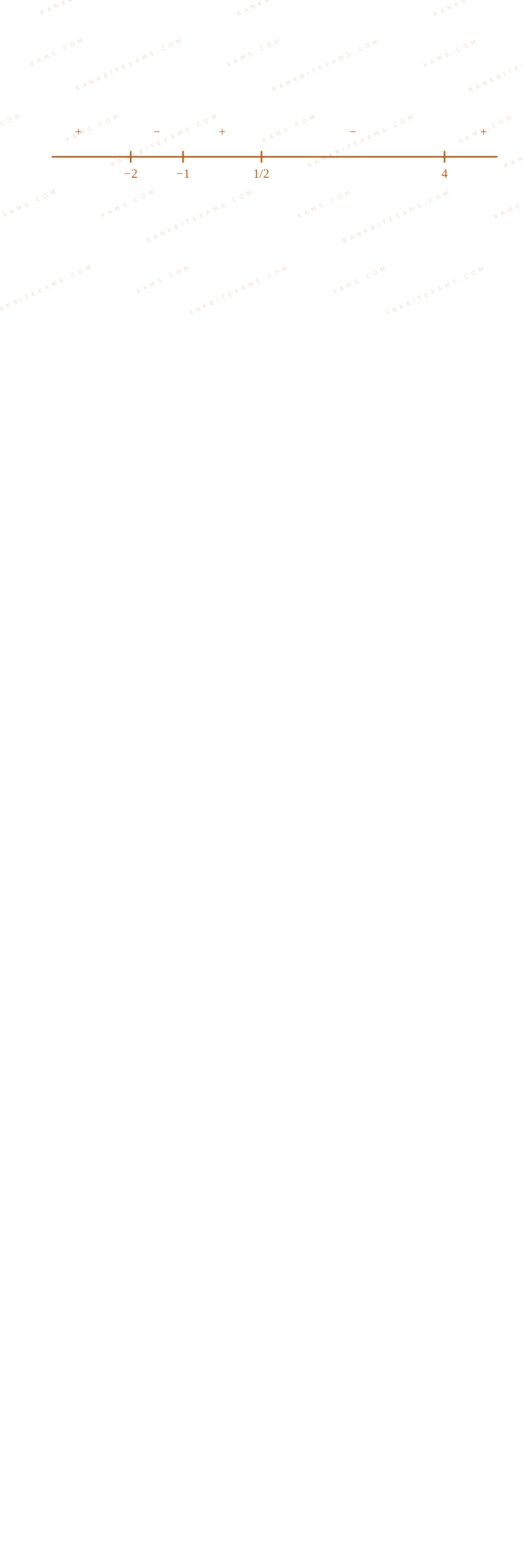
frac2x^2 + 3x - 2x^2 - 3x - 4 > 0 implies frac(2x - 1)(x + 2)(x - 4)(x + 1) > 0$$\frac{2x^2 + 3x - 2}{x^2 - 3x - 4} > 0 \implies \frac{(2x - 1)(x + 2)}{(x - 4)(x + 1)} > 0$$
### Step 2: Apply Sign Scheme
Using the wave-curve method to determine where the rational fraction is positive:
Domain of a Function diagram for Q54 - JEE Main 2025 Evening
Combining this with x > 1$x > 1$ and x neq 2$x \neq 2$, the common interval is:
x in (4, infty)$$x \in (4, \infty)$$
Thus, gamma = 4$\gamma = 4$.
### Step 3: Calculate final sum
alpha^2 + beta^2 + gamma^2 = 7^2 + 11^2 + 4^2 = 49 + 121 + 16 = 186$$\alpha^2 + \beta^2 + \gamma^2 = 7^2 + 11^2 + 4^2 = 49 + 121 + 16 = 186$$
### Pattern Recognition
For domain intersections involving variables in both the log base and argument, always list base rules (>0, neq 1$>0, \neq 1$) first to eliminate invalid sign fields early on.
### Evaluation Rubric / Model Answer
null
### Chapter Mix
Class 11 Mathematics: Relations and Functions
Q54jee_main_2025_28_jan_morningFunctional Equations and Series
If f(x) = frac2^x2^x + sqrt2$f(x) = \frac{2^x}{2^x + \sqrt{2}}$, x in mathbbR$x \in \mathbb{R}$, then sum_k=1^81 fleft(frack82right)$\sum_{k=1}^{81} f\left(\frac{k}{82}\right)$ is equal to:
(1) 41
(2) frac812$\frac{81}{2}$
(3) 82
(4) 81sqrt2$81\sqrt{2}$
A. 41
B.frac812$\frac{81}{2}$
C. 82
D.81sqrt2$81\sqrt{2}$
Solution
### Related Formula
Symmetric identity wrapper for matching indices:
f(x) + f(1-x) = 1$$f(x) + f(1-x) = 1$$
### Core Logic
Let's evaluate f(x) + f(1-x)$f(x) + f(1-x)$:
f(x) + f(1-x) = frac2^x2^x + sqrt2 + frac2^1-x2^1-x + sqrt2$$f(x) + f(1-x) = \frac{2^x}{2^x + \sqrt{2}} + \frac{2^{1-x}}{2^{1-x} + \sqrt{2}}$$= frac2^x2^x + sqrt2 + frac22 + sqrt2cdot 2^x = frac2^x + sqrt22^x + sqrt2 = 1$$= \frac{2^x}{2^x + \sqrt{2}} + \frac{2}{2 + \sqrt{2}\cdot 2^x} = \frac{2^x + \sqrt{2}}{2^x + \sqrt{2}} = 1$$
### Step 1: Expanding the Series
Pairing matching terms from opposite ends of the summation:
sum_k=1^81 fleft(frack82right) = left[fleft(frac182right) + fleft(frac8182
ight)right] + dots + fleft(frac4182
ight)$$\sum_{k=1}^{81} f\left(\frac{k}{82}\right) = \left[f\left(\frac{1}{82}\right) + f\left(\frac{81}{82}
ight)\right] + \dots + f\left(\frac{41}{82}
ight)$$
There are 40 complete pairs matching the f(x) + f(1-x) = 1$f(x) + f(1-x) = 1$ identity, plus one lone center term fleft(frac12right)$f\left(\frac{1}{2}\right)$.
### Step 2: Computing Final Valuation
textSum = 40 + fleft(frac12right) = 40 + fracsqrt2sqrt2 + sqrt2 = 40 + frac12 = frac812$$\text{Sum} = 40 + f\left(\frac{1}{2}\right) = 40 + \frac{\sqrt{2}}{\sqrt{2} + \sqrt{2}} = 40 + \frac{1}{2} = \frac{81}{2}$$
### Pattern Recognition
When encountering fractional summation bounds, always check the sum of components x + (1-x)$x + (1-x)$ to find linear reduction templates.
### Evaluation Rubric / Model Answer
null
### Chapter Mix
Class 11 Maths: Sequences and Series
Class 12 Maths: Relations and Functions
Q55jee_main_2025_28_jan_morningFunctional Relations and Properties
Let f: mathbbR to mathbbR$f: \mathbb{R} \to \mathbb{R}$ be a function defined by f(x) = (2 + 3a)x^2 + left( fraca + 2a - 1 right)x + b, a neq 1$f(x) = (2 + 3a)x^2 + \left( \frac{a + 2}{a - 1} \right)x + b, a \neq 1$. If f(x + y) = f(x) + f(y) + 1 - frac27xy,$f(x + y) = f(x) + f(y) + 1 - \frac{2}{7}xy,$ then the value of 28sum_i = 1^5|f(i)|$28\sum_{i = 1}^{5}|f(i)|$ is:
(1) 715
(2) 735
(3) 545
(4) 675
A. 715
B. 735
C. 545
D. 675
Solution
### Related Formula
Given functional property equation:
f(x + y) = f(x) + f(y) + 1 - frac27xy$$f(x + y) = f(x) + f(y) + 1 - \frac{2}{7}xy$$
### Core Logic
Substitute x = y = 0$x = y = 0$ into the property equation:
f(0) = 2f(0) + 1 implies f(0) = -1$f(0) = 2f(0) + 1 \implies f(0) = -1$.
Since f(0) = b$f(0) = b$, we instantly find b = -1$b = -1$.
### Step 1: Extracting Parameter Values
Substitute y = -x$y = -x$ into the property equation:
f(0) = f(x) + f(-x) + 1 + frac27x^2$$f(0) = f(x) + f(-x) + 1 + \frac{2}{7}x^2$$-1 = 2(3a + 2)x^2 + 2b + 1 + frac27x^2$$-1 = 2(3a + 2)x^2 + 2b + 1 + \frac{2}{7}x^2$$
Matching coefficients for x^2$x^2$ gives:
6a + 4 + frac27 = 0 implies a = -frac57$$6a + 4 + \frac{2}{7} = 0 \implies a = -\frac{5}{7}$$
Therefore, the absolute functional identity is:
f(x) = -frac17x^2 - frac34x - 1$$f(x) = -\frac{1}{7}x^2 - \frac{3}{4}x - 1$$
### Step 2: Computing the Target Series
Rewriting using common denominators:
|f(x)| = frac128|4x^2 + 21x + 28|$$|f(x)| = \frac{1}{28}|4x^2 + 21x + 28|$$
Evaluating for i=1$i=1$ to 5$5$:
28 sum_i = 1^5 |f(i)| = 675$$28 \sum_{i = 1}^{5} |f(i)| = 675$$
### Pattern Recognition
Substituting standard points like 0$0$ and -x$-x$ decouples symmetric multi-variable systems with maximum efficiency.
### Evaluation Rubric / Model Answer
null
### Chapter Mix
Class 12 Maths: Relations and Functions
The relation R = \(x, y) : x, y in mathbbZ text and x + y text is even\$R = \{(x, y) : x, y \in \mathbb{Z} \text{ and } x + y \text{ is even}\}$ is:
A. reflexive and transitive but not symmetric
B. reflexive and symmetric but not transitive
C. an equivalence relation
D. symmetric and transitive but not reflexive
Solution
### Related Formula
An equivalence relation must be simultaneously reflexive, symmetric, and transitive.
### Core Logic
Let's check each property sequentially:
1. **Reflexive:** For any x in mathbbZ$x \in \mathbb{Z}$, x + x = 2x$x + x = 2x$, which is always even. Thus, (x, x) in R$(x, x) \in R$.
2. **Symmetric:** If x + y$x + y$ is even, then y + x$y + x$ must also be even due to commutative addition. Thus, if (x, y) in R implies (y, x) in R$(x, y) \in R \implies (y, x) \in R$.
3. **Transitive:** If x + y$x + y$ is even and y + z$y + z$ is even, then adding them gives (x + y) + (y + z) = x + 2y + z = texteven implies x + z = texteven - 2y = texteven$(x + y) + (y + z) = x + 2y + z = \text{even} \implies x + z = \text{even} - 2y = \text{even}$. Thus, (x, z) in R$(x, z) \in R$.
### Step 1: Final Property Summary
Since all three criteria are satisfies simultaneously, R$R$ is an equivalence relation.
### Pattern Recognition
Parity relation properties (even/odd checking sums) over integer sets universally form clean modular equivalence systems.
### Evaluation Rubric / Model Answer
null
### Chapter Mix
Class 12 Maths: Relations and Functions
Q55jee_main_2025_03_april_morningTypes of Relations
Let A = \-3, -2, -1, 0, 1, 2, 3\$A = \{-3, -2, -1, 0, 1, 2, 3\}$[cite: 555]. Let R$R$ be a relation on A$A$ defined by xRy$xRy$ if and only if 0 le x^2 + 2y le 4$0 \le x^2 + 2y \le 4$[cite: 555]. Let l$l$ be the number of elements in R$R$ and m$m$ be the minimum number of elements required to be added in R$R$ to make it a reflexive relation[cite: 556, 557]. Then l + m$l + m$ is equal to[cite: 558]:
A. 19
B. 20
C. 17
D. 18
Solution
### Related Formula
1. Elements in a relation satisfy the exact range constraint.
2. Reflexive criteria: For every x in A$x \in A$, (x, x) in R$(x, x) \in R$.
### Core Logic
Rewrite the inequality to isolate variables systematically [cite: 1235]:
-2y le x^2 le 4-2y$$-2y \le x^2 \le 4-2y$$ [cite: 1235]
Test every valid value of y in A$y \in A$ to discover valid integer values for x$x$[cite: 1237, 1238, 1241, 1259, 1260, 1261]:
- y = -3 implies 6 le x^2 le 10 implies x in \-3, 3\$y = -3 \implies 6 \le x^2 \le 10 \implies x \in \{-3, 3\}$
- y = -2 implies 4 le x^2 le 8 implies x in \-2, 2\$y = -2 \implies 4 \le x^2 \le 8 \implies x \in \{-2, 2\}$
- y = -1 implies 2 le x^2 le 6 implies x in \-2, 2\$y = -1 \implies 2 \le x^2 \le 6 \implies x \in \{-2, 2\}$
- y = 0 implies 0 le x^2 le 4 implies x in \-2, -1, 0, 1, 2\$y = 0 \implies 0 \le x^2 \le 4 \implies x \in \{-2, -1, 0, 1, 2\}$
- y = 1 implies -2 le x^2 le 2 implies x in \-1, 0, 1\$y = 1 \implies -2 \le x^2 \le 2 \implies x \in \{-1, 0, 1\}$
- y = 2 implies -4 le x^2 le 0 implies x in \0\$y = 2 \implies -4 \le x^2 \le 0 \implies x \in \{0\}$
- y = 3 implies -6 le x^2 le -2 implies textNo real x text exists$y = 3 \implies -6 \le x^2 \le -2 \implies \text{No real } x \text{ exists}$
### Step 1: Listing set elements and counting
Compile all distinct matching coordinate pairs (x,y)$(x,y)$ into set R$R$ [cite: 1264]:
R = \(-3,-3), (-3,3), (-2,-2), (-2,2), (-1,-2), (-1,2), (0,-2), (0,-1), (0,0), (0,1), (0,2), (1,-1), (1,0), (1,1), (2,0)\$$R = \{(-3,-3), (-3,3), (-2,-2), (-2,2), (-1,-2), (-1,2), (0,-2), (0,-1), (0,0), (0,1), (0,2), (1,-1), (1,0), (1,1), (2,0)\}$$ [cite: 1264]
Counting elements gives [cite: 1265]:
l = 15$l = 15$ [cite: 1265]
To make the relation reflexive, the pairs (-3,-3), (-2,-2), (-1,-1), (0,0), (1,1), (2,2), (3,3)$(-3,-3), (-2,-2), (-1,-1), (0,0), (1,1), (2,2), (3,3)$ must all belong to R$R$.
Checking missing elements [cite: 1267]:
\(-1,-1), (2,2), (3,3)\ implies m = 3$$\{(-1,-1), (2,2), (3,3)\} \implies m = 3$$ [cite: 1267]
Sum of variables [cite: 1268]:
l + m = 15 + 3 = 18$$l + m = 15 + 3 = 18$$ [cite: 1268]
### Pattern Recognition
Isolating terms explicitly via a variable-by-variable bounded testing grid avoids missing distinct coordinate boundary values.
### Evaluation Rubric / Model Answer
null
### Chapter Mix
Class 11 Mathematics: Relations and Functions
More Relations and Functions Questions — jee_main_2025_02_april_evening
We Map Every Repeating Question in Competitive Exams.
Say goodbye to generic mock test fatigue. RankBit uses smart analysis to group past exam questions into their foundational Repeating Question Types. Find chapter weightage, track repeating questions, and score higher with targeted practice.
Select Your Target Exam
Choose an exam track below to find formulas per chapter and patterns.
Syncing Exam Intelligence
Mapping formulas and patterns across all tracks…
PATH A — FULL LENGTH PRACTICE
Full Mock Test Hub
Simulate real NTA exam conditions with fully tracked mocks. Time yourself against past papers.
Practice past-year questions one chapter at a time. Pick an exam → subject → chapter and get every PYQ for that topic — pulled together from all past papers — with the chapter's key formulas alongside.