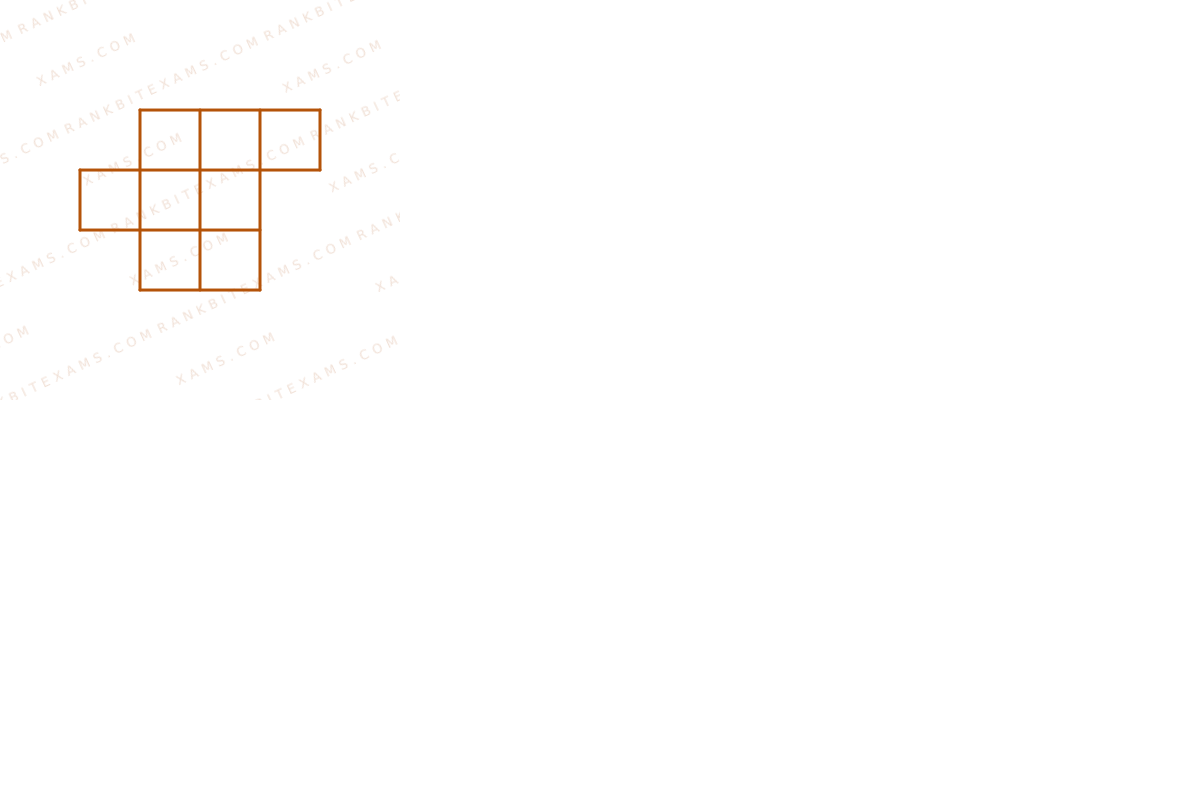
The number of ways, in which the letters A, B, C, D, E can be placed in the 8 boxes of the figure below so that no row remains empty and at most one letter can be placed in a box, is:
Boxes layout diagram for Q66 - JEE Main 2025 Evening
The grid diagram shows 8 boxes arranged in three horizontal rows of sizes 3, 2, and 3.

Solution & Explanation

### Related Formula textNumber of arrangements of r text items in n text boxes = binomnr cdot r! ### Core Logic This is a permutations problem with row constraints. We compute the total arrangements of placing 5 distinct letters into 8 boxes and then subtract the invalid cases where one or more rows are left completely empty. ### Step 1: Compute total unrestricted arrangements The grid has a total of 8 boxes. We have 5 distinct letters (A, B, C, D, E): textTotal unrestricted arrangements = binom85 cdot 5! = 56 cdot 120 = 6720 ### Step 2: Identify and subtract the invalid empty-row cases Let the rows be R_1, R_2, and R_3, with box counts 3, 2, and 3 respectively. Since we must distribute 5 letters, it is impossible for 2 rows to be empty simultaneously (as the remaining single row would have at most 3 boxes, which cannot fit 5 letters). Thus, we only subtract cases where exactly one row is empty: - Case 1: Row R_1 (3 boxes) is empty. The 5 letters must go to the remaining 5 boxes of R_2 and R_3: textWays = binom55 cdot 5! = 120 - Case 2: Row R_3 (3 boxes) is empty. Same as Case 1, the 5 letters must go to the remaining 5 boxes of R_1 and R_2: textWays = binom55 cdot 5! = 120 - Case 3: Row R_2 (2 boxes) is empty. The 5 letters must go to the remaining 6 boxes of R_1 and R_3: textWays = binom65 cdot 5! = 6 cdot 120 = 720 ### Step 3: Calculate the final valid arrangements Subtracting all empty-row cases from the total arrangements: textValid arrangements = 6720 - (120 + 120 + 720) = 6720 - 960 = 5760 ### Pattern Recognition Inclusion-Exclusion Principle: For distribution problems with simple boundary exclusions, subtracting the complement set (invalid configurations) is mathematically much cleaner than calculating all possible partitions of row assignments. ### Evaluation Rubric / Model Answer null ### Chapter Mix Class 11 Mathematics: Permutations and Combinations

Reference Study Guides

More Permutations and Combinations Previous-Year Questions — Page 6

Q26 jee_main_2024_30_january_evening Selection of Objects
In an examination of Mathematics paper, there are 20 questions of equal marks and the question paper is divided into three sections: A, B and C. A student is required to attempt total 15 questions taking at least 4 questions from each section. If section A has 8 questions, section B has 6 questions and section C has 6 questions, then the total number of ways a student can select 15 questions is
Numerical Answer. Answer: 11376 to 11376

Solution

### Related Formula textCombinations: ^nC_r = fracn!r!(n-r)! ### Core Logic Total Questions = 20 (A: 8, B: 6, C: 6). Total to attempt = 15. Minimum required from each section = 4. Base attempt gives: 4 (textfrom A) + 4 (textfrom B) + 4 (textfrom C) = 12 questions. We have to distribute the remaining 15 - 12 = 3 questions across the sections A, B, and C. Let the additional questions picked be x, y, z for sections A, B, C respectively. Then x + y + z = 3, with constraints based on the maximum questions per section: A max extra = 8 - 4 = 4 Rightarrow x le 4 B max extra = 6 - 4 = 2 Rightarrow y le 2 C max extra = 6 - 4 = 2 Rightarrow z le 2 ### Step 1: Identifying Valid Selection Cases The possible sets of (x, y, z) are: Case 1: (1, 1, 1) Rightarrow Total picks: A(5), B(5), C(5) Case 2: (2, 1, 0) and its permutations (respecting constraints). Valid permutations: - A gets 2, B gets 1, C gets 0 Rightarrow A(6), B(5), C(4) - A gets 2, C gets 1, B gets 0 Rightarrow A(6), B(4), C(5) - B gets 2, A gets 1, C gets 0 Rightarrow A(5), B(6), C(4) - C gets 2, A gets 1, B gets 0 Rightarrow A(5), B(4), C(6) (Note: B(2), C(1) or C(2), B(1) are not allowed if it forces A to take 0, wait, A gets 0 means A(4). A is allowed to have 4.) Let's check permutations of (2, 1, 0): - A(4), B(6), C(5) [x=0, y=2, z=1] - A(4), B(5), C(6) [x=0, y=1, z=2] Case 3: (3, 0, 0) and permutations. Since y le 2 and z le 2, only x can be 3. So, x=3, y=0, z=0 Rightarrow A(7), B(4), C(4). ### Step 2: Calculating Combinations per Case Let's list all valid final section breakdowns (A, B, C): 1) (5, 5, 5) Rightarrow ^8C_5 cdot ^6C_5 cdot ^6C_5 = 56 cdot 6 cdot 6 = 2016 2) (6, 5, 4) Rightarrow ^8C_6 cdot ^6C_5 cdot ^6C_4 = 28 cdot 6 cdot 15 = 2520 3) (6, 4, 5) Rightarrow ^8C_6 cdot ^6C_4 cdot ^6C_5 = 28 cdot 15 cdot 6 = 2520 4) (5, 6, 4) Rightarrow ^8C_5 cdot ^6C_6 cdot ^6C_4 = 56 cdot 1 cdot 15 = 840 5) (5, 4, 6) Rightarrow ^8C_5 cdot ^6C_4 cdot ^6C_6 = 56 cdot 15 cdot 1 = 840 6) (4, 6, 5) Rightarrow ^8C_4 cdot ^6C_6 cdot ^6C_5 = 70 cdot 1 cdot 6 = 420 7) (4, 5, 6) Rightarrow ^8C_4 cdot ^6C_5 cdot ^6C_6 = 70 cdot 6 cdot 1 = 420 8) (7, 4, 4) Rightarrow ^8C_7 cdot ^6C_4 cdot ^6C_4 = 8 cdot 15 cdot 15 = 1800 ### Step 3: Summing the Total Ways Total ways = 2016 + 2520 + 2520 + 840 + 840 + 420 + 420 + 1800 Total ways = 2016 + 5040 + 1680 + 840 + 1800 = 11376 ### Pattern Recognition Combinatorial distribution with rigid lower bounds is solved by shifting the baseline. Allocate the minimums immediately (4+4+4=12), then distribute the remaining items via casework ensuring upper capacities aren't breached. ### Evaluation Rubric / Model Answer null ### Chapter Mix Class 11 Maths: Permutations and Combinations

Q1 jee_main_2024_31_jan_evening Distribution of Identical Objects
The number of ways in which 21 identical apples can be distributed among three children such that each child gets at least 2 apples, is
  • A. 406
  • B. 130
  • C. 142
  • D. 136

Solution

### Related Formula textWays to distribute n text identical objects among r text persons = ^n+r-1C_r-1 ### Core Logic First, distribute 2 apples to each of the 3 children to satisfy the minimum requirement. Remaining apples = 21 - 3 times 2 = 15. Now distribute the remaining 15 identical apples among the 3 children without restrictions. textNumber of ways = ^15+3-1C_3-1 = ^17C_2 = frac17 times 162 = 136 ### Pattern Recognition Beggar's Method: For x_1+x_2+dots+x_r = n with x_i ge k, pre-allocate k to each and apply standard distribution formula on remainder. ### Evaluation Rubric / Model Answer null ### Chapter Mix Class 11 Maths: Permutations and Combinations
Q17 jee_main_2024_31_jan_evening Combinations and Permutations Formula
If for some m, n; ^6C_m + 2(^6C_m+1) + ^6C_m+2 > ^8C_3 and ^n-1P_3 : ^nP_4 = 1:8, then ^nP_m+1 + ^n+1C_m is equal to
  • A. 380
  • B. 376
  • C. 384
  • D. 372

Solution

### Related Formula ^nC_r + ^nC_r-1 = ^n+1C_r ### Core Logic Simplify the binomial combination: ^6C_m + 2(^6C_m+1) + ^6C_m+2 = (^6C_m + ^6C_m+1) + (^6C_m+1 + ^6C_m+2) Using Pascal's rule, this becomes: ^7C_m+1 + ^7C_m+2 = ^8C_m+2 Given condition: ^8C_m+2 > ^8C_3 = 56. For N=8, the central combinations yield the maximum value: ^8C_4 = 70. Others like ^8C_5 = 56, which is not strictly greater than 56. So m + 2 = 4 implies m = 2. Solve the permutations ratio: frac^n-1P_3^nP_4 = frac18 frac(n-1)(n-2)(n-3)n(n-1)(n-2)(n-3) = frac18 implies frac1n = frac18 implies n = 8 Calculate the target expression: ^nP_m+1 + ^n+1C_m = ^8P_3 + ^9C_2 = (8 times 7 times 6) + frac9 times 82 = 336 + 36 = 372 ### Pattern Recognition Binomial coefficient reduction using Pascal's triangle quickly collapses expanded nCr sums. ### Evaluation Rubric / Model Answer null ### Chapter Mix Class 11 Maths: Permutations and Combinations
Q23 jee_main_2024_31_jan_morning Word Formation
The total number of words (with or without meaning) that can be formed out of the letters of the word 'DISTRIBUTION' taken four at a time, is equal to
Numerical Answer. Answer: 3734 to 3734

Solution

### Core Logic Letters in 'DISTRIBUTION': I(3), T(2), D, S, R, B, U, O, N. There are 9 distinct letters. ### Step 1: Case Analysis **Case 1: 3 alike, 1 distinct** Selection: Choose the letter 'I' (^1C_1) and 1 from the remaining 8 distinct letters (^8C_1). Arrangement: ^8C_1 times frac4!3! = 8 times 4 = 32. **Case 2: 2 alike of one kind, 2 alike of another kind** Since only 'I' and 'T' appear at least twice, we must choose both. Arrangement: ^2C_2 times frac4!2!2! = 1 times 6 = 6. ### Step 2: Further Cases **Case 3: 2 alike, 2 distinct** Selection: Choose 1 from the 2 repeated sets (^2C_1) and 2 from the remaining 8 distinct letters (^8C_2). Arrangement: ^2C_1 times ^8C_2 times frac4!2! = 2 times 28 times 12 = 672. **Case 4: All 4 distinct** Selection: Choose 4 from the 9 distinct letters (^9C_4). Arrangement: ^9C_4 times 4! = 126 times 24 = 3024. ### Step 3: Total Words Total = 3024 + 672 + 6 + 32 = 3734. ### Evaluation Rubric / Model Answer null ### Chapter Mix Class 11 Maths: Permutations and Combinations

More Permutations and Combinations Questions — jee_main_2025_02_april_evening

Practice all Permutations and Combinations previous-year questions →

Rankbit System
JEE Physics: Waves (+15.5%) | Electrostatics: Concentric Shells (-29.7%) | Modern Physics: Photoelectric Clones (+34.2%) | Mathematics: Definite Integrals (+18.1%) | Chemistry: Coordination Splitting (-11.4%) | JEE Physics: Waves (+15.5%) | Electrostatics: Concentric Shells (-29.7%) | Modern Physics: Photoelectric Clones (+34.2%) | Mathematics: Definite Integrals (+18.1%) | Chemistry: Coordination Splitting (-11.4%)