JEE Main · Mathematics → Steady

Permutations and Combinations appeared 40 times across 3 years — 4.6% of Mathematics. This question is from Combinatorial Coefficients and Locus.

Year 2026 2025 2024 Total
Questions 13 19 8 40

Let ⁿCr - 1 = 28, ⁿCᵣ = 56 and ⁿCr + 1 = 70. Let A(4cost, 4sint), B(2sint, -2cost) and C(3r - n, r² - n - 1) be the vertices of a triangle ABC, where t is a parameter. If (3x - 1)² + (3y)² = α, is the locus of the centroid of triangle ABC, then α equals:

Solution & Explanation

Related Formula

Consecutive combinations ratio property:

ⁿCᵣ₋₁ⁿCᵣ = (r)/(n-r+1)
Core Logic

Setting up ratios between consecutive given coefficients:

(28)/(56) = (1)/(2) = (r)/(n-r+1) 3r = n + 1 (1) (56)/(70) = (4)/(5) = (r+1)/(n-r) 9r = 4n - 5 (2)

Solving equations (1) and (2) gives r = 3 and n = 8.

Step 1: Locating Vertices and Centroid Locus

Substituting values for point C gives C(1,0). Let the centroid coordinates be (x,y):

3x = 4 t + 2 t + 1 3x - 1 = 4 t + 2 t 3y = 4 t - 2 t + 0 3y = 4 t - 2 t
Step 2: Squaring and Summing Trig Components

Squaring and adding both parametric tracking components eliminates t:

(3x - 1)² + (3y)² = (4 t + 2 t)² + (4 t - 2 t)² = 16 + 4 = 20

Thus, α = 20.

Pattern Recognition

Symmetric parameter sets of form (A t + B t)² + (A t - B t)² collapse instantly into A² + B² via basic Pythagorean identities.

Chapter Mix

Class 11 Maths: Straight Lines Class 11 Maths: Permutations and Combinations

More Permutations and Combinations Previous-Year Questions

Q9 jee_main_2026_21_jan_morning Strictly Increasing Functions and Derangements
The number of strictly increasing functions f from the set 1, 2, 3, 4, 5, 6 to the set 1, 2, 3, …, 9 such that f(i) ≠ i for 1 ≤ i ≤ 6 , is equal to:
  • A. 21
  • B. 27
  • C. 22
  • D. 28

Solution

Related Formula

For a strictly increasing function f: A → B where |A| = m and |B| = n, the number of functions without restrictions is nm.

Core Logic

We need strictly increasing functions f: 1,2,3,4,5,6 → 1,2, ,9 subject to f(i) ≠ i. Since f is strictly increasing, f(i) ≥ i must always hold because the target values are drawn from an equally spaced domain. If f(i) = i for any i, it forces a strict ladder down to 1. But we are given f(i) ≠ i. Thus, f(i) > i for all 1 ≤ i ≤ 6. This implies f(1) ≥ 2.

Function mapping sets diagram Q9 - JEE Main 2026 Morning

Step 1: Case Analysis on f(1)

Since f(1) > 1, we evaluate possible starting points: Case 1: f(1) = 2 Remaining 5 values f(2) to f(6) must be strictly increasing and chosen from 3, 4, 5, 6, 7, 8, 9 (7 available numbers). Since f(1)=2, f(i)>i is naturally preserved for subsequent elements (e.g., f(2) ≥ 3 > 2). Number of ways = 75 = 21.
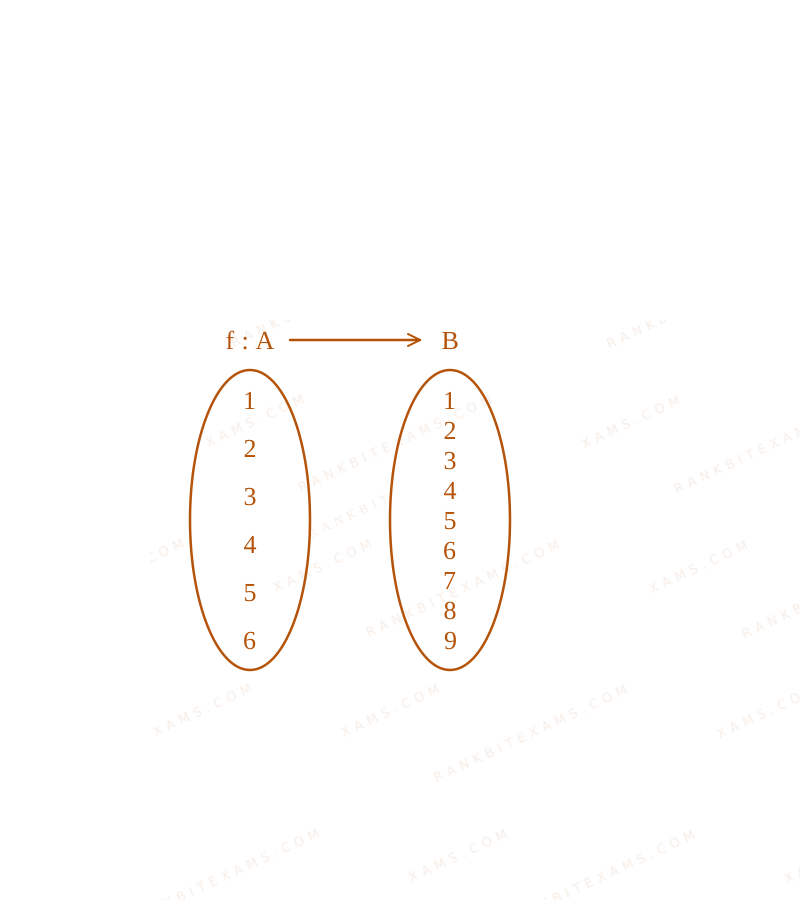
Function mapping sets diagram Q9 - JEE Main 2026 Morning

Step 2: Subsequent Cases

Case 2: f(1) = 3 Remaining 5 values chosen from 4, 5, 6, 7, 8, 9 (6 available numbers). Number of ways = 65 = 6.

Case 3: f(1) = 4 Remaining 5 values chosen from 5, 6, 7, 8, 9 (5 available numbers). Number of ways = 55 = 1.

Case 4: f(1) = 5 Requires choosing 5 values from 6,7,8,9, which is impossible.

Step 3: Total Sum

Total number of valid functions = 21 + 6 + 1 = 28.

Pattern Recognition

For f(i) ≠ i on strictly increasing integer arrays, f(x) - x > 0. Using the substitution g(x) = f(x) - x, you convert a constrained increasing function into a standard non-decreasing one, or simply pivot on f(1) and sum the cascading binomials.

Chapter Mix

Class 11 Maths: Permutations and Combinations Class 12 Maths: Functions

Q23 jee_main_2026_21_jan_morning Divisibility and Counting Rules
Let S = (m, n): m, n in 1, 2, 3, , 50 . If the number of elements (m, n) in S such that 6^m + 9ⁿ is a multiple of 5 is p and the number of elements (m, n) in S such that m + n is a square of a prime number is q , then p + q is equal to......
Numerical Answer. Answer: 1333 to 1333

Solution

Related Formula

Modular arithmetic reductions for power cycles:

a ≡ b m ⇒ a^k ≡ b^k m
Core Logic

Analyze condition p: (6^m + 9ⁿ) is divisible by 5. 6 ≡ 1 5 ⇒ 6^m ≡ 1^m ≡ 1 5. 9 ≡ -1 5 ⇒ 9ⁿ ≡ (-1)ⁿ 5. For the sum to be divisible by 5: 1 + (-1)ⁿ ≡ 0 5 ⇒ (-1)ⁿ = -1. This implies n must be an ODD integer.

Since m in 1, 2, , 50, m can be anything (50 choices). Since n must be odd in 1, , 50, n has 25 choices. p = 50 × 25 = 1250.

Step 1: Compute q

Analyze condition q: (m + n) is the square of a prime number. Max value of m+n = 50+50 = 100. Primes whose squares are ≤ 100: 2, 3, 5, 7. Their squares are 4, 9, 25, 49. So m+n can be 4, 9, 25, 49.

Match List-I with List-II:

m+n=4m+n=9m+n=25m+n=49
No. of ways382448

Explanation for counts: If m+n = S, and m, n ≥ 1, the number of ways is S-1 (since S ≤ 50). For S=4: 3 ways. For S=9: 8 ways. For S=25: 24 ways. For S=49: 48 ways. q = 3 + 8 + 24 + 48 = 83.

Step 2: Final Sum
p + q = 1250 + 83 = 1333
Pattern Recognition

Modular exponentiation immediately shrinks large powers to ± 1. The sum m+n=S where 1 ≤ m,n ≤ N has exactly S-1 solutions if S ≤ N, allowing instant combinatorics tallying without manual counting.

Chapter Mix

Class 11 Maths: Permutations and Combinations

Q20 jee_main_2026_21_jan_evening Exponent of Prime in n!
The largest n in N, for which 7ⁿ divides 101!, is:
  • A. 16
  • B. 18
  • C. 15
  • D. 19

Solution

Related Formula
Legendre's Formula: The exponent of a prime p in N! is given by: Eₚ(N!) = (N)/(p) + (N)/(p²) + (N)/(p³) + …
Core Logic

To find the maximum power n such that 7ⁿ divides 101!, we need to find the exponent of the prime 7 in the prime factorization of 101!.

Step 1: Apply Legendre's Formula
n = (101)/(7) + (101)/(7²) + (101)/(7³) + … n = (101)/(7) + (101)/(49) + (101)/(343)

n = 14 + 2 + 0 n = 16

Pattern Recognition

For prime p in N!, iteratively divide N by p taking only integer parts and sum them. Fast mental math: 101 ÷ 7 = 14, 14 ÷ 7 = 2. 14+2=16.

Chapter Mix

Class 11 Maths: Permutations and Combinations Class 11 Maths: Number Theory

Q25 jee_main_2026_22_january_morning Geometry Based Combinatorics
Let ABC be a triangle. Consider four points p₁, p₂, p₃, p₄ on the side AB, five points p₅, p₆, p₇, p₈, p₉ on the side BC and four points p₁₀, p₁₁, p₁₂, p₁₃ on the side AC. None of these points is a vertex of the triangle ABC. Then the total number of pentagons, that can be formed by taking all the vertices from the points p₁, p₂, .... p₁₃, is ____.
Numerical Answer. Answer: 660 to 660

Solution

Related Formula
Combinations ⁿCᵣ = (n!)/(r!(n-r)!)
Core Logic

A pentagon requires 5 distinct points as vertices. No three points can be collinear to form a proper polygon. Since the available points lie on the three sides of a triangle, picking 3 points from the same side will form a degenerate straight line segment rather than building a strictly convex vertex frame.

Therefore, we must select the 5 points distributed across the three sides (AB with 4 points, BC with 5 points, AC with 4 points) such that a maximum of 2 points is selected from any one side.

Step 1: Case Breakdown

We need to choose 5 points total from the three groups (4, 5, 4) with the condition that no group contributes more than 2 points. The only valid numerical partitions of 5 into 3 parts bounded by 2 are:

  • Case 1: 2 points from AB, 2 points from BC, 1 point from AC
  • Case 2: 2 points from AB, 1 point from BC, 2 points from AC
  • Case 3: 1 point from AB, 2 points from BC, 2 points from AC
Step 2: Calculating Combinations for Each Case

Case 1: (2 from AB, 2 from BC, 1 from AC)

⁴C₂ × ⁵C₂ × ⁴C₁ = 6 × 10 × 4 = 240

Case 2: (2 from AB, 1 from BC, 2 from AC)

⁴C₂ × ⁵C₁ × ⁴C₂ = 6 × 5 × 6 = 180

Case 3: (1 from AB, 2 from BC, 2 from AC)

⁴C₁ × ⁵C₂ × ⁴C₂ = 4 × 10 × 6 = 240
Step 3: Total Pentagons

Total number of pentagons is the sum of all valid cases:

Total = 240 + 180 + 240 = 660

Geometry Based Combinatorics diagram for Q25 - JEE Main 2026 Morning

Pattern Recognition

For polygon formation from collinear sets, always frame it as a restricted partition problem. A polygon of k sides requires selecting k vertices such that no maximum allowable threshold of collinearity is breached (for a strict polygon, no 3 points on a line).

Chapter Mix

Class 11 Maths: Permutations and Combinations

Q25 jee_main_2026_22_january_evening Subsets with Even Product
Let S be the set of the first 11 natural numbers. Then the number of elements in A = B S : n(B) ≥ 2 and the product of all elements of B is even is ____.
Numerical Answer. Answer: 1979 to 1979

Solution

Related Formula

Complementary counting principle:

Favorable Subsets = Total Subsets - Subsets with odd product - Singletons - Empty set
Core Logic

Set S = 1, 2, 3, , 11 contains 11 elements (6 odd: 1, 3, 5, 7, 9, 11 and 5 even: 2, 4, 6, 8, 10).

  • Total possible subsets of S = 2¹¹ = 2048.
  • Subsets where product is odd consist entirely of odd numbers: 2⁶ = 64.
  • Singletons with even product: 5 (the even numbers themselves).
Step 1: Complementary Subtraction

Excluded subsets:

  • Empty set (size 0): 1
  • Singletons with odd elements: 6
  • Singletons with even elements: 5
  • Subsets of size ≥ 2 with only odd elements: 2⁶ - 1 - 6 = 57
  • Required count:

Total - (all odd subsets) - (even singletons) = 2¹¹ - 2⁶ - 5 = 2048 - 64 - 5 = 1979
Pattern Recognition

Complement method: Total subsets minus subsets containing only odd elements minus even singletons.

Chapter Mix

Class 11 Maths: Permutations and Combinations

Rankbit System
JEE Physics: Waves (+15.5%) | Electrostatics: Concentric Shells (-29.7%) | Modern Physics: Photoelectric Clones (+34.2%) | Mathematics: Definite Integrals (+18.1%) | Chemistry: Coordination Splitting (-11.4%) | JEE Physics: Waves (+15.5%) | Electrostatics: Concentric Shells (-29.7%) | Modern Physics: Photoelectric Clones (+34.2%) | Mathematics: Definite Integrals (+18.1%) | Chemistry: Coordination Splitting (-11.4%)
