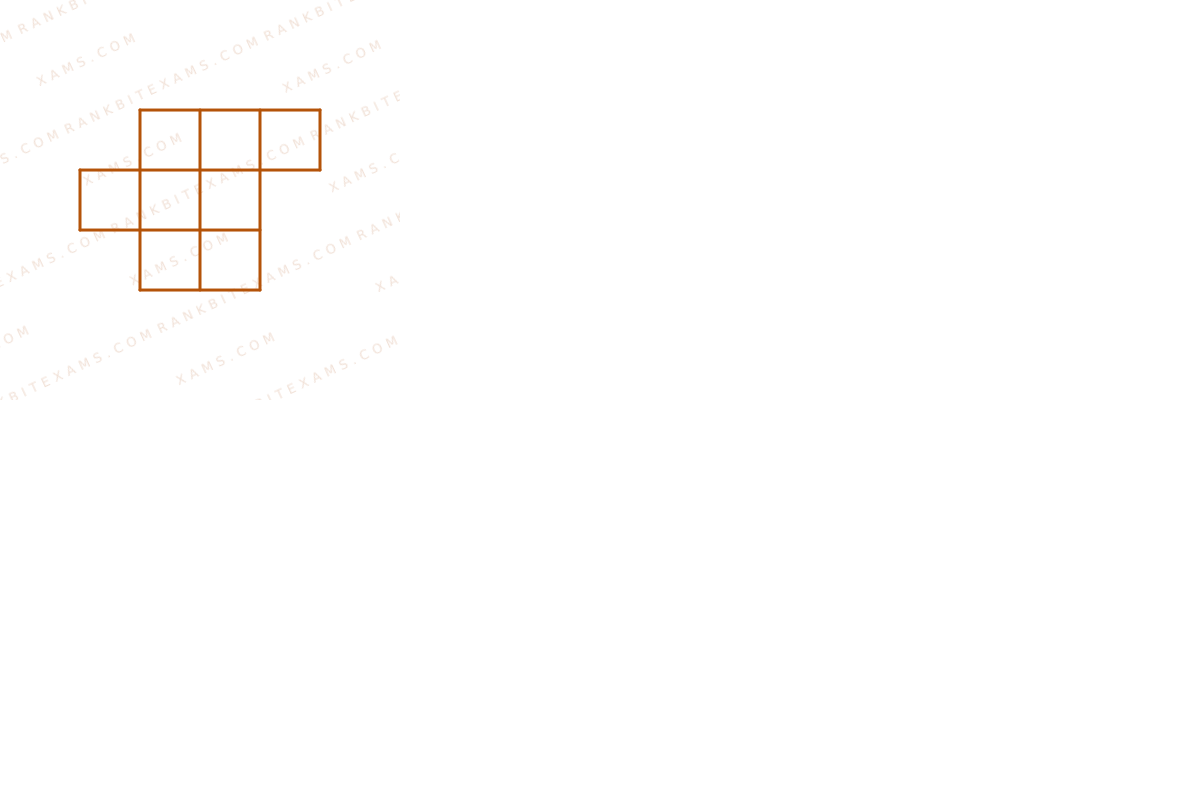
The number of ways, in which the letters A, B, C, D, E can be placed in the 8 boxes of the figure below so that no row remains empty and at most one letter can be placed in a box, is:
Boxes layout diagram for Q66 - JEE Main 2025 Evening
The grid diagram shows 8 boxes arranged in three horizontal rows of sizes 3, 2, and 3.

Solution & Explanation

### Related Formula textNumber of arrangements of r text items in n text boxes = binomnr cdot r! ### Core Logic This is a permutations problem with row constraints. We compute the total arrangements of placing 5 distinct letters into 8 boxes and then subtract the invalid cases where one or more rows are left completely empty. ### Step 1: Compute total unrestricted arrangements The grid has a total of 8 boxes. We have 5 distinct letters (A, B, C, D, E): textTotal unrestricted arrangements = binom85 cdot 5! = 56 cdot 120 = 6720 ### Step 2: Identify and subtract the invalid empty-row cases Let the rows be R_1, R_2, and R_3, with box counts 3, 2, and 3 respectively. Since we must distribute 5 letters, it is impossible for 2 rows to be empty simultaneously (as the remaining single row would have at most 3 boxes, which cannot fit 5 letters). Thus, we only subtract cases where exactly one row is empty: - Case 1: Row R_1 (3 boxes) is empty. The 5 letters must go to the remaining 5 boxes of R_2 and R_3: textWays = binom55 cdot 5! = 120 - Case 2: Row R_3 (3 boxes) is empty. Same as Case 1, the 5 letters must go to the remaining 5 boxes of R_1 and R_2: textWays = binom55 cdot 5! = 120 - Case 3: Row R_2 (2 boxes) is empty. The 5 letters must go to the remaining 6 boxes of R_1 and R_3: textWays = binom65 cdot 5! = 6 cdot 120 = 720 ### Step 3: Calculate the final valid arrangements Subtracting all empty-row cases from the total arrangements: textValid arrangements = 6720 - (120 + 120 + 720) = 6720 - 960 = 5760 ### Pattern Recognition Inclusion-Exclusion Principle: For distribution problems with simple boundary exclusions, subtracting the complement set (invalid configurations) is mathematically much cleaner than calculating all possible partitions of row assignments. ### Evaluation Rubric / Model Answer null ### Chapter Mix Class 11 Mathematics: Permutations and Combinations

Reference Study Guides

More Permutations and Combinations Previous-Year Questions — Page 5

Q74 jee_main_2025_29_jan_morning Permutations with Repetition
The number of 6-letter words, with or without meaning, that can be formed using the letters of the word MATHS such that any letter that appears in the word must appear at least twice, is
Numerical Answer. Answer: 1405

Solution

### Related Formula textTotal Words = sum textPermutations of each selection partition distribution case ### Core Logic The word MATHS has 5 distinct letters: {M, A, T, H, S}. We need to form 6-letter words such that any chosen letter appears geq 2 \times. We analyze combinations by structural frequency cases. ### Case 1: Single letter used 6 \times Format: a a a a a a Choose 1 letter out of 5: binom51 = 5 words. ### Case 2: Two distinct letters used Subcase 2a: One letter 4 \times, another 2 \times (aaaa bb) textWords = binom52 times left( frac6!4! 2! times 2! right) = 10 times (15 times 2) = 300 Subcase 2b: Both letters used 3 \times each (aaa bbb) textWords = binom52 times frac6!3! 3! = 10 times 20 = 200 Total for Case 2 = 300 + 200 = 500 words. ### Case 3: Three distinct letters used Format: Each letter appears exactly 2 \times (aa bb cc) textWords = binom53 times frac6!2! 2! 2! = 10 times 90 = 900text words. ### Step 1: Calculate Total Words textTotal Words = 5 + 500 + 900 = 1405 ### Pattern Recognition When constraints enforce frequencies geq 2, organize calculations strictly by number of distinct letters to cover all possibilities without overcounting. ### Evaluation Rubric / Model Answer null ### Chapter Mix Class 11 Mathematics: Permutations and Combinations
Q5 jee_main_2024_01_february_morning Partitioning of Objects
If n is the number of ways five different employees can sit into four indistinguishable offices where any office may have any number of persons including zero, then n is equal to:
  • A. 47
  • B. 53
  • C. 51
  • D. 43

Solution

### Related Formula The number of ways to distribute m distinct items into k indistinguishable groups is given by the sum of Stirling numbers of the second kind: sum_r=1^k S(m, r) ### Core Logic Since the offices are **indistinguishable**, we look at partitions of the number 5 into at most 4 parts. Let's analyze each case based on distribution patterns: ### Step 1: Calculate Case Combinations - **Case 1: 5, 0, 0, 0** All employees in one office: frac5!5! = 1 text way - **Case 2: 4, 1, 0, 0** Four employees in one office, one in another: frac5!4!1! = 5 text ways - **Case 3: 3, 2, 0, 0** Three employees in one office, two in another: frac5!3!2! = 10 text ways - **Case 4: 3, 1, 1, 0** Three in one, and one each in two other offices. Since the two single-person offices are identical: frac5!3!1!1! cdot 2! = 10 text ways - **Case 5: 2, 2, 1, 0** Two groups of two, and one group of one. Since the two two-person offices are identical: frac5!2!2!1! cdot 2! = 15 text ways - **Case 6: 2, 1, 1, 1** One group of two, three groups of one. Since the three single-person offices are identical: frac5!2!(1!)^3 cdot 3! = 10 text ways ### Step 2: Total Sum Summing all these distinct non-overlapping partition groups: textTotal ways n = 1 + 5 + 10 + 10 + 15 + 10 = 51 ### Pattern Recognition Sees: Distinct items placed into identical/indistinguishable containers. Trap: When dividing items into groups of equal sizes (like two groups of 2 or three groups of 1), you must divide by the factorial of the frequency of those groups (2! and 3!) to avoid overcounting permutations. ### Evaluation Rubric / Model Answer null ### Chapter Mix Class 11 Mathematics: Permutations and Combinations
Q22 jee_main_2024_01_february_morning Integral Solutions of Equations
The number of elements in the set S = \(x, y, z): x,y,z in Z, x + 2y + 3z = 42, x, y, z ge 0\ equals
Numerical Answer. Answer: 169 to 169

Solution

### Related Formula For a linear equation x + 2y = k, where x, y ge 0 are non-negative integers, the number of distinct integral pairs (x,y) is equal to the number of possible non-negative values that y can take, which is given by: leftlfloor frack2 rightrfloor + 1 ### Core Logic We need to find the number of non-negative integer solutions to: x + 2y + 3z = 42 Rearranging the equation to analyze values branch-by-branch based on z: x + 2y = 42 - 3z Since x, y ge 0, the maximum value z can attain corresponds to x=0, y=0, so 3z le 42 implies z le 14. ### Step 1: Enumerate Values across all z configurations Let's count the possible solutions for each integer value of z from 0 to 14: - z = 0 implies x + 2y = 42 implies lfloor 42/2 rfloor + 1 = 22 text solutions - z = 1 implies x + 2y = 39 implies lfloor 39/2 rfloor + 1 = 20 text solutions - z = 2 implies x + 2y = 36 implies lfloor 36/2 rfloor + 1 = 19 text solutions - z = 3 implies x + 2y = 33 implies lfloor 33/2 rfloor + 1 = 17 text solutions - z = 4 implies x + 2y = 30 implies lfloor 30/2 rfloor + 1 = 16 text solutions - z = 5 implies x + 2y = 27 implies lfloor 27/2 rfloor + 1 = 14 text solutions - z = 6 implies x + 2y = 24 implies lfloor 24/2 rfloor + 1 = 13 text solutions - z = 7 implies x + 2y = 21 implies lfloor 21/2 rfloor + 1 = 11 text solutions - z = 8 implies x + 2y = 18 implies lfloor 18/2 rfloor + 1 = 10 text solutions - z = 9 implies x + 2y = 15 implies lfloor 15/2 rfloor + 1 = 8 text solutions - z = 10 implies x + 2y = 12 implies lfloor 12/2 rfloor + 1 = 7 text solutions - z = 11 implies x + 2y = 9 implies lfloor 9/2 rfloor + 1 = 5 text solutions - z = 12 implies x + 2y = 6 implies lfloor 6/2 rfloor + 1 = 4 text solutions - z = 13 implies x + 2y = 3 implies lfloor 3/2 rfloor + 1 = 2 text solutions - z = 14 implies x + 2y = 0 implies lfloor 0/2 rfloor + 1 = 1 text solution ### Step 2: Total Sum Computation Summing all the calculated distribution counts: textTotal solutions = 22 + 20 + 19 + 17 + 16 + 14 + 13 + 11 + 10 + 8 + 7 + 5 + 4 + 2 + 1 = 169 ### Pattern Recognition Sees: Linear multi-variable diophantine solution constraints. Shortcut: Grouping into alternating arithmetic sequences can expedite the total calculation step instead of adding each discrete integer row manually. ### Evaluation Rubric / Model Answer null ### Chapter Mix Class 11 Mathematics: Permutations and Combinations
Q2 jee_main_2024_29_january_evening Partitioning of Identical Objects
Number of ways of arranging 8 identical books into 4 identical shelves where any number of shelves may remain empty is equal to
  • A. 18
  • B. 16
  • C. 12
  • D. 15

Solution

### Related Formula Since both the objects (books) and the containers (shelves) are identical, this problem is equivalent to finding the number of partitions of the integer 8 into at most 4 parts. ### Core Logic Let us systematically list out all the possible distributions based on the number of empty shelves: 1. **3 Shelves empty:** * (8, 0, 0, 0) rightarrow 1text way 2. **2 Shelves empty:** * (7, 1, 0, 0) * (6, 2, 0, 0) * (5, 3, 0, 0) * (4, 4, 0, 0) rightarrow 4text ways 3. **1 Shelf empty:** * (6, 1, 1, 0) * (5, 2, 1, 0) * (4, 3, 1, 0) * (4, 2, 2, 0) * (3, 3, 2, 0) rightarrow 5text ways 4. **0 Shelves empty:** * (5, 1, 1, 1) * (4, 2, 1, 1) * (3, 3, 1, 1) * (3, 2, 2, 1) * (2, 2, 2, 2) rightarrow 5text ways ### Step 1: Total Computations Summing all these cases together: textTotal ways = 1 + 4 + 5 + 5 = 15text ways ### Pattern Recognition Be very careful to identify if containers/objects are identical or distinct. Identical into identical means simple partition of integers. Listing them in descending order ensures no partition is missed or duplicated. ### Evaluation Rubric / Model Answer null ### Chapter Mix Class 11 Mathematics: Permutations and Combinations
Q22 jee_main_2024_29_jan_morning Dictionary Rank of a Word
All the letters of the word "GTWENTY" are written in all possible ways with or without meaning and these words are written as in a dictionary. The serial number of the word "GTWENTY" is
Numerical Answer. Answer: 553 to 553

Solution

### Related Formula textPermutations of n text objects with p text identical elements = fracn!p! ### Core Logic Alphabetize the letters in the word "GTWENTY": E, G, N, T, T, W, Y. We calculate the number of permutations that alphabetically precede "GTWENTY" by exhaustively scanning dictionary prefixes. ### Step 1: Calculate Block Combinations 1. Words starting with 'E': Remaining letters {G, N, T, T, W, Y}. We have 6 letters with 'T' repeating twice. Permutations = frac6!2! = frac7202 = 360. 2. Words starting with 'G': This locks the first letter. Next alphabetical letter is 'E'. - Starting with 'GE': Remaining {N, T, T, W, Y}. 5 letters, 'T' repeating. Permutations = frac5!2! = frac1202 = 60. - Starting with 'GN': Remaining {E, T, T, W, Y}. 5 letters, 'T' repeating. Permutations = frac5!2! = 60. - Starting with 'GT': This locks the second letter as well. We iterate through the remaining sorted pool {E, N, T, W, Y}. -- Starting with 'GTE': Remaining {N, T, W, Y}. No repetitions. Permutations = 4! = 24. -- Starting with 'GTN': Remaining {E, T, W, Y}. No repetitions. Permutations = 4! = 24. -- Starting with 'GTT': Remaining {E, N, W, Y}. No repetitions. Permutations = 4! = 24. -- Starting with 'GTW': This locks the third letter. Iterate through {E, N, T, Y}. ### Step 2: Trace Remaining Exact String We are now tracking the prefix 'GTW'. The remaining letters alphabetically are E, N, T, Y. The target word is precisely built out of these letters in exact alphabetical order: E, then N, then T, then Y. This means "GTWENTY" is the very first word in the 'GTW' block. So, it adds exactly 1 to the count. ### Step 3: Sum the Permutations Total serial number = 360 + 60 + 60 + 24 + 24 + 24 + 1 = 553. ### Pattern Recognition When calculating dictionary rank with repeating letters, remember to divide by p! only when the repeating letter is roaming freely in the available blanks. If a repeating letter is 'locked' as the current prefix, it no longer acts as a repeater for the remaining slots. ### Evaluation Rubric / Model Answer null ### Chapter Mix Class 11 Mathematics: Permutations and Combinations

More Permutations and Combinations Questions — jee_main_2025_02_april_evening

Practice all Permutations and Combinations previous-year questions →

Rankbit System
JEE Physics: Waves (+15.5%) | Electrostatics: Concentric Shells (-29.7%) | Modern Physics: Photoelectric Clones (+34.2%) | Mathematics: Definite Integrals (+18.1%) | Chemistry: Coordination Splitting (-11.4%) | JEE Physics: Waves (+15.5%) | Electrostatics: Concentric Shells (-29.7%) | Modern Physics: Photoelectric Clones (+34.2%) | Mathematics: Definite Integrals (+18.1%) | Chemistry: Coordination Splitting (-11.4%)