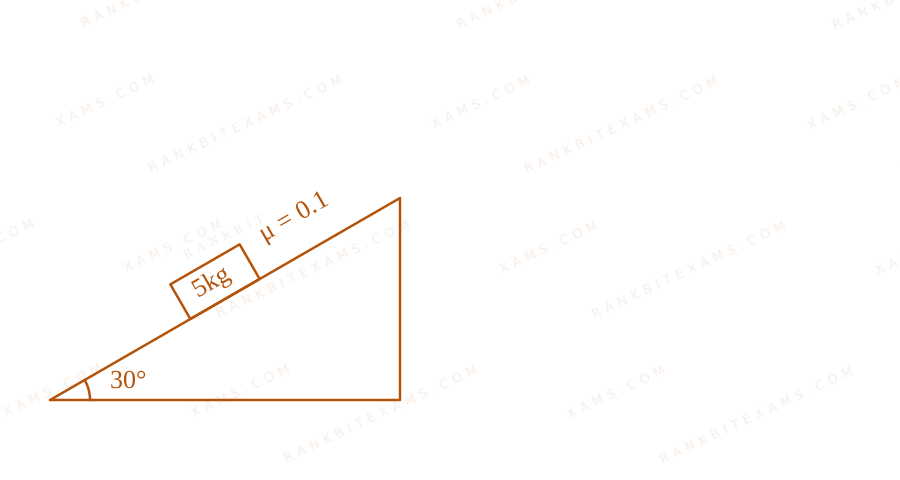
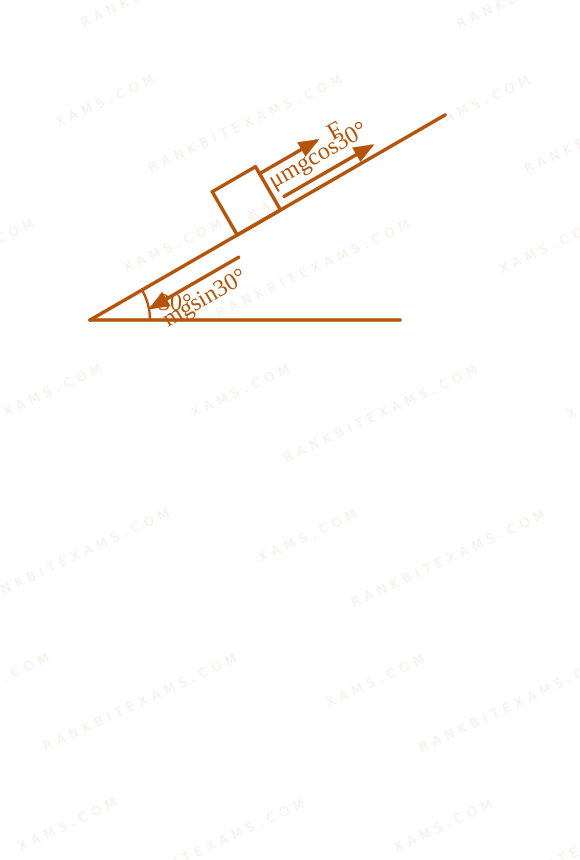
A block of mass 5 kg$5 \text{ kg}$ is placed on a rough inclined surface as shown in the figure.
The image shows a 5 kg block on a rough plane inclined at 30 degrees, with coefficient of friction mu = 0.1.
If F₁$\vec{F}_1$ is the force required to just move the block up the inclined plane and F₂$\vec{F}_2$ is the force required to just prevent the block from sliding down, then the value of | F₁| - | F₂|$|\vec{F}_1| - |\vec{F}_2|$ is: [Use g = 10 m/s²$g = 10 \text{ m/s}^2$]
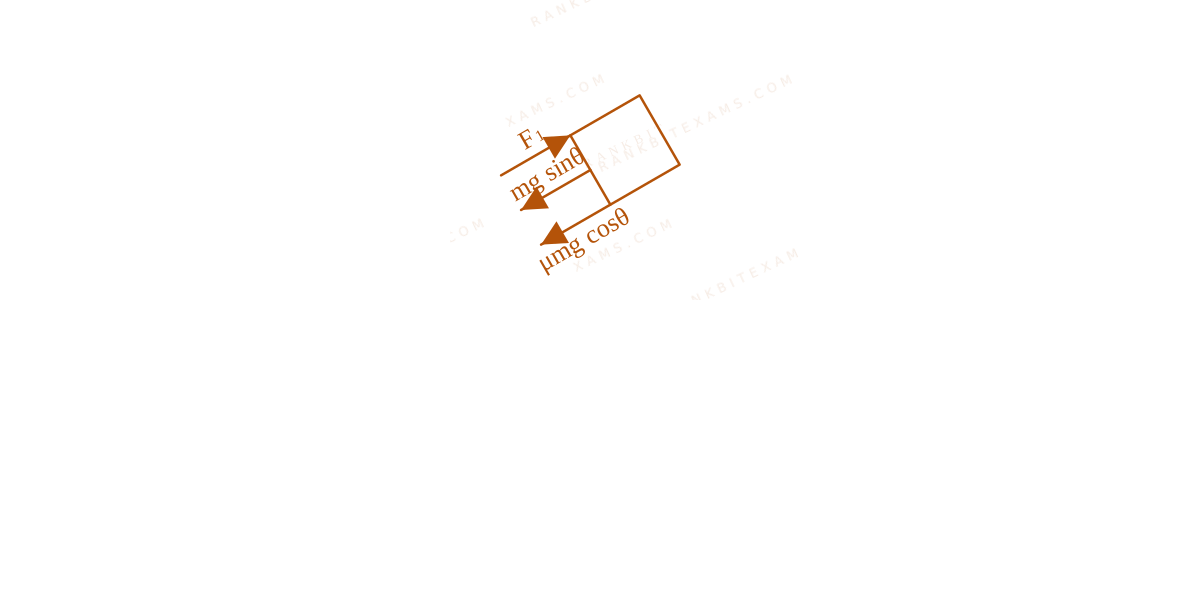
To move the block up, the applied force F₁$F_1$ must overcome both the downward gravitational component and the downward frictional force.
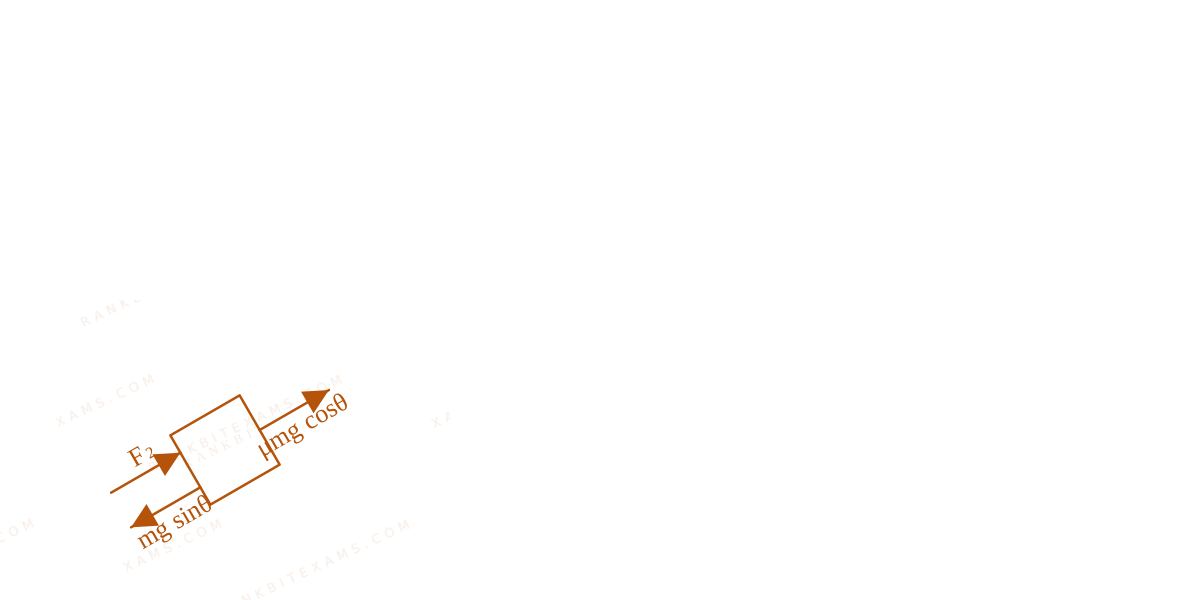
To prevent it from sliding down, the applied force F₂$F_2$ acts upwards and is aided by friction which acts upwards to oppose impending downward slip.
The image shows a 5 kg block on a rough plane inclined at 30 degrees, with coefficient of friction mu = 0.1.
Note: The official options had an anomaly where 5√(3) N$5\sqrt{3} \text{ N}$ was missing or evaluated as a bonus. Option 2 was listed as 50√(3)$50\sqrt{3}$ in the primary text. We track the closest logic path indicating Bonus.
Pattern Recognition
The difference between 'push up' and 'hold from sliding' forces on an incline is always precisely 2 fk$2 f_k$ (2 μ mg θ$2 \mu mg \cos \theta$). Bypass calculating the mg θ$mg \sin \theta$ terms entirely.
Keywords:#rough inclined surface#JEE Main 2024 Evening Q42#Laws of Motion JEE Main 2024#Friction on an Inclined Plane JEE Main 2024#inclined plane#friction#block#angle
More Laws of Motion Previous-Year Questions — Page 2
Q40jee_main_2026_24_january_eveningEquilibrium of Forces
A flexible chain of mass m hangs between two fixed points at the same level. The inclination of the chain with the horizontal at the two points of support is 30°$30^{\circ}$ . Considering the equilibrium of each half of the chain, the tension of the chain at the lowest point is ____.
A.√(3)2 m g$\frac{\sqrt{3}}{2} m g$
B.(1)/(2) m g$\frac{1}{2} m g$
C.m g$m g$
D.√(3) m g$\sqrt{3} m g$
Solution
Related Formula
Σ Fy = 0 T θ = (mg)/(2)$$\sum F_y = 0 \implies T \sin\theta = \frac{mg}{2}$$Σ Fₓ = 0 T θ = T₀$$\sum F_x = 0 \implies T \cos\theta = T_0$$
Core Logic
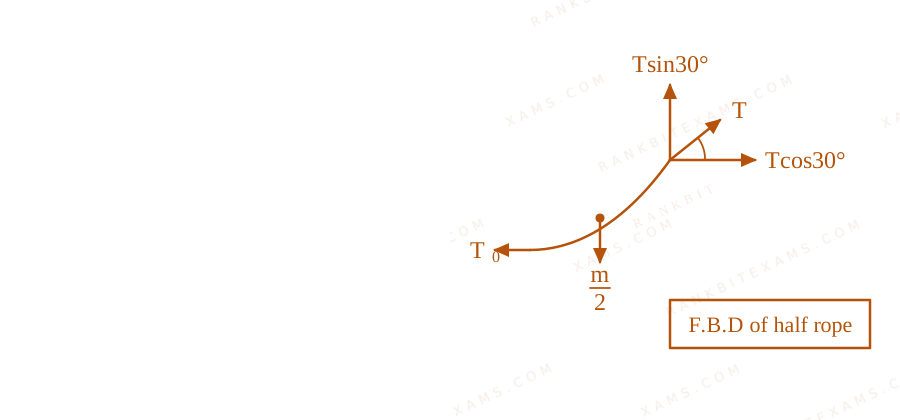
Equilibrium of Forces diagram for Q40 - JEE Main 2026 Evening
Draw the Free Body Diagram (F.B.D) of half of the rope.
The forces acting on half the rope (mass m/2$m/2$) are:
Weight (mg)/(2)$\frac{mg}{2}$ acting downwards.
Tension T$T$ at the support point acting at 30°$30^{\circ}$ to the horizontal.
Horizontal tension T₀$T_0$ at the lowest point.
Step 1: Equilibrium Equations
For vertical equilibrium:
T 30° = (m)/(2) g$$T \sin 30^{\circ} = \frac{m}{2} g$$
For horizontal equilibrium:
T 30° = T₀$$T \cos 30^{\circ} = T_0$$
Step 2: Solve for T_0
Dividing the vertical equation by the horizontal equation:
When dealing with symmetrical hanging chains, always cut the chain at the lowest point. The tension at the lowest point is purely horizontal and is given by T₀ = (W/2) / θ$T_0 = (W/2) / \tan\theta$, where θ$\theta$ is the angle at the supports.
Chapter Mix
Class 11 Physics: Laws of Motion
Q40jee_main_2026_28_january_morningFriction on an Inclined Plane
A block of mass 5 kg is moving on an inclined plane which makes an angle of 30°$30^{\circ}$ with the horizontal. Friction coefficient between the block and inclined plane surface is √(3)2$\frac{\sqrt{3}}{2}$ . The force to be applied on the block so that the block will move down without acceleration is ____ N.
A.25$25$
B.12.5$12.5$
C.7.5$7.5$
D.15$15$
Solution
Related Formula
fk = μk N = μk mg θ$$f_k = \mu_k N = \mu_k mg \cos\theta$$Fdown = mg θ$$F_{\text{down}} = mg \sin\theta$$
Net force = 0 for constant velocity$\text{Net force } = 0 \text{ for constant velocity}$
Core Logic
For the block to move down at a constant velocity (zero acceleration), the sum of forces parallel to the incline must be zero.
Free body diagram of block on an incline
Step 1: Force Balance Equation
Force pulling it down the incline = mg (30°)$mg \sin(30^{\circ})$
Friction acting up the incline (since block moves down) = μ mg (30°)$\mu mg \cos(30^{\circ})$
Let external force F$F$ act down the incline.
mg (30°) + F = μ mg (30°)$$mg \sin(30^{\circ}) + F = \mu mg \cos(30^{\circ})$$
Note: The PDF solution calculates this with F assigned up the incline and gets F = -12.5N$F = -12.5\mathrm{N}$. The magnitude is 12.5N$12.5\mathrm{N}$ downward on the incline.
Pattern Recognition
If μ > θ$\mu > \tan\theta$ (here √(3)2 = 0.866$\frac{\sqrt{3}}{2} = 0.866$ and 30^° = 1√(3) ≈ 0.577$\tan 30^\circ = \frac{1}{\sqrt{3}} \approx 0.577$), friction is stronger than gravity's pull. You must actively pull it down to keep it moving.
Chapter Mix
Class 11 Physics: Laws of Motion
Q45jee_main_2026_28_january_morningMotion with Drag Force
A particle of mass m falls from rest through a resistive medium having resistive force, F = -kv$F = -kv$, where v is the velocity of the particle and k is a constant. Which of the following graphs represents velocity (v) versus time(t)?
Integrate the differential equation of motion to find how velocity depends on time. Initially, acceleration is g$g$. As velocity increases, the resistive force kv$kv$ increases, reducing acceleration until it reaches zero (terminal velocity).
This shows an exponential increase that asymptotically approaches a terminal velocity vterminal = mg/k$v_{\text{terminal}} = mg/k$. Option (2) represents this curve.
Pattern Recognition
The equation 1 - e-t$1 - e^{-t}$ always produces a curve starting at origin and flattening out horizontally (asymptotic approach to a limit).
Chapter Mix
Class 11 Physics: Laws of Motion

Q40jee_main_2026_28_january_eveningPseudo Force and Inclined Plane
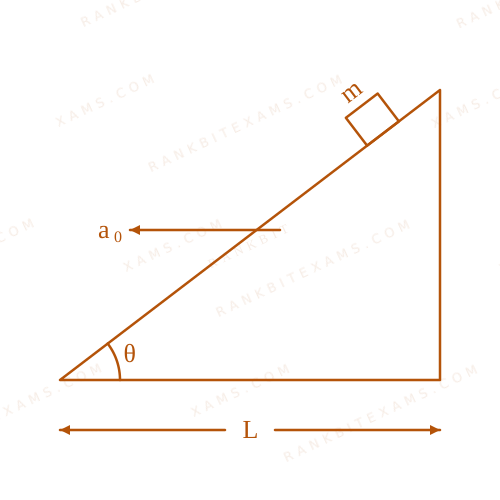
A small block of mass m slides down from the top of a frictionless inclined surface, while the inclined plane is moving towards left with constant acceleration a₀$a_{0}$ . The angle between the inclined plane and ground is θ$\theta$ and its base length is L. Assuming that initially the small block is at the top of the inclined plane, the time it takes to reach the lowest point of the inclined plane is ____.
A mass m on an inclined plane of base L, accelerating to the left with a0.
s = ut + (1)/(2)at²$$s = ut + \frac{1}{2}at^2$$Fpseudo = m a₀$$F_{\text{pseudo}} = m a_0$$
Core Logic
A mass m on an inclined plane of base L, accelerating to the left with a0.
We solve the problem from the non-inertial frame of reference of the inclined plane. A pseudo force m a₀$m a_0$ acts on the block towards the right.
Forces acting parallel to the incline (downward positive):
Component of gravity: mg θ$mg \sin \theta$
Component of pseudo force (pointing up the incline): -ma₀ θ$-ma_0 \cos \theta$
Step 1: Calculate Effective Acceleration
Net force down the incline:
Fₙₑₜ = mg θ - m a₀ θ$$F_{\text{net}} = mg \sin \theta - m a_0 \cos \theta$$
Thus, the acceleration relative to the incline is:
a = g θ - a₀ θ$$a = g \sin \theta - a_0 \cos \theta$$
Step 2: Distance Travelled
The base length of the incline is L$L$. Thus, the total length of the inclined surface is:
Whenever an inclined plane accelerates horizontally, resolve the pseudo force ma₀$ma_0$ parallel and perpendicular to the incline. Multiply by 2 inside the root to simplify into double-angle formats if options demand it.
Chapter Mix
Class 11 Physics: Laws of Motion
Class 11 Physics: Kinematics
Q16jee_main_2025_02_april_eveningEquilibrium of Forces
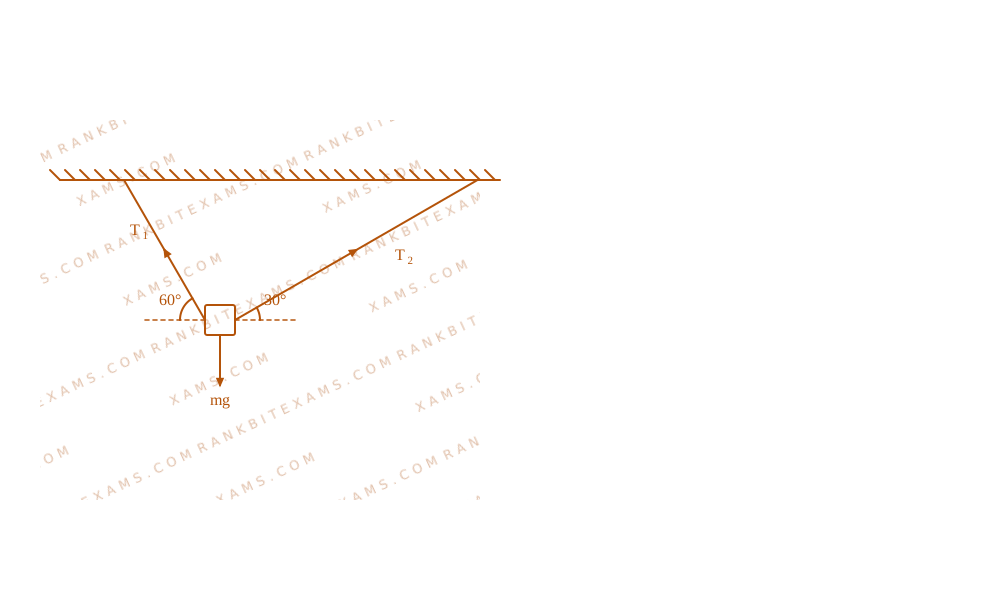
A body of mass 1kg$1\mathrm{kg}$ is suspended with the help of two strings making angles as shown in figure. Magnitude of tensions T₁$\mathbf{T}_1$ and T₂$\mathbf{T}_2$ , respectively, are (in N):
The diagram shows a suspended mass of 1 kg held by two strings making angles of 60 and 30 degrees with the horizontal.
Thus, the tension magnitudes are T₁ = 5√(3) N$T_1 = 5\sqrt{3} \ \mathrm{N}$ and T₂ = 5 N$T_2 = 5 \ \mathrm{N}$.
Pattern Recognition
Sees: Suspending particle static equilibrium with asymmetric strings.
Trap: Associating components with incorrect trigonometry axes or swapping T₁$T_1$ and T₂$T_2$ in options.
Shortcut: Since the incline of T₁$T_1$ (60^°$60^\circ$) is steeper than that of T₂$T_2$ (30^°$30^\circ$), T₁$T_1$ must carry a larger portion of the load, meaning T₁ > T₂$T_1 > T_2$. From the choices, only (2) satisfies this hierarchy.
Chapter Mix
Class 11 Physics: Laws of Motion

More Laws of Motion Questions — jee_main_2024_31_jan_evening
Practice past-year questions one chapter at a time. Pick an exam → subject → chapter and get every PYQ for that topic — pulled together from all past papers — with the chapter's key formulas alongside.