A block of mass 1 ~kg$1 \mathrm{~kg}$ is pushed up a surface inclined to horizontal at an angle of 60°$60^{\circ}$ by a force of 10 ~N$10 \mathrm{~N}$ parallel to the inclined surface as shown in figure. When the block is pushed up by 10 ~m$10 \mathrm{~m}$ along inclined surface, the work done against frictional force is: [g = 10 ~m / s²]$\left[\mathrm{g} = 10 \mathrm{~m} / \mathrm{s}^{2}\right]$A block of mass M on an incline at 60 degrees, pulled by 10 N force, with coefficient of static friction 0.1.
A.5√(3) ~J$5\sqrt{3} \mathrm{~J}$
B.5 ~J$5 \mathrm{~J}$
C.5 × 10³ ~J$5 \times 10^{3} \mathrm{~J}$
D.10 ~J$10 \mathrm{~J}$
Solution & Explanation
Related Formula
Wf = fk · d$$W_f = f_k \cdot d$$
fk = μ N$f_k = \mu N$
N = mg θ$$N = mg \cos\theta$$
Core Logic
The work done against the frictional force is the product of the kinetic friction force and the displacement along the plane.
The normal force N$N$ on the block is given by N = mg θ$N = mg \cos\theta$, where θ = 60°$\theta = 60^{\circ}$.
Whenever asked for "work done against friction", simply compute μ mg θ × d$\mu mg \cos\theta \times d$. The applied force (10 ~N$10 \mathrm{~N}$) is irrelevant to the friction calculation itself since it is parallel to the plane.
Chapter Mix
Class 11 Physics: Laws of Motion
Class 11 Physics: Work, Energy and Power
Keywords:#work done against frictional force#JEE Main 2024 Evening Q32#Laws of Motion JEE Main 2024#Work Done by Friction on Incline JEE Main 2024#inclined plane#friction block#force vector
More Laws of Motion Previous-Year Questions — Page 7
Q31jee_main_2024_31_jan_eveningPulley Systems and Tension
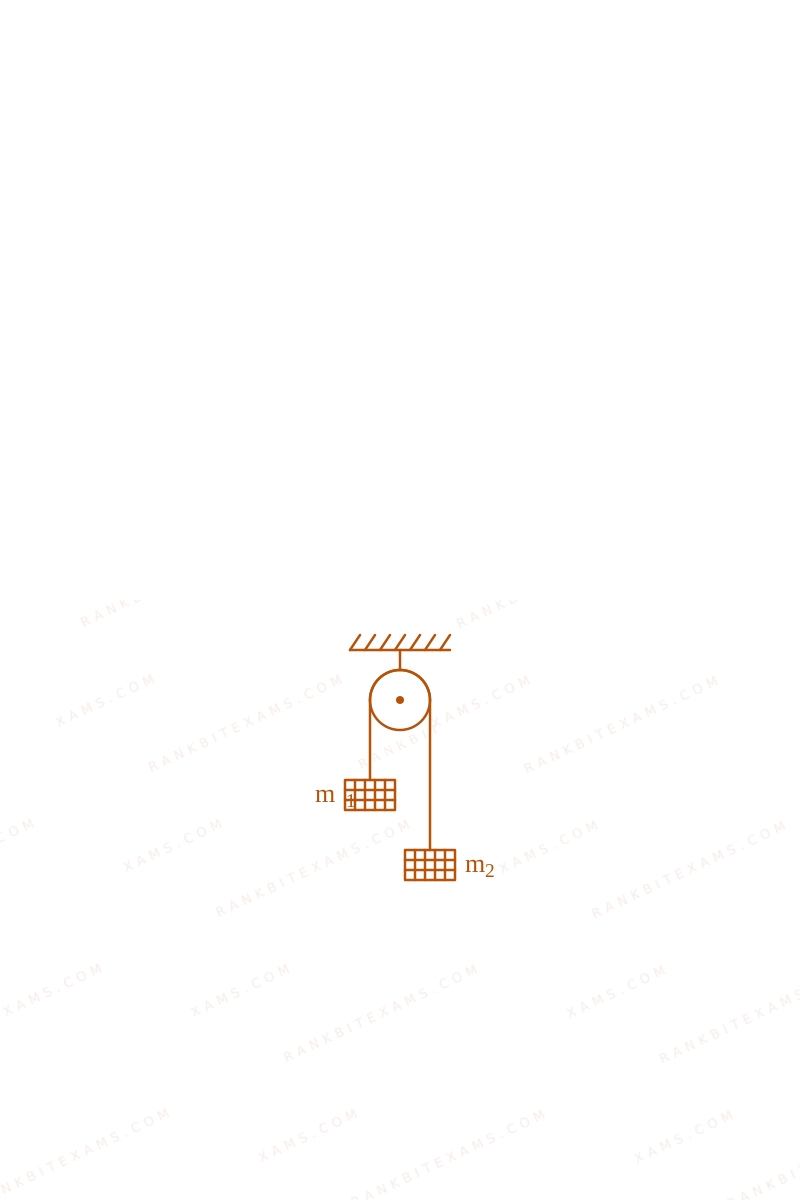
A light string passing over a smooth light fixed pulley connects two blocks of masses m₁$m_1$ and m₂$m_2$. If the acceleration of the system is g/8$g/8$, then the ratio of masses is
The image displays two masses suspended over a single fixed smooth pulley.
For standard Atwood machines, a = g × Difference in massSum of mass$a = g \times \frac{\text{Difference in mass}}{\text{Sum of mass}}$. If a/g = 1/8$a/g = 1/8$, then (m₁-m₂)/(m₁+m₂) = 1/8$(m_1-m_2)/(m_1+m_2) = 1/8$, which can be solved using componendo and dividendo: m₁/m₂ = (8+1)/(8-1) = 9/7$m_1/m_2 = (8+1)/(8-1) = 9/7$.
Chapter Mix
Class 11 Physics: Laws of Motion
Q42jee_main_2024_31_jan_eveningFriction on an Inclined Plane
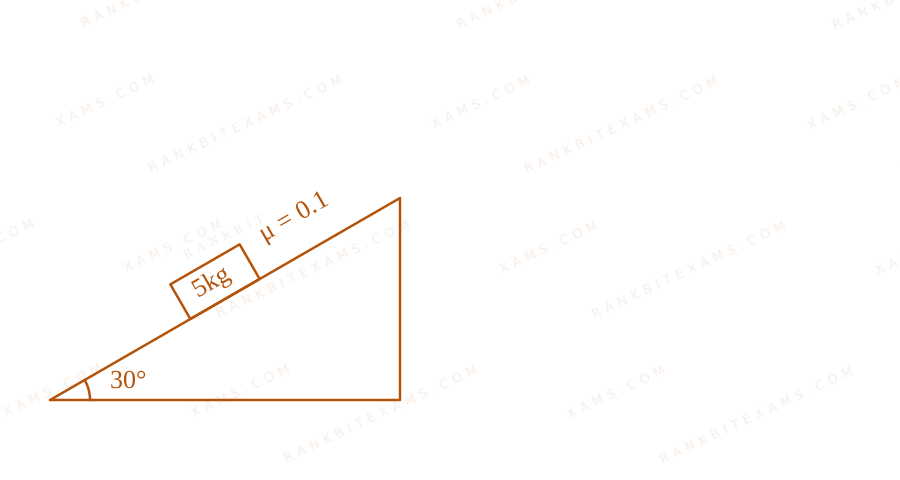
A block of mass 5 kg$5 \text{ kg}$ is placed on a rough inclined surface as shown in the figure.
The image shows a 5 kg block on a rough plane inclined at 30 degrees, with coefficient of friction mu = 0.1.
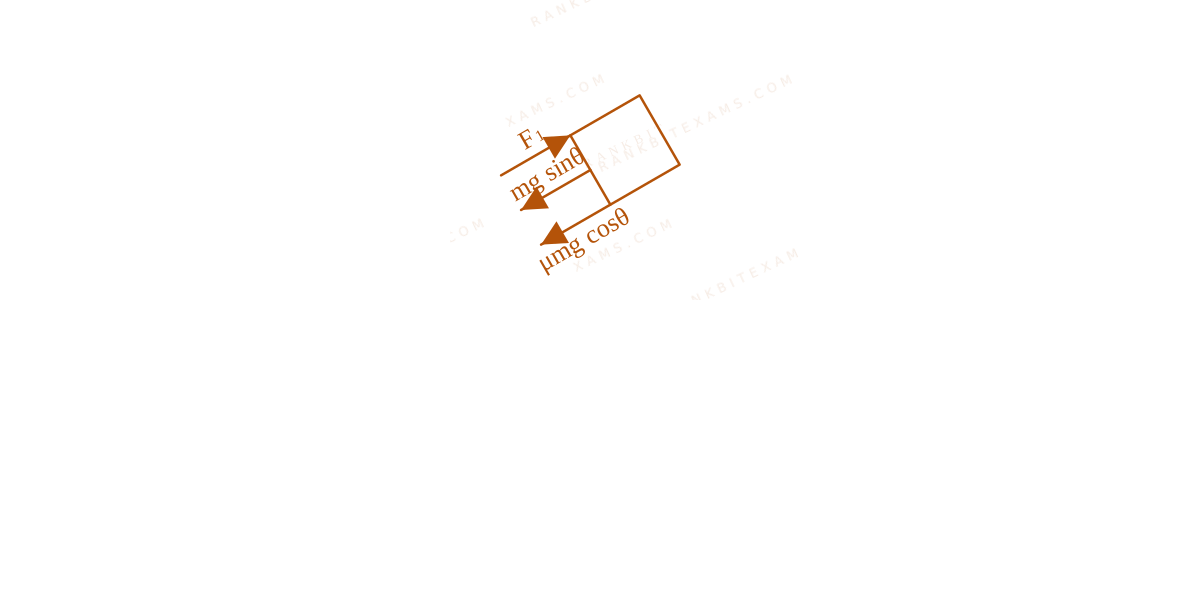
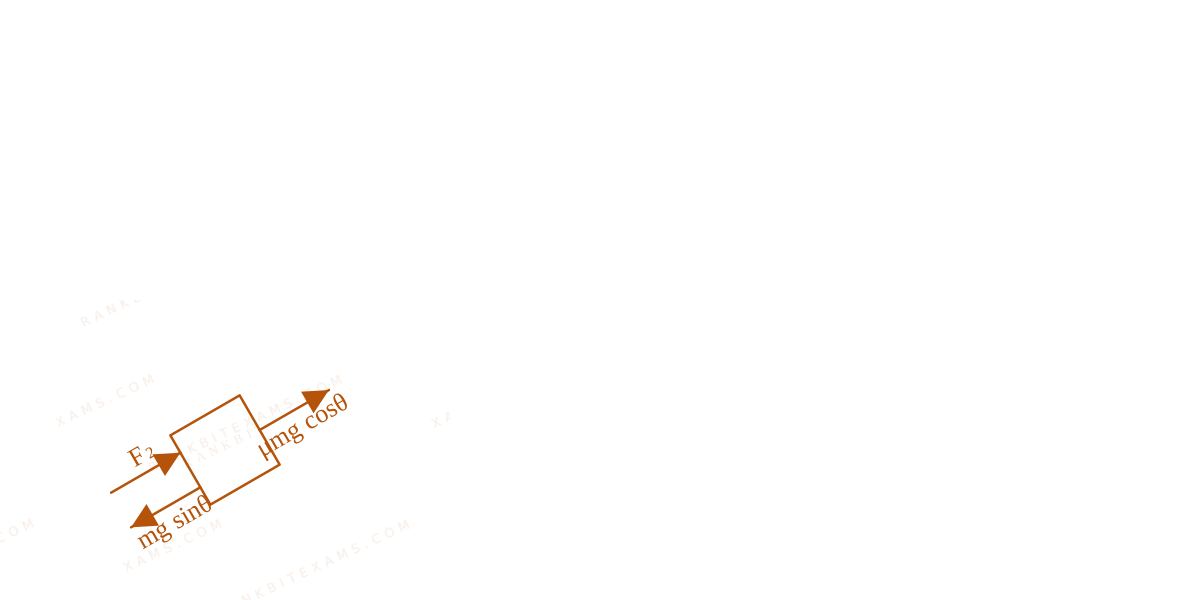
If F₁$\vec{F}_1$ is the force required to just move the block up the inclined plane and F₂$\vec{F}_2$ is the force required to just prevent the block from sliding down, then the value of | F₁| - | F₂|$|\vec{F}_1| - |\vec{F}_2|$ is: [Use g = 10 m/s²$g = 10 \text{ m/s}^2$]
To move the block up, the applied force F₁$F_1$ must overcome both the downward gravitational component and the downward frictional force.
To prevent it from sliding down, the applied force F₂$F_2$ acts upwards and is aided by friction which acts upwards to oppose impending downward slip.
The image shows a 5 kg block on a rough plane inclined at 30 degrees, with coefficient of friction mu = 0.1.
The image shows a 5 kg block on a rough plane inclined at 30 degrees, with coefficient of friction mu = 0.1.
Note: The official options had an anomaly where 5√(3) N$5\sqrt{3} \text{ N}$ was missing or evaluated as a bonus. Option 2 was listed as 50√(3)$50\sqrt{3}$ in the primary text. We track the closest logic path indicating Bonus.
Pattern Recognition
The difference between 'push up' and 'hold from sliding' forces on an incline is always precisely 2 fk$2 f_k$ (2 μ mg θ$2 \mu mg \cos \theta$). Bypass calculating the mg θ$mg \sin \theta$ terms entirely.
Chapter Mix
Class 11 Physics: Laws of Motion
Qjee_main_2024_31_jan_morningPulley And Incline Friction
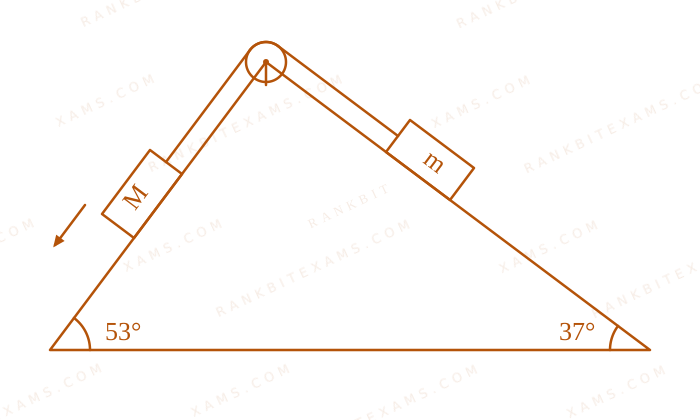
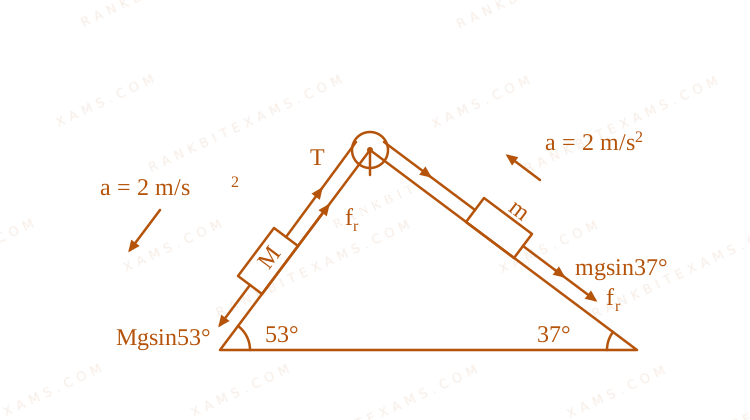
In the given arrangement of a doubly inclined plane two blocks of masses M$M$ and m$m$ are placed. The blocks are connected by a light string passing over an ideal pulley as shown. The coefficient of friction between the surface of the plane and the blocks is 0.25$0.25$. The value of m$m$, for which M = 10 kg$M = 10\mathrm{\ kg}$ will move down with an acceleration of 2 m/s²$2\mathrm{\ m/s^2}$ is : (take g = 10 m/s²$g = 10\mathrm{\ m/s^2}$ and 37° = 3 / 4$\tan 37^{\circ} = 3 / 4$)
Two blocks M and m on opposite sides of a double inclined plane linked by a rope over a top pulley. M is on the 53-degree slope and moving downwards, m is on the 37-degree slope.
A.9 kg$9\mathrm{\ kg}$
B.4.5 kg$4.5\mathrm{\ kg}$
C.6.5 kg$6.5\mathrm{\ kg}$
D.2.25 kg$2.25\mathrm{\ kg}$
Solution
Related Formula
Σ F = ma$$\sum F = ma$$fk = μk N = μk mg θ$$f_k = \mu_k N = \mu_k mg \cos\theta$$
Core Logic
Two blocks M and m on opposite sides of a double inclined plane linked by a rope over a top pulley. M is on the 53-degree slope and moving downwards, m is on the 37-degree slope.
Since block M$M$ moves down the incline, kinetic friction opposes its motion (acts upwards).
Block m$m$ is pulled up the incline, so kinetic friction opposes its motion (acts downwards).
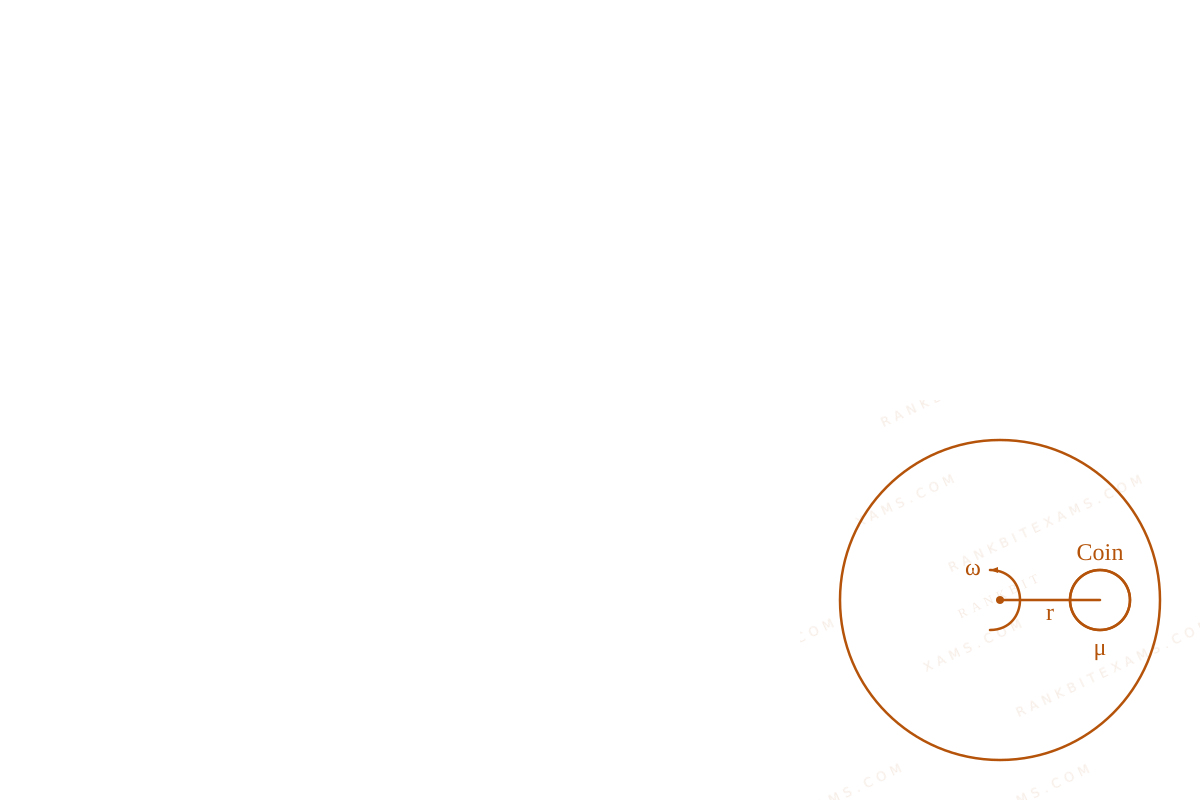
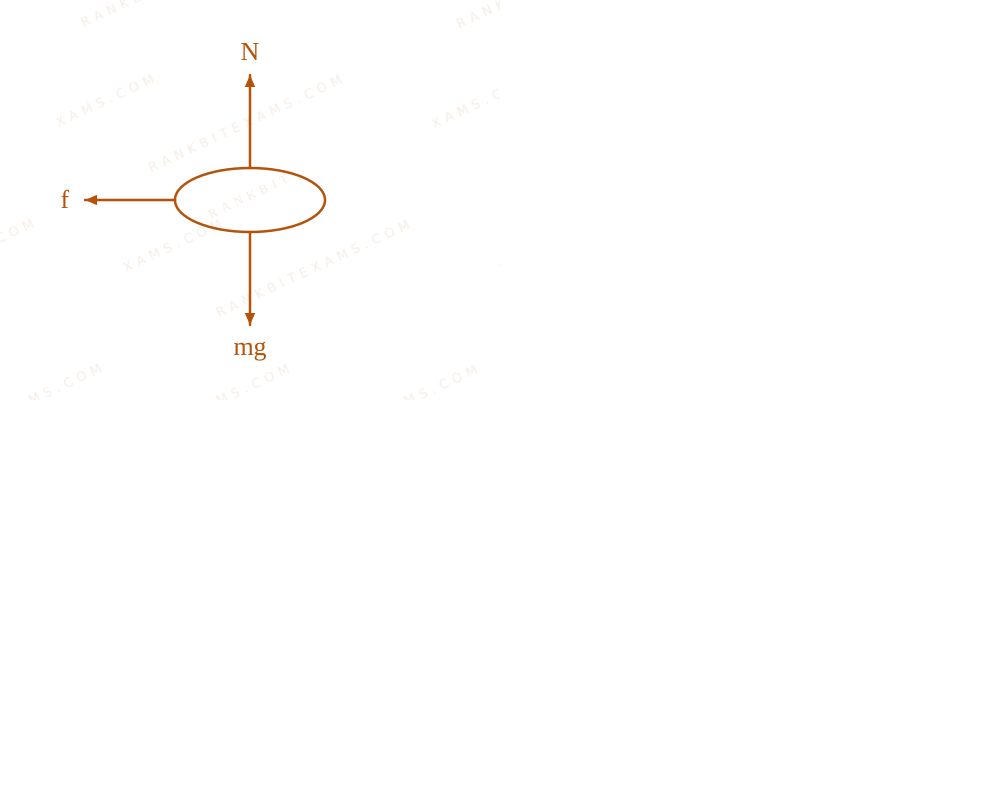
A coin is placed on a disc. The coefficient of friction between the coin and the disc is μ$\mu$. If the distance of the coin from the center of the disc is r$r$, the maximum angular velocity which can be given to the disc, so that the coin does not slip away, is:
Practice past-year questions one chapter at a time. Pick an exam → subject → chapter and get every PYQ for that topic — pulled together from all past papers — with the chapter's key formulas alongside.