Q37
jee_main_2024_01_february_morning
Circular Motion
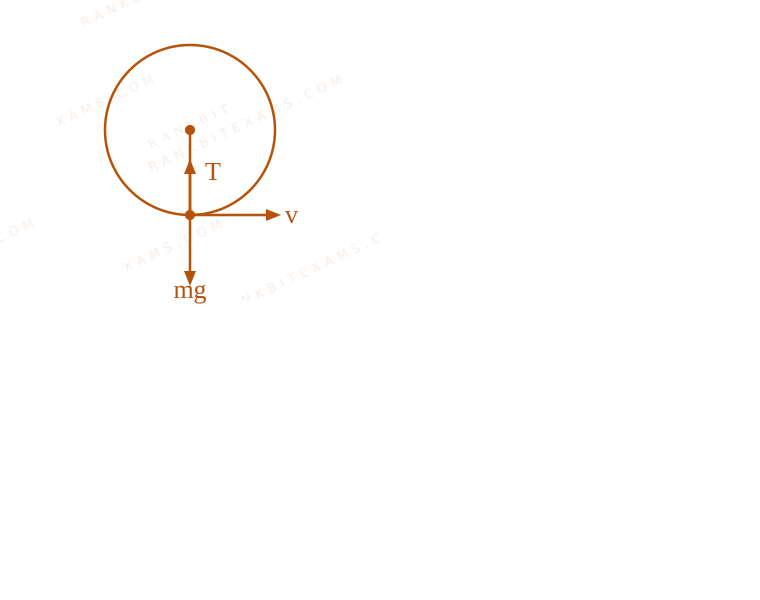
A ball of mass 0.5~kg is attached to a string of length 50~cm. The ball is rotated on a horizontal circular path about its vertical axis. The maximum tension that the string can bear is 400~N. The maximum possible value of angular velocity of the ball in rad/s is:
Solution
Related Formula
Centripetal force configuration for simplified horizontal rotation layout:
T = mω² l
Core Logic
Given values: m = 0.5~kg, l = 50~cm = 0.5~m, Tmax = 400~N.
Equating max tension to centripetal requirement:
400 = 0.5 × ω² × 0.5Step 1: Compute Angular Velocity
400 = 0.25 ω² ω² = (400)/(0.25) = 1600 ω = √(1600) = 40~rad/sPattern Recognition
Ensure units are metric (50~cm → 0.5~m). Direct mapping to horizontal string projection metrics.
Chapter Mix
Class 11 Physics: Laws of Motion