Let P be a point on the hyperbola H: fracx^29 -fracy^24 = 1$H: \frac{x^2}{9} -\frac{y^2}{4} = 1$ in the first quadrant such that the area of triangle formed by P and the two foci of H is 2sqrt13$2\sqrt{13}$ . Then, the square of the distance of P from the origin is
A.18$18$
B.26$26$
C.22$22$
D.20$20$
Solution & Explanation
### Related Formula
textEccentricity of Hyperbola: e^2 = 1 + fracb^2a^2$\text{Eccentricity of Hyperbola: } e^2 = 1 + \frac{b^2}{a^2}$textFoci coordinates: (pm ae, 0)$\text{Foci coordinates: } (\pm ae, 0)$textArea of Triangle: frac12 times textbase times textheight$\text{Area of Triangle: } \frac{1}{2} \times \text{base} \times \text{height}$
### Core Logic
For the hyperbola fracx^29 - fracy^24 = 1$\frac{x^2}{9} - \frac{y^2}{4} = 1$, we have a^2 = 9$a^2 = 9$ and b^2 = 4$b^2 = 4$.
e^2 = 1 + frac49 = frac139 Rightarrow e = fracsqrt133$e^2 = 1 + \frac{4}{9} = \frac{13}{9} \Rightarrow e = \frac{\sqrt{13}}{3}$
The distance between the two foci S_1, S_2$S_1, S_2$ is 2ae$2ae$:
2ae = 2(3)left(fracsqrt133right) = 2sqrt13$2ae = 2(3)\left(\frac{\sqrt{13}}{3}\right) = 2\sqrt{13}$
### Step 1: Using the Triangle Area
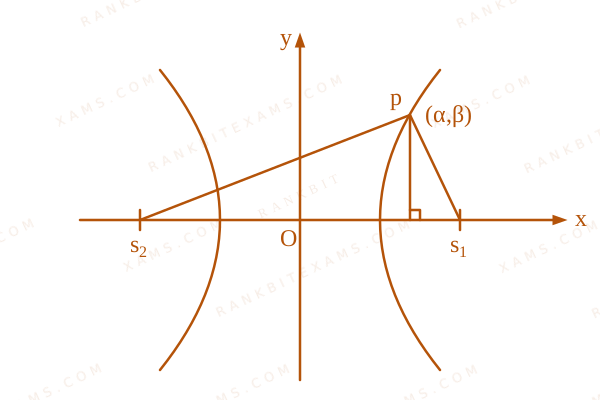
Hyperbola diagram for Q10 - JEE Main 2024 Evening
Let point P on the hyperbola be (alpha, beta)$(\alpha, \beta)$ in the first quadrant (so alpha, beta gt 0$\alpha, \beta \gt 0$).
The base of the triangle is the segment between foci, length = 2sqrt13$= 2\sqrt{13}$.
The height of the triangle is the y-coordinate of P, which is beta$\beta$.
Area of Delta PS_1S_2 = frac12 times textbase times textheight$\Delta PS_1S_2 = \frac{1}{2} \times \text{base} \times \text{height}$2sqrt13 = frac12 times (2sqrt13) times beta$2\sqrt{13} = \frac{1}{2} \times (2\sqrt{13}) \times \beta$2sqrt13 = sqrt13 cdot beta Rightarrow beta = 2$2\sqrt{13} = \sqrt{13} \cdot \beta \Rightarrow \beta = 2$
### Step 2: Finding P's coordinates and Distance
Since P lies on the hyperbola:
fracalpha^29 - fracbeta^24 = 1$\frac{\alpha^2}{9} - \frac{\beta^2}{4} = 1$
Substitute beta = 2$\beta = 2$:
fracalpha^29 - frac44 = 1$\frac{\alpha^2}{9} - \frac{4}{4} = 1$fracalpha^29 - 1 = 1 Rightarrow fracalpha^29 = 2 Rightarrow alpha^2 = 18$\frac{\alpha^2}{9} - 1 = 1 \Rightarrow \frac{\alpha^2}{9} = 2 \Rightarrow \alpha^2 = 18$
We need the square of the distance of P from the origin, which is alpha^2 + beta^2$\alpha^2 + \beta^2$:
textDistance^2 = alpha^2 + beta^2 = 18 + 2^2 = 18 + 4 = 22$\text{Distance}^2 = \alpha^2 + \beta^2 = 18 + 2^2 = 18 + 4 = 22$
### Pattern Recognition
Area formed by a point on a conic and its foci uses the interfocal distance 2ae$2ae$ as a flat base on the x-axis, directly exposing the point's y-coordinate.
### Evaluation Rubric / Model Answer
null
### Chapter Mix
Class 11 Maths: Conic Sections
Keywords:#Area of triangle hyperbola foci#JEE Main 2024 Evening Q10#Conic Sections JEE Main 2024#Hyperbola JEE Main 2024
More Conic Sections Previous-Year Questions — Page 4
Q52jee_main_2025_28_jan_morningParabola and Trapezium Properties
Let ABCD be a trapezium whose vertices lie on the parabolay^2 = 4x$y^2 = 4x$. Let the sides AD and BC of the trapezium be parallel to y-axis. If the diagonal AC is of length frac254$\frac{25}{4}$ and it passes through the point (1,0)$(1,0)$, then the area of ABCD is:
(1) frac754$\frac{75}{4}$
(2) frac252$\frac{25}{2}$
(3) frac1258$\frac{125}{8}$
(4) frac758$\frac{75}{8}$
A.frac754$\frac{75}{4}$
B.frac252$\frac{25}{2}$
C.frac1258$\frac{125}{8}$
D.frac758$\frac{75}{8}$
Solution
### Related Formula
Area of a trapezium is given by:
textArea = frac12 times (textsum of parallel sides) times (textdistance between them)$\text{Area} = \frac{1}{2} \times (\text{sum of parallel sides}) \times (\text{distance between them})$
### Core Logic
Let the coordinates of the vertices be parameterized on the parabola y^2 = 4x$y^2 = 4x$. Since AD$AD$ and BC$BC$ are parallel to the y-axis, the coordinates take the form:
A(at_1^2, 2at_1)$A(at_1^2, 2at_1)$ and D(at_1^2, -2at_1)$D(at_1^2, -2at_1)$B(at_2^2, 2at_2)$B(at_2^2, 2at_2)$ and C(at_2^2, -2at_2)$C(at_2^2, -2at_2)$
Given a=1$a=1$, the points simplify accordingly. Parabola and Trapezium Properties diagram for Q52 - JEE Main 2025 Morning
### Step 1: Using Diagonal Properties
The length of diagonal AC$AC$ passing through focal point (1,0)$(1,0)$ implies focal chord properties:
textLength AC = aleft(t_1 + frac1t_1right)^2 = frac254$\text{Length AC} = a\left(t_1 + \frac{1}{t_1}\right)^2 = \frac{25}{4}$t_1 + frac1t_1 = pmfrac52 implies t_1 = 2 text or frac12$t_1 + \frac{1}{t_1} = \pm\frac{5}{2} \implies t_1 = 2 \text{ or } \frac{1}{2}$
### Step 2: Finding Coordinates and Area
Substituting t_1 = 2$t_1 = 2$, we get:
Aleft(frac12, 1right), Dleft(frac14, -1right), B(4, 4), C(4, -4)$A\left(\frac{1}{2}, 1\right), D\left(\frac{1}{4}, -1\right), B(4, 4), C(4, -4)$
Evaluating the area formula:
textArea = frac12 times (8 + 2) times left(4 - frac14
ight) = frac754$\text{Area} = \frac{1}{2} \times (8 + 2) \times \left(4 - \frac{1}{4}
ight) = \frac{75}{4}$
### Pattern Recognition
Focal chords of parabolas always satisfy t_1 t_2 = -1$t_1 t_2 = -1$. Recognizing the passage through (1,0)$(1,0)$ unlocks quick parametric simplifications.
### Evaluation Rubric / Model Answer
null
### Chapter Mix
Class 11 Maths: Conic Sections
Q75jee_main_2025_28_jan_morningInfinite Series of Ellipses
Let E_1: fracx^29 + fracy^24 = 1$E_1: \frac{x^2}{9} + \frac{y^2}{4} = 1$ be an ellipse. Ellipses E_i$E_i$ 's are constructed such that their centres and eccentricities are same as that of E_1$E_1$ , and the length of minor axis of E_i$E_i$ is the length of major axis of E_i+1$E_{i+1}$ ( i ge 1$i \ge 1$ ). If A_i$A_i$ is the area of the ellipse E_i$E_i$ , then frac5pi left( sum_i=1^infty A_i right)$\frac{5}{pi} \left( \sum_{i=1}^{\infty} A_i \right)$ , is equal to ....
Numerical Answer.Answer: 54 to 54
Solution
### Related Formula
Area of an ellipse with semi-axes a$a$ and b$b$:
textArea = pi a b$\text{Area} = \pi a b$
### Core Logic
Calculate the constant eccentricity e$e$ from the initial ellipse E_1$E_1$: Infinite Series of Ellipses diagram for Q75 - JEE Main 2025 Morninge = sqrt1 - frac49 = fracsqrt53$e = \sqrt{1 - \frac{4}{9}} = \frac{\sqrt{5}}{3}$
For any subsequent ellipse E_2$E_2$, its major axis equals the minor axis of E_1$E_1$ (2b_1 = 4 implies a_2 = 2$2b_1 = 4 \implies a_2 = 2$). Since eccentricity remains constant:
frac59 = 1 - fracb_2^2a_2^2 = 1 - fracb_2^24 implies b_2^2 = frac169 implies b_2 = frac43$\frac{5}{9} = 1 - \frac{b_2^2}{a_2^2} = 1 - \frac{b_2^2}{4} \implies b_2^2 = \frac{16}{9} \implies b_2 = \frac{4}{3}$
### Step 1: Finding the Area Sequence Terms
Evaluate the area values for the initial ellipses:
A_1 = pi cdot 3 cdot 2 = 6pi$A_1 = \pi \cdot 3 \cdot 2 = 6\pi$A_2 = pi cdot 2 cdot frac43 = frac8pi3$A_2 = \pi \cdot 2 \cdot \frac{4}{3} = \frac{8\pi}{3}$
The areas form an infinite geometric progression with a common ratio r = frac49$r = \frac{4}{9}$.
### Step 2: Summing the Infinite Geometric Series
sum_i=1^infty A_i = frac6pi1 - frac49 = frac6pifrac59 = frac54pi5$\sum_{i=1}^{\infty} A_i = \frac{6\pi}{1 - \frac{4}{9}} = \frac{6\pi}{\frac{5}{9}} = \frac{54\pi}{5}$
Evaluating the final scaling formula:
frac5pi left( frac54pi5 right) = 54$\frac{5}{\pi} \left( \frac{54\pi}{5} \right) = 54$
### Pattern Recognition
Iterative dimensional scaling creates geometric progressions where the ratio equals the square of the linear scaling factor.
### Evaluation Rubric / Model Answer
null
### Chapter Mix
Class 11 Maths: Conic Sections
Q56jee_main_2025_03_april_morningEllipse and Line Properties
A line passing through the point P(sqrt5, sqrt5)$P(\sqrt{5}, \sqrt{5})$ intersects the ellipse fracx^236 + fracy^225 = 1$\frac{x^2}{36} + \frac{y^2}{25} = 1$ at A$A$ and B$B$ [cite: 567] such that (PA) cdot (PB)$(PA) \cdot (PB)$ is maximum. Then 5(PA^2 + PB^2)$5(PA^{2} + PB^{2})$ is equal to[cite: 570]:
A. 218
B. 377
C. 290
D. 338
Solution
### Related Formula
Parametric line equation relative to an offset point P(x_0, y_0)$P(x_0, y_0)$:
x = x_0 + rcostheta, quad y = y_0 + rsintheta$x = x_0 + r\cos\theta, \quad y = y_0 + r\sin\theta$Ellipse and Line Properties diagram for Q56 - JEE Main 2025 Morning
### Core Logic
Assume any line through P$P$ can be represented parametrically by [cite: 1277]:
Q(sqrt5 + rcostheta, sqrt5 + rsintheta)$Q(\sqrt{5} + r\cos\theta, \sqrt{5} + r\sin\theta)$ [cite: 1277]
Substitute coordinates into the standard ellipse formula [cite: 1278]:
25(sqrt5 + rcostheta)^2 + 36(sqrt5 + rsintheta)^2 = 900$25(\sqrt{5} + r\cos\theta)^2 + 36(sqrt{5} + r\sin\theta)^2 = 900$ [cite: 1278]
Expanding and gathering powers of r$r$ yields [cite: 1280]:
r^2(25cos^2theta + 36sin^2theta) + 2sqrt5r(25costheta + 36sintheta) - 595 = 0$r^2(25\cos^2\theta + 36\sin^2\theta) + 2\sqrt{5}r(25\cos\theta + 36\sin\theta) - 595 = 0$ [cite: 1280]
The product of roots corresponds to the distance product value[cite: 1281, 1283]:
PA cdot PB = |r_1 r_2| = frac59525cos^2theta + 36sin^2theta = frac59525 + 11sin^2theta$PA \cdot PB = |r_1 r_2| = \frac{595}{25\cos^2\theta + 36\sin^2\theta} = \frac{595}{25 + 11\sin^2\theta}$ [cite: 1283]
### Step 1: Maximization condition
To make PA cdot PB$PA \cdot PB$ maximum, the denominator must be minimized [cite: 1284]:
sin^2theta = 0 implies theta = 0$\sin^2\theta = 0 \implies \theta = 0$ [cite: 1284]
This implies the chord line AB$AB$ must run parallel to the x-axis [cite: 1285]:
y_A = y_B = sqrt5$y_A = y_B = \sqrt{5}$ [cite: 1285]
Substitute y = sqrt5$y = \sqrt{5}$ back into the ellipse equation to calculate x-coordinates [cite: 1286]:
fracx^236 + frac525 = 1 implies fracx^236 = frac45 implies x^2 = frac1445$\frac{x^2}{36} + \frac{5}{25} = 1 \implies \frac{x^2}{36} = \frac{4}{5} \implies x^2 = \frac{144}{5}$ [cite: 1287]
Therefore, the coordinates are x = pm frac12sqrt5$x = \pm \frac{12}{\sqrt{5}}$.
### Step 2: Distance value summation
Compute PA^2 + PB^2$PA^2 + PB^2$ using coordinates directly [cite: 1289]:
PA^2 + PB^2 = left(sqrt5 - frac12sqrt5right)^2 + left(sqrt5 + frac12sqrt5right)^2$PA^2 + PB^2 = \left(\sqrt{5} - \frac{12}{\sqrt{5}}\right)^2 + \left(\sqrt{5} + \frac{12}{\sqrt{5}}\right)^2$ [cite: 1289]
= 2left(5 + frac1445right) = frac3385$= 2\left(5 + \frac{144}{5}\right) = \frac{338}{5}$ [cite: 1290]
Multiplying by 5 gives the target integer answer [cite: 1290]:
5(PA^2 + PB^2) = 338$5(PA^2 + PB^2) = 338$ [cite: 1290]
### Pattern Recognition
Parametric distances from a point intersecting a conic configuration usually form a standard quadratic equation in r$r$. The angle parameter immediately simplifies the boundary constraint optimization.
### Evaluation Rubric / Model Answer
null
### Chapter Mix
Class 11 Mathematics: Conic Sections (Ellipse)
Q68jee_main_2025_03_april_morningCommon Tangents and Shortest Distance
The radius of the smallest circle which touches the parabolas y = x^2 + 2$y = x^{2} + 2$ and x = y^2 + 2$x = y^{2} + 2$ is[cite: 673]:
A.frac7sqrt22$\frac{7\sqrt{2}}{2}$
B.frac7sqrt216$\frac{7\sqrt{2}}{16}$
C.frac7sqrt24$\frac{7\sqrt{2}}{4}$
D.frac7sqrt28$\frac{7\sqrt{2}}{8}$
Solution
### Related Formula
Shortest distance between symmetric profiles: The minimal spacing normal line runs completely perpendicular to the mutual line of symmetry y=x$y=x$.
Common Tangents and Shortest Distance diagram for Q68 - JEE Main 2025 Morning
### Core Logic
The given curve equations reflect symmetry across line y=x$y=x$[cite: 1382, 1383]. The tangent slope at the closest matching locations must run parallel to this mirror path [cite: 1403]:
fracmathrmdymathrmdx = 1$\frac{\mathrm{d}y}{\mathrm{d}x} = 1$ [cite: 1403]
Differentiate curve equation y = x^2 + 2$y = x^2 + 2$ [cite: 1404]:
fracmathrmdymathrmdx = 2x = 1 implies x = frac12$\frac{\mathrm{d}y}{\mathrm{d}x} = 2x = 1 \implies x = \frac{1}{2}$ [cite: 1405, 1406]
Substitute back to get y-coordinate [cite: 1406]:
y = left(frac12right)^2 + 2 = frac94 implies Bleft(frac12, frac94right)$y = \left(\frac{1}{2}\right)^2 + 2 = \frac{9}{4} \implies B\left(\frac{1}{2}, \frac{9}{4}\right)$ [cite: 1406, 1407]
By mirror symmetry, the corresponding point on the other parabola is [cite: 1407]:
Aleft(frac94, frac12right)$A\left(\frac{9}{4}, \frac{1}{2}\right)$ [cite: 1407]
### Step 1: Calculating distance and circle radius
Evaluate chord distance AB$AB$ using standard metrics [cite: 1407]:
AB = sqrtleft(frac94 - frac12right)^2 + left(frac12 - frac94right)^2 = sqrt2 cdot left(frac74right)^2 = frac7sqrt24$AB = \sqrt{\left(\frac{9}{4} - \frac{1}{2}\right)^2 + \left(\frac{1}{2} - \frac{9}{4}\right)^2} = \sqrt{2 \cdot \left(\frac{7}{4}\right)^2} = \frac{7\sqrt{2}}{4}$ [cite: 1407, 1408]
The diameter of the smallest circle spanning between these touching curves equals distance AB$AB$ [cite: 1408].
textRadius = fracAB2 = frac7sqrt28$\text{Radius} = \frac{AB}{2} = \frac{7\sqrt{2}}{8}$ [cite: 1408]
### Pattern Recognition
Mutually inverse conic curves track symmetric footprints. Their closest distance segments always align perfectly perpendicular to the main baseline axis line y=x$y=x$.
### Evaluation Rubric / Model Answer
null
### Chapter Mix
Class 11 Mathematics: Conic Sections (Parabola)
Let the product of the focal distances of the point P(4, 2sqrt3)$P(4, 2\sqrt{3})$ on the hyperbola H : fracx^2a^2 - fracy^2b^2 = 1$H : \frac{x^2}{a^2} - \frac{y^2}{b^2} = 1$ be 32[cite: 690, 691]. Let the length of the conjugate axis of H$H$ be p$p$ and the length of its latus rectum be q$q$[cite: 692]. Then p^2 + q^2$p^2 + q^2$ is equal to[cite: 693]:
We Map Every Repeating Question in Competitive Exams.
Say goodbye to generic mock test fatigue. RankBit uses smart analysis to group past exam questions into their foundational Repeating Question Types. Find chapter weightage, track repeating questions, and score higher with targeted practice.
Select Your Target Exam
Choose an exam track below to find formulas per chapter and patterns.
Syncing Exam Intelligence
Mapping formulas and patterns across all tracks…
PATH A — FULL LENGTH PRACTICE
Full Mock Test Hub
Simulate real NTA exam conditions with fully tracked mocks. Time yourself against past papers.
Under Development
PATH B — TARGETED PRACTICE
Topic-wise Practice Hub
Practice past-year questions one chapter at a time. Pick an exam → subject → chapter and get every PYQ for that topic — pulled together from all past papers — with the chapter's key formulas alongside.